

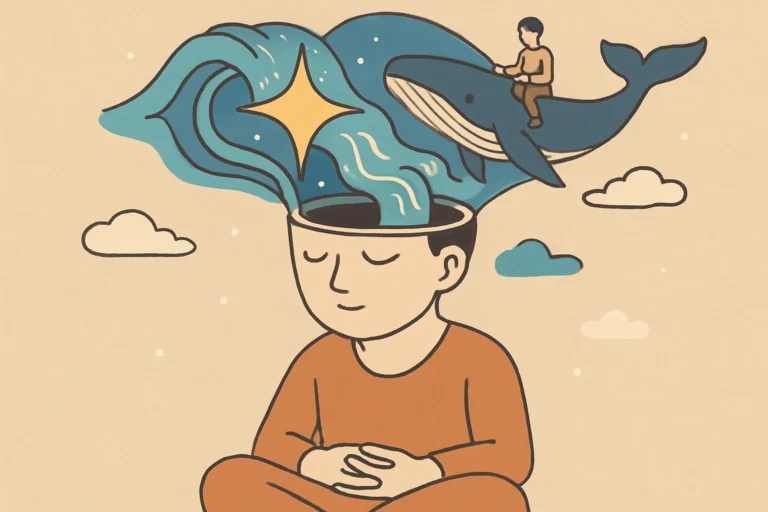
Beyond Reality: Discussing Consciousness in Korean
Hello! Welcome back to [Maeil Han-geul], the place to upgrade your Korean skills to the next level!
Today, we’re diving deep into a fascinating and complex topic: altered states of consciousness (변경된 의식 상태). This isn’t your everyday conversation, but it’s perfect for advanced learners who want to discuss philosophy, psychology, or even mind-bending movies and books. Lately in Korea, there’s a growing interest in cognitive science, mindfulness, and the nature of the self, especially among younger generations exploring wellness and philosophy. So, if you want to engage in profound conversations about dreams, meditation, or even the philosophical implications of psychedelics, these expressions will be your key to unlocking a whole new level of discussion.
Let’s explore the landscape of the mind, in Korean!
Core Expressions for the Inquisitive Mind
Here are some essential terms to navigate conversations about consciousness.
1. 자각몽 (自覺夢)
- Pronunciation [romaja]: Jagakmong
- English Meaning: Lucid Dream
- Detailed Explanation: This is a compound word from 자각 (jagak), meaning ‘self-awareness’ or ‘realization’, and 몽 (mong), meaning ‘dream’. A 자각몽 is a dream in which the dreamer is aware that they are dreaming. It’s a specific, technical term used in psychology and among dream enthusiasts. You can use it to describe the fascinating experience of controlling your own dream world.
- 💡 Pronunciation Tip:
The final consonant ‘ㄱ’ in ‘자각 (jagak)’ is unreleased when said alone. However, when followed by ‘몽 (mong)’, it links smoothly. The key is not to put a hard stop after ‘jagak’. Think of it as one fluid word: [ja-gang-mong], where the ‘k’ sound naturally transitions into the ‘m’ sound.
2. 초월적 경험 (超越的 經驗)
- Pronunciation [romaja]: Chowoljeok gyeongheom
- English Meaning: Transcendental Experience
- Detailed Explanation: This is a highly advanced phrase. 초월 (chowol) means ‘transcendence’, -적 (-jeok) is a suffix that turns a noun into an adjective (like ‘-al’ or ‘-ic’ in English), and 경험 (gyeongheom) means ‘experience’. It refers to an experience that goes beyond the ordinary limits of physical reality and consciousness, often associated with deep meditation, spiritual epiphanies, or the effects of psychedelics. It’s a perfect term for philosophical or spiritual discussions.
- 💡 Pronunciation Tip:
The pronunciation of ‘초월적’ is [초월쩍 (chowoljjeok)]. The ‘ㅈ’ in ‘-적’ undergoes tensing (경음화) after the consonant ‘ㄹ’. While written as ‘jeok’, the sound becomes the tense, or “double,” consonant ‘ㅉ (jj)’. This is a common rule in Korean, making your pronunciation sound much more native.
3. 의식의 흐름 (意識의 흐름)
- Pronunciation [romaja]: Uisigui heureum
- English Meaning: Stream of Consciousness
- Detailed Explanation: A direct translation and a concept borrowed from Western literature and psychology (popularized by William James). 의식 (uisik) means ‘consciousness’ and 흐름 (heureum) means ‘flow’ or ‘stream’. It describes the continuous, flowing, and often chaotic train of thought in the human mind. It’s used to discuss literary techniques (like in the works of James Joyce) or to describe a state of mind during meditation or creative brainstorming.
- 💡 Pronunciation Tip:
The genitive (possessive) particle ‘의 (ui)’ has multiple pronunciations. While its base sound is [ui], when used as a particle like this, it is often pronounced as [에 (e)]. So, ‘의식의’ is most naturally pronounced as [의시게 (uisige)]. Saying [의시긔 (uisigui)] is not wrong, but [의시게 (uisige)] is far more common in everyday speech.
Example Dialogue
Let’s see how these expressions might be used in a conversation between two university students, A and B, after a philosophy class.
A: 오늘 인지과학 수업 정말 흥미롭지 않았어? 특히 변경된 의식 상태에 대한 부분이 인상 깊었어.
(Oneul injigwahak sueop jeongmal heungmiropji anasseo? Teuki byeongyeongdoen uisik sangtae-e daehan bubuni insang gipeosseo.)
Wasn’t today’s cognitive science class fascinating? I was especially impressed by the part about altered states of consciousness.
B: 맞아. 교수님이 자각몽에 대해 설명하실 때 완전 몰입했잖아. 나도 가끔 자각몽을 꾸는데, 꿈속에서 내가 원하는 대로 할 수 있다는 게 신기해.
(Maja. Gyosunimi jagakmong-e daehae seolmyeonghasil ttae wanjeon moripaetjana. Nado gakkeum jagakmong-eul kkuneunde, kkumsogeseo naega wonhaneun daero hal su itdaneun ge singihae.)
I know, right? I was totally engrossed when the professor was explaining lucid dreams. I have them sometimes, and it’s amazing that I can do whatever I want in the dream.
A: 정말? 그건 거의 초월적 경험 아니야? 나는 그런 경험을 해본 적이 없어서 상상이 안 가. 그냥 내 머릿속은 항상 뒤죽박죽 의식의 흐름 그 자체인 것 같아.
(Jeongmal? Geugeon geoui chowoljeok gyeongheom aniya? Naneun geureon gyeongheom-eul haebon jeogi eopseoseo sangsang-i an ga. Geunyang nae meoritsogeun hangsang dwijukbakjuk uisigui heureum geu chachein geot gata.)
Really? Isn’t that almost a transcendental experience? I’ve never had one, so I can’t even imagine it. My head just always feels like a chaotic stream of consciousness itself.
B: 하하, 너도 연습하면 할 수 있을 거야. 다음엔 환각이나 인공지능의 의식에 대해 토론해 봐도 재밌겠다.
(Haha, neodo yeonseupamyeon hal su isseul geoya. Daeum-en hwangagina inggongjineungui uisige daehae toronhae bwado jaemissgetda.)
Haha, you could probably do it with practice. It would be fun to discuss hallucinations or the consciousness of AI next time.
Cultural Tip & Trend Deep Dive
While the scientific discussion of consciousness is a relatively modern trend in Korea, the interpretation of dreams has a deep-rooted history. Traditionally, dreams (꿈) were not just random neural firings but were seen as omens or messages.
- Dream Interpretation (꿈 해몽 – Kkum Haemon): Even today, many Koreans will look up the meaning of their dreams online or discuss them with family. There are specific types of highly regarded dreams, like 태몽 (taemong), a conception dream that foretells the birth and future of a child, and 길몽 (gilmong), a lucky dream (often involving pigs, dragons, or fire) that might prompt someone to buy a lottery ticket!
- Modern Context: This traditional background creates a fascinating dynamic. Young Koreans might discuss lucid dreaming (자각몽) from a scientific or hobbyist perspective, while their parents might ask them if they’ve had any lucky dreams (길몽). Understanding this cultural layer adds immense depth to your conversations. When you use a term like 초월적 경험, you can connect it not just to modern science but also to concepts from Korean Buddhism or traditional spirituality, showing a truly advanced cultural understanding.
Let’s Wrap It Up & Practice!
Today, we explored some high-level vocabulary to discuss the complex world of consciousness, from 자각몽 (lucid dreams) and 초월적 경험 (transcendental experiences) to the very concept of 의식의 흐름 (stream of consciousness). These aren’t just words; they are gateways to deeper, more meaningful conversations.
Now, let’s put your brain to the test!
Practice Question:
Using at least one of the expressions learned today, answer the following question in Korean: “인간의 의식을 과학만으로 완전히 설명할 수 있다고 생각하십니까? 왜 그렇게 생각하시나요?” (Do you think human consciousness can be fully explained by science alone? Why or why not?)
Share your profound thoughts in the comments below! We can’t wait to read your perspective.
Frequently Asked Questions (FAQ)
Q: What does "자각" mean in Korean and how do you pronounce it?
A: In Korean, "자각" is pronounced [jagak] and means: , meaning 'self-awareness' or 'realization', and
Q: What does "몽" mean in Korean and how do you pronounce it?
A: In Korean, "몽" is pronounced [mong] and means: , meaning 'dream'. A 자각몽 is a dream in which the dreamer is aware that they are dreaming. It's a specific, technical term used in psychology and among dream enthusiasts. You can use it to describe the fascinating experience of controlling your own dream world.
Q: What does "초월" mean in Korean and how do you pronounce it?
A: In Korean, "초월" is pronounced [chowol] and means: means 'transcendence',
Q: What does "-적" mean in Korean and how do you pronounce it?
A: In Korean, "-적" is pronounced [-jeok] and means: is a suffix that turns a noun into an adjective (like '-al' or '-ic' in English), and







