

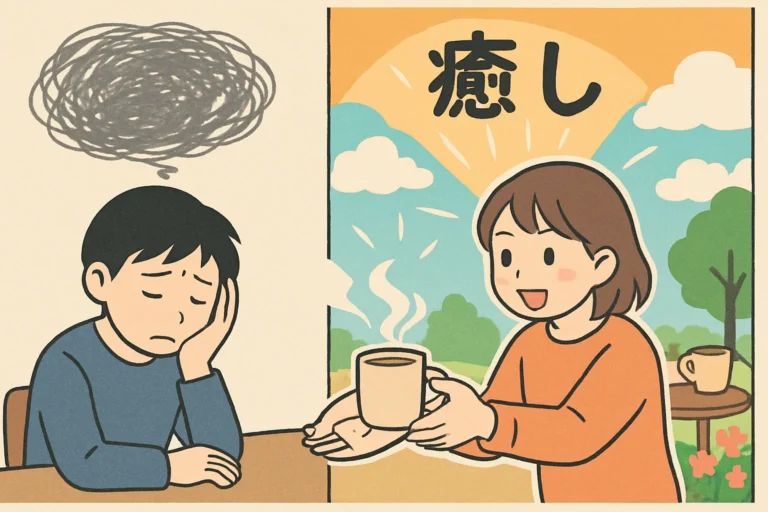
Feeling Stressed? Let’s ‘Heal’ the Korean Way!
Hello! This is [Daily Hangul], here to upgrade your Korean skills!
Feeling a little tired or stressed out lately? You’re not alone! Today, we’re going to learn some essential Korean phrases to suggest ways to relax and cheer up a friend who’s having a tough time.
Lately in Korea, “healing” (힐링) is a huge trend. It’s all about finding small ways to de-stress and take care of your mental well-being, whether that’s by binge-watching a hit K-drama like Queen of Tears or listening to a calming playlist from your favorite K-pop group. These phrases will help you join the conversation and show you care!
Core Expressions for ‘Healing’
Here are three key expressions you can use to comfort a friend and suggest some fun healing activities.
1. 스트레스 풀다 (seuteureseu pulda)
- Pronunciation [Romanized]: [seuteureseu pulda]
- English Meaning: to relieve/release stress
- Detailed Explanation: This is the most direct phrase for talking about stress relief. ‘스트레스’ (seuteureseu) is the Korean way of saying “stress,” and ‘풀다’ (pulda) means “to untie” or “to solve.” So, you are literally “untying your stress”! You often use it with the object particle ‘를/을’, like 스트레스를 풀다 (seuteureseureul pulda).
-
💡 Pronunciation Tip:
When you add a particle or ending that starts with a vowel after a consonant, the consonant sound “moves over” to the next syllable. This is called 연음 (yeon-eum) or linking. So, 스트레스를 (seuteureseu-reul) is pronounced smoothly as [스트레스를 (seuteureseureul)], not [seuteureseu-eul]. It makes your Korean sound much more natural!
2. -는 거 어때요? (-neun geo eottaeyo?)
- Pronunciation [Romanized]: [-neun geo eottaeyo?]
- English Meaning: How about doing (verb)?
-
Detailed Explanation: This is a fantastic, gentle way to make a suggestion. You attach it to a verb stem to ask, “How about…?” It’s polite (because of the ‘-요’ ending) but also friendly and casual. You can use it to suggest almost anything!
- Example: 영화 보다 (to watch a movie) + -는 거 어때요? → 영화 보는 거 어때요? (Yeonghwa boneun geo eottaeyo?) – How about watching a movie?
- 💡 Pronunciation Tip:
The word ‘어때요’ has a double consonant ‘ㄸ’ (ssang-digeut). This means you need to make a stronger, tenser ‘t’ sound than the regular ‘ㄷ’ (d/t). Imagine putting a little pause before the sound and then releasing it with a burst of air. It’s the difference between “eo-tae-yo” and [eo-ttae-yo]. This tense sound is very common in Korean!
3. 푹 쉬세요 (puk swiseyo)
- Pronunciation [Romanized]: [puk swiseyo]
- English Meaning: Get some good rest. / Rest well.
-
Detailed Explanation: This is a warm and caring phrase. ‘푹’ (puk) is an adverb that means “deeply” or “soundly.” ‘쉬다’ (swida) means “to rest,” and ‘-세요’ (-seyo) is a polite ending. So, you’re not just telling someone to rest, but to rest deeply and well. It’s perfect for a friend who looks exhausted.
-
💡 Pronunciation Tip:
The first consonant ‘ㅍ’ (p) is an aspirated sound. This means you should release a strong puff of air when you say it. Try holding a piece of paper in front of your mouth. When you say [puk], the paper should move! This is different from the softer ‘ㅂ’ (b/p) sound.
Example Dialogue
Let’s see how these phrases work in a real conversation. Imagine two friends, A and B, talking after a long week.
A: 너 피곤해 보여. 무슨 일 있어?
(Neo pigonhae boyeo. Museun il isseo?)
You look tired. Is something wrong?
B: 응, 요즘 일이 많아서 스트레스를 너무 많이 받았어.
(Eung, yojeum iri manaseo seuteureseureul neomu mani badasseo.)
Yeah, I’ve been so stressed because I have too much work these days.
A: 그럼 스트레스 풀러 맛있는 거 먹는 거 어때요? 아니면 그냥 집에서 푹 쉬세요.
(Geureom seuteureseu pulleo masinneun geo meongneun geo eottaeyo? Animyeon geunyang jibeseo puk swiseyo.)
Then how about eating something delicious to relieve stress? Or just get some good rest at home.
B: 좋은 생각이야! 우리 맛있는 떡볶이 먹으러 가자!
(Joeun saenggagiya! Uri masinneun tteokbokki meogeureo gaja!)
That’s a great idea! Let’s go eat some delicious tteokbokki!
Culture Tip & Trend Deep Dive
In Korea, the concept of “힐링 (healing)” is a huge part of daily culture, especially for the younger generation. It’s not about big, expensive vacations. It’s about finding “small but certain happiness” (소확행 – sohwakhaeng).
So, when you use a phrase like “커피 마시는 거 어때요? (Keopi masineun geo eottaeyo? – How about drinking coffee?)” you’re doing more than just suggesting a drink. You are inviting someone to take a “healing time” (힐링 타임).
- K-Pop & Healing: Fans often say that watching their favorite idol’s live stream or listening to a new album is the best way to “스트레스 풀다.”
- Modern Healing: Many Koreans relieve stress by going to unique cafes (like board game cafes), doing solo coin karaoke (코인 노래방), or watching “mukbang” (먹방 – eating shows) online.
So next time you use these phrases, remember you’re tapping into a very modern and important part of Korean culture!
Let’s Practice!
Ready to check your understanding? Try these simple exercises!
- Fill in the blank: Your friend says they are very tired from studying. You want to tell them to “Rest well.” What do you say?
- 친구가 너무 피곤해요. “________” 라고 말해주세요.
- Sentence Building: Using the grammar ‘-는 거 어때요?’, how would you suggest “listening to music” (음악을 듣다)?
Great job today! You’re now ready to help a friend de-stress like a true local.
Why don’t you try making your own “healing” suggestion in the comments below using what you learned? We’d love to see them
Frequently Asked Questions (FAQ)
Q: What does "연음" mean in Korean and how do you pronounce it?
A: In Korean, "연음" is pronounced [yeon-eum] and means: or linking. So, 스트레스를 (seuteureseu-reul) is pronounced smoothly as
Q: What does "영화 보는 거 어때요?" mean in Korean and how do you pronounce it?
A: In Korean, "영화 보는 거 어때요?" is pronounced [Yeonghwa boneun geo eottaeyo?] and means: - How about watching a movie?







