

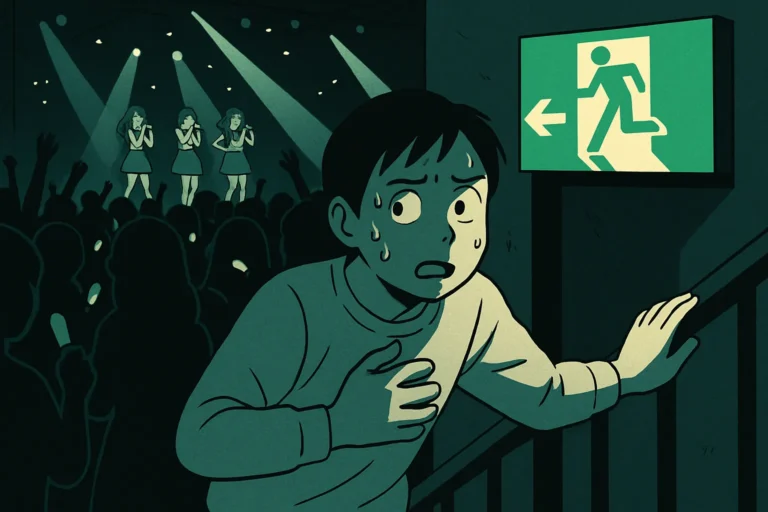
Korean Survival Guide: Finding the Emergency Exit!
Hello! Welcome to [Maeil Hangeul], here to upgrade your Korean skills!
Today, we’re going to learn some truly essential Korean phrases for your safety. Imagine you’re at a huge K-pop concert, a bustling shopping mall, or a crowded subway station in Seoul. It’s exciting, but it’s always smart to know where the exits are, just in case. Recently in Korea, with so many amazing events happening, public safety has become a hot topic. Knowing how to ask for the emergency exit isn’t just useful—it’s a superpower that will make you feel confident and secure as you explore Korea. Let’s get started!
Core Expressions You Must Know
Here are three key expressions to help you find your way to safety.
1. 비상구 (Bisang-gu)
- Pronunciation [Romanization]: Bisang-gu
- English Meaning: Emergency Exit
- Detailed Explanation: This is the word you will see on all the green emergency exit signs in Korea. It’s a combination of two words: 비상 (bisang), which means “emergency,” and 구 (gu), which means “exit” or “opening.” It’s a formal word used specifically for safety signs, so you’ll see it written more often than you’ll hear it in casual conversation.
-
💡 Pronunciation Tip: The first letter ‘ㅂ’ (b) sounds like a soft ‘b’ at the beginning of a word, almost like a ‘p’. Try to say it without a strong puff of air. The vowels are simple: ‘ㅣ’ (i) is like the “ee” in “see,” ‘ㅏ’ (a) is like the “a” in “father,” and ‘ㅜ’ (u) is like the “oo” in “moon.” So, it’s Bi-sang-gu!
2. 어디에 있어요? (Eodie isseoyo?)
- Pronunciation [Romanization]: Eodie isseoyo?
- English Meaning: Where is it?
-
Detailed Explanation: This is your magic question for finding anything! 어디 (eodi) means “where,” 에 (e) is a particle that marks a location, and 있어요 (isseoyo) is the polite way to say “to be” or “to exist.” You can put any noun before it. For example, “화장실은 어디에 있어요?” (Hwajangsil-eun eodie isseoyo?) means “Where is the restroom?”
-
💡 Pronunciation Tip: The ‘ㅆ’ (ss) in ‘있어요’ is a tense consonant. To make this sound, press your tongue against the roof of your mouth and push the air out forcefully. It’s stronger and higher-pitched than a regular ‘ㅅ’ (s). It’s the key to sounding natural!
3. 저쪽이에요. (Jeojjog-ieyo.)
- Pronunciation [Romanization]: Jeojjog-ieyo.
- English Meaning: It’s over there.
-
Detailed Explanation: This is a perfect answer to “Where is it?”. 저쪽 (jeojjok) means “that way” or “over there,” used when something is far from both you and the person you’re talking to. 이에요 (ieyo) is the polite “it is” ending for nouns that end in a consonant.
-
💡 Pronunciation Tip: This phrase has a super important pronunciation rule called linking sound (연음, yeoneum). The final consonant ‘ㄱ’ (k) from 쪽 (jjok) links to the vowel ‘ㅣ’ (i) that follows it. So, instead of saying “jeot-jjok / i-e-yo,” the ‘k’ sound moves over, and it sounds like [저쪼기에요 (jeojjog-ieyo)]. This makes your Korean flow much more smoothly!
Example Dialogue
Let’s see these phrases in action! Imagine you (B) are at a crowded pop-up store for your favorite K-drama and you ask an employee (A) for help.
A: 어서 오세요. 무엇을 도와드릴까요?
(Eoseo oseyo. Mueos-eul dowadeurilkkayo?)
Welcome. How may I help you?
B: 안녕하세요. 죄송하지만, 비상구는 어디에 있어요?
(Annyeonghaseyo. Joesonghajiman, bisang-guneun eodie isseoyo?)
Hello. Excuse me, but where is the emergency exit?
A: 아, 비상구요? 저쪽이에요. 저기 초록색 표지판 보이시죠?
(A, bisang-guyo? Jeojjog-ieyo. Jeogi choroksaek pyojipan bo-isijyo?)
Oh, the emergency exit? It’s over there. Do you see that green sign?
B: 네, 보여요. 감사합니다!
(Ne, boyeoyo. Gamsahamnida!)
Yes, I see it. Thank you!
Culture Tip & Trend Deep Dive
In Korea, especially in big cities like Seoul, people are very aware of public safety. You’ll see the green 비상구 sign everywhere, and it’s a symbol of reassurance.
Here’s a fun tip to look like a true insider: Recently, a member of a famous K-pop group told their fans on a live stream to always check the emergency exits before a show. This started a cool trend among Korean Z-generation fans! They now often take a quick picture of the 비상구 sign at a concert venue or fan meeting and post it on social media with the hashtag #비상구확인 (#CheckTheEmergencyExit). It’s their way of showing they are being responsible and looking out for each other. If you do this at an event in Korea, you’ll not only be safe, but you’ll also look totally in sync with the local culture!
Wrap-up & Practice Time!
Great job today! You’ve learned how to find the 비상구 (bisang-gu) using essential phrases like 어디에 있어요? (eodie isseoyo?) and understand the answer 저쪽이에요 (jeojjog-ieyo). Knowing these phrases will make you a smarter and safer traveler in Korea.
Now, let’s practice!
- Fill in the blank: You are in a crowded subway station and want to ask an employee where the emergency exit is.
“저기요, 비상구는 ______ ______?”
- Make a sentence: How would you tell your friend, “The emergency exit is that way”? (Hint: Use the expression for “over there”!)
Leave your answers in the comments below! We are excited to see you use what you’ve learned. Stay safe and happy learning
Frequently Asked Questions (FAQ)
Q: What does "비상" mean in Korean and how do you pronounce it?
A: In Korean, "비상" is pronounced [bisang] and means: , which means "emergency," and
Q: What does "구" mean in Korean and how do you pronounce it?
A: In Korean, "구" is pronounced [gu] and means: , which means "exit" or "opening." It's a formal word used specifically for safety signs, so you'll see it written more often than you'll hear it in casual conversation.
Q: What does "어디" mean in Korean and how do you pronounce it?
A: In Korean, "어디" is pronounced [eodi] and means: means "where,"
Q: What does "에" mean in Korean and how do you pronounce it?
A: In Korean, "에" is pronounced [e] and means: is a particle that marks a location, and







