

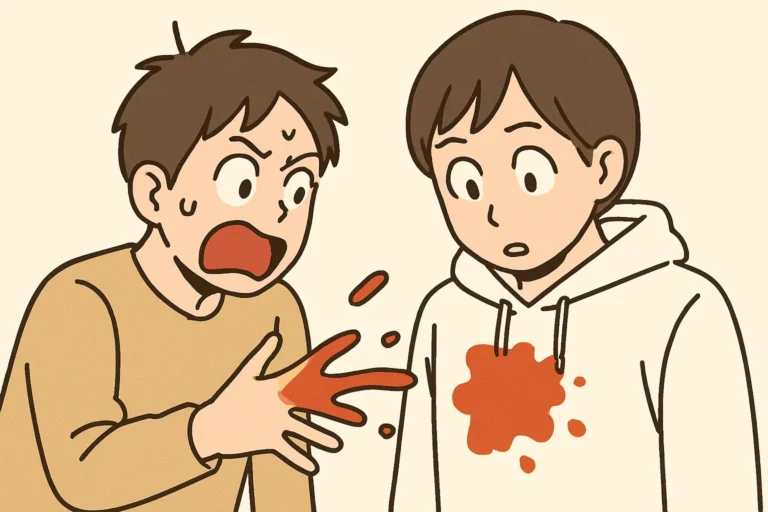
Oops! I Stained Your Shirt! Korean Apologies for When ‘Sorry’ Isn’t Enough
Hello! Welcome to [Maeil Hangeul], here to upgrade your Korean skills!
Ever had that heart-stopping moment when you accidentally spill something on a friend’s borrowed clothes? It’s awkward in any language! Today, we’re going to tackle this exact situation. We’ll learn how to apologize sincerely and fix the problem smoothly in Korean.
You’ve probably seen this in K-dramas a million times—a clumsy encounter leads to a dramatic coffee spill on a white designer shirt. In Korea, where maintaining good relationships (관계, gwangye) is incredibly important, knowing how to apologize properly is more than just good manners; it’s a crucial social skill. Let’s learn how to handle these “oops” moments like a pro!
Core Expressions for a Sincere Apology
Here are three key expressions that will help you navigate this tricky situation with grace.
1. Acknowledging the Mistake: “Oh no, I got a stain on your clothes.”
- Korean Expression: 어떡해, 네 옷에 얼룩이 묻었어.
- Pronunciation [Romanization]: Eotteokae, ne ose eollugi mudeosseo.
- English Meaning: Oh no / What should I do, I got a stain on your clothes.
- Detailed Explanation: 어떡해 (Eotteokae) is a fantastic phrase that perfectly captures a feeling of panic and concern, like “Oh no!” or “What do I do?!”. It immediately shows your friend that you understand the gravity of the situation. 얼룩이 묻다 (eollugi mutda) specifically means “to get a stain on something.” Starting your apology with this shows you’re not trying to hide the mistake.
- 💡 Pronunciation Tip: The final syllable in ‘어떡해’ is a combination of ‘ㅎ(h)’ and ‘ㄱ(k)’. In fast speech, the ‘ㅎ(h)’ sound is very weak and often merges with the ‘ㄱ(k)’, making it sound like [어떠캐 (Eotteokae)]. This is a common sound change that will make you sound more like a native speaker!
2. Taking Full Responsibility: “It’s my mistake. I’m really sorry.”
- Korean Expression: 내 실수야. 정말 미안해.
- Pronunciation [Romanization]: Nae silsuyah. Jeongmal mianhae.
- English Meaning: It’s my mistake. I’m really sorry.
- Detailed Explanation: While a simple “미안해 (mianhae)” is good, adding 내 실수야 (Nae silsuyah) takes your apology to the next level. It means “It’s my fault” or “It’s my mistake,” and it clearly communicates that you are taking 100% responsibility. This is a very important step in a Korean apology. (Note: This is casual language for friends. With someone older or in a more formal setting, you would say 제 실수예요 (Je silsuyeyo).)
- 💡 Pronunciation Tip: For 정말 (jeongmal), make sure to pronounce the first syllable’s final consonant ‘ㅇ(ng)’ like the ‘ng’ in the English word “singing,” not like a separate ‘n’ and ‘g’ sound.
3. Offering a Solution: “I’ll pay for dry cleaning. Or, I’ll buy you a new one.”
- Korean Expression: 내가 세탁비 줄게. 아니면 새로 사 줄게.
- Pronunciation [Romanization]: Naega setakbi julge. Animyeon saero sa julge.
- English Meaning: I’ll give you money for dry cleaning. Or, I’ll buy you a new one.
- Detailed Explanation: This is the crucial final step! A sincere apology in Korea is often backed by action. Offering a concrete solution shows you are serious about making things right. 세탁비 (setakbi) means “laundry/dry cleaning fee,” and 새로 사 줄게 (saero sa julge) is the golden phrase: “I’ll buy (you) a new one.” Providing these two options gives your friend control and shows your respect.
- 💡 Pronunciation Tip: The grammar pattern -ㄹ/을게 (-l/eulge), which indicates the speaker’s intention or promise, is almost always pronounced as [-ㄹ/을께 (-lkke/-eulkke)] with a tensed ‘ㄲ(kk)’ sound. So, even though it’s written ‘줄게 (julge)’, pronouncing it as [줄께 (julkke)] sounds much more natural and fluent.
Example Dialogue
Let’s see how these expressions work in a real conversation. Imagine Yuna borrowed her friend Minsu’s favorite hoodie to go to a tteokbokki restaurant.
- Yuna: 민수야… 어떡해, 네 옷에 얼룩이 묻었어. 떡볶이 국물이 튀었나 봐.
- (Minsu… Oh no, I got a stain on your hoodie. I think some tteokbokki sauce splattered on it.)
- Minsu: 진짜? 괜찮아? 내 최애 후드티인데…
- (Really? Is it bad? That’s my absolute favorite hoodie…)
- Yuna: 내 실수야. 정말 미안해. 바로 세탁소에 맡겨볼게.
- (It’s my mistake. I’m so, so sorry. I’ll take it to the dry cleaner’s right away.)
- Minsu: 음… 그 얼룩 지워질까?
- (Hmm… do you think the stain will come out?)
- Yuna: 만약 안 지워지면, 내가 세탁비 줄게. 아니면 새로 사 줄게! 똑같은 걸로.
- (If it doesn’t come out, I’ll pay for the cleaning. Or, I’ll buy you a new one! The exact same one.)
- Minsu: 알았어. 일단 맡겨보고 얘기해 줘. 너무 속상해하지 마.
- (Okay. Take it to the cleaner’s first and let me know. Don’t be too upset about it.)
Culture Tip: Action Speaks Louder Than Words
In Korea, there’s a strong emphasis on 책임감 (chaegimgam), which means ‘a sense of responsibility’. When a mistake happens, especially one that involves damaging property, a verbal apology is just the first step. The most important part is demonstrating your responsibility through action.
This is why offering to pay or replace the item (새로 사 줄게) is so powerful. It’s not just about the money; it’s a cultural signal that you respect the other person, value your relationship, and are committed to fixing your mistake. You’ll notice this in many K-dramas and movies. The moment a character breaks something, their immediate follow-up to “I’m sorry” is almost always, “How much was it? I’ll pay for it.” Adopting this mindset will make your apologies in Korean much more effective and sincere!
Let’s Practice!
You’ve learned some incredibly useful phrases today! Let’s review and put them to the test.
- Fill in the Blank: You accidentally spilled coffee on your roommate’s important book. You say:
“내 실수야. 정말 미안해. 이 책, 내가 ________!”
(Hint: Use the expression for “I’ll buy you a new one.”) -
Make a Sentence: Your friend lent you their wireless earbuds, and you lost one. How would you combine the phrases we learned today to apologize?
Great job today! Mastering these expressions will not only improve your Korean but also help you build stronger friendships.
Why not try making your own apology sentence in the comments below? We’d love to see what you come up with
Frequently Asked Questions (FAQ)
Q: What does "어떡해" mean in Korean and how do you pronounce it?
A: In Korean, "어떡해" is pronounced [Eotteokae] and means: is a fantastic phrase that perfectly captures a feeling of panic and concern, like "Oh no!" or "What do I do?!". It immediately shows your friend that you understand the gravity of the situation.
Q: What does "얼룩이 묻다" mean in Korean and how do you pronounce it?
A: In Korean, "얼룩이 묻다" is pronounced [eollugi mutda] and means: specifically means "to get a stain on something." Starting your apology with this shows you're not trying to hide the mistake.
Q: What does "내 실수야" mean in Korean and how do you pronounce it?
A: In Korean, "내 실수야" is pronounced [Nae silsuyah] and means: takes your apology to the next level. It means "It's my fault" or "It's my mistake," and it clearly communicates that you are taking 100% responsibility. This is a very important step in a Korean apology. (Note: This is casual language for friends. With someone older or in a more formal setting, you would say
Q: What does "정말" mean in Korean and how do you pronounce it?
A: In Korean, "정말" is pronounced [jeongmal] and means: , make sure to pronounce the first syllable's final consonant 'ㅇ(ng)' like the 'ng' in the English word "singing," not like a separate 'n' and 'g' sound.







