

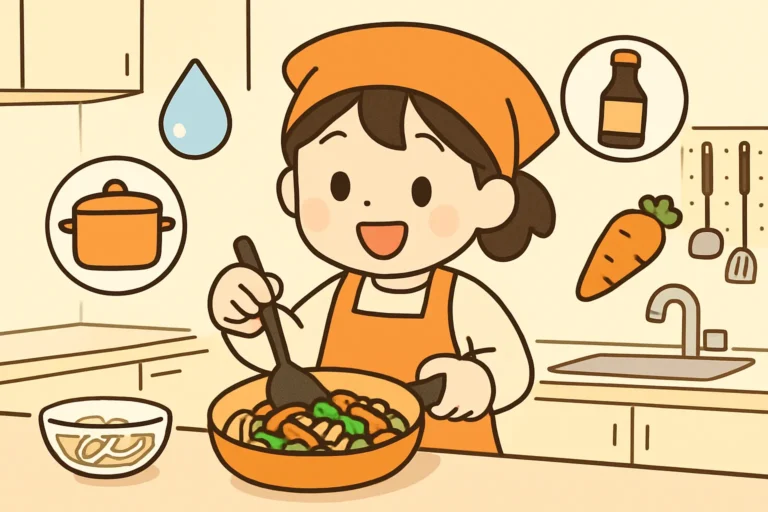
Cook Like a K-Drama Chef! Master Korean Recipes with These Phrases
Hello! It’s your favorite Korean language booster, [Maeil Hangeul], here to upgrade your skills!
Have you ever watched a Korean cooking show or a K-drama and been amazed by the delicious food? Lately in Korea, everyone’s obsessed with making complex traditional dishes at home, like Galbi-jjim (braised short ribs), thanks to the hit cooking show ‘Seoul Kitchen Masters’. The final dish looks incredible, but the recipe can seem intimidating!
Don’t worry! Today, we’re going to learn the essential Korean phrases to explain any recipe, step-by-step. With these expressions, you’ll be able to follow along with your favorite Korean chefs and even explain your own recipes like a pro. Let’s get cooking!
Core Expressions for Cooking
Here are the key phrases you need to narrate a recipe in Korean.
1. 먼저 (Meonjeo) – First / First of all
- Korean Expression: 먼저
- Pronunciation [Romanization]: Meonjeo
- English Meaning: First / First of all
- Detailed Explanation: This is the perfect word to start any set of instructions. It clearly signals the very first step of the process. It’s neutral in politeness and can be used in almost any situation, from explaining a recipe to giving directions.
- 💡 Pronunciation Tip:
- The vowel ‘어’ (eo) can be tricky. It’s not ‘oh’. Think of the ‘o’ sound in the English word “son” or the ‘u’ in “cut”. Make the sound short and in the back of your throat: meon-jeo.
2. 그 다음에 (Geu da-eume) – After that / Next
- Korean Expression: 그 다음에
- Pronunciation [Romanization]: Geu da-eume
- English Meaning: After that / And then / Next
- Detailed Explanation: This is your go-to phrase for connecting steps. It literally means “at the next of that.” It keeps the instructions flowing smoothly. For a more casual feel among friends, you can simply say 다음에 (da-eume).
- 💡 Pronunciation Tip:
- This is a great example of a Korean pronunciation rule called liaison (연음). Instead of pronouncing it as
geu da-eum-e, the final consonant ‘ㅁ’ (m) from ‘다음’ moves into the next empty syllable. This makes the pronunciation smooth: [그 다으메 / geu da-eu-me].
- This is a great example of a Korean pronunciation rule called liaison (연음). Instead of pronouncing it as
3. -을/를 넣고 (-eul/reul neoko) – Put in (something) and then…
- Korean Expression: (명사)을/를 넣고
- Pronunciation [Romanization]: (myeongsa)-eul/reul neoko
- English Meaning: Put in (noun) and then…
- Detailed Explanation: This is a super useful grammar pattern for cooking! It combines the verb 넣다 (neota – to put in) with the connector -고 (-go – and/and then).
- Use -을 넣고 after a noun ending in a consonant (e.g., 설탕을 넣고 / seoltangeul neoko – put in sugar and…).
- Use -를 넣고 after a noun ending in a vowel (e.g., 채소를 넣고 / chaesoreul neoko – put in vegetables and…).
- 💡 Pronunciation Tip:
- Watch out for aspiration! The ‘ㅎ’ (h) in ‘넣’ combines with the ‘ㄱ’ (g) in ‘고’, changing the sound to an aspirated ‘ㅋ’ (k). So, it’s not pronounced [neoh-go], but rather [너코 / neoko]. This will make you sound much more natural!
4. 마지막으로 (Majimageuro) – Lastly / Finally
- Korean Expression: 마지막으로
- Pronunciation [Romanization]: Majimageuro
- English Meaning: Lastly / Finally
- Detailed Explanation: Just as 먼저 starts the recipe, 마지막으로 signals the final step. It neatly wraps up your instructions, letting everyone know the delicious end is near!
- 💡 Pronunciation Tip:
- Let’s break it down: Ma-ji-ma-geu-ro. The particle -으로 (-euro) means “as” or “by means of,” so the word literally translates to “as the last thing.” Practice saying it slowly to get the rhythm right.
Example Dialogue: Making Trendy Galbi-jjim!
Let’s see how these phrases work in a real conversation.
A: 와, 네가 만든 갈비찜 진짜 맛있다! 너무 복잡해 보여. 어떻게 만들어?
(Wa, nega mandeun galbi-jjim jinjja masitda! Neomu bokjaphae boyeo. Eotteoke mandeureo?)
Wow, this Galbi-jjim you made is delicious! It looks so complicated. How do you make it?
B: 생각보다 쉬워! 먼저, 갈비를 찬물에 담가서 핏물을 빼야 해.
(Saenggakboda swiwo! Meonjeo, galbireul chanmure damgaseo pinmureul ppaeya hae.)
It’s easier than you think! First, you have to soak the ribs in cold water to drain the blood.
A: 알았어. 먼저 핏물 빼기. 그 다음은?
(Arasseo. Meonjeo pinmul ppaegi. Geu daeumeun?)
Got it. First, drain the blood. What’s next?
B: 그 다음에, 갈비를 한번 데치고 물은 버려. 그리고 냄비에 간장하고 설탕을 넣고 1시간 동안 끓이는 거야.
( Geu da-eume, galbireul hanbeon dechigo mureun beoryeo. Geurigo naembie ganjanghago seoltangeul neoko 1sigan dongan kkeurineun geoya.)
After that, parboil the ribs and throw away the water. Then, put the soy sauce and sugar in the pot and boil for 1 hour.
A: 1시간이나? 그럼 끝이야?
(1siganina? Geureom kkeuchiya?)
For a whole hour? Is it done then?
B: 거의! 마지막으로, 당근하고 감자를 넣고 부드러워질 때까지 더 끓이면 돼.
(Geoui! Majimageuro, danggeunhago gamjareul neoko budeureowojil ttaekkaji deo kkeurimyeon dwae.)
Almost! Lastly, add the carrots and potatoes and boil until they’re soft.
Cultural Tip & Trend Deep Dive
In Korea, food is love, and food is connection. Sharing recipes (레시피 공유 / resipi gong-yu) is a huge part of the culture, especially online. On Instagram and blogs, people love posting step-by-step photos of their cooking adventures.
Pro-Tip: If you post your own Korean cooking photos, try writing a caption using today’s phrases! A simple “먼저, 재료를 준비해요. (First, prepare the ingredients.)” will get tons of love from Korean followers.
Furthermore, the chefs on popular shows like ‘Seoul Kitchen Masters’ use these exact sequential phrases to teach viewers. Paying attention to how they speak is excellent listening practice. You’ll notice they speak clearly and methodically—making it easier for you to follow along and learn!
Let’s Practice!
Ready to test your new skills?
1. Fill in the blanks to complete the recipe for Kimchi Fried Rice (김치볶음밥).
(________), 김치를 잘게 썰어요.
(________), 팬에 기름을 두르고 김치를 볶아요.
밥을 넣고 같이 볶아주세요.
(________), 계란 프라이를 위에 올리면 완성!Choices: 마지막으로, 먼저, 그 다음에
2. Your Turn!
Think of a simple recipe you love (like making a sandwich or a cup of coffee). In the comments, write the very first step using 먼저 and the final step using 마지막으로.
You did an amazing job today! Now you’re ready to tackle any Korean recipe you find.
Leave a comment below with your practice sentences! I can’t wait to see what you’ll be cooking. Happy learning
Frequently Asked Questions (FAQ)
Q: What does "넣다" mean in Korean and how do you pronounce it?
A: In Korean, "넣다" is pronounced [neota - to put in] and means: with the connector
Q: What does "-으로" mean in Korean and how do you pronounce it?
A: In Korean, "-으로" is pronounced [-euro] and means: means "as" or "by means of," so the word literally translates to "as the last thing." Practice saying it slowly to get the rhythm right.







