

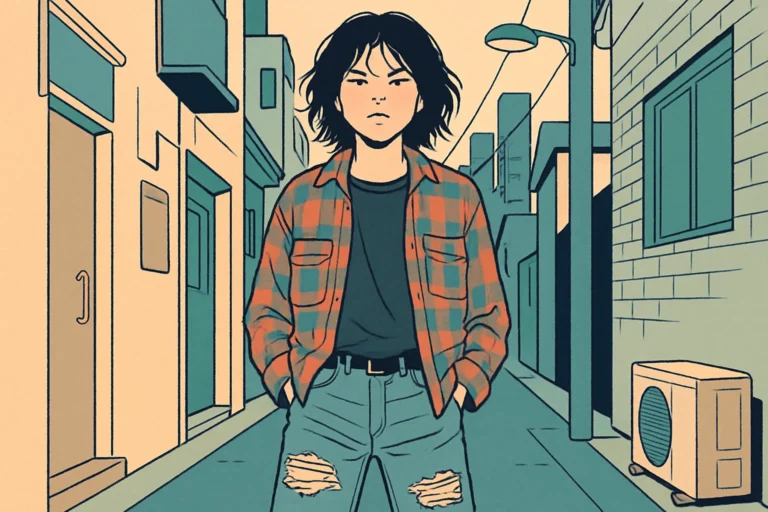
그런지 룩: Decoding the Rebellious Spirit of Korean Grunge Fashion
Hello! It’s your favorite Korean booster, [Maeil Hangeul], here to upgrade your Korean skills! ✨
Have you ever felt tired of perfectly polished, glamorous styles? Do you sometimes want to express a more raw, authentic side of yourself? If so, today’s lesson is for you! We’re diving deep into the world of 그런지 룩 (Grunge Look). Lately in Korea, especially in trend-setting districts like Hongdae and Seongsu, you can feel a powerful shift. The meticulously curated, flawless aesthetic is making way for something more undone, effortless, and full of attitude. This isn’t just about fashion; it’s a cultural statement, and today, we’ll learn the advanced Korean vocabulary to discuss it like a native.
Core Expressions for the Fashion Rebel
Here are some key expressions that capture the essence of the grunge philosophy.
1. 일부러 (ilbureo)
- Pronunciation [로마자]: il-bu-reo
- English Meaning: Intentionally, on purpose
- Detailed Explanation: This adverb is the secret key to understanding grunge. The style isn’t about being genuinely messy or careless—it’s about intentionally crafting a look of nonchalance. It’s the difference between 못 꾸민 것 (not being able to dress up) and 안 꾸민 것 (choosing not to dress up). Grunge is a calculated, aesthetic choice to appear uncalculated.
- 💡 Pronunciation Tip:
- The pronunciation is quite straightforward and follows the spelling. However, focus on the smooth flow between the syllables: [il-bu-reo]. Don’t pause between ‘il’ and ‘bu’. The ㄹ (l) sound at the end of a syllable followed by a vowel often carries over, but here, since ‘부’ starts with a consonant, ‘il’ is pronounced distinctly.
2. ~에 대한 반기를 들다 (~e daehan bangi-reul deulda)
- Pronunciation [로마자]: ~e dae-han ban-gi-reul deul-da
- English Meaning: To raise a flag of rebellion against ~; to rebel against ~
- Detailed Explanation: This is a powerful, almost literary phrase that perfectly describes the spirit of grunge. It literally means “to raise a flag of revolt.” You use it to talk about a strong, principled opposition to an established norm, authority, or trend. Grunge fashion was a direct rebellion against the excessive, materialistic glamour of the 1980s.
- 💡 Pronunciation Tip:
- ‘반기를’ is pronounced [반기를 (ban-gi-reul)]. Note that in fast speech, the particle ‘를’ might sound more like ‘을’ if the preceding word ends in a consonant, but here it’s clear. The phrase is often used without ‘들다’, as in “이것은 주류 문화에 대한 반기였다.” (This was a rebellion against mainstream culture.)
3. 퇴색되다 (toesaekdoeda)
- Pronunciation [로마자]: toe-saek-doe-da
- English Meaning: To be faded (in color); to be diminished (in significance)
- Detailed Explanation: This verb is fantastic because it has both a literal and a metaphorical meaning. Literally, it describes colors that have lost their vibrancy, like a well-worn pair of jeans (퇴색된 청바지). Metaphorically, it can describe ideals, memories, or values that have lost their original power or meaning. Grunge fashion fully embraces literally 퇴색된 colors and textures as part of its core aesthetic.
- 💡 Pronunciation Tip:
- The syllable ‘퇴’ [toe] requires aspiration; it’s a strong ‘t’ sound with a puff of air. The ‘되’ [dwe] is a diphthong, a quick glide from an ‘o’ sound to an ‘e’ sound. Practice saying it as one fluid sound: [toe-saek-dwe-da].
4. 정형화되다 (jeonghyeonghwadoeda)
- Pronunciation [로마자]: jeong-hyeong-hwa-doe-da
- English Meaning: To be standardized, formalized, or stereotyped.
- Detailed Explanation: This word describes the process of becoming rigid, conforming to a fixed pattern, or losing individuality. The grunge movement was a fierce reaction against 정형화된 미의 기준 (standardized beauty standards) and the 정형화된 삶 (conventional lifestyle) that society promoted. It celebrated uniqueness and imperfection.
- 💡 Pronunciation Tip:
- This word can look intimidating! Let’s break it down: [정(jeong)-형(hyeong)-화(hwa)-되(dwe)-다(da)]. The ‘ㅎ’ (h) sound in ‘화’ after the ‘ㅇ’ (ng) of ‘형’ should be clearly pronounced. It’s not silent. Pay attention to the smooth transition from ‘hyeong’ to ‘hwa’.
Example Dialogue: Shopping in Hongdae
Let’s see how these expressions come to life in a real conversation.
A (Sumin): 와, 저 사람 스타일 좀 봐. 완전 90년대 너바나 느낌인데?
(Wa, jeo saram seutail jom bwa. Wanjeon gusimnyeondae neobana neukkiminde?)
Wow, look at that person’s style. It has a total 90s Nirvana vibe, doesn’t it?
B (Jiho): 맞아. 저렇게 퇴색된 체크 셔츠에 찢어진 청바지. 저게 바로 그런지 룩의 정석이지.
(Maja. Jeoreoke toesaekdoen chekeu syeocheu-e jjijeojin cheongbaji. Jeoge baro geureonji rugui jeongseogiji.)
Exactly. That faded flannel shirt and ripped jeans… that’s the epitome of the grunge look.
A (Sumin): 응, 요즘 아이돌들도 무대에서 저런 옷 일부러 낡아 보이게 입잖아.
(Eung, yojeum aidoldeuldo mudae-eseo jeoreon ot ilbureo nalga boige ipjana.)
Yeah, even K-pop idols wear clothes like that on stage, intentionally making them look worn out.
B (Jiho): 그게 바로 화려하고 정형화된 아이돌 이미지에 대한 반기를 드는 거지. 자유로워 보여서 너무 멋있어.
(Geuge baro hwaryeohago jeonghyeonghwadoen aidol imiji-e daehan bangi-reul deuneun geoji. Jayurowo boyeoseo neomu meosisseo.)
That’s basically them rebelling against the glamorous and standardized idol image. It looks so free and cool.
Culture Tip & Trend Analysis 📈
In Korea today, the grunge look is more than just a 90s revival. It’s a powerful tool for the Z-generation and even K-pop idols to push back against the immense societal pressure for perfection.
When you see a member of a group like TOMORROW X TOGETHER or (G)I-DLE wearing a perfectly distressed, 일부러 ripped designer jacket, it’s a fascinating paradox. It’s a high-fashion reinterpretation of an anti-fashion movement. This modern grunge is a symbolic 반기 against the flawless, almost unrealistically perfect image (비현실적으로 완벽한 이미지) often expected in the K-pop industry. It’s a way of communicating authenticity and a more human, accessible side to their fans. By embracing a style that is inherently imperfect and 퇴색된, they are challenging the very definition of 정형화된 K-pop beauty.
So, next time you see this style, you’ll know it’s not just messy clothes—it’s a complex cultural dialogue happening right on the streets and stages of Seoul.
Let’s Wrap It Up & Practice!
Today, we explored the deep meaning behind the 그런지 룩 (Grunge Look). We learned that it’s about 일부러 (intentionally) creating an imperfect style, using 퇴색된 (faded) items as a form of 반기 (rebellion) against 정형화된 (standardized) beauty.
Now it’s your turn to practice!
- Fill in the blank:
- 그런지 룩은 1980년대의 화려한 패션에 대한 _______________였다.
(The grunge look was a _______________ against the glamorous fashion of the 1980s.)
- 그런지 룩은 1980년대의 화려한 패션에 대한 _______________였다.
- Make a sentence:
- Using the word 일부러, try to describe an element of the grunge style or any other fashion style.
What do you think of the grunge look? Is it popular in your country? Leave a comment below using the vocabulary we learned today! I can’t wait to read your thoughts. Happy learning! 🤘
Frequently Asked Questions (FAQ)
Q: What does "그런지 룩" mean in Korean and how do you pronounce it?
A: In Korean, "그런지 룩" is pronounced [Grunge Look] and means: . Lately in Korea, especially in trend-setting districts like Hongdae and Seongsu, you can feel a powerful shift. The meticulously curated, flawless aesthetic is making way for something more undone, effortless, and full of attitude. This isn't just about fashion; it's a cultural statement, and today, we'll learn the advanced Korean vocabulary to discuss it like a native.







