

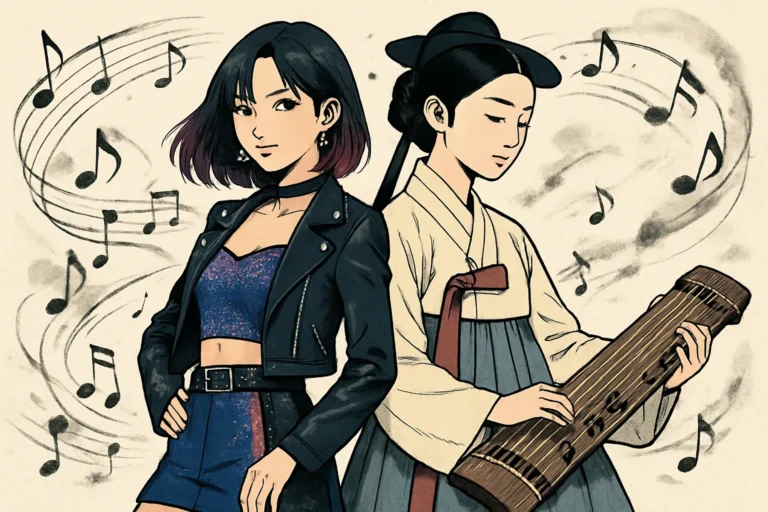
K-Pop’s Secret Weapon? Master Korean Music Talk!
Hello! This is [Maeil Hangeul], here to upgrade your Korean skills!
Have you ever listened to a K-Pop song like Stray Kids’ “Thunderous (소리꾼)” or Agust D’s “Daechwita (대취타)” and thought, “Wow, what is that powerful, unique sound?” You’re not alone! These days in Korea, K-Pop artists are famously blending modern beats with traditional Korean music, creating a sound that’s taking the world by storm.
Today, we’ll learn how to talk about these amazing sounds. You’ll be able to ask your Korean friends about their country’s music and even share a bit about your own. Let’s get started!
Core Expressions You Need to Know
Here are three key phrases to help you dive into the world of Korean music.
1. 전통 음악 (Traditional Music)
- Pronunciation [Romanization]: Jeontong eumak
- English Meaning: Traditional music
- Detailed Explanation: This is the essential term you need! 전통 (jeontong) means ‘tradition’ and 음악 (eumak) means ‘music’. You can use this to talk about any country’s traditional music, not just Korea’s. For example, “한국의 전통 음악 (Hangugui jeontong eumak)” means “Korean traditional music.”
-
💡 Pronunciation Tip:
- The pronunciation here is quite straightforward and follows the letters. Make sure to pronounce each syllable clearly: 전 (jeon) – 통 (tong) – 음 (eum) – 악 (ak). Unlike English, where syllables can blend together, Korean syllables are often pronounced distinctly.
2. 어떤 특징이 있어요? (What are its characteristics?)
- Pronunciation [Romanization]: Eotteon teukjingi isseoyo?
- English Meaning: What are its characteristics? / What makes it special?
- Detailed Explanation: This is a fantastic question for showing genuine interest. 어떤 (eotteon) means ‘what kind of’, and 특징 (teukjing) means ‘a special feature’ or ‘characteristic’. You can use this to ask about music, food, places—almost anything! It’s a polite and natural way to ask for more details.
-
💡 Pronunciation Tip:
- Listen closely to 특징! It’s written as ‘teuk-jing’, but it’s actually pronounced [특찡 / teukjjing]. This is a common Korean pronunciation rule called ‘경음화 (gyeong-eum-hwa)’ or ‘tensing’. When a syllable ending in a ‘stop sound’ like ‘ㄱ’ (k) is followed by certain consonants like ‘ㅈ’ (j), the second consonant becomes a ‘tensed’ or double sound ‘ㅉ’ (jj). It’s a small change that makes you sound much more natural!
3. 소리가 정말 독특하네요. (The sound is really unique.)
- Pronunciation [Romanization]: Soriga jeongmal dokteukaneyo.
- English Meaning: The sound is really unique.
- Detailed Explanation: This is the perfect compliment! 소리 (sori) means ‘sound’, 정말 (jeongmal) means ‘really’, and 독특하다 (dokteukada) means ‘to be unique’. The -네요 (-neyo) ending is used to express your genuine feeling or mild surprise upon experiencing something new. It shows you’re impressed!
-
💡 Pronunciation Tip:
- The magic happens in 독특하네요. It’s written ‘dok-teuk-ha-ne-yo’, but the real pronunciation is [독트카네요 / dokteukaneyo]. Why? It’s another rule called ‘격음화 (gyeog-eum-hwa)’ or ‘aspiration’. When a final consonant ‘ㄱ’ (k) is followed by ‘ㅎ’ (h), they combine to make a strong, airy ‘ㅋ’ (k) sound. So,
특 (teuk) + 하 (ha)becomes [카 / ka]. Practice this, and your Korean friends will be amazed!
- The magic happens in 독특하네요. It’s written ‘dok-teuk-ha-ne-yo’, but the real pronunciation is [독트카네요 / dokteukaneyo]. Why? It’s another rule called ‘격음화 (gyeog-eum-hwa)’ or ‘aspiration’. When a final consonant ‘ㄱ’ (k) is followed by ‘ㅎ’ (h), they combine to make a strong, airy ‘ㅋ’ (k) sound. So,
Example Dialogue
Let’s see how these expressions work in a real conversation. Two friends, Mina (Korean) and Chris (learner), are listening to music.
Chris: 이 노래 진짜 멋있다! K팝 같은데, 뭔가 달라.
(I norae jinjja meositda! K-pop gateunde, mwonga dalla.)
This song is so cool! It sounds like K-Pop, but something’s different.
Mina: 맞아! 한국 전통 음악을 섞어서 그래.
(Maja! Han-guk jeontong eumageul seokkeoseo geurae.)
Right! That’s because it’s mixed with Korean traditional music.
Chris: 아, 그렇구나! 한국 전통 음악은 어떤 특징이 있어요?
(A, geureokuna! Han-guk jeontong eumageun eotteon teukjingi isseoyo?)
Oh, I see! What are its characteristics?
Mina: 음… 감정을 표현하는 강한 목소리랑 북 같은 악기를 많이 써.
(Eum… gamjeongeul pyohyeonhaneun ganghan moksorirang buk gateun aggireul mani sseo.)
Hmm… It uses a powerful voice to express emotions and instruments like drums.
Chris: 와, 그래서 그렇구나. 소리가 정말 독특하네요!
(Wa, geuraeseo geureokuna. Soriga jeongmal dokteukaneyo!)
Wow, so that’s why. The sound is really unique!
Culture Tip & Trend Deep Dive: K-Pop Meets Gugak!
What you’re hearing in those hit songs is often a fusion of K-Pop and ‘국악 (Gugak)’, the official term for Korean traditional music.
- BTS’s “IDOL” famously includes exclamations like “얼쑤 좋다! (Eolssu jota!)” and “지화자 좋다! (Jihwaja jota!)”. These are called ‘추임새 (chuimsae)’, which are encouraging shouts used by the audience or a drummer during a traditional Pansori (판소리, musical storytelling) performance.
- Stray Kids’ “Thunderous (소리꾼)” directly translates to “singer” in the context of Pansori. The song uses traditional brass and percussion instruments to create an intense, powerful vibe.
- BLACKPINK’s “How You Like That” features a melody line in its final dance break that is heavily inspired by traditional Korean scales, giving it an epic and dramatic finish.
By blending Gugak with modern genres, these artists are not just making cool music; they’re celebrating their cultural identity and sharing it with the world. Knowing these expressions allows you to join that exciting cultural conversation!
Let’s Practice!
Ready to test your knowledge? Try these simple exercises.
- Fill in the blank:
- Your friend plays you some traditional music from their country. You want to compliment it.
- “와, ___________ 정말 독특하네요!” (Wow, the ___________ is really unique!)
- Make a sentence:
- How would you ask your Korean friend about the characteristics of Gugak? (Use one of today’s key phrases!)
Great job today! You’re now ready to talk about music like a true culture expert.
Now it’s your turn! What’s the traditional music from your country like? Try to describe it in the comments using the phrases you learned today! We can’t wait to read them.
Frequently Asked Questions (FAQ)
Q: What does "전통" mean in Korean and how do you pronounce it?
A: In Korean, "전통" is pronounced [jeontong] and means: means 'tradition' and
Q: What does "음악" mean in Korean and how do you pronounce it?
A: In Korean, "음악" is pronounced [eumak] and means: means 'music'. You can use this to talk about any country's traditional music, not just Korea's. For example, "한국의 전통 음악 (Hangugui jeontong eumak)" means "Korean traditional music."
Q: What does "어떤" mean in Korean and how do you pronounce it?
A: In Korean, "어떤" is pronounced [eotteon] and means: means 'what kind of', and
Q: What does "특징" mean in Korean and how do you pronounce it?
A: In Korean, "특징" is pronounced [teukjing] and means: means 'a special feature' or 'characteristic'. You can use this to ask about music, food, places—almost anything! It's a polite and natural way to ask for more details.







