

Bark Like a Korean Dog! Fun Animal Sounds You Need to Know 🐾
Hello! Welcome to [Maeil Han-geul], here to upgrade your Korean skills!
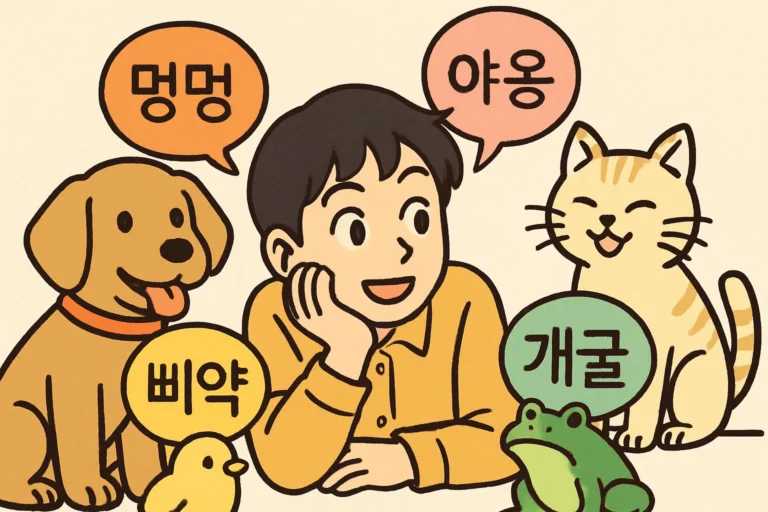
Have you ever wondered what a dog says in Korea? Is it “woof woof”? Or what about a cat? Is it “meow”? While the animals are the same, the sounds we use to describe them can be very different and super fun to learn!
Lately in Korea, there’s a huge trend of sharing cute and funny pet videos on social media. In the comments, you’ll see Koreans writing things like “우리 강아지 멍멍!” But what does that mean? Today, we’ll learn the most common Korean animal sounds so you can understand these cute videos and even talk about your own pets like a native speaker. Let’s get started!
Core Expressions: The Sounds of the Animal Kingdom
Here are some essential onomatopoeia (words that imitate sounds) you’ll hear all the time in Korea.
1. For Dogs 🐶: 멍멍 (meong-meong)
- Pronunciation [Romanization]: Meongmeong
- English Meaning: Woof woof / Bark bark
- Detailed Explanation: This is the standard sound for a dog’s bark. It’s used everywhere, from children’s books to conversations between friends. It’s a very friendly and common expression. If a dog is big and loud, you might hear 컹컹 (keong-keong), but 멍멍 is what you’ll use 99% of the time.
-
💡 Pronunciation Tip:
The key here is the 받침 (final consonant) ‘ㅇ’ (ng). This is the same sound you find at the end of the English word “sing“. Make the sound in the back of your throat, not with your tongue. So, it’s [meong], not “me-ong-guh”. Just repeat it twice for a cute “woof woof”!
2. For Cats 🐱: 야옹 (ya-ong)
- Pronunciation [Romanization]: Ya-ong
- English Meaning: Meow
-
Detailed Explanation: This is the perfect Korean equivalent of “meow.” It beautifully captures the sound of a cat asking for food or attention. You can repeat it, 야옹야옹 (ya-ong-ya-ong), to sound extra cute.
-
💡 Pronunciation Tip:
Just like with 멍멍, the ‘ㅇ’ (ng) sound at the end of 옹 is crucial. Pronounce ‘야 (ya)’ quickly and then flow right into ‘옹 (ong)’. It’s one smooth sound: [ya-ong].
3. For Chicks 🐤: 삐약삐약 (ppiyak-ppiyak)
- Pronunciation [Romanization]: Ppiyak-ppiyak
- English Meaning: Peep peep / Chirp chirp
-
Detailed Explanation: This is the adorable sound a baby chick makes. Because it’s associated with small, cute things, you’ll hear it often in children’s songs and cartoons.
-
💡 Pronunciation Tip:
Let’s talk about the ‘ㅃ’ (pp) sound! This is a “tense consonant.” To make this sound, press your lips together firmly and then release a short, sharp burst of sound without a puff of air. It’s stronger than ‘ㅂ’ (b) and not breathy like ‘ㅍ’ (p). Think of the ‘p’ sound in the English word “spin”. Try saying [ppiyak] with a little force!
4. For Frogs 🐸: 개굴개굴 (gaegul-gaegul)
- Pronunciation [Romanization]: Gaegul-gaegul
- English Meaning: Ribbit ribbit
-
Detailed Explanation: This is the classic sound for a frog, famous from many Korean nursery rhymes. The word itself sounds a bit bouncy, just like a frog!
-
💡 Pronunciation Tip:
The consonant ‘ㄹ’ (r/l) can be tricky. When it’s between two vowels, like in 개굴 (gae-gul), it sounds like a soft, quick tap of the tongue, similar to the ‘r’ in the Spanish word “pero” or the ‘tt’ in the American pronunciation of “water”. So, it sounds more like [gaegur] than a hard [gae-gul].
Example Dialogue
Let’s see how these sounds are used in a real conversation! Two friends, A and B, are watching videos on their phones.
A: 이 비디오 좀 봐! 이 강아지 너무 귀여워.
(I bidio jom bwa! I gangaji neomu gwiyeowo.)
(Look at this video! This puppy is so cute.)
B: 와, 진짜네! 무슨 소리를 내?
(Wa, jinjjane! Museun sorireul nae?)
(Wow, for real! What sound does it make?)
A: 멍멍! 아, 이 고양이는 야옹~ 하고 우네.
(Meongmeong! A, i goyangineun ya-ong~ hago une.)
(It goes woof woof! Oh, and this cat is crying meow~.)
B: 어릴 때 부르던 개굴개굴 개구리 노래가 생각난다.
(Eoril ttae bureudeon gaegul-gaegul gaeguri noraega saenggangnanda.)
(It reminds me of the ribbit ribbit frog song I used to sing when I was little.)
Culture Tip & Trend Deep Dive
In Korea, using these sound words, called 의성어 (uiseong-eo), is a huge part of daily life and online culture.
- Social Media Slang: On Instagram, you’ll see pet owners using cute slang! Instead of just “dog” (개, gae), they often use 멍멍이 (meongmeong-i) or even the internet slang 댕댕이 (daengdaeng-i), which looks similar to 멍멍이 in Hangul. A common caption might be: “우리 댕댕이 오늘 기분 좋아요! 멍멍!” (Our doggo is in a good mood today! Woof woof!)
-
K-Pop and Aegyo (애교): These sounds are a key part of “aegyo,” or acting cute. K-pop idols often imitate cat sounds by saying 야옹~ and making a paw gesture during live streams or fan events. Now when you see it, you’ll be in on the secret!
Let’s Review and Practice!
Great job today! We learned four fun and essential Korean animal sounds:
* Dog: 멍멍 (meong-meong)
* Cat: 야옹 (ya-ong)
* Chick: 삐약삐약 (ppiyak-ppiyak)
* Frog: 개굴개굴 (gaegul-gaegul)
Now, let’s test your knowledge!
1. Fill in the blank:
You see a very cute, tiny puppy. It looks at you and says “_______!”
2. Quick Quiz:
What sound does a 고양이 (goyangi – cat) make in Korean?
You’re doing an amazing job. Keep practicing, and you’ll sound more natural in no time!
What’s your favorite animal? Try leaving a comment below using one of the expressions we learned today!
Frequently Asked Questions (FAQ)
Q: What does "컹컹" mean in Korean and how do you pronounce it?
A: In Korean, "컹컹" is pronounced [keong-keong] and means: , but
Q: What does "야옹야옹" mean in Korean and how do you pronounce it?
A: In Korean, "야옹야옹" is pronounced [ya-ong-ya-ong] and means: , to sound extra cute.
Q: What does "개굴" mean in Korean and how do you pronounce it?
A: In Korean, "개굴" is pronounced [gae-gul] and means: , it sounds like a soft, quick tap of the tongue, similar to the 'r' in the Spanish word "pe
Q: What does "의성어" mean in Korean and how do you pronounce it?
A: In Korean, "의성어" is pronounced [uiseong-eo] and means: , is a huge part of daily life and online culture.







