

Korea’s Agri-Tech Revolution: Debating Food Security
Hello! This is [매일한글], here to upgrade your Korean skills to the next level!
Today, we’re stepping into the world of global policy and innovation. Imagine you’re at an international conference, tasked with drafting a keynote speech on a critical global issue. The topic? Food security. We’ll learn the sophisticated vocabulary and expressions you need to discuss this topic with fluency and confidence.
Especially recently in Korea, there’s a huge buzz around ‘스마트 농업’ (smart agriculture) and agri-tech as solutions to the climate crisis and potential food shortages. We’ll be using this cutting-edge trend to make our learning relevant and exciting! Let’s get started.
Core Expressions for Your Keynote Speech
Here are some essential phrases that will make you sound like a policy expert.
1. 식량 안보 (Singnyang anbo)
- Romanization: [Singnyang anbo]
- English Meaning: Food Security
- Detailed Explanation: This is the cornerstone term for our topic. It’s a formal, Sino-Korean compound word. 식량 (食糧, singnyang) means ‘food’ or ‘provisions’, and 안보 (安保, anbo) means ‘security’ (the same ‘anbo’ used in ‘national security’, 국가 안보). This term refers to the state of having reliable access to a sufficient quantity of affordable, nutritious food. It’s the standard term used in government reports, academic papers, and news broadcasts.
- 💡 Pronunciation Tip:
- Notice the pronunciation of 식량 is [싱냥/singnyang], not [식량/sik-ryang]. This is due to a phonological rule called ‘nasalization’ (비음화). When the final consonant ‘ㄱ’ (k) is followed by a nasal consonant ‘ㄹ’ (r/l), the ‘ㄱ’ sound changes to ‘ㅇ’ (ng), and the ‘ㄹ’ sound changes to ‘ㄴ’ (n) for a smoother, more natural flow. It’s a small change that makes a big difference in sounding fluent!
2. 지속 가능한 농업 (Jisok ganeunghan nongeop)
- Romanization: [Jisok ganeunghan nongeop]
- English Meaning: Sustainable Agriculture
- Detailed Explanation: This phrase is crucial for any modern discussion on agriculture. 지속 가능하다 (jisok ganeunghada) means ‘to be sustainable’, and 농업 (農業, nongeop) means ‘agriculture’. Together, it refers to farming practices that can be maintained over the long term without degrading the environment. It’s a key concept in policy-making.
- 💡 Pronunciation Tip:
- In 가능한, the ‘ㅎ’ (h) sound is very soft, almost silent, when followed by a vowel. The key here is the smooth connection of syllables. Practice saying “jisok-ga-neung-han” as one continuous phrase rather than separate words.
3. 기후 변화에 대응하다 (Gihu byeonhwae daeeunghada)
- Romanization: [Gihu byeonhwae daeeunghada]
- English Meaning: To respond to / tackle / counter climate change
- Detailed Explanation: This is a powerful verb phrase. 기후 변화 (氣候變化, gihu byeonhwa) is ‘climate change’. The verb 대응하다 (對應하다, daeeunghada) is more active and strategic than simply ‘reacting’ (반응하다). It implies creating a plan or taking measures to counter a challenge. Using this verb shows you are talking about proactive solutions.
- 💡 Pronunciation Tip:
- The particle 에 links smoothly to the preceding word: 변화에 is pronounced [변화에/byeonhwa-e]. The final vowel of ‘hwa’ flows directly into the ‘e’ sound. Avoid a pause between them.
4. 총체적인 접근 방식 (Chongchejeogin jeopgeun bangsik)
- Romanization: [Chongchejeogin jeopgeun bangsik]
- English Meaning: A holistic / comprehensive approach
- Detailed Explanation: This is a very advanced phrase that will impress any listener. 총체적 (總體的, chongchejeok) means ‘holistic’ or ‘all-encompassing’. 접근 방식 (接近方式, jeopgeun bangsik) means ‘approach’ or ‘method’. You use this phrase when you want to argue that a problem (like food security) cannot be solved by a single solution but requires a multi-faceted, comprehensive strategy.
- 💡 Pronunciation Tip:
- In the word 접근, the final consonant ‘ㅂ’ (b) before ‘ㄱ’ (g) causes the ‘ㄱ’ to become a tensed sound, [접끈/jeopkkeun]. This is a consonant assimilation rule known as ‘tensing’ (경음화). Mastering this will make your pronunciation sound incredibly authentic.
Example Dialogue: Conference Prep
Let’s see how these expressions work in a real conversation between a conference organizer (A) and a keynote speaker (B).
A: 교수님, 기조연설 초안은 잘 되어가시나요?
(Gyosunim, gijoyeonseol choaneun jal doe-eogasina-yo?)
(Professor, how is the draft of the keynote speech coming along?)
B: 네, 거의 마무리 단계입니다. 저는 연설에서 식량 안보 문제를 해결하기 위한 총체적인 접근 방식을 강조할 계획입니다.
(Ne, geo-ui mamuri dangye-imnida. Jeoneun yeonseoreseo singnyang anbo munjereul haegyeolhagi wihan chongchejeogin jeopgeun bangsikeul gangjohal gyehoegimnida.)
(Yes, it’s nearly finished. In my speech, I plan to emphasize a holistic approach to solving the food security issue.)
A: 아주 좋습니다. 특히 요즘 한국의 ‘스마트팜’ 기술이 주목받고 있으니 그 부분도 언급하시면 좋겠네요.
(Aju josseumnida. Teuki yojeum hangugui ‘seumateupam’ gisuri jumokbatgo isseuni geu bubundo eongeup-hasimyeon jokenne-yo.)
(That’s excellent. It would be great if you could also mention Korea’s ‘smart farm’ technology, as it’s getting a lot of attention these days.)
B: 물론입니다. 지속 가능한 농업의 핵심 사례로서, 기술을 통해 기후 변화에 대응하는 한국의 노력을 소개할 겁니다.
(Mullonimnida. Jisok ganeunghan nongeopui haeksim sarero-seo, gisureul tonghae gihu byeonhwae daeeunghaneun hangugui noryeogeul sogaehal geomnida.)
(Of course. As a key example of sustainable agriculture, I will introduce Korea’s efforts in tackling climate change through technology.)
Cultural Tip & Trend Deep Dive: Korea’s Agri-Tech Boom
Why is “Smart Farming” (스마트 농업) such a hot topic in Korea? It’s not just a buzzword; it’s a national priority.
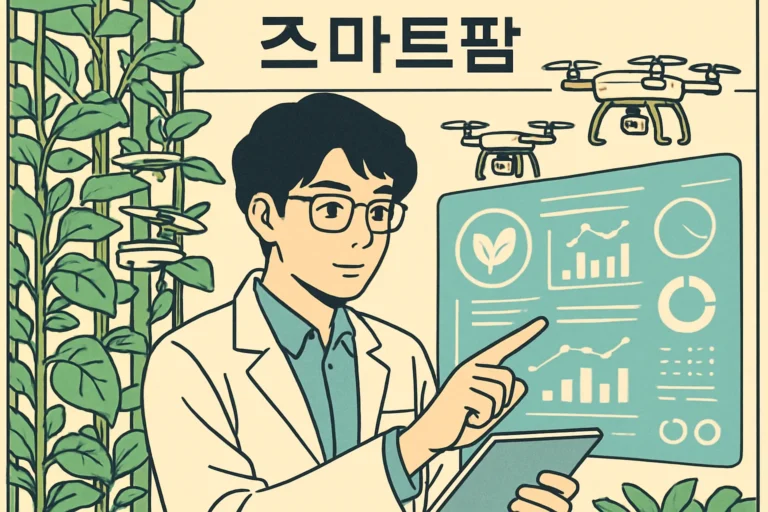
Korea faces unique agricultural challenges: limited arable land, a rapidly aging farming population, and vulnerability to climate-related events. To counter this, the government and major corporations are investing heavily in agri-tech. This includes everything from AI-powered vertical farms in the middle of Seoul that grow produce year-round, to drones that monitor crop health and automate pesticide spraying.
When you hear Korean leaders discuss 미래 농업 (mirae nongeop – future agriculture), they are almost always referring to this high-tech, data-driven approach. They see it not only as a way to secure their own food supply but also as a new export industry—sharing this technology with the world. So, when you use a phrase like “기후 변화에 대응하다,” connecting it to Korea’s smart farm technology shows you have a deep, contemporary understanding of the country’s vision for the future.
Let’s Practice!
Time to put your new knowledge to the test.
- Fill in the Blank:
To ensure a stable food supply for future generations, we must promote _______________.
(Hint: The phrase for “sustainable agriculture”) -
Sentence Building:
Using the term 식량 안보 (food security), write one sentence in Korean about why it is a critical global issue.
Great job today! You’ve learned how to discuss a complex and important topic at a professional level. Now, try creating your own sentences with today’s expressions and share them in the comments below! We’d love to see what you come up with.
Frequently Asked Questions (FAQ)
Q: What does "식량" mean in Korean and how do you pronounce it?
A: In Korean, "식량" is pronounced [食糧, singnyang] and means: means 'food' or 'provisions', and
Q: What does "안보" mean in Korean and how do you pronounce it?
A: In Korean, "안보" is pronounced [安保, anbo] and means: means 'security' (the same 'anbo' used in 'national security', 국가 안보). This term refers to the state of having reliable access to a sufficient quantity of affordable, nutritious food. It's the standard term used in government reports, academic papers, and news broadcasts.
Q: What does "지속 가능하다" mean in Korean and how do you pronounce it?
A: In Korean, "지속 가능하다" is pronounced [jisok ganeunghada] and means: means 'to be sustainable', and
Q: What does "농업" mean in Korean and how do you pronounce it?
A: In Korean, "농업" is pronounced [農業, nongeop] and means: means 'agriculture'. Together, it refers to farming practices that can be maintained over the long term without degrading the environment. It’s a key concept in policy-making.







