Phase 1: Locked Out at Midnight? You Are Not Alone!
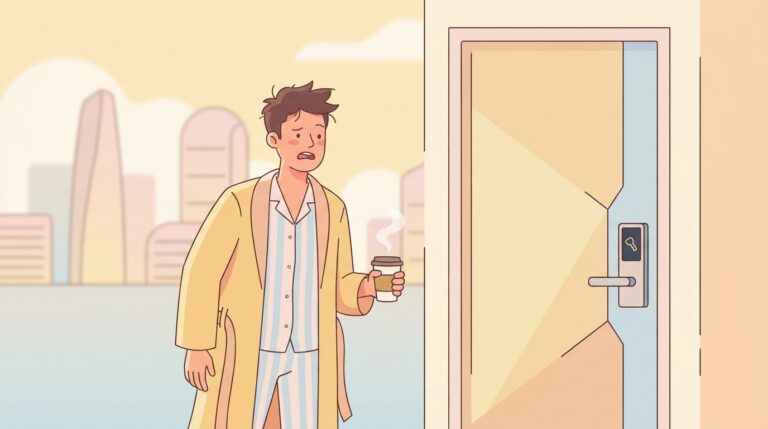
안녕하세요! 매일한글 에디터입니다. (Annyeonghaseyo! Maeil Hangul Editeo-imnida. – Hello! I am the Daily Hangul Editor.) Picture this: it is midnight in Seoul. You step outside your hotel room in your cozy pajamas just to grab hot ramyeon from the hallway. Suddenly—click! The heavy door shuts behind you, and your key card is sitting inside on the desk. Just like that awkward K-Drama scene, panic hits! Many of my beginner students say getting locked out or asking for hotel Wi-Fi in Korean is their biggest travel fear. Based on real traveler feedback, today’s easy guide gives you friendly survival phrases so you never have to stress at the front desk!
Phase 2: Top 3 Key Expressions Deep Dive
1. 카드키를 방에 두고 나왔어요. (Kadeuki-reul bang-e dugo nawasseoyo.)
- Pronunciation: [Kadeuki-reul bang-e dugo nawasseoyo] (kah-deu-kee-reul bahng-eh doo-go nah-wah-ssuh-yo — think of “kah-deu” like “card” with a soft “uh” at the end, and “doo-go” like “do go”!)
- Meaning: Literally “I put the key card in the room and came out.” Actual nuance: “I accidentally locked my key card inside my room!”
- K-Culture Moment: In countless K-Dramas like Business Proposal or King the Land, characters dash into the hotel hallway in a rush and freeze the moment the auto-lock clicks shut.
- Editor’s Insight: Notice there is no word for “accidentally” here! Saying
두고 나왔어요 (dugo nawasseoyo)naturally implies to Koreans that you left it behind by mistake.- Situation Spectrum: Casual 🚫 | Semi-formal ✅ | Formal ⚠️
- 🤔 Think About It: In English, we say “I locked myself out” (focusing on the lock). In Korean, you say “I left the key and came out” (focusing on your action). How does framing it as a sequence of actions change the feeling?
2. 문 좀 열어 주세요. (Mun jom yeoreo juseyo.)
- Pronunciation: [Mun jom yeoreo juseyo] (moon johm yuh-ruh joo-seh-yo — “moon” sounds just like the English word “moon”, and “johm” rhymes with “home”!)
- Meaning: Literally “Please open the door a little.” Actual nuance: “Could you please open my door for me?”
- K-Culture Moment: You hear this handy phrase on K-Travel variety shows like Jinny’s Kitchen or travel vlogs whenever guests need help entering a room or guesthouse.
- Editor’s Insight: The tiny magic word
좀 (jom)softens any request. Without좀 (jom), it can sound like a blunt order; with it, you immediately sound polite and gentle!- Situation Spectrum: Casual 🚫 | Semi-formal ✅ | Formal ⚠️
- 🤔 Think About It: Koreans add “a little” (
좀 jom) to make big favors sound smaller and easier to grant. Do you have a softening word like this in your native language?3. 와이파이 비밀번호가 뭐예요? (Waipai bimilbeonho-ga mwoyeyo?)
- Pronunciation: [Waipai bimilbeonho-ga mwoyeyo] (wah-ee-pah-ee bee-meel-buhn-ho-gah mwoh-yeh-yo — “Waipai” sounds like “Y-pie” because Korean has no “F” sound!)
- Meaning: Literally “What is the Wi-Fi secret number?” Actual nuance: “What is the Wi-Fi password?”
- K-Culture Moment: Right after getting their key card back on Korean travel reality shows, celebrities always ask this so they can message friends or check local maps.
- Editor’s Insight: Don’t panic if you forget
비밀번호 (bimilbeonho)! Even saying와이파이? (Waipai?)while showing your phone works in a pinch, though saying the full sentence earns huge smiles from hotel staff.- Situation Spectrum: Casual 🚫 | Semi-formal ✅ | Formal ⚠️
- 🤔 Think About It: Korean turns “password” into “secret number” (
비밀번호 bimilbeonho). Why do you think Korean builds everyday tech words from simple roots like “secret” + “number”?
Phase 3: Textbook Korean vs Real Korean
Situation 1: Explaining You Are Locked Out
- 📖 Textbook Korean:
실례지만, 제가 객실 열쇠를 방 안에 두고 나와서 문을 열 수 없습니다. (Sillyejiman, jega gaeksil yeolsoe-reul bang an-e dugo nawaseo mun-eul yeol su eopseumnida.)— “Excuse me, because I left the guestroom key inside the room, I cannot open the door.” - 🗣️ Real Korean:
저기요, 방에 카드키 두고 나왔어요. 문 좀 열어 주세요! (Jeogiyo, bang-e kadeuki dugo nawasseoyo. Mun jom yeoreo juseyo!)— “Excuse me, I left my key card in the room. Please open the door for me!” - 💡 Why the difference? In real life, nobody says stiff words like
객실 열쇠 (gaeksil yeolsoe - guestroom key)when standing in the lobby in slippers! Koreans call it카드키 (kadeuki)and keep sentences short and direct.
Situation 2: Asking for Extra Room Amenities
- 📖 Textbook Korean:
수건과 생수를 추가로 제공해 주시겠습니까? (Sugeon-gwa saengsu-reul chugaro jegonghae jusigetseumnikka?)— “Would you kindly provide additional towels and bottled water?” - 🗣️ Real Korean:
수건이랑 물 좀 더 주실 수 있어요? (Sugeon-irang mul jom deo jusil su isseoyo?)— “Could you give me some more towels and water?” - 💡 Why the difference? Spoken Korean replaces formal verbs like
제공하다 (jegonghada - to provide)with the cozy connector~이랑 (-irang - and)and the friendly phrase좀 더 (jom deo - a little more).
Phase 4: K-Culture Deep Dive & Non-Verbal Manners
4-1. Nunchi & Gestures
When you walk up to the hotel desk locked out, Korean 눈치 (nunchi - social awareness) is all about warm politeness. Start with a small head bow (꾸벅 kkubeok) and a slightly sheepish smile to signal “oops, I made a silly mistake!” When the staff member hands you a replacement key card, always receive it with both hands—or hold it with your right hand while your left hand gently touches your right forearm. This simple gesture shows instant respect and gratitude in Korea.
4-2. Cultural Code Analysis: K-Travel & Auto-Lock Culture
If you love K-Dramas or K-Travel vlogs, you have probably noticed that almost every Korean hotel, guesthouse, and apartment uses digital 도어락 (do-eo-rak - digital door locks) or smart card readers. Unlike doors in some countries that stay unlocked unless you turn a deadbolt, Korean doors lock automatically the second they click shut! Because stepping out to the hallway or lobby in casual indoor clothes or hotel slippers is totally normal in Korea, getting locked out is practically a K-Travel rite of passage—so hotel staff are super used to helping guests with a smile.
Phase 5: Real-Life Roleplay Scenario
- Setting: Midnight at a cozy boutique hotel in Hongdae, Seoul. Soft K-Indie music hums in the warm lobby.
- NPC: Minjun (
민준), a friendly night-shift receptionist wearing a neat name badge, sipping an iced Americano.
- You:
저기요! 죄송한데... (Jeogiyo! Joesonghande...)— “Excuse me! I’m sorry, but…” 🎭 (Approaching the desk in hotel slippers with a sheepish smile) - Minjun:
네, 손님! 무슨 일이세요? (Ne, sonnim! Museun iriseyo?)— “Yes, guest! What happened?” 🎭 (Setting down his coffee and leaning forward attentively) - You:
방에 카드키를 두고 나왔어요. (Bang-e kadeuki-reul dugo nawasseoyo.)— “I left my key card inside the room.” 🎭 (Miming a door closing behind you with your hands) - Minjun:
아이고, 문이 잠겼군요! 몇 호예요? (Aigo, mun-i jamgyeotgunyo! Myeot hoyeyo?)— “Oh dear, the door locked! What room number is it?” 🎭 (Smiling kindly and tapping on his computer) - You:
302호예요. 문 좀 열어 주세요. (Sambaek-i-ho-yeyo. Mun jom yeoreo juseyo.)— “It’s room 302. Please open the door for me.” 🎭 (Holding up 3 fingers, then 0, then 2 just to be clear) - Minjun:
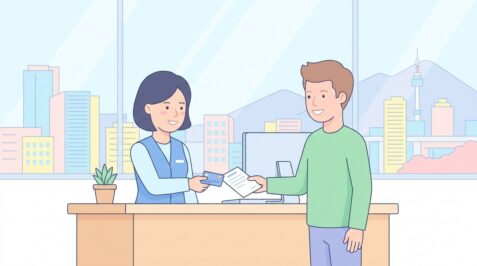
네, 새 카드키 드릴게요. 여기 있어요! (Ne, sae kadeuki deurilgeyo. Yeogi isseoyo!)— “Yes, I’ll give you a new key card. Here you go!” 🎭 (Encoding a new card and handing it over with two hands) - You:
감사합니다! 혹시 와이파이 비밀번호가 뭐예요? (Gamsahamnida! Hoksi waipai bimilbeonho-ga mwoyeyo?)— “Thank you! By the way, what is the Wi-Fi password?” 🎭 (Receiving the card with both hands and pointing gently at your phone) - Minjun:
카드키 종이 뒤에 있어요! (Kadeuki jong-i dwi-e isseoyo!)— “It’s on the back of the key card sleeve!” 🎭 (Flipping the paper sleeve over to show the printed Wi-Fi code)
🔀 Interactive Branching Point!
Wait! Before handing you the key, Minjun politely asks: 실례지만 성함이 어떻게 되세요? (Sillyejiman seongham-i eotteoke doeseyo? - Excuse me, what is your name?) to verify your room. How do you respond?
- Choice A: Smile, say your name clearly, and say
잠시만요, 여권 사진 보여 드릴게요! (Jamsimanyo, yeogwon sajin boyeo deurilgeyo! - Just a moment, I'll show you my passport photo!)if you left your passport inside.- Feedback (Best!): 10/10! Staying calm and offering a passport photo on your phone (or verifying your booking info) makes security checks fast and easy. Always keep a photo of your passport on your phone!
- Choice B: Cross your arms and say
왜요? 그냥 빨리 열어 주세요! (Waeyo? Geunyang ppalli yeoreo juseyo! - Why? Just open it quickly!)- Feedback (Bad!): Ouch! Hotels check ID for your safety so strangers can’t enter your room. Demanding
빨리 (ppalli - quickly)sounds rude and hurts the friendly atmosphere.
- Feedback (Bad!): Ouch! Hotels check ID for your safety so strangers can’t enter your room. Demanding
- Choice C: Just point silently at your room key sleeve and say
삼백이! (Sambaek-i! - 302!)in casual speech.- Feedback (Risk!): Dropping polite endings like
~호예요 (-hoyeyo)and pointing silently can come across as abrupt to Korean staff. Adding예요 (yeyo)keeps things warm and respectful!
- Feedback (Risk!): Dropping polite endings like
Phase 6: 10-Second Emotion Shadowing Drill
Read each line aloud with feeling, pausing briefly at every / mark!
[🥺 Flustered and apologetic]저기요 / 방에 카드키를 / 두고 나왔어요.(Jeogiyo / bang-e kadeuki-reul / dugo nawasseoyo.) — “Excuse me / I left my key card / in the room.”[🙏 Polite and hopeful]죄송한데 / 문 좀 / 열어 주세요.(Joesonghande / mun jom / yeoreo juseyo.) — “I’m sorry, but / please open / the door.”[😊 Bright and curious]혹시 / 와이파이 비밀번호가 / 뭐예요?(Hoksi / waipai bimilbeonho-ga / mwoyeyo?) — “By the way / what is / the Wi-Fi password?”
Phase 7: K-Culture Mini Dictionary
카드키 (Kadeuki)| Key card | Used at almost all Korean hotels and modern offices instead of metal keys.와이파이 (Waipai)| Wi-Fi | Essential word for cafes, hotels, and subways—remember it starts with a “W” sound, not “V” or “F”!수건 (Sugeon)| Towel | Useful for asking housekeeping or front desk for fresh amenities (수건 좀 더 주세요).도어락 (Do-eo-rak)| Digital door lock | From English “door lock”; nearly every Korean home, guesthouse, and Airbnb uses a keypad lock.
Phase 8: Traveler’s Survival Kit
Top 3 Survival Phrases
수건 좀 더 주세요. (Sugeon jom deo juseyo.)— “Please give me more towels.” Pro Tip: Need just one? Say수건 하나만 더 주세요 (Sugeon hanaman deo juseyo).물 좀 더 주세요. (Mul jom deo juseyo.)— “Please give me more bottled water.” Pro Tip: Most Korean hotels give 2 free bottles per day, and front desks happily hand out extras if you ask politely!제 방은 302호예요. (Je bang-eun sambaek-i-ho-yeyo.)— “My room is 302.” Pro Tip: Typing the number on your phone screen while saying it avoids any pronunciation mix-ups.
Editor’s Travel Note
Before you fly to Korea, install two lifesavers: grab the Naver Map App Download (Google Maps walking directions do not work well in Korea!) and the Papago Korean Translator Download for super accurate hotel conversations. Also, keep a photo of your passport on your phone in case you lock your physical passport inside your room, and carry a T-Money card or international Visa/Mastercard—Korea is almost completely cashless, even for late-night convenience store snacks!
Phase 9: One Step Deeper
In Korea, service interactions blend fast efficiency (빨리빨리 ppalli-ppalli) with warm human care (정 jeong). Even if you lock yourself out at 2 AM, Korean hotel staff rarely scold you; they quickly solve the problem with an empathetic “Aigo!” as if helping a neighbor. In return, using softeners like 좀 (jom) and accepting your new key with two hands shows that you appreciate their kindness rather than treating them like a machine. Small polite habits turn a stressful travel mishap into a heartwarming Korean memory.
💬 Your Turn: Have you ever locked yourself out of a hotel room while traveling? Drop your funniest lockout story in the comments—or try typing 방에 카드키를 두고 나왔어요 in Hangul right now to practice!
Phase 10: FAQ & Common Mistakes
Q: Do Korean hotels charge a fee if I lock my key card inside the room?
A: Almost never! Standard hotels simply verify your ID or booking name and issue a temporary or replacement key card for free. (Only permanently losing a key card at some small guesthouses might carry a small replacement fee.)
Q: Can I ask for extra bottled water and towels for free at Korean hotels?
A: Yes! Most Korean hotels and business hotels happily provide extra towels (수건 sugeon) and small bottled water (생수 saengsu) for free when you ask politely at the front desk.
Q: What if my Airbnb or guesthouse uses a keypad door lock instead of a key card?
A: If your battery dies or you forget the passcode (비밀번호 bimilbeonho), message your host right away on the booking app or KakaoTalk and say: 비밀번호를 잊어버렸어요 (Bimilbeonho-reul ijeobeoryeosseoyo - I forgot the password).
🚨 Common Mistakes TOP 3
- Calling a key card “key” in English: Many staff might hear “key” and look for a metal key, or get confused. Correct Action: Say
카드키 (kadeuki)clearly! - Saying “Wi-Fi” with an “F” sound: Korean has no “F” sound, so pronouncing it strongly as “Wai-Fai” can occasionally confuse beginners. Correct Action: Pronounce it softly as
와이파이 (wa-i-pa-i)with a “P” sound! - Forgetting to check your key card sleeve: Many travelers ask for the Wi-Fi password when it is already printed inside the paper sleeve! Correct Action: Check the back of your
카드키 (kadeuki)paper holder first, or ask와이파이 비밀번호가 뭐예요? (Waipai bimilbeonho-ga mwoyeyo?).
Phase 11: Action Mission & Engagement
- 🥉 Bronze Mission (Solo Practice): Stand in front of your bedroom door right now, look in a mirror, and say
방에 카드키를 두고 나왔어요. 문 좀 열어 주세요.out loud 3 times! - 🥈 Silver Mission (Share Online): Screenshot Phase 2’s Top 3 Expressions and save them to your “Korea Trip” phone album, or share them with your travel buddy on Instagram Stories!
- 🥇 Gold Mission (Real-World Use): Next time you stay at a Korean hotel or talk with a Korean language partner, practice asking
와이파이 비밀번호가 뭐예요?or수건 좀 더 주세요in real life!
🎮 K-Culture Mission: Watch a hotel scene in your favorite K-Drama (like Hotel Del Luna or King the Land) or a K-Pop idol tour vlog. Listen closely when they enter their hotel rooms—can you spot the digital door lock chime or hear words like 방 (bang) or 카드키 (kadeuki)?
Phase 12: Interactive Quiz Challenge
Test what you learned today! Try answering all three questions before opening the answer box.
1. Situational Judgment: You locked your key card inside Room 501. What is the BEST, most natural thing to say to the receptionist?
* A) 객실 열쇠를 찾을 수 없습니다. (Gaeksil yeolsoe-reul chajeul su eopseumnida.)
* B) 저기요, 방에 카드키를 두고 나왔어요. 문 좀 열어 주세요! (Jeogiyo, bang-e kadeuki-reul dugo nawasseoyo. Mun jom yeoreo juseyo!)
* C) 와이파이 비밀번호가 뭐예요? (Waipai bimilbeonho-ga mwoyeyo?)
2. Fill in the Blank: Complete this polite request for extra towels!
수건 ______ 더 주세요. (Sugeon ______ deo juseyo.)
(Hint: It means “a little” and makes requests sound sweet and polite!)
3. True or False Cultural Quiz: True or False? In Korea, hotel doors usually stay unlocked unless you manually turn a key from the outside.
Click here to reveal the answers & explanations!
1. Answer: B!
Feedback: Option A sounds overly stiff like a textbook, and Option C asks for the Wi-Fi password instead of unlocking your door! Option B is friendly, natural, and uses the magic softener 좀 (jom).
2. Answer: 좀 (jom)
Explanation: 수건 좀 더 주세요 (Sugeon jom deo juseyo) means “Please give me a little more towels.” Adding 좀 (jom) makes any request sound warm and polite!
3. Answer: False!
Explanation: Almost all Korean hotels and apartments use auto-locking digital locks or card readers that lock automatically within seconds of closing—so always double-check that your 카드키 (kadeuki) is in your hand before stepping out!
🎬 Watch Our Daily Videos! (Daily Hangul Official Instagram)
Review the expressions you learned in this article with our fun daily short videos! Check out native pronunciation and real-life nuances in action.
- Instagram @dailyhangul_en