

Phase 1: Empathy & Story Opening
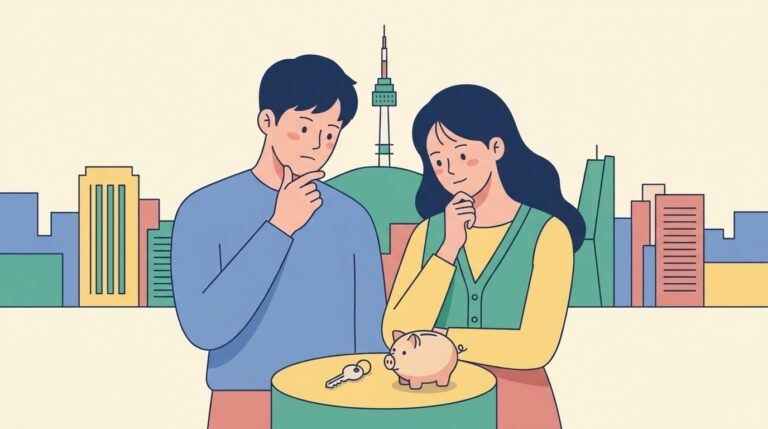
안녕하세요! 매일한글 에디터입니다. (Hello! I’m your Daily Hangul Editor.) Picture this: you’re watching a slice-of-life K-Drama over chimaek, and suddenly the couple starts arguing over a massive jeonse housing deposit and sky-high hagwon fees. In real life, young Koreans face these exact financial hurdles when thinking about marriage and kids. Many intermediate learners tell me they freeze up when local friends discuss housing costs or low birthrates because textbooks skip real adult worries! Built from real learner feedback, this guide gives you natural B1 expressions to share your thoughts with genuine warmth and confidence.
Phase 2: Deep Dive into 3 Core Expressions
1. 현실의 벽에 부딪히다 (hyeonsirui byeoge budichida)
- Pronunciation: hyeonsirui byeoge budichida (Sounds like “hyun-shi-ray byuh-gay boo-dee-chee-da”—think of “boo-dee” hitting with a crisp ‘d’ like bumping straight into a solid wall!)
- Meaning: Literal: “To collide with the wall of reality.” Actual Nuance: Realizing that big dreams—like buying a home, getting married, or starting a family—are blocked by harsh financial and practical limits.
- K-Culture Moment: Think of those quiet, bittersweet scenes in slice-of-life K-Dramas like Because This Is My First Life or My Liberation Notes, where characters in their late 20s stare at loan rejection texts over late-night convenience store beer.
- Editor’s Insight: Intermediate learners often overuse 어렵다 (eoryeopda / it’s hard). Using 현실의 벽에 부딪히다 (hyeonsirui byeoge budichida) instantly elevates your Korean because it captures both practical exhaustion and emotional resignation—especially around 집값 (jipgap / housing prices) and marriage.
- Situation Spectrum: Casual ✅ / Semi-formal ✅ / Formal ✅ (Works naturally in heartfelt chats with friends, news interviews, and essays!)
- 🤔 Think About It: In English, you might say “hit a brick wall” or “get a reality check.” Why do you think framing financial struggles as a shared “wall” helps Korean youth talk about low birthrates as a social issue rather than personal failure?
2. 선뜻 엄두가 나지 않다 (seontteut eomduga naji anta)
- Pronunciation: seontteut eomduga naji anta (Sounds like “sun-ddeut um-doo-ga na-jee an-ta”—hold your breath slightly before the tense “dd” in tteut, like hesitating before taking a leap!)
- Meaning: Literal: “The thought or courage does not readily arise.” Actual Nuance: Hesitating to even consider a major life step—like marriage or having a baby—because the responsibility and costs feel way too heavy.
- K-Culture Moment: You’ll hear this exact phrasing on Korean talk shows like You Quiz on the Block or street interviews whenever young couples explain why they delay having a child.
- Editor’s Insight: This is a gorgeous B1-level upgrade from 무서워요 (museowoyo / I’m scared) or 못 해요 (mot haeyo / I can’t). Pairing 선뜻 (seontteut / willingly, readily) with 엄두가 안 나다 (eomduga an nada / can’t dare to attempt) shows thoughtful, realistic hesitation without sounding overly dramatic.
- Situation Spectrum: Casual ✅ / Semi-formal ✅ / Formal ⚠️ (Swap the ending to 엄두가 나지 않습니다 (eomduga naji anseumnida) for formal speeches or reports.)
- 🤔 Think About It: Notice how Korean frames this passively—courage “doesn’t come out” on its own instead of “I refuse to do it.” How does this softer phrasing reflect the pressure young Koreans feel to avoid sounding selfish when discussing marriage?
3. 등골이 휘다 (deunggori hwida)
- Pronunciation: deunggori hwida (Sounds like “deung-go-ree hwee-da”—say “hwee” like a quick exhale as your back bends under a heavy backpack!)
- Meaning: Literal: “One’s spine bends.” Actual Nuance: Suffering severe financial strain or working yourself to exhaustion to pay crushing expenses—most famously parents paying for 사교육비 (sagyoyukbi / private education costs) or young adults paying high rent.
- K-Culture Moment: Picture intense education K-Dramas like SKY Castle or Crash Course in Romance, where parents half-joke and half-cry over their spines bending just to afford top Gangnam academy tuition.
- Editor’s Insight: Vivid, relatable, and slightly self-deprecating! Trust me, my own back bends every time I check Seoul apartment listings. Just remember to use it about yourself, parents in general, or society—never say it directly to your boss about your paycheck!
- Situation Spectrum: Casual ✅ / Semi-formal ✅ / Formal 🚫 (Too vivid and colloquial for formal presentations; stick to 경제적 부담이 크다 (gyeongjejeok budami keuda / the financial burden is heavy) in formal settings.)
- 🤔 Think About It: English has “break the bank” and “back-breaking work.” Both cultures connect money to physical strain—what does this tell us about how deeply education competition impacts everyday Korean family life?
Phase 3: Textbook Korean vs. Real Korean
Situation 1: Reacting to outrageous Seoul housing prices
- 📖 Textbook Korean: 서울의 집값이 너무 비싸서 결혼하기 어렵습니다. (Seourui jipgabsi neomu bissaseo gyeolhonhagi eoryeopseumnida. — Seoul’s house prices are too expensive, so it is difficult to get married.)
- 🗣️ Real Korean: 요즘 집값이 미쳐서 결혼은커녕 내 집 마련도 꿈도 못 꿔. (Yojeum jipgabsi michyeoseo gyeolhoneunkeonyeong nae jip maryeondo kkumdo mot kkwo. — House prices are insane lately; forget marriage, I can’t even dream of owning my own place.)
- 💡 Why is it different? Textbooks play it safe with 비싸다 (bissada / expensive). In real conversations, Koreans use -은/는커녕 (-eun/neunkeonyeong / let alone) and 꿈도 못 꾸다 (kkumdo mot kkuda / can’t even dream of it) to capture just how impossible 내 집 마련 (nae jip maryeon / buying one’s own home) feels right now.
Situation 2: Talking about the burden of private education costs
- 📖 Textbook Korean: 아이를 키우면 사교육비 때문에 돈이 많이 듭니다. (Aireul kiumyeon sagyoyukbi ttaemune doni mani deumnida. — If you raise a child, it costs a lot of money because of private education expenses.)
- 🗣️ Real Korean: 애 하나 키우는 데도 학원비가 만만치 않아서 선뜻 애 낳기가 부담스러워요. (Ae hana kiuneun dedo hagwonbiga manmanchi anaseo seontteut ae nakiga budamseureowoyo. — Even for raising one kid, academy fees are no joke, so having a baby feels daunting.)
- 💡 Why is it different? Outside news broadcasts, friends say 학원비 (hagwonbi / academy fees) rather than the stiff 사교육비 (sagyoyukbi), and pair 만만치 않다 (manmanchi anta / no joke, formidable) with -기가 부담스럽다 (-giga budamseureopda / feels burdensome to do) to sound natural and empathetic.
Phase 4: K-Culture Deep Dive & Non-Verbal Manners
4-1. Nunchi (눈치) & Gestures
When Koreans talk about 주거비 (jugeobi / housing costs) or low birthrates, pay attention to body language! You’ll often see a gentle downward glance, a quiet exhale, or someone lightly touching the back of their neck—a nod to the classic idiom 뒷목을 잡다 (dwinmogeul japda / to grab the back of one’s neck from shock or stress). Most importantly, good 눈치 (nunchi / social awareness) means never asking a Korean friend or couple directly, “Why aren’t you married yet?” or “When are you having kids?” Those questions hit sensitive financial and personal nerves. Instead, listen warmly, nod along, and validate their feelings with 맞아요, 진짜 부담스럽죠 (Majayo, jinjja budamseureopjyo / Right, it really is a heavy burden).
4-2. Cultural Code Analysis: K-Drama Mirrors Real Life
If you want to understand Korean youth mindset in two dramas, watch Because This Is My First Life (이번 생은 처음이라) and Crash Course in Romance (일타 스캔들). In Because This Is My First Life, two thirty-somethings enter a contract marriage purely to split Seoul’s crushing rent and housing deposit—a storyline that resonated deeply because 집값 (jipgap / housing prices) genuinely shapes life milestones in Korea. Meanwhile, Crash Course in Romance spotlights the fierce 학원 (hagwon / private academy) race in Gangnam’s Daechi-dong, where families spend huge portions of their income just to keep up. Put those two realities together, and you’ll immediately see why young Koreans call marriage and parenting a “high-cost barrier” rather than a simple choice.
Phase 5: Interactive Roleplay Scenario
Setting: A warm, bustling pocha (street-style pub) in Seoul’s Euljiro alley on a rainy Friday evening. Steam rises from sizzling kimchi-jeon and clinking glasses.
NPC: Min-jun (민준), your 31-year-old Korean designer friend who just renewed his tiny studio lease and looks a bit worn out.
- Min-jun: 🎭 (Sighs lightly while pouring barley tea into your cup) 야, 오늘 월세 재계약했는데 또 올랐더라. (Ya, oneul wolse jaegyeyakhaenneunde tto ollatdeora. — Hey, I renewed my monthly rent contract today and it went up again.)
- You: 🎭 (Looks surprised and leans in empathetically) 진짜? 요즘 서울 주거비가 너무 심한 것 같아. (Jinjja? Yojeum Seorul jugeobiga neomu simhan geot gata. — Really? Seoul housing costs seem way too extreme lately.)
- Min-jun: 🎭 (Nods slowly, rubbing the back of his neck) 응, 이러다 보니까 친구들도 다 현실의 벽에 부딪혀서 결혼을 미루고 있어. (Eung, ireoda bonikka chingudeuldo da hyeonsirui byeoge budichyeoseo gyeolhoneul mirugo isseo. — Yeah, because of this, all my friends are hitting the wall of reality and putting off marriage.)
- You: 🎭 (Nods warmly) 게다가 결혼해도 아이 키우는 게 쉽지 않잖아. (Gedaga gyeolhonhaedo ai kiuneun ge swipji anchana. — Plus, even if you get married, raising a kid isn’t easy.)
- Min-jun: 🎭 (Gives a wry smile) 맞지. 애 낳으면 사교육비 때문에 부모 등골이 휜다는데, 나도 선뜻 엄두가 안 나. (Matji. Ae naeumyeon sagyoyukbi ttaemune bumo deunggori hwindaneunde, nado seontteut eomduga an na. — Exactly. They say parents’ backs bend from private education costs once you have a kid, so even I can’t bring myself to consider it.)
- You: 🎭 (Raises your glass gently to cheer him up) 그 마음 충분히 이해돼. 혼자서도 잘 살 수 있는 게 더 중요하지. (Geu maeum chungbunhi ihaedwae. Honjaseodo jal sal su inneun ge deo jungyohaji. — I totally understand how you feel. Being able to live well on your own matters more anyway.)
- Min-jun: 🎭 (Smiles genuinely, relieved) 그렇게 말해 주니까 고맙다. 너희 나라에서도 청년들이 이런 고민 많이 해? (Geureoke malhae junikka gomapda. Neohui naraeseodo cheongnyeondeuri ireon gomin mani hae? — Thanks for saying that. Do young people in your country worry about this stuff a lot too?)
- You: 🎭 (Your turn to respond!)
🔀 Interactive Branching Point: How will you reply to Min-jun?
- Choice A: “응, 우리 나라도 집값이 비싸서 비슷해. 그래도 너무 걱정하지 마, 같이 맛있는 거 먹으면서 풀자!” (Eung, uri narado jipgabsi bissaseo biseuthae. Geuraedo neomu geokjeonghaji ma, gachi masinneun geo meogeumyeonseo pulja! — Yeah, housing is expensive in my country too, so it’s similar. Still, don’t worry too much, let’s unwind over good food!)
- Feedback (Best!): Warm, empathetic, and culturally spot-on! You validate his struggle with shared global experience while gently lifting the mood over food—classic Korean friendship energy.
- Choice B: “응, 하지만 애를 안 낳으면 나라가 큰일 나니까 무조건 낳아야지!” (Eung, hajiman aereul an naeumyeon naraga keunil nanikka mujogeon naayaji! — Yeah, but if people don’t have kids the country will be in big trouble, so you definitely have to have them!)
- Feedback (Bad!): Ouch! Lecturing a stressed friend about national demographics using 무조건 (mujogeon / unconditionally) ignores his real financial pain and breaks nunchi.
- Choice C: “그럼 그냥 부모님 집에 들어가서 살면 돈 아끼지 않아?” (Geureom geunyang bumonim jibe deureogaseo salmyeon don akkiji ana? — Then wouldn’t you save money if you just moved back in with your parents?)
- Feedback (Risk!): While practical in some cases, saying 그냥 (geunyang / just) can sound dismissive if his family lives far from his Seoul job or if he values his hard-earned independence.
Phase 6: 10-Second Emotion Shadowing Drill
Read these lines aloud using the / marks for natural pauses and match the emotion tags!
- [😔 With an empathetic sigh] 요즘 집값이 / 너무 올라서 / 선뜻 결혼할 엄두가 안 나요. (Yojeum jipgabsi / neomu ollaseo / seontteut gyeolhonhal eomduga an nayo. — Housing prices have gone up so much lately that I can’t bring myself to think about marriage.)
- [😮 Sounding shocked and exasperated] 애 하나 키우는 데도 / 학원비가 만만치 않아서 / 등골이 휘겠어요! (Ae hana kiuneun dedo / hagwonbiga manmanchi anaseo / deunggori hwigesseoyo! — Even raising one child, academy fees are no joke—it’s back-breaking!)
- [😌 Calmly yet sincerely] 결국 다들 / 현실의 벽에 부딪혀서 / 출산을 망설이는 거예요. (Gyeolguk dadeul / hyeonsirui byeoge budichyeoseo / chulsaneul mangseorineun geoyeyo. — In the end, everyone hesitates to have kids because they hit the wall of reality.)
Phase 7: K-Culture Mini Dictionary (4 Core Keywords)
- 영끌 (yeongkkeul) | Pulling together every ounce of one’s soul (and money) | Short for 영혼까지 끌어모으다 (yeonghonkkaji kkeureomoeuda). Used constantly in daily chats and news when young Koreans max out loans to buy an apartment before prices climb higher.
- 딩크족 (dingkeujok) | DINK (Double Income, No Kids) lifestyle | Common in casual conversations and lifestyle articles about married Korean couples who prioritize financial stability and personal freedom over parenting.
- 학군지 (hakgunji) | Elite school and academy district | A huge keyword in Korean real estate and parenting—neighborhoods like Gangnam’s Daechi-dong where housing prices soar because of top 학원 (hagwon) access.
- 비혼주의 (bihonjueui) | Voluntary non-marriage philosophy | Used respectfully in social discussions and media interviews when someone consciously chooses not to marry, focusing instead on career and self-fulfillment.
Phase 8: Survival Kit for Travelers
Top 3 Conversational Icebreakers for Locals & Friends
- 요즘 물가가 장난 아니죠? (Yojeum mulgaga jangnan anijyo?) — Prices are no joke lately, right? (Pro Tip: Instant bonding line at cafes, markets, or dinners!)
- 서울 집값이 진짜 비싸긴 하네요. (Seorul jipgabsi jinjja bissagin haneyo.) — Seoul housing prices really are expensive. (Pro Tip: Adding -긴 하네요 (-gin haneyo) sounds thoughtful and observant, not blunt.)
- 다들 너무 바쁘게 사는 것 같아요. (Dadeul neomu bappeuge saneun geot gatayo.) — Everyone seems to live so busily. (Pro Tip: A gentle, safe way to empathize with Korean work-life stress.)
Editor’s Travel Note
Exploring Seoul neighborhoods where young Koreans actually live and hang out—like Yeonnam-dong, Seongsu, or Euljiro—gives you a real feel for Korea’s housing and lifestyle contrasts! Before you head out, make sure to Download the Naver Map App for Accurate Seoul Navigation and Check KakaoMap for Local District Transit Routes, since global map apps don’t provide walking directions well in Korea. Grab a rechargeable T-money transit card at any convenience store (CU, GS25) for subways and buses, and keep a physical credit card handy—while Koreans tap their phones everywhere, foreign cards still work smoothest as physical taps at cafes and restaurants!
Phase 9: One Step Deeper
For decades, Korean society operated on a strong collective script: graduate from a top university, get a stable job, buy an apartment, marry by thirty, and invest everything in your children’s education. Today’s Korean youth haven’t stopped valuing family or 정 (jeong / deep human affection)—rather, skyrocketing 주거비 (jugeobi / housing costs) and fierce 사교육 (sagyoyuk / private education) competition have made that traditional script feel mathematically impossible. Choosing to delay marriage or remain 비혼 (bihon / unmarried) is often an act of self-preservation, a quiet way of protecting one’s dignity and mental peace in a hyper-competitive society. Understanding this shift helps you see past dry statistics and connect with the real hopes and anxieties of young Koreans.
- 💬 Your Turn: How do housing prices or education costs shape young people’s decisions about marriage and kids in your country? Share your thoughts in the comments below—I’d love to compare notes!
Phase 10: FAQ & Common Mistakes
Q: Why do Koreans talk about apartment prices (집값) so openly, even over casual meals?
A: In Korea, real estate isn’t just shelter—it’s the primary way families build financial security and even access good school districts (학군지 / hakgunji). Because housing affects almost every major life milestone, discussing rent (월세 / 전세) or apartment prices is seen as practical life talk rather than bragging or being nosy.
Q: What is the difference between 사교육비 (private education expenses) and regular school tuition?
A: Public schools in Korea are actually quite affordable! 사교육비 (sagyoyukbi) specifically refers to extra spending outside regular school—such as math, English, or coding 학원 (hagwon / cram schools) and private tutors—which many parents feel pressured to pay so their kids stay competitive for university entrance.
Q: Is it okay to ask a Korean friend in their 30s why they aren’t married or don’t have kids?
A: No, definitely avoid asking directly! Even among close friends, questions like 왜 아직 결혼 안 했어요? (Wae ajik gyeolhon an haesseoyo? / Why aren’t you married yet?) can feel invasive and stressful. Wait for your friend to bring up the topic first, and respond with empathy.
🚨 Common Mistakes Alert (TOP 3)
- Mistake: Saying “한국 사람들은 돈만 좋아해요” (Hanguk saramdeureun donman joahaeyo / Koreans only like money) when hearing about marriage hesitation.
- Correct Action: Frame it around systemic pressure! Say “현실적인 부담이 진짜 큰 것 같아요” (Hyeonsiljeogin budami jinjja keun geot gatayo / The practical burden seems really huge).
- Mistake: Confusing 전세 (jeonse) with 월세 (wolse).
- Correct Action: Remember 월세 (wolse) is monthly rent, while 전세 (jeonse) is a huge lump-sum refundable deposit system unique to Korea—saving up that deposit is a major reason young couples delay marriage!
- Mistake: Using 등골이 휘다 (deunggori hwida) in a formal business presentation or essay.
- Correct Action: Save 등골이 휘다 for friends! In formal settings, use 경제적 부담이 가중되다 (gyeongjejeok budami gajungdoeda / economic burden intensifies).
Phase 11: Action Mission & Engagement
- 🥉 Bronze Mission (Solo Practice): Read the 3 shadowing sentences in Phase 6 out loud three times tonight, exaggerating the emotional sighs and pauses until they flow smoothly.
- 🥈 Silver Mission (Community Share): Post one sentence in your language journal or on social media using 선뜻 엄두가 나지 않다 (seontteut eomduga naji anta) to describe something big you’ve been hesitant to try!
- 🥇 Gold Mission (Real-World Use): Next time you chat with a Korean friend or language partner on HelloTalk or in person, share your view on housing costs using 현실의 벽에 부딪히다 (hyeonsirui byeoge budichida).
- 🎮 K-Culture Mission: Watch a Korean street-interview video on YouTube (channels like ODG or Workman) or an episode of Because This Is My First Life and count how many times you hear 집값 (jipgap), 월세 (wolse), or 부담 (budam)!
Phase 12: Interactive Quiz Challenge
Quiz 1: Situational Judgment
Your Korean friend Ji-yeon tells you she and her partner want a second child, but after calculating daycare and future academy fees, they decided to wait. Which reply shows the best nunchi and natural B1 Korean?
* A) 요즘 학원비가 만만치 않아서 선뜻 엄두가 안 날 만해요. (Yojeum hagwonbiga manmanchi anaseo seontteut eomduga an nal manhaeyo.)
* B) 돈이 없어도 일단 낳으면 다 키울 수 있어요! (Doni eopseodo ildan naeumyeon da kiul su isseoyo!)
* C) 당신들은 비혼주의라서 아이를 안 낳는 거죠? (Dangshindeureun bihonjueuiraseo aireul an nanneun geojyo?)
Click to Reveal Answer & Explanation
Correct Answer: A! Option A empathetically validates her financial concern using natural expressions (만만치 않다 + 선뜻 엄두가 안 나다). Why B & C are wrong: Option B dismisses her real financial worries with unsolicited advice, and Option C misuses 비혼주의 (non-marriage philosophy) for an already-partnered couple wanting kids and sounds accusatory with 당신들.
Quiz 2: Fill in the Blank
Complete the sentence with the most natural idiom for facing harsh financial limits:
“청년들이 높은 집값 때문에 ______ 결혼을 미루고 있어요.” (Cheongnyeondeuri nopeun jipgap ttaemune ______ gyeolhoneul mirugo isseoyo. — Young people are postponing marriage because they hit the wall of reality due to high housing prices.)
Click to Reveal Answer & Explanation
Correct Answer: 현실의 벽에 부딪혀서 (hyeonsirui byeoge budichyeoseo)! Combining 현실의 벽에 부딪히다 with -아/어서 connects the harsh financial reality directly to the decision to delay marriage.
Quiz 3: True or False Culture Quiz
Statement: In Korea, asking a married couple in their 30s “Why don’t you have kids yet?” over dinner is considered a polite way to show warm interest in their family.
Click to Reveal Answer & Explanation
Correct Answer: False! Asking directly about marriage or childbirth plans violates Korean 눈치 (nunchi) because housing deposits, career stability, and 사교육비 (private education costs) make it a deeply sensitive and stressful topic for many young Koreans.
🎬 Watch Our Daily Videos! (Daily Hangul Official Instagram)
Review the expressions you learned in this article with our fun daily short videos! Check out native pronunciation and real-life nuances in action.
- Instagram @dailyhangul_en







