

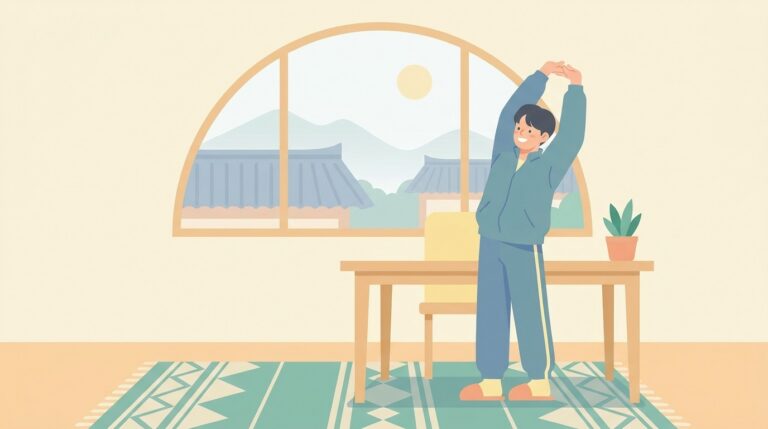
Phase 1: Empathy Opening
안녕하세요! 매일한글 에디터입니다. (Annyeonghaseyo! Hello, I’m your Daily Hangul editor!) Have you ever gotten so hooked on a K-Drama marathon or worked at a cozy Seoul cafe for five hours straight without moving? Then you stand up, wobble on a slightly sprained ankle, and feel your back scream in protest! Walking into a Korean orthopedic clinic (정형외과, jeonghyeong-oigwa) for physical therapy can feel super intimidating when you are already sore. Trust me, I have been there—trying to mime a stiff neck to a doctor is not fun! Based on real feedback from beginner learners in Korea, this practical guide will help you understand the exact posture and stretching advice Korean therapists give so you can heal comfortably and stress-free.
Phase 2: Top 3 Key Expressions Deep Dive
1. 자세를 자주 바꾸세요. (Jasereul jaju bakkuseyo.)
- Pronunciation: Jasereul jaju bakkuseyo (Sounds like: “jah-seh-reul jah-joo bah-kkoo-seh-yo” — think of jah as in “jar” without the r, and kkoo like “cool” without the l).
- Meaning: Literally “Change your posture often.” In real life, it is warm, caring advice from a doctor or friend telling you not to stay frozen in one stiff position.
- K-Culture Moment: Imagine an exhausted office worker in a K-Drama like Misaeng hunched over a monitor all day until a kind physical therapist or senior colleague taps their shoulder and says this.
- Editor’s Insight: The ending -세요 (-seyo) makes a command polite and gentle. Even though it tells you what to do, in Korea it feels like protective care rather than a bossy order.
- Situation Spectrum:
- Casual (to close friends): ⚠️ Use “자세 자주 바꿔!” (Jase jaju bakkwo!) instead.
- Semi-formal (clinic staff, coworkers): ✅ Perfect and natural!
- Formal (older patients, bosses): ✅ Respectful and polite.
- 🤔 Think About It: In English, “Change your posture” can sound a bit blunt unless you add “please.” Why do you think Korean builds politeness directly into the verb ending -세요 (-seyo)?
2. 한 시간마다 스트레칭을 하세요. (Han siganmada seuteurechingeul haseyo.)
- Pronunciation: Han siganmada seuteurechingeul haseyo (Sounds like: “hahn shee-gahn-mah-dah seu-teu-reh-ching-eul hah-seh-yo” — note how “stretching” becomes a rhythmic five-syllable Korean loanword!).
- Meaning: Literally “Do stretching every one hour.” It is the golden rule Korean therapists give for muscle pain and desk fatigue.
- K-Culture Moment: K-Pop idols in behind-the-scenes dance practice videos always stop every hour to stretch their ankles and shoulders together so they don’t get injured.
- Editor’s Insight: The little word 마다 (mada) means “every” when attached to time words! You can easily swap it out: 매일마다 (maeilmada) for every day, or 30분마다 (samsipbunmada) for every 30 minutes.
- Situation Spectrum:
- Casual: ⚠️ Drop -요 or use 해 (hae) with close friends.
- Semi-formal: ✅ Great for therapists, trainers, and friends.
- Formal: ✅ Very polite and clear.
- 🤔 Think About It: Notice how Korean adapts English words like “stretching” (스트레칭) into local rhythm. What wellness words in your native language come from another language?
3. 중간에 꼭 일어나서 움직이세요. (Junggane kkok ireonaseo umjigiseyo.)
- Pronunciation: Junggane kkok ireonaseo umjigiseyo (Sounds like: “joong-gahn-eh kkohk ee-reo-nah-seo oom-jee-gee-seh-yo” — hold the “kk” in kkok tightly for a split second like the “c” in “soccer”).
- Meaning: Literally “In the middle, definitely get up and move.” It means taking active breaks during long sitting sessions.
- K-Culture Moment: High school students in Korean study vlogs (Gongbang) often set timers during library sessions so they remember to stand up and walk around for five minutes.
- Editor’s Insight: Adding 꼭 (kkok) means “for sure” or “definitely.” It adds emotional warmth, showing the speaker genuinely wants you to take care of your body.
- Situation Spectrum:
- Casual: ⚠️ Use “중간에 꼭 일어나서 움직여!” (Junggane kkok ireonaseo umjigyeo!).
- Semi-formal: ✅ Warm and encouraging.
- Formal: ✅ Helpful and caring.
- 🤔 Think About It: In Korean culture, telling someone what to do for their health (꼭 움직이세요) is a classic way to show affection. How do people show care through advice in your culture?
Phase 3: Textbook Korean vs. Real Korean
Situation 1: Telling a friend to take a stretch break
- 📖 Textbook Korean: “장시간 앉아 있지 말고 스트레칭을 하십시오.” (Jangsigan anja itji malgo seuteurechingeul hasipsio. / Do not sit for a long time and please stretch.)
- 🗣️ Real Korean: “잠깐 일어나서 기지개 좀 펴요!” (Jamkkan ireonaseo gijigae jom pyeoyo! / Get up for a second and stretch your arms out!)
- 💡 Why is it different? Nobody uses -십시오 (-sipsio) in everyday life—it sounds like a subway announcement! Real Koreans use the super cute word 기지개 (gijigae), which specifically means that big, satisfying overhead stretch you do after sitting or waking up.
Situation 2: Describing stiff muscles after sitting too long
- 📖 Textbook Korean: “오래 앉아서 근육통이 생겼습니다.” (Orae anjaseo geunyuktongi saenggyeotseumnida. / Muscle pain occurred because I sat for a long time.)
- 🗣️ Real Korean: “계속 앉아 있어서 온몸이 뻐근해요.” (Gyesok anja isseoseo onmomi ppeogeunhaeyo. / I’ve been sitting non-stop, so my whole body feels stiff.)
- 💡 Why is it different? 근육통 (geunyuktong) is a medical term you read on clinic posters, while 뻐근하다 (ppeogeunhada) is the exact everyday feeling of tight, sore, stiff muscles that every Korean complains about after work.
Phase 4: K-Culture Deep Dive & Non-Verbal Manners
4-1. Nunchi (눈치) & Gestures at the Clinic
In a Korean 정형외과 (jeonghyeong-oigwa, orthopedic clinic), non-verbal manners go a long way! When you greet the physical therapist (물리치료사, mullichiryosa), give a small, polite head nod. If you don’t know the exact Korean word for your pain, point gently to your sprained ankle or lower back and say 여기가 아파요 (Yeogiga apayo / It hurts here). Also, when handing over your passport, ID card, or credit card at the front desk, always use two hands (or support your right forearm with your left hand). Good nunchi here means keeping your voice soft in the shared physical therapy room, where patients are resting under warm heat packs!
4-2. Culture Code: Korea’s Beloved Neighborhood Orthopedic Clinics
If you twist your ankle or wake up with a stiff neck in Seoul, you don’t wait weeks for a hospital appointment. Koreans visit local 정형외과 (jeonghyeong-oigwa) on almost every street corner! Just like you see in K-Dramas where characters end up getting their ankles wrapped or lying on therapy beds, Korean clinics offer fast, affordable 물리치료 (mullichiryo, physical therapy)—including hot packs (온찜질, onjjimjil), electrical muscle stimulation, and quick stretching guides—all in under 40 minutes.
Phase 5: Real-Life Roleplay Scenario
Setting: A bright, warm orthopedic clinic in Hongdae, Seoul. The gentle hum of therapy machines fills the room, and there is a faint scent of menthol pain patches.
Characters:
* Min-ji (민지 선생님): A cheerful, energetic Korean physical therapist in light blue scrubs.
* You: A traveler recovering from a mild ankle sprain and stiff back from long flights.
Dialogue:
1. Min-ji: 안녕하세요! 오늘 발목이랑 허리는 좀 어떠세요? (Annyeonghaseyo! Oneul balmok-irang heorineun jom eotteoseyo? / Hello! How are your ankle and lower back today?) 🎭 Min-ji smiles warmly while checking your chart.
2. You: 발목은 괜찮은데, 계속 앉아 있어서 허리가 뻐근해요. (Balmogeun gwaenchaneunde, gyesok anja isseoseo heoriga ppeogeunhaeyo. / My ankle is okay, but my lower back is stiff from sitting non-stop.) 🎭 You gently touch your lower back.
3. Min-ji: 아, 비행기를 오래 타셨군요! 물리치료 먼저 받으실게요. (A, bihaenggireul orae tasyeotgunyo! Mullichiryo meonjeo badeusilgeyo. / Ah, you were on a long flight! You’ll get physical therapy first.) 🎭 She guides you toward a cozy therapy bed with a curtain.
4. You: 네, 감사합니다! 치료 후에 집에서 뭘 해야 돼요? (Ne, gamsahamnida! Chiryo hue jibeseo mwol haeya dwaeyo? / Yes, thank you! What should I do at home after therapy?) 🎭 You nod politely as you sit down.
5. Min-ji: 중간에 앉은 자세를 자주 바꾸세요. (Junggane anjeun jasereul jaju bakkuseyo. / Change your sitting posture often in between.) 🎭 She demonstrates shifting her weight while sitting.
6. You: 아, 자세를 자주 바꾸고요? 또 있어요? (A, jasereul jaju bakkugoyo? Tto isseoyo? / Oh, change my posture often? Anything else?) 🎭 You listen attentively.
7. Min-ji: 네! 그리고 한 시간마다 스트레칭을 꼭 하세요. (Ne! Geurigo han siganmada seuteurechingeul kkok haseyo. / Yes! And make sure to stretch every hour.) 🎭 She stretches both arms up toward the ceiling to show you.
8. You: 알겠어요! 한 시간마다 스트레칭할게요! (Algesseoyo! Han siganmada seuteurechinghalgeyo! / Got it! I’ll stretch every hour!) 🎭 You smile and mimic her stretch.
🔀 Interactive Branching Point: What do you say when Min-ji finishes wrapping your ankle?
- A) “너무 시원해요! 감사합니다!” (Neomu siwonhaeyo! Gamsahamnida! / It feels so refreshing! Thank you!)
- B) “안 아파요. 가요.” (An apayo. Gayo. / It doesn’t hurt. Going.)
- C) “선생님, 오늘 밤에 바로 등산 가도 돼요?” (Seonsaengnim, oneul bame baro deungsan gado dwaeyo? / Therapist, can I go hiking tonight right away?)
Feedback:
* Option A (Best!): Calling a massage or therapy 시원하다 (siwonhada)—literally “cool/refreshing”—is the ultimate Korean compliment! Min-ji will beam with pride.
* Option B (Bad): Dropping polite endings like -요 (-yo) sounds abrupt and rude to medical staff.
* Option C (Risk!): Asking to go hiking right after an ankle sprain might give poor Min-ji a mini heart attack! Rest that ankle first.
Phase 6: 10-Second Emotion Shadowing Drill
Read these aloud and follow the / pause marks to nail natural Korean rhythm!
[😫 Tired & stiff]계속 앉아 있어서 / 온몸이 뻐근해요. (Gyesok anja isseoseo / onmomi ppeogeunhaeyo. / Because I’ve been sitting non-stop, my whole body is stiff.)[😊 Caring & gentle]중간에 / 자세를 자주 바꾸세요. (Junggane / jasereul jaju bakkuseyo. / Change your posture often in between.)[💪 Energetic & determined]한 시간마다 / 스트레칭을 / 꼭 할게요! (Han siganmada / seuteurechingeul / kkok halgeyo! / I’ll definitely stretch every hour!)
Phase 7: K-Culture Mini Dictionary
- 정형외과 (Jeonghyeong-oigwa) | Orthopedic clinic | Your go-to neighborhood clinic in Korea for sprained ankles, back pain, and physical therapy.
- 물리치료 (Mullichiryo) | Physical therapy | Super common treatment in Korean clinics using heat packs, ultrasound, and stretching.
- 자세 (Jase) | Posture / Pose | Used both for sitting posture at work and posing for photos at Korean photo booths!
- 뻐근하다 (Ppeogeunhada) | To feel stiff/sore | The must-know everyday adjective for tight muscles after walking 20,000 steps in Seoul or sitting at a desk.
Phase 8: Traveler’s Survival Kit
Top 3 Survival Expressions
- 발목을 삐었어요. (Balmogeul ppieosseoyo.) — I sprained my ankle. Pro Tip: Point gently to your ankle; the doctor will immediately know what to check!
- 여기 파스 있어요? (Yeogi paseu isseoyo?) — Do you have pain relief patches here? Pro Tip: Korean pharmacies (약국, yakguk) sell amazing cooling and warming patches called 파스 (paseu).
- 잠깐 쉬었다 가요. (Jamkkan swieotda gayo.) — Let’s rest for a bit before going. Pro Tip: Lifesaver phrase when traveling with energetic friends in hilly Seoul neighborhoods!
Editor’s Travel Note
Before you even sprain an ankle, download the Naver Map app for English clinic navigation and search 정형외과 to see ratings and opening hours near your hotel! Most neighborhood clinics take walk-ins, and you can pay easily at the reception desk (수납, sunap) using your international credit card or Korean transit card. Just remember to bring your passport for registration!
Phase 9: One Step Deeper
Korea is famous for its fast-paced 빨리빨리 (ppalli-ppalli, hurry-hurry) work and study culture, where people often sit at cafes or desks for hours without blinking. Because of that, caring for each other’s bodies has become a subtle love language! When a Korean doctor, friend, or even a coworker reminds you to stretch every hour using gentle -세요 (-seyo) endings, they aren’t trying to control your schedule—they are expressing 정 (jeong, warm human affection) and looking out for your health.
💬 Your Turn: Have you ever visited a clinic abroad, or do you forget to stretch while studying Korean? Drop a comment below and tell us your favorite way to relax after a long day!
Phase 10: FAQ & Common Mistakes
Q: Can I use “바꾸세요 (bakkuseyo)” for things other than posture?
A: Yes! 바꾸다 (bakkuda) means “to change/switch.” You can use it when asking to exchange money (환전), change a schedule, or switch seats (자리를 바꾸세요).
Q: Why does “한 시간마다” mean “every hour” when “한” means “one”?
A: In Korean, 한 (han) is the native Korean number “one” used before counters like 시간 (sigan, hour). Adding 마다 (mada) attaches “every” to it—so literally “every one hour”!
Q: Do I need a reservation to get physical therapy at a Korean clinic?
A: Usually no! Most local 정형외과 (jeonghyeong-oigwa) accept walk-in patients. Just check lunch break hours (usually 1:00 PM – 2:00 PM) before you go.
🚨 Common Mistakes TOP 3
- Mistake: Saying 두 시간 with Sino-Korean numbers like 이 시간 (i sigan). -> Correct Action: Always use native Korean numbers (한 시간, 두 시간, 세 시간) with 시간 (hours)!
- Mistake: Pronouncing 스트레칭 like one fast English word “stretching” in Korean sentences. -> Correct Action: Give each syllable an even beat: seu-teu-reh-ching so Koreans understand you clearly.
- Mistake: Forgetting -요 (-yo) when talking to clinic staff. -> Correct Action: Always keep your endings polite with -세요 (-seyo) or -요 (-yo).
Phase 11: Action Mission & K-Culture Challenge
- 🥉 Bronze Mission: Set a 1-hour timer right now. When it rings, stand up, stretch your arms, and say “한 시간마다 스트레칭해요!” (Han siganmada seuteurechinghaeyo!) out loud three times.
- 🥈 Silver Mission: Share one photo of your study desk on Instagram or X with the caption “자세를 자주 바꾸세요! #DailyHangul”.
- 🥇 Gold Mission: Next time you talk with a Korean language partner or tutor, ask them what they do when their body feels 뻐근해요 (ppeogeunhaeyo)!
- 🎮 K-Culture Mission: Watch a K-Pop dance practice video or a K-Drama office scene this week and spot someone doing 기지개 (gijigae, big overhead stretch)—listen closely to see if they groan “아이고, 뻐근해!”!
Phase 12: Interactive Quiz Challenge
Quiz 1 (Situation): You have been sitting at a Seoul cafe studying Korean for two hours, and your back feels stiff. Which phrase describes this naturally?
A) 물 주세요. (Mul juseyo.)
B) 계속 앉아 있어서 허리가 뻐근해요. (Gyesok anja isseoseo heoriga ppeogeunhaeyo.)
C) 발목이 아주 시원해요. (Balmogi aju siwonhaeyo.)
Click to check the answer & explanation!
Answer: B! “허리가 뻐근해요” means your lower back feels stiff. (A means “Water, please,” and C means “My ankle feels refreshing”—funny, unless you just finished great therapy!)
Quiz 2 (Fill in the Blank): Complete the sentence for “Stretch every hour.”
한 시간______ 스트레칭을 하세요. (Han sigan______ seuteurechingeul haseyo.)
Click to check the answer & explanation!
Answer: 마다 (mada)! Attach 마다 directly after a time word to mean “every” (한 시간마다 = every hour).
Quiz 3 (True or False): In Korean clinics, using the word “시원하다 (siwonhada)” after physical therapy or a massage means it felt too cold and uncomfortable.
Click to check the answer & explanation!
Answer: False! Even though 시원하다 means “cool/refreshing,” Koreans use it after hot packs, massages, or hot soup to express a deeply satisfying, relieving feeling!
🎬 Watch Our Daily Videos! (Daily Hangul Official Instagram)
Review the expressions you learned in this article with our fun daily short videos! Check out native pronunciation and real-life nuances in action.
- Instagram @dailyhangul_en







