

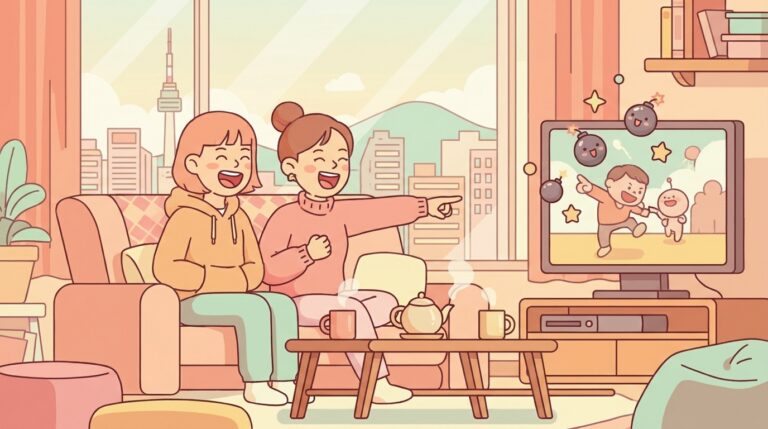
Phase 1: Why Are Korean Variety Shows Warning Us About Bellybuttons?
안녕하세요! (Annyeonghaseyo!) Hello, I’m your Daily Hangul editor. Picture this: you are cozy on your couch watching a hit Korean variety show like Running Man. Suddenly, the cast bursts into tears of laughter, and huge, colorful captions explode across the screen reading 웃음 폭탄 (Useum poktan) and 배꼽 주의 (Baekkop juui)! You type them into a translator and get “laugh bomb” and “bellybutton warning.” Wait, what?! Do not worry—you are not alone! Many of our beginner students felt totally lost by these quirky TV captions too. Based on real learner feedback, this guide will decode these hilarious expressions so you can finally understand the jokes and react naturally just like your Korean best friend.
Phase 2: Top 3 Must-Know Laugh Expressions
1. 웃음 폭탄 (Useum poktan)
- Pronunciation: Useum poktan (Sounds like oo-seum pok-tahn, where “pok” pops sharply like a cork, and “tahn” rhymes with “palm” + n)
- Meaning: Literally “laugh bomb.” In real life, it means something is explosively funny—a joke or moment so hilarious it blows everyone away with laughter.
- K-Culture Moment: Picture a K-Pop idol on Knowing Bros or GOING SEVENTEEN accidentally dropping a prop or making an unexpected silly face, and the editors flash giant red comic-style text: 웃음 폭탄 투하! (Useum poktan tuha! – Laugh bomb dropped!).
- Editor’s Insight: Koreans love comparing sudden, unstoppable laughter to an explosion. You will often see this phrase paired with bomb graphics and sound effects on TV! Even though it uses the word “bomb,” it is 100% cheerful and playful.
- Situation Spectrum: Casual ✅ / Semi-formal ✅ / Formal ⚠️ (Stick to casual talks, variety show chats, or friendly group chats rather than serious business meetings.)
- 🤔 Think About It: In English, people say a joke “bombed” when it failed! Why do you think Korean uses “laugh bomb” to mean a joke was a massive success?
2. 배꼽 주의 (Baekkop juui)
- Pronunciation: Baekkop juui (Sounds like beh-kkop joo-ee—press your lips firmly for the double “kk” sound in kkop like “stop”)
- Meaning: Literally “bellybutton warning.” It is a playful heads-up meaning “watch out, you are going to laugh so hard your bellybutton might fall off!” It comes from the classic Korean idiom 배꼽 빠지다 (Baekkop ppajida – your bellybutton falls out).
- K-Culture Moment: Before a legendary comedy clip starts on Earth Arcade or a YouTube vlog, a yellow caution sign pops up at the corner of the screen saying 배꼽 주의 (Baekkop juui) to warn viewers to hold onto their stomachs.
- Editor’s Insight: English speakers say “I laughed my head off” or “I laughed my butt off,” right? Koreans laugh their bellybutton off! Because your abs ache when you laugh hard, focusing on the center of your stomach makes total physical sense.
- Situation Spectrum: Casual ✅ / Semi-formal ✅ / Formal ⚠️ (Great with friends and in social media captions, but skip it in formal presentations.)
- 🤔 Think About It: Every language picks a different body part for extreme laughter. What body part does your native language use when something is uncontrollably funny?
3. 빵 터지다 (Ppang teojida)
- Pronunciation: Ppang teojida (Sounds like ppahng tuh-jee-dah—pop your lips boldly on ppang like a balloon popping, and use a relaxed “uh” sound for teo)
- Meaning: Literally “to burst with a ppang sound.” It means to burst out laughing suddenly after trying to hold it in—like “cracking up” or “losing it.”
- K-Culture Moment: During a “don’t laugh” challenge on Run BTS, the members try to keep straight faces until one member makes a squeaky noise and everyone immediately goes 빵 터졌어요! (Ppang teojyeosseoyo! – We burst out laughing!).
- Editor’s Insight: The word 빵 (ppang) is an onomatopoeia for a loud pop or explosion (not bread here, even though bread is also 빵!). You can use this as a verb in past tense—빵 터졌어요 (Ppang teojyeosseoyo)—when telling a friend how hard you laughed.
- Situation Spectrum: Casual ✅ / Semi-formal ✅ / Formal ⚠️ (Super natural in everyday speech with friends and coworkers during lunch breaks.)
- 🤔 Think About It: How does sound imagery (like ppang for popping) make reactions feel livelier than simply saying “I laughed”?
Phase 3: Textbook Korean vs. Real Korean
Situation 1: Reacting to a hilarious joke
- 📖 Textbook Korean: 정말 재미있어요. (Jeongmal jaemiisseoyo. – That is really interesting/fun.)
- 🗣️ Real Korean: 완전 빵 터졌어요! (Wanjeon ppang teojyeosseoyo! – I totally cracked up!)
- 💡 Why the difference? Textbook Korean uses 재미있다 (jaemiitta) for everything from a good book to a funny meme. In real life, Koreans use vivid action verbs like 터지다 (teojida – to burst) so the other person can feel how hard you laughed.
Situation 2: Describing side-splitting laughter
- 📖 Textbook Korean: 배가 아플 정도로 많이 웃었어요. (Baega apeul jeongdoro mani useosseoyo. – I laughed so much my stomach hurt.)
- 🗣️ Real Korean: 배꼽 빠질 뻔했어요! (Baekkop ppajil ppeonhaesseoyo! – My bellybutton almost fell off!)
- 💡 Why the difference? Describing stomach pain sounds a bit dry and medical in casual chats. Using the playful “bellybutton” idiom shows warmth, humor, and shared excitement!
Phase 4: K-Culture Deep Dive & Non-Verbal Manners
4-1. Nunchi (눈치) & Laughing Gestures
When Koreans experience a 웃음 폭탄 (Useum poktan – laugh bomb), their body language tells half the story! Here is what you will see on Korean TV and in cafes:
* Holding the stomach: People literally clutch their belly with both hands and bend forward (배를 잡고 쓰러지다 – baereul japgo sseureojida).
* Collapsing to the floor: On variety shows, cast members dramatize great jokes by sliding off their chairs onto the floor to show maximum appreciation for a friend’s humor.
* Covering the mouth: In semi-formal settings or around elders, many Koreans cover their mouth with one hand while laughing to keep a polite, gentle image.
* Light shoulder tap: Close friends might lightly tap the table or a best friend’s shoulder while cracking up—just watch your Nunchi (눈치 – social awareness) and only do this with close buddies!
4-2. Cultural Code Analysis: Why Are Korean Variety Captions So Huge?
If you watch K-Pop idol shows like GOING SEVENTEEN or weekend hits like Running Man, you might wonder why giant text covers a third of the screen. In Korean entertainment, captions—called 자막 (Jamak)—are not just subtitles for hearing accessibility. The show’s PDs (producers) use colorful captions as a witty, invisible co-host! Phrases like 배꼽 주의 (Baekkop juui – bellybutton warning) tell viewers how the cast feels and invite you to laugh together as part of one big living-room crowd.
Phase 5: Real-Life Roleplay Scenario
Setting: Friday night in a cozy Hongdae apartment. You and your Korean bestie Minji are eating crispy fried chicken and watching a new Korean variety show episode on the couch.
- Minji: 야, 이 장면 봐! 완전 기대돼! (Ya, i jangmyeon bwa! Wanjeon gidaedwae!) (Hey, watch this scene! I’m so excited!) 🎭 Points excitedly at the TV screen with a chicken drumstick.
- You: 오, 무슨 일이에요? (O, museun irieyo?) (Oh, what’s happening?) 🎭 Leans forward curiously from the couch.
- Minji: 아까부터 이 사람 실수하는 게 너무 웃겨요! (Akkabuteo i saram silsuhaneun ge neomu utgyeoyo!) (The mistakes this guy has been making are so funny!) 🎭 Giggles while holding a tissue.
- You: 자막에 ‘배꼽 주의’라고 나와요! 무슨 뜻이에요? (Jamage ‘Baekkop juui’rago nawayo! Museun tteusieyo?) (The caption says ‘bellybutton warning’! What does that mean?) 🎭 Squints playfully at the colorful yellow sign on screen.
- Minji: 아, 너무 웃겨서 배꼽이 빠질 수 있으니까 조심하라는 뜻이에요! (A, neomu utgyeoseo baekkopi ppajil su isseunikka josimharaneun tteusieyo!) (Ah, it means watch out because it’s so funny your bellybutton might fall off!) 🎭 Laughs and pats her stomach.
- You: 아하! 진짜 웃음 폭탄이네요! 저 완전 빵 터졌어요! (Aha! Jinjja useum poktanineyo! Jeo wanjeon ppang teojyeosseoyo!) (Aha! It really is a laugh bomb! I totally cracked up!) 🎭 Doubles over laughing on the sofa cushions.
- Minji: 우와, 한국어 표현 진짜 잘 쓰네요! (Uwa, hangugeo pyohyeon jinjja jal sseuneyo!) (Whoa, you use Korean expressions so well!) 🎭 Gives you an impressed thumbs-up.
- You: 다 민지 씨 덕분이에요! (Da Minji ssi deokbunieyo!) (It’s all thanks to you, Minji!) 🎭 Smiles brightly and clinks soda cans together.
🔀 Interactive Branching Point: What Would You Say Next?
Suddenly, the comedian on TV slips into a mud pool and makes a hilarious face. Minji bursts out laughing and looks at you. How do you respond?
- A) “배꼽 빠질 뻔했어요!” (Baekkop ppajil ppeonhaesseoyo! – My bellybutton almost fell off!)
- B) “폭탄이 무서워요.” (Poktani museowoyo. – I am scared of bombs.)
- C) “정말 재미있군요.” (Jeongmal jaemiitgunyo. – That is quite amusing indeed.)
Feedback:
* Choice A (Best!): Natural, energetic, and 100% native-sounding! Minji will love that you used the bellybutton idiom right on cue.
* Choice B (Bad!): Oops! Taking 웃음 폭탄 (Useum poktan) literally as a real dangerous bomb will confuse your friend—don’t worry, no real explosives here!
* Choice C (Risk!): Grammatically fine, but it sounds like a robot or a stiff news anchor while sitting on a couch eating fried chicken. Keep it casual!
Phase 6: 10-Second Emotion Shadowing Drill
Read these lines aloud! Pause briefly at each / and match the emotion!
[😆 Bursting with sudden laughter]아, 진짜 / 빵 터졌어요! (A, jinjja / ppang teojyeosseoyo! – Ah, I seriously burst out laughing!)[🤣 Holding your stomach in tears]배꼽 / 빠질 뻔했어요! (Baekkop / ppajil ppeonhaesseoyo! – My bellybutton almost fell off!)[🤩 Hyping up a funny video]이거 / 완전 웃음 폭탄이에요! (Igeo / wanjeon useum poktanieyo! – This is a total laugh bomb!)
Phase 7: K-Culture Mini Dictionary
- 자막 (Jamak) | Captions / Subtitles | On Korean TV, these colorful pop-up comments add jokes and explain cast emotions, not just spoken dialogue.
- 리액션 (Riaeksyeon) | Reaction | Borrowed from English! Good “riaeksyeon” (clapping, gasping, laughing big) is praised as a top skill on Korean variety shows.
- 예능감 (Yeneunggam) | Variety show sense | The talent for being naturally funny and quick-witted on camera. Friends say this to compliment a funny buddy!
- 현웃 (Hyeonut) | Real-life laugh | Short for 현실 웃음 (hyeonsil useum). Used online or in texts when you aren’t just typing “lol”—you actually laughed out loud in real life.
Phase 8: Survival Kit for Travelers
Top 3 Survival Phrases
- 너무 웃겨요! (Neomu utgyeoyo!) — So funny! Pro Tip: Use this whenever a street performer, friend, or café sign makes you laugh.
- 무슨 뜻이에요? (Museun tteusieyo?) — What does it mean? Pro Tip: Point to a funny Korean poster or TV caption and ask a friendly local—it is an instant icebreaker!
- 같이 봐요! (Gachi bwayo!) — Let’s watch together! Pro Tip: Great for sharing funny reels or variety clips with new Korean friends at a guesthouse.
Editor’s Travel Note
Heading to Korea soon? Before you hop on the subway with your T-money card, grab a few must-have tools on your phone. Check out our Naver Papago Translation App Download Guide for snapping quick photos of menus and street signs, and get the Naver Map App for Seoul Subway Navigation so you never get lost finding late-night chicken spots! Remember: while Papago is awesome for menus, slang like 배꼽 주의 (Baekkop juui) still needs you—the human expert—to decode the real humor.
Phase 9: One Step Deeper
In Korean culture, laughter is rarely a quiet, solo activity—it is a warm bridge that brings people together. Korea’s strong sense of community—often called 우리 (Uri, meaning “we” or “our”)—turns watching a TV show into a shared celebration. When variety captions shout 웃음 폭탄 (Useum poktan) or 배꼽 주의 (Baekkop juui), they invite every viewer into the same joyful circle. Even if you are watching alone in your bedroom miles away from Seoul, those playful captions make you feel like you are sitting right beside friends.
💬 Your Turn: What is the funniest K-Variety show or K-Pop moment that made you go 빵 터졌어요 (Ppang teojyeosseoyo)? Tell us in the comments below!
Phase 10: FAQ & Common Mistakes
Q: Can I say ‘배꼽 주의 (Baekkop juui)’ in real-life conversations, or is it only for TV captions?
A: You can definitely use it in texts, social media captions, or when warning a friend before showing them a funny video! In spoken conversation, though, Koreans more often say 배꼽 빠질 뻔했어요 (Baekkop ppajil ppeonhaesseoyo – my bellybutton almost fell off).
Q: Is ‘빵 터지다 (Ppang teojida)’ related to the Korean word for bread (빵)?
A: Great question! They sound identical, but they are completely different. Here, 빵 (ppang) is a sound word like “pop!” or “bang!” describing sudden laughter exploding out.
Q: Is it polite to use these phrases with my Korean teacher or boss?
A: They are cheerful and clean, not rude words! However, they are quite casual and expressive. Use them freely with friends, classmates, and younger coworkers, and stick to 재미있어요 (Jaemiisseoyo – It’s fun/funny) in very formal meetings.
🚨 Common Mistakes Warning Board
- Mistake: Saying “빵을 먹었어요” instead of “빵 터졌어요” when laughing. Correct Action: Remember 터지다 (teojida – to burst)! Otherwise you are telling your friend “I ate bread” in the middle of a joke!
- Mistake: Translating 웃음 폭탄 (Useum poktan) word-for-word and worrying it sounds aggressive. Correct Action: Relax and embrace the exaggeration—in Korean comedy, “bomb” simply means “huge burst of joy.”
- Mistake: Using “웃기다” (utgida – funny) in a serious tone. Correct Action: Always smile and keep your tone bright! Saying “웃기시네” (Utgisine) with a straight face can sarcastically mean “You’re ridiculous.”
Phase 11: Action Mission & Engagement
- 🥉 Bronze Mission: Stand in front of your mirror and practice saying “완전 빵 터졌어요! (Wanjeon ppang teojyeosseoyo!)” three times with a big laugh and smile.
- 🥈 Silver Mission: Share a hilarious K-Pop or K-Drama meme on your Instagram Story or X and caption it with
#웃음폭탄or#배꼽주의! - 🥇 Gold Mission: Next time a Korean friend sends you a funny clip, reply with “배꼽 빠질 뻔했어요 ㅋㅋㅋ (Baekkop ppajil ppeonhaesseoyo kkk)”!
🎮 K-Culture Mission: Watch one 10-minute clip of Running Man, GOING SEVENTEEN, or Earth Arcade on YouTube with Korean captions visible. Spot at least one time the editors use 폭탄 (poktan), 배꼽 (baekkop), or 빵 (ppang)!
Phase 12: Interactive Quiz Challenge
Quiz 1: Situation Judgment
Your friend sends you a funny cat video, and you laugh so hard you drop your phone. Which reaction fits best?
A) 배고파요. (Baegopayo.)
B) 완전 빵 터졌어요! (Wanjeon ppang teojyeosseoyo!)
C) 잘 자요. (Jal jayo.)
Click to check the answer & explanation!
Answer: B) 완전 빵 터졌어요! (Wanjeon ppang teojyeosseoyo!)
Explanation: 빵 터지다 means to burst out laughing! Choice A means “I’m hungry” and Choice C means “Good night.”
Quiz 2: Fill in the Blank
Complete the Korean warning sign for something super hilarious: ____ 주의 (____ juui) — “Watch your bellybutton!”
Click to check the answer & explanation!
Answer: 배꼽 (Baekkop)
Explanation: 배꼽 주의 (Baekkop juui) literally means “bellybutton warning,” telling viewers they might laugh their bellybuttons off!
Quiz 3: True or False Cultural Quiz
True or False: In Korean variety shows, 웃음 폭탄 (Useum poktan – laugh bomb) means a comedian told a bad joke and nobody laughed.
Click to check the answer & explanation!
Answer: False!
Explanation: Unlike English where “a joke bombed” means it failed, in Korean 웃음 폭탄 (Useum poktan) means a joke exploded with massive laughter!
🎬 Watch Our Daily Videos! (Daily Hangul Official Instagram)
Review the expressions you learned in this article with our fun daily short videos! Check out native pronunciation and real-life nuances in action.
- Instagram @dailyhangul_en







