

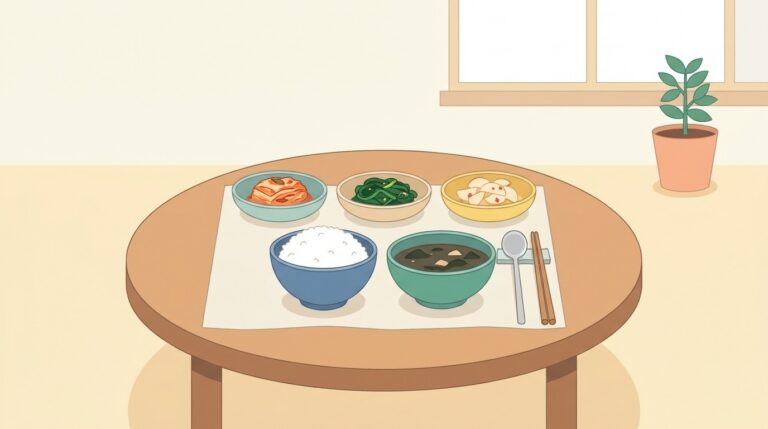
Phase 1: Never Freeze at the Korean Dinner Table Again
Annyeonghaseyo! (안녕하세요!) I’m your Daily Hangul editor. Picture this: you finally land in Seoul, sit down at a sizzling Korean BBQ spot, and the juicy pork belly hits the grill. Everyone picks up their chopsticks, smiles, and says a quick phrase in unison—while you freeze, staring at your rice bowl! Does that awkward silence sound familiar? After 10 years of coaching Korean learners, I can tell you that mealtime greetings are the number-one panic moment for beginners. In this guide, based on real student feedback, you’ll learn how to say ‘Please enjoy your meal’ and master essential Korean table manners so you can eat like a true local!
Phase 2: 3 Essential Mealtime Expressions Deep Dive
1. 맛있게 드세요! (Masitge deuseyo!)
- Pronunciation: Masitge deuseyo (Sounds like mah-sheet-geh deu-seh-yo, where the ‘eu’ sounds like the ‘oo’ in good without rounding your lips!)
- Meaning: Literally ‘Eat deliciously!’ In real life, it means ‘Please enjoy your meal!’ or ‘Bon appetit!’
- K-Culture Moment: Picture a warm restaurant owner in Hospital Playlist or Jinny’s Kitchen setting down a bubbling pot of kimchi stew in front of hungry guests and smiling brightly as she says, ‘맛있게 드세요! (Masitge deuseyo!)’
- Editor’s Insight: Unlike English, where you say ‘Enjoy your meal’ right before digging in, Koreans mostly say this to someone else—like a waiter to customers, a host to guests, or a coworker to teammates. You don’t say it to yourself!
- Situation Spectrum: Casual ⚠️ (A bit too polite for your best friend) / Semi-formal ✅ (Perfect for coworkers and acquaintances) / Formal ✅ (Great for elders, bosses, and restaurant staff)
- 🤔 Think About It: In English, ‘Enjoy your meal’ focuses on having a good time. In Korean, ‘맛있게 (masitge)’ literally focuses on taste—wishing that the food tastes delicious to the other person. How do people in your culture wish others a good meal?
2. 잘 먹겠습니다! (Jal meokgetseumnida!)
- Pronunciation: Jal meokgetseumnida (Sounds like jahl muhk-get-seum-nee-dah—keep the ‘g’ crisp and short!)
- Meaning: Literally ‘I will eat well!’ Practically, it means ‘Thank you for the food!’ right before you take your first bite.
- K-Culture Moment: You’ve seen this in every K-Drama family dinner! Before picking up their spoons, everyone around the table folds their hands or nods slightly and says, ‘잘 먹겠습니다! (Jal meokgetseumnida!)’ to whoever cooked or paid.
- Editor’s Insight: This is the ultimate magic phrase in Korea. Even if you are paying for your own meal at a restaurant, saying it to the chef or server shows immense warmth and appreciation for their hard work.
- Situation Spectrum: Casual ⚠️ (Slightly stiff with close buddies) / Semi-formal ✅ (Super polite and sweet) / Formal ✅ (Absolute must with elders, bosses, or hosts)
- 🤔 Think About It: Notice how this phrase shows gratitude before eating, thanking the person who prepared or bought the meal. Why do you think Korean culture puts so much emphasis on thanking the provider before even taking a bite?
3. 잘 먹었습니다! (Jal meogeotseumnida!)
- Pronunciation: Jal meogeotseumnida (Sounds like jahl muh-guht-seum-nee-dah—smoothly link ‘meok’ and ‘eot’ together!)
- Meaning: Literally ‘I ate well!’ Practically, it means ‘Thank you for the wonderful meal!’ after you finish eating.
- K-Culture Moment: Think of the members of Running Man or BTS finishing a massive feast on a variety show. They pat their stomachs, smile at the camera or the restaurant auntie, and bow slightly saying, ‘잘 먹었습니다! (Jal meogeotseumnida!)’
- Editor’s Insight: Saying this when you walk out of a Korean restaurant guarantees you a huge, genuine smile from the owner. It works just like leaving a verbal five-star review!
- Situation Spectrum: Casual ⚠️ (Too formal for your little sibling) / Semi-formal ✅ (Wonderful with friends who treated you) / Formal ✅ (Essential when leaving a restaurant or finishing a meal with elders)
- 🤔 Think About It: Saying ‘I ate well’ doesn’t use the word ‘thank you’ (고맙습니다, gomapseumnida), yet it is the highest compliment to a cook. In your language, how do you compliment the chef after a great meal?
Phase 3: Textbook Korean vs. Real Korean
Situation 1: Wishing a close friend a good meal
- 📖 Textbook Korean: 맛있게 드세요! (Masitge deuseyo!) — Please enjoy your meal!
- 🗣️ Real Korean: 맛있게 먹어! (Masitge meogeo!) or 많이 먹어! (Mani meogeo!) — Eat up! / Eat lots!
- 💡 Why the difference? Between close friends or people younger than you, using the honorific verb ‘드시다 (deusida)’ feels distant and robotic. Switching to ‘먹어 (meogeo)’ or telling them to ‘eat lots’ (많이 먹어, mani meogeo) is how Koreans express real affection!
Situation 2: Right before eating when a friend treats you
- 📖 Textbook Korean: 잘 먹겠습니다! (Jal meokgetseumnida!) — I will eat well!
- 🗣️ Real Korean: 잘 먹을게! (Jal meogeulge!) — Thanks, I’m gonna enjoy this!
- 💡 Why the difference? Among peers, dropping the formal ending ‘-겠습니다 (-getseumnida)’ for the friendly ‘-을게 (-eulge)’ sounds super natural, warm, and thankful without creating an awkward wall of politeness.
Phase 4: K-Culture Deep Dive & Non-Verbal Manners
4-1. Nunchi (눈치) & Table Gestures
In Korea, good table manners are all about 눈치 (nunchi)—reading the room and showing respect through actions:
* The Elder’s Spoon Rule: Never pick up your spoon or chopsticks before the oldest person at the table picks up theirs! Watch their hands gently out of the corner of your eye.
* Hands Off the Bowl: Unlike in China or Japan, Koreans leave their rice bowl (밥그릇, bapgeureut) and soup bowl (국그릇, gukgeureut) flat on the table while eating. Picking up your bowl to eat is considered bad manners.
* Two Hands & A Nod: When saying ‘잘 먹겠습니다! (Jal meokgetseumnida!)’ to an elder or boss, give a slight head nod. If someone pours you a drink, hold your glass with two hands!
4-2. Cultural Code Analysis: K-Food & K-Drama’s ‘Jeong’ (정)
Have you noticed in K-Dramas that characters constantly ask, ‘밥 먹었어? (Bap meogeosseo? — Did you eat?)’ instead of ‘How are you?’ In Korean culture, sharing food is sharing love, known as 정 (Jeong)—a deep bond of warmth and care. Even side dishes (반찬, banchan) and stews are placed in the center to share. Saying ‘맛있게 드세요! (Masitge deuseyo!)’ and ‘잘 먹었습니다! (Jal meogeotseumnida!)’ isn’t just etiquette; it’s how you join that warm circle of Jeong!
Phase 5: Real-Life Roleplay Scenario
Setting: A lively, smoky Korean BBQ restaurant in Hongdae, Seoul. Sizzling pork belly fills the air with mouthwatering aroma. You are dining with your Korean bestie Minji (민지) and the warmhearted restaurant owner, Imonim (이모님, Auntie).
- Imonim (이모님): 여기 삼겹살 나왔습니다! 맛있게 드세요! (Yeogi samgyeopsal nawatseumnida! Masitge deuseyo!) — Here is your pork belly! Please enjoy your meal! 🎭 (Places sizzling meat and fresh lettuce wraps on the table with a bright smile)
- You: 와, 맛있겠다! 잘 먹겠습니다! (Wa, masitgetda! Jal meokgetseumnida!) — Wow, that looks delicious! Thank you for the meal! 🎭 (Claps hands softly and gives a polite little nod to Imonim)
- Minji (민지): 이모님, 감사합니다! 우리 오늘 진짜 배부르게 먹자. (Imonim, gamsahamnida! Uri oneul jinjja baebureuge meokja.) — Thank you, Auntie! Let’s eat until we’re super full today. 🎭 (Hands you a pair of metal chopsticks and flips the meat with tongs)
- You: 응! 민지야, 맛있게 먹어! (Eung! Minjiya, masitge meogeo!) — Yeah! Minji, enjoy your meal! 🎭 (Places a grilled piece of meat onto Minji’s plate)
- Minji (민지): 고마워! 너도 많이 먹어! (Gomawo! Neodo mani meogeo!) — Thanks! You eat lots, too! 🎭 (Wraps meat, garlic, and ssamjang in a lettuce leaf and takes a happy bite)
- You: 음! 진짜 맛있어요! (Eum! Jinjja masisseoyo!) — Mmm! It’s seriously delicious! 🎭 (Eyes widen in amazement while chewing)
- Imonim (이모님): 더 필요하면 말씀하세요! (Deo piryohamyeon malsseumhaseyo!) — Let me know if you need anything else! 🎭 (Checks on your table while passing by)
- You: 네, 감사합니다! 잘 먹었습니다! (Ne, gamsahamnida! Jal meogeotseumnida!) — Yes, thank you! We had a wonderful meal! 🎭 (Bows slightly as you get up to pay at the counter after finishing)
🔀 Interactive Branching Point: What Would You Do?
Imonim sets down extra complimentary steamed egg (계란찜, gyeranjjim) for free as ‘service’ (서비스, seobiseu)! What do you say?
* Choice A: ‘와, 감사해요! 잘 먹겠습니다!’ (Wa, gamsahaeyo! Jal meokgetseumnida!) — Wow, thank you! I will eat well!
* Feedback (Best!): 10/10! You showed instant gratitude and used the exact right pre-meal greeting. Imonim will probably call you ‘cute’ and give you extra kimchi next time!
* Choice B: ‘맛있게 드세요!’ (Masitge deuseyo!) — Please enjoy your meal!
* Feedback (Risk!): Oops! You just told the restaurant owner to enjoy the food she’s giving you. She’ll understand you’re learning and chuckle warmly, so don’t worry—just remember ‘잘 먹겠습니다 (jal meokgetseumnida)’ is for you eating!
* Choice C: Say nothing and immediately stick your chopsticks into it.
* Feedback (Bad!): Total nunchi fail! Even a quick ‘감사합니다! (Gamsahamnida!)’ goes a long way in Korea.
Phase 6: 10-Second Emotion Shadowing Drill
Read these out loud! Pause at / and pour your heart into the emotion tags:
- [😊 Warm & Welcoming] 맛있게 / 드세요! (Masitge / deuseyo!) — Please enjoy your meal!
- [🙏 Grateful & Excited] 와! / 잘 / 먹겠습니다! (Wa! / Jal / meokgetseumnida!) — Whoa! Thank you for the meal!
- [🥰 Friendly & Caring] 민지야, / 많이 / 먹어! (Minjiya, / mani / meogeo!) — Minji, eat lots!
- [😌 Satisfied & Happy] 진짜 / 잘 / 먹었습니다! (Jinjja / jal / meogeotseumnida!) — I really enjoyed the meal!
Phase 7: K-Culture Mini Dictionary
- 밥 (Bap) | 2. Cooked rice / A meal | 3. Literally means rice, but Koreans use it to mean ‘a meal’ in general. You’ll hear ‘밥 먹자! (Bap meokja! — Let’s eat!)’ constantly at school and work!
- 반찬 (Banchan) | 2. Side dishes | 3. The colorful small plates (like kimchi and pickled radish) served with rice. In most Korean restaurants, refills are totally free!
- 수저 (Sujeo) | 2. Spoon and chopsticks | 3. A combo word from ‘숟가락 (sutgarak, spoon)’ and ‘젓가락 (jeotgarak, chopsticks)’. Always set them neatly on a napkin or chopstick rest—never stick chopsticks upright into rice!
- 이모님 (Imonim) | 2. Auntie (friendly term for female restaurant staff) | 3. Literally ‘maternal aunt,’ this affectionate title is used at casual Korean eateries to call kindly middle-aged servers.
Phase 8: Survival Kit for Travelers
Top 3 Restaurant Survival Phrases
- 여기요! (Yeogiyo!) — Excuse me! (Over here!)
- Pro Tip: Korean servers don’t hover around your table like in Western restaurants. Raise your hand slightly and say ‘여기요! (Yeogiyo!)’ or press the table bell!
- 물 좀 주세요! (Mul jom juseyo!) — Water, please!
- Pro Tip: Water is almost always free in Korea—sometimes it’s ‘셀프 (selpeu / self-service)’ at a water purifier near the corner.
- 계산서 주세요! (Gyesanseo juseyo!) — Bill, please!
- Pro Tip: Usually, your bill is already on your table in a little cup, and you simply take it to the front counter when leaving.
Editor’s Travel Note
Before hopping on your flight to Seoul, make sure to grab Naver Map for Accurate Korea Navigation (Google Maps doesn’t give walking directions well in Korea!) and Papago AI Translator for Menu Photos so you can scan Korean menus in a snap. Also, remember two golden rules: zero tipping in Korea (it’s already included in the price!), and load up a T-Money transit card at any convenience store so you can hop on the subway straight to your next BBQ feast!
Phase 9: One Step Deeper
In Korea, the dining table is a tiny mirror of society. Waiting for the eldest person to pick up their spoon shows respect for life experience, while sharing side dishes from the center celebrates unity over individualism. Even a simple three-word greeting before and after eating turns a daily routine into a moment of mutual appreciation. When you speak these phrases, you’re not just translating English—you’re stepping right into the heart of Korean hospitality.
💬 Your Turn: What is one unique table rule from your own country or family that always surprises visitors? Share it in the comments below!
Phase 10: FAQ & Common Mistakes
Q: Can I say ‘맛있게 드세요! (Masitge deuseyo!)’ to my Korean boss or elderly host?
A: Yes! Because it uses the polite honorific verb ‘드시다 (deusida),’ it is completely respectful to say to elders, bosses, and hosts—just make sure they are the ones eating, or say ‘잘 먹겠습니다! (Jal meokgetseumnida!)’ if they are treating you!
Q: What if I’m eating alone at a Korean restaurant—should I still say ‘잘 먹겠습니다’?
A: Absolutely! When the server puts your food down, saying a cheerful ‘감사합니다, 잘 먹겠습니다! (Gamsahamnida, jal meokgetseumnida!)’ is super charming and polite.
Q: Is it rude to blow my nose at the Korean dining table?
A: Yes, blowing your nose loudly at the table is considered a major manners faux pas in Korea. If you need to blow your nose (even from spicy tteokbokki!), quietly step away to the restroom.
🚨 Common Mistakes Warning Board
- Mistake: Saying ‘맛있게 드세요! (Masitge deuseyo!)’ to yourself before eating.
- Correct Action: Always say ‘잘 먹겠습니다! (Jal meokgetseumnida!)’ for yourself, and ‘맛있게 드세요!’ to others!
- Mistake: Sticking your chopsticks vertically into your rice bowl while taking a break.
- Correct Action: Never do this—it resembles incense sticks used at Korean funerals! Rest your chopsticks flat on the table or on a napkin.
- Mistake: Asking for the check and waiting at your table for 15 minutes to pay.
- Correct Action: Stand up, grab the paper receipt on your table, walk to the counter near the exit, pay, and smile saying ‘잘 먹었습니다! (Jal meogeotseumnida!)’
Phase 11: Action Mission & Engagement
- 🥉 Bronze Mission (Solo Practice): Tonight before dinner, look at your food, smile, and say ‘잘 먹겠습니다! (Jal meokgetseumnida!)’ out loud three times.
- 🥈 Silver Mission (Share Online): Snap a photo of your favorite meal today and post it on social media with the caption ‘맛있게 드세요! (Masitge deuseyo!) #DailyHangul’
- 🥇 Gold Mission (Real-Life Challenge): Visit a local Korean restaurant this weekend and say ‘잘 먹었습니다! (Jal meogeotseumnida!)’ to the staff when you leave—watch their eyes light up!
- 🎮 K-Culture Mission: Watch one episode of your favorite K-Drama or a Korean Mukbang video on YouTube today and catch how many times they say ‘잘 먹겠습니다!’ or ‘맛있게 드세요!’
Phase 12: Interactive Quiz Challenge
Test your new Korean table manners skills! Click the toggle below each question to check your answer.
Quiz 1 (Situation Judgment): Your Korean friend’s mom sets a delicious homemade meal in front of you. What is the BEST thing to say before taking your first bite?
A) 맛있게 드세요! (Masitge deuseyo!)
B) 잘 먹겠습니다! (Jal meokgetseumnida!)
C) 잘 먹었습니다! (Jal meogeotseumnida!)
Check Answer & Explanation for Quiz 1
Correct Answer: B) 잘 먹겠습니다! (Jal meokgetseumnida!)
* Why not A? ‘맛있게 드세요!’ means ‘Enjoy your meal’—you’d be telling your friend’s mom to enjoy the food while you stare at it! Save A for when she starts eating too.
* Why not C? ‘잘 먹었습니다!’ is past tense (‘I ate well’), so save it for after you finish eating!
Quiz 2 (Fill in the Blank): You just finished an amazing bowl of bibimbap at a restaurant in Seoul and are walking out the door. You smile at the owner and say: ‘_____ 먹었습니다! (_____ meogeotseumnida!)’
Check Answer & Explanation for Quiz 2
Correct Answer: 잘 (Jal) -> 잘 먹었습니다! (Jal meogeotseumnida!)
* ‘잘 (Jal)’ means ‘well.’ Saying ‘I ate well!’ is the warmest way to thank the restaurant staff after a meal.
Quiz 3 (True or False): In Korea, it is polite to pick up your rice bowl with one hand and hold it close to your mouth while eating.
Check Answer & Explanation for Quiz 3
Correct Answer: False!
* In Korean table manners, you leave both your rice bowl and soup bowl resting flat on the table while eating with your spoon and chopsticks.
🎬 Watch Our Daily Videos! (Daily Hangul Official Instagram)
Review the expressions you learned in this article with our fun daily short videos! Check out native pronunciation and real-life nuances in action.
- Instagram @dailyhangul_en







