

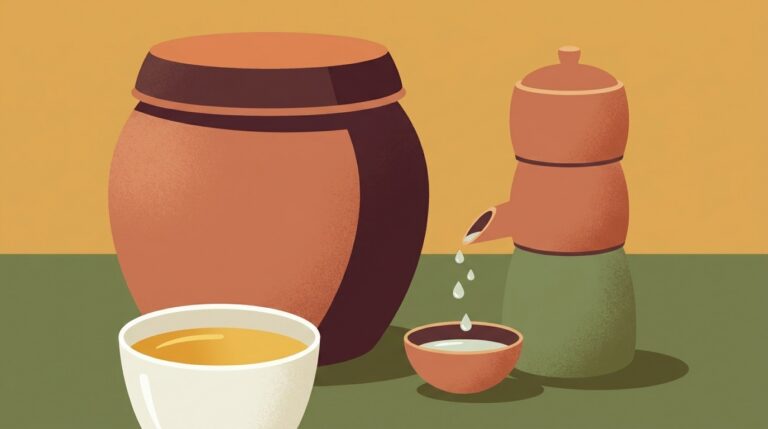
Phase 1: The Moment You Want to Sound Like a True Connoisseur
Hello! This is the Daily Hangul Editor. Imagine sitting in a cozy wooden Korean jujeom (traditional pub) straight out of a K-drama. Around you, friends clink ceramic cups filled with glowing amber yakju and crisp artisanal soju instead of the usual green bottles. You want to join the conversation about how makgeolli settles into clear cheongju or how a sojutgori distills jeungnyusik soju drop by drop—but you freeze, unsure of the right words. Based on real feedback from our Level 4 learners, tasting terms are the hardest hurdle at Korean tables. Today, we will bridge that gap so you can order, savor, and chat like a true local!
Phase 2: Deep Dive into 3 Essential Expressions
1. 맑게 가라앉다 (malge garaanda)
- Pronunciation: mal-ge ga-ra-an-da (Think “mahl-geh gah-rah-ahn-dah,” keeping the ‘g’ in ge soft rather than a sharp ‘k’.)
- Meaning: Literal: To sink/settle clearly / Real Nuance: When fermented rice sediment sinks naturally to the bottom, leaving pure golden yakju at the top—also used metaphorically when a noisy mind or murky situation becomes calm and crystal clear.
- K-Culture Moment: In culinary documentaries and historical K-dramas like Mr. Queen, master brewers lift the lid of an earthenware onggi jar and explain how patience lets the makgeolli settle clearly so the finest cheongju can be ladled from the top.
- Editor’s Insight: Unlike simple kkaekkeutada (to be clean), 맑게 가라앉다 (malge garaanda) celebrates gravity and time working in harmony—the very heart of Korean fermentation (balhyo).
- Situation Spectrum: Casual ✅ / Semi-formal ✅ / Formal ⚠️ (Use 맑게 가라앉습니다 (malge garaanseumnida) in formal presentations.)
- 🤔 Think About It: In English, we often use active verbs like “filter” or “clarify.” Why do you think Korean frames this as 가라앉다 (garaanda)—letting it settle on its own? How does that reflect Korean patience toward fermented foods?
2. 한 방울씩 받아 내다 (han bangulssik bada naeda)
- Pronunciation: han bang-ul-ssik ba-da nae-da (The ssik sounds like a crisp “sheek,” and ba-da flows smoothly like “bah-dah.”)
- Meaning: Literal: To catch and draw out drop by drop / Real Nuance: Highlights painstaking artisanal effort, slow craftsmanship, and preciousness—nothing is rushed or mass-produced.
- K-Culture Moment: On Korean craft brewery tours or travel shows, you will see steam rising inside a traditional sojutgori (still) while cool water condenses the vapor, dripping precious traditional distilled soju into a bowl one drop at a time.
- Editor’s Insight: Adding the auxiliary verb ~아/어 내다 (~a/eo naeda) to 받다 (batda – to receive) implies achieving something through dedication and persistence, elevating a simple action into a craft.
- Situation Spectrum: Casual ✅ / Semi-formal ✅ / Formal ✅ (Conjugate to 받아 내요 (bada naeyo) or 받아 냅니다 (bada naemnida).)
- 🤔 Think About It: Hearing that a spirit was collected “drop by drop” changes how we taste it. How does your culture describe slow-crafted drinks versus factory-made ones?
3. 목 넘김이 깔끔하다 (mok neomgimi kkalkkeumhada)
- Pronunciation: mong-neom-gi-mi kkal-kkeum-ha-da (Notice the nasal assimilation! Mok + neom shifts to “mong-neom,” while kkalkkeum has a tight, snappy “kahl-keum” punch.)
- Meaning: Literal: The throat-passing is neat / Real Nuance: “It goes down smoothly with a clean finish”—the gold-standard compliment for refined yakju and well-crafted distilled soju.
- K-Culture Moment: In gourmet shows like Sikgaek Heo Young-man’s Baekban Trip, hosts take a slow sip of Andong Soju or chilled yakju, pause, and immediately utter “목 넘김이 깔끔하네요!” (Mok neomgimi kkalkkeumhaneyo!)
- Editor’s Insight: 깔끔하다 (kkalkkeumhada) implies zero harsh burn or chemical aftertaste (뒷맛 – dwinmat). Mastering that mok -> mong nasal shift will instantly make your Korean sound effortless!
- Situation Spectrum: Casual ✅ / Semi-formal ✅ / Formal ✅ (Use 깔끔해요 (kkalkkeumhaeyo) or 깔끔합니다 (kkalkkeumhamnida).)
- 🤔 Think About It: English leans on visual or tactile words like “crisp” or “smooth.” Why do you think Korean food vocabulary zeroes in on 목 넘김 (mok neomgim)—the physical journey down the throat?
Phase 3: Textbook Korean vs. Real Korean
Situation 1: Asking about how a traditional liquor was made
- 📖 Textbook Korean: 이 술은 어떻게 만든 술인가요? (I sureun eotteoke mandeun suringayo?) — How is this alcohol made?
- 🗣️ Real Korean: 이거 막걸리 윗물만 떠낸 약주예요, 아니면 소줏고리로 내린 증류주예요? (Igeo makgeolli winmulman tteonaen yakjuyeyo, animyeon sojutgoriro naerin jeungnyujuyeyo?) — Is this yakju ladled from the clear top of makgeolli, or a distilled liquor made with a sojutgori?
- 💡 Why the difference? At specialty jeontongju (traditional liquor) bars, showing you know 윗물 (winmul – clear top layer) and 소줏고리 (sojutgori) immediately signals genuine curiosity and prompts bartenders to share hidden bottles!
Situation 2: Praising high-proof traditional distilled soju
- 📖 Textbook Korean: 도수가 높지만 맛이 좋습니다. (Dosuga nopjiman masi joseumnida.) — The alcohol percentage is high, but it tastes good.
- 🗣️ Real Korean: 도수는 꽤 센데 목 넘김이 부드럽고 곡물 향이 확 올라오네요. (Dosuneun kkwae sende mok neomgimi budeureopgo gongmul hyangi hwak ollaoneyo.) — The ABV is pretty strong, yet it goes down smoothly and the grain aroma really blooms!
- 💡 Why the difference? Native speakers pair natural contrast endings (~는데) with vivid sensory words like 확 (hwak – bursting vividly) and 곡물 향 (gongmul hyang – grain aroma) rather than a stiff “tastes good.”
Phase 4: K-Culture Deep Dive & Non-Verbal Manners
4-1. Nunchi (눈치) & Gestures at the Table
When drinking refined yakju or aromatic distilled soju with elders, hosts, or colleagues, etiquette elevates the experience:
* Two Hands Always: Receive and pour with both hands (or place your left hand gently under your right forearm).
* Respectful Head Turn: When drinking in front of someone older or senior, turn your head slightly to the side while taking a sip.
* Savor, Don’t Slam: Unlike cheap green-bottle soju, artisanal yakju and jeungnyusik soju are meant to be swirled gently so you can appreciate the 누룩 (nuruk) and grain aromas before sipping.
4-2. Cultural Code: Korean Fermentation Philosophy (K-Food)
Korean fermentation rests on zero waste and patient transformation—the same wisdom behind gimjang (winter kimchi-making) and jang (aging soy sauce and soybean paste in onggi). A single grain mash (술빚기 – sulbitgi) gives birth to three distinct drinks: nourishing cloudy makgeolli, refined golden cheongju/yakju ladled from the top, and potent, fragrant jeungnyusik soju distilled drop by drop through a sojutgori. Pairing follows balance too: delicate yakju enhances savory pancakes (전 – jeon) or braised fish, while high-proof distilled soju cuts cleanly through rich bossam (boiled pork belly) and aged kimchi (묵은지 – mukeunji).
Phase 5: Interactive Roleplay Scenario
Setting: A cozy, lantern-lit jeontongju bistro in Ikseon-dong, Seoul, lined with clay onggi jars.
Characters: Min-jun (민준), a warm and passionate traditional liquor sommelier, and You (나), a curious Level 4 learner.
- Min-jun: 🎭 Polishing a white porcelain cup with a warm smile 어서 오세요! 오늘 어떤 전통주 찾으세요? (Eoseo oseyo! Oneul eotteon jeontongju chajeuseyo?) — “Welcome! What kind of traditional liquor are you looking for today?”
- You: 🎭 Scanning the handwritten menu curiously 막걸리 말고 맑고 깔끔한 술을 마셔 보고 싶은데요. (Makgeolli malgo malggo kkalkkeumhan sureul masyeo bogo sipeundeyo.) — “Instead of makgeolli, I would like to try a clear and clean liquor.”
- Min-jun: 🎭 Pointing to an amber bottle 그럼 막걸리 위쪽의 맑은 술만 떠낸 약주는 어때요? (Geureom makgeolli wijjogui malgeun sulman tteonaen yakjuneun eottaeyo?) — “Then how about yakju, made by ladling only the clear liquor from the top of makgeolli?”
- You: 🎭 Nodding thoughtfully 아, 발효 후에 맑게 가라앉은 술이요? 향이 은은할 것 같아요. (A, balhyo hue malge garaanjeun suriyo? Hyangi euneunhal geot gatayo.) — “Ah, the liquor that settled clearly after fermentation? I imagine the aroma is gentle and subtle.”
- Min-jun: 🎭 Leaning in, genuinely impressed 오, 잘 아시네요! 만약 도수가 좀 더 세고 진한 곡물 향을 원하시면 증류식 소주도 있어요. (O, jal asineyo! Manyak dosuga jom deo sego jinhan gongmul hyangeul wonhasimyeon jeungnyusik sojudo isseoyo.) — “Oh, you really know your stuff! If you want a higher ABV and richer grain aroma, we also have distilled soju.”
- You: 🎭 Eyes lighting up 그게 바로 소줏고리에 넣고 한 방울씩 받아 낸 전통 소주 맞죠? (Geuge baro sojutgorie neoko han bangulssik bada naen jeontong soju matjyo?) — “That is the traditional soju placed in a sojutgori and distilled drop by drop, right?”
- Min-jun: 🎭 Pouring two tiny tasting samples with care 맞아요! 은은한 약주 한 잔, 그리고 향기로운 증류식 소주 한 잔 먼저 맛보실래요? (Majayo! Euneunhan yakju han jan, geurigo hyanggiroun jeungnyusik soju han jan meonjeo matbosillaeyo?) — “Exactly! Would you like to sample a glass of gentle yakju and a glass of aromatic distilled soju first?”
- You: 🎭 Accepting the cups with both hands 감사합니다! 안주로는 뭐랑 페어링하면 좋을까요? (Gamsahamnida! Anjuroneun mworang pe-eoringhamyeon joeulkkayo?) — “Thank you! What dish would pair best with them?”
🔀 Interactive Branching Point: After tasting the distilled soju, how do you reply to Min-jun?
- Option A: “너무 써서 사이다 좀 섞어 마실게요.” (Neomu sseoseo saida jom seokkeo masilgeyo.) — “It is too bitter, so I will mix it with Sprite.” → Bad: Masking craft jeungnyusik soju with sweet soda erases weeks of delicate grain fermentation! Try asking for ice instead.
- Option B: “목 넘김이 정말 깔끔하네요! 기름진 보쌈이나 숙성 김치랑 같이 주실래요?” (Mok neomgimi jeongmal kkalkkeumhaneyo! Gireumjin bossamina sukseong gimchirang gachi jusillaeyo?) — “It goes down so cleanly! Could you bring it with rich bossam or aged kimchi?” → Best: Perfection! You complimented the finish like a native and picked a textbook Korean fermentation pairing.
- Option C: “그냥 녹색 병 소주랑 똑같은 맛인데요?” (Geunyang noksaek byeong sojurang ttokgateun masindeyo?) — “Does this not taste the exact same as green-bottle soju?” → Risk: Green-bottle huiseoksik soju is diluted ethanol with sweeteners, whereas distilled soju is pure rice distillate. Saying this might break a craft brewer’s heart!
Phase 6: 10-Second Emotion Shadowing Drill
Practice reading aloud, pausing at / and matching the emotional cue:
[😌 Calmly & appreciatively]막걸리가 발효되면서 / 위쪽에 / 맑게 가라앉은 술이 / 바로 약주예요. (Makgeolliga balhyodoemyeonseo / wijjoge / malge garaanjeun suri / baro yakjuyeyo.) — As makgeolli ferments, the liquor that settles clearly on top is yakju.[🤩 Fascinated & impressed]소줏고리로 / 한 방울씩 받아 낸 거라 / 향이 정말 / 남다르네요! (Sojutgoriro / han bangulssik bada naen geora / hyangi jeongmal / namdareuneyo!) — Because it was distilled drop by drop with a sojutgori, the aroma is truly extraordinary![😋 Savoring the smooth finish]도수는 높은데 / 목 넘김이 / 의외로 아주 / 깔끔해요. (Dosuneun nopeunde / mok neomgimi / uiwero aju / kkalkkeumhaeyo.) — The alcohol content is high, yet it goes down surprisingly cleanly.
Phase 7: K-Culture Mini Dictionary
- 청주 / 약주 (Cheongju / Yakju) | Clear refined Korean rice wine | Historically brewed with medicinal herbs or served to royalty and ancestors (charye); today, ordering yakju at upscale business dinners (jeopdae) shows refined taste.
- 소줏고리 (Sojutgori) | Traditional Korean clay or copper distiller | Seen in heritage breweries and historical dramas; in modern craft-liquor marketing, mentioning sojutgori guarantees authenticity and slow craftsmanship.
- 증류식 소주 (Jeungnyusik Soju) | Traditional distilled soju | Very different from cheap diluted green-bottle huiseoksik soju. Enjoying jeungnyusik soju over ice is booming among Korean foodies and young professionals.
- 누룩 (Nuruk) | Traditional Korean fermentation starter cake | Crushed wheat or rice packed with natural wild yeasts and enzymes—essential for creating the deep, earthy aroma (누룩 향 – nuruk hyang) in makgeolli, yakju, and doenjang.
Phase 8: Traveler’s Survival Kit
Top 3 Survival Phrases
- 전통주 샘플러 있어요? (Jeontongju saempeulleo isseoyo?) — Do you have a traditional liquor sampler? (Pro Tip: Many bars in Euljiro and Jongno offer 3-glass flights comparing makgeolli, yakju, and distilled soju!)
- 얼음이랑 잔 좀 주시겠어요? (Eoreumirang jan jom jusigesseoyo?) — Could you bring some ice and a glass? (Pro Tip: High-proof distilled soju (25%–45% ABV) blooms wonderfully over a large ice cube.)
- 도수가 몇 도예요? (Dosuga myeot doyeyo?) — What is the alcohol percentage? (Pro Tip: 도 (do) means degree/ABV—super helpful so you do not accidentally order 45% Andong Soju expecting 16%!)
Editor’s Travel Note
To find authentic craft breweries and hidden jujeom across Seoul, check out Naver Map for Finding Seoul Traditional Liquor Bars and browse official heritage tasting experiences on the VisitKorea Artisanal Brewery & Food Guide. Remember: Korea enforces strict zero-tolerance drunk-driving laws, so always hop on the subway or call a designated driver (대리 운전 – daeri unjeon) via Kakao T. International cards and Apple/Samsung Pay work at most modern bistros, and tipping is never expected!
Phase 9: One Step Deeper — The Philosophy of Patience
In Korean culture, true flavor is never rushed—whether it is gimjang kimchi resting underground, jang maturing for years in sunlit onggi jars, or yakju settling slowly above makgeolli. Notice how Koreans affectionately call clear rice wine 약주 (yakju – medicinal liquor) and pour for one another rather than filling their own glass (자작 – jajak). Just as a sojutgori gathers pure spirit drop by drop through the balance of rising heat and cooling water, Korean dining culture reminds us that the richest tastes—and deepest human bonds (정 – jeong)—are distilled through patience and shared tables.
💬 Your Turn: What fermented food or craft beverage from your home culture requires patience? Share it in the comments and try describing its taste in Korean!
Phase 10: FAQ & Common Mistakes
Q: Is Korean cheongju the same thing as Japanese sake?
A: While both are clear rice wines, traditional Korean cheongju (often legally labeled yakju) relies on wild-fermented grain cakes called 누룩 (nuruk) rather than Japanese koji alone, giving Korean yakju a richer, earthier, and subtly tangy depth.
Q: Why does traditional distilled soju cost more than green-bottle soju?
A: Green-bottle 희석식 소주 (huiseoksik soju) is mass-produced by diluting industrial ethanol with water and sweeteners. Traditional 증류식 소주 (jeungnyusik soju) requires fermenting makgeolli/yakju first and slowly distilling it drop by drop in a sojutgori, demanding far more rice and weeks of care.
Q: What is the difference between yakju and cheongju on Korean labels?
A: Under Korean Liquor Tax Law, 청주 (cheongju) uses less than 1% nuruk (often brewed with purified starter), whereas clear rice wines crafted with traditional nuruk are classified and sold as 약주 (yakju).
🚨 Common Mistakes Warning Board
- Mistake: Saying “소주 한 병 주세요” (Soju han byeong juseyo) and expecting craft distilled soju. → Correct Action: Ask for “증류식 소주 추천해 주세요” (Jeungnyusik soju chucheonhae juseyo – Please recommend a distilled soju) so you do not get a standard green bottle.
- Mistake: Shaking a bottle of yakju before pouring! → Correct Action: Gently swirl makgeolli to mix its nutritious sediment, but never shake yakju—time worked hard to settle it clear!
- Mistake: Pouring your own drink (자작 – jajak) in front of Korean elders or colleagues. → Correct Action: Keep an eye on others’ glasses and pour for them first; someone will happily return the favor.
Phase 11: Action Missions & K-Culture Challenge
- 🥉 Bronze (Solo Practice): Read the 3 lines in Phase 6 aloud three times, nailing the nasal sound in 목 넘김이 깔끔해요 (mong-neom-gi-mi kkal-kkeum-haeyo).
- 🥈 Silver (SNS Share): Snap a picture of your favorite meal and drink pairing and post it with the Korean caption:
오늘의 표현: 목 넘김이 깔끔하네요! (Mok neomgimi kkalkkeumhaneyo!) - 🥇 Gold (Real-Life Use): Next time you visit a Korean restaurant or bottle shop, ask the staff for a yakju or jeungnyusik soju recommendation using today’s phrases!
- 🎮 K-Culture Mission: Watch an episode of Paik’s Spirit on Netflix or a historical K-drama banquet scene and spot when characters ladle yakju or mention 증류주 (jeungnyuju)!
Phase 12: Interactive Quiz Challenge
1. Situational Judgment: You take a sip of 25% ABV jeungnyusik soju at a Korean craft bar. It has zero harsh chemical burn and tastes remarkably clean. What is the most natural compliment?
* A) 소줏고리가 정말 무거워요. (Sojutgoriga jeongmal mugeowoyo.)
* B) 목 넘김이 아주 깔끔하네요! (Mok neomgimi aju kkalkkeumhaneyo!)
* C) 막걸리를 흔들어 주세요. (Makgeollireul heundeureo juseyo.)
2. Fill in the Blank: 막걸리를 소줏고리에 넣고 한 ____씩 받아 내면 향기로운 증류식 소주가 됩니다. (Makgeollireul sojutgorie neoko han ____ssik bada naemyeon hyanggiroun jeungnyusik sojuga doemnida.) — When you put makgeolli into a sojutgori and distill it ____ by ____, it becomes aromatic distilled soju.
3. True or False (Culture Quiz): Just like makgeolli, you should always shake a bottle of yakju vigorously before opening it so the sediment mixes evenly.
Click to reveal answers and explanations
- Answer: B! 목 넘김이 아주 깔끔하네요! naturally praises a clean, smooth finish. (Option A randomly says “The distiller is heavy,” and Option C asks to shake makgeolli!)
- Answer: 방울 (bangul – drop)! 한 방울씩 받아 내다 (han bangulssik bada naeda) means “to catch/distill drop by drop.”
- Answer: False! You gently mix makgeolli, whereas yakju is the clear golden layer that settled (맑게 가라앉다) at the top—shaking it ruins its prized clarity!
🎬 Watch Our Daily Videos! (Daily Hangul Official Instagram)
Review the expressions you learned in this article with our fun daily short videos! Check out native pronunciation and real-life nuances in action.
- Instagram @dailyhangul_en







