

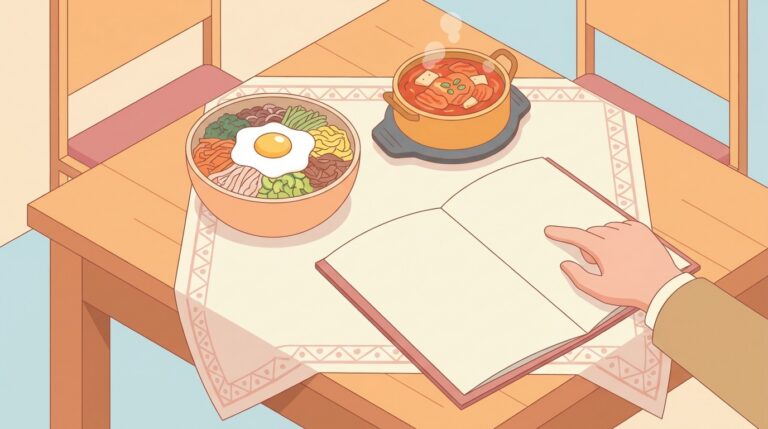
Phase 1: Why Korean Menus Feel Scary (And How We Fix It)
안녕하세요! 매일한글 에디터입니다. (Annyeonghaseyo! Maeil Hangeul editeo-imnida. / Hello! I am the Daily Hangul Editor.) Picture this: you just landed in Seoul, inspired by your favorite K-Drama food scenes. You step into a cozy local diner smelling of savory stew, only to freeze when you see a wooden menu on the wall with zero pictures. When the busy server walks over, your mind goes blank and you awkwardly point at a random table. Sound familiar? You are definitely not alone. Hundreds of our A1 Daily Hangul learners told us that ordering their first meal was their biggest travel panic. Today, we are fixing that forever. By learning just one magic pattern to order bibimbap and kimchi stew, you will eat like a confident local!
Phase 2: Top 3 Must-Know Ordering Expressions
1. 비빔밥 하나랑 김치찌개 하나 주세요 (Bibimbap hanarang kimchi-jjigae hana juseyo)
- Pronunciation: Bee-bim-bap ha-na-rang kim-chi-jji-gae ha-na joo-seh-yo. (Think of hana like “Hannah” without the heavy H, rang like “rung” on a ladder, and juseyo like “juice-say-yo” spoken smoothly!)
- Meaning: Literally “Bibimbap one-with and kimchi stew one please-give.” In real life, it is the warmest, most natural way to say, “One bibimbap and one kimchi stew, please.”
- K-Culture Moment: Remember those late-night diner scenes in Reply 1988 or Hospital Playlist, where exhausted doctors rush into a restaurant and rattle off their comfort food order in one breath? That effortless rhythm comes from linking dishes with -랑 (-rang / and)!
- Editor’s Insight: Beginners often try to use 그리고 (geurigo / and) between dishes, which sounds like reading a grocery receipt to a robot! Adding -랑 (-rang) right after 하나 (hana / one) makes you sound instantly friendly and natural.
- Situation Spectrum:
- Casual (Friends/Family): ⚠️ (Drop the “yo” at the end with close friends, or keep it polite with staff)
- Semi-formal (Local diners, cafes, street stalls): ✅ (Absolute gold standard!)
- Formal (High-end Michelin dining): ⚠️ (Still polite, though 한 그릇 (han geureut / one bowl) sounds slightly fancier)
- 🤔 Think About It: Notice how in English we put the number before the food (“one bibimbap”), while in Korean the food always comes first (“bibimbap one”)? Why do you think Korean puts the main topic first before counting it?
2. 저기요, 주문할게요! (Jeogiyo, jumunhalgeyo!)
- Pronunciation: Juh-gi-yo, joo-moon-hal-geh-yo! (Jeo sounds like the “u” in “uh-oh,” and hal-ge-yo flows quickly like “hal-gay-yo.”)
- Meaning: Literally “Over there, I will order.” In real life, it simply means, “Excuse me, I am ready to order!”
- K-Culture Moment: You will hear this in almost every K-Drama cafe or pojangmacha (street tent bar) scene. Whenever the leads finish whispering their secrets and actually decide what to eat, one of them raises a hand slightly and calls out 저기요! (Jeogiyo!).
- Editor’s Insight: Unlike Western restaurants where waiters check on your table every five minutes, Korean servers respect your privacy and wait until you call them. Calling out 저기요 (Jeogiyo) is never rude—it is actually helpful!
- Situation Spectrum:
- Casual (Street food stall): ✅
- Semi-formal (Regular restaurants): ✅
- Formal (Upscale hotel restaurants): ⚠️ (Better to make quiet eye contact and gently raise a hand)
- 🤔 Think About It: In your home country, do you wait for the server to come to you, or do you call them over? How does Korea’s “call when you need us” system change the dining vibe?
3. 메뉴판 좀 주세요 (Menyupan jom juseyo)
- Pronunciation: Meh-nyu-pan jom joo-seh-yo. (Notice how 메뉴 (menyu) sounds just like the English word “menu”! Add pan like a frying pan, and jom like “johm.”)
- Meaning: Literally “Menu board a-little please-give.” Practically, it means, “Could I see the menu, please?”
- K-Culture Moment: In shows like Extraordinary Attorney Woo or Business Proposal, characters often sit down at a rustic restaurant where the menu is only painted on the far wall. Asking for a 메뉴판 (menyupan) lets you read things up close—or sneak a quick photo with your translation app!
- Editor’s Insight: That tiny word 좀 (jom) literally means “a little,” but here it acts as a magic politeness cushion, softening your request into “Could you please…”
- Situation Spectrum:
- Casual (Casual snack bar): ✅
- Semi-formal (Any diner or cafe): ✅
- Formal (Fine dining): ✅ (Super polite and safe everywhere!)
- 🤔 Think About It: Why do you think Korean adds “a little” (좀 / jom) when asking someone for a favor? Does your native language have a small word that softens commands too?
Phase 3: Textbook Korean vs. Real Korean
Situation 1: Calling the Server
- 📖 Textbook Korean: 실례합니다, 주문을 하고 싶습니다. (Sillyehamnida, jumuneul hago sipseumnida. / Excuse me, I would like to place an order.)
- 🗣️ Real Korean: 저기요! 여기 주문할게요! (Jeogiyo! Yeogi jumunhalgeyo! / Excuse me! Ready to order over here!)
- 💡 Why is it different? Textbook Korean sounds like you are reading a formal speech in a courtroom. Real diners are lively and fast-paced, so Koreans keep it punchy and friendly with 저기요 (Jeogiyo) or 여기요 (Yeogiyo / Over here).
Situation 2: Listing Your Food Order
- 📖 Textbook Korean: 저는 비빔밥 한 개와 김치찌개 한 개를 원합니다. (Jeoneun bibimbap han gaewa kimchi-jjigae han gaereul wonhamnida. / I want one bibimbap and one kimchi stew.)
- 🗣️ Real Korean: 비빔밥 하나랑 김치찌개 하나 주세요! (Bibimbap hanarang kimchi-jjigae hana juseyo! / One bibimbap and one kimchi stew, please!)
- 💡 Why is it different? Using 원합니다 (wonhamnida / I want) sounds weirdly stiff in Korean restaurants. Dropping “I” and ending with 주세요 (juseyo / please give me) while linking items with -랑 (-rang) is how locals order every single day.
Phase 4: K-Culture Deep Dive & Non-Verbal Manners
4-1. Nunchi (눈치) & Gestures at the Table
In Korea, good 눈치 (nunchi / social awareness) makes dining smooth and joyful. When you want to order, never snap your fingers or whistle—that is considered very rude! Instead, make eye contact with the staff, lift your hand gently to shoulder height with your palm facing slightly down or inward, and say 저기요 (Jeogiyo). Also, look closely at the corner of your table! Many Korean restaurants have a small round plastic 벨 (bel / call bell). Press it once, wait calmly, and your server will come right over.
4-2. Cultural Code Analysis: The Joy of Sharing K-Food
When you order 비빔밥 (bibimbap) and 김치찌개 (kimchi-jjigae) with a friend in Korea, do not be surprised if the server places the bubbling stew right in the middle of the table! Korean food culture revolves around sharing. Along with your main dishes, you will automatically get free side dishes called 반찬 (banchan)—like kimchi, seasoned spinach, or fish cakes. You do not have to order them, and if you finish them, you can politely ask for a free refill!
Phase 5: Real-Life Roleplay Scenario
Setting: It is 7:00 PM on a rainy evening in Hongdae. You and your friend duck into a warm, bustling restaurant called “Grandma’s Kitchen.” Steam rises from stone pots, and the friendly owner—whom locals affectionately call 이모님 (Imonim / Auntie)—walks by carrying a tray.
Dialogue:
* You: 🎭 (Raising your hand slightly with a warm smile) 저기요! 메뉴판 좀 주세요. (Jeogiyo! Menyupan jom juseyo. / Excuse me! Menu, please.)
* Imonim: 🎭 (Handing over a laminated menu swiftly) 네, 여기 있어요! (Ne, yeogi isseoyo! / Yes, here you go!)
* You: 🎭 (Scanning the menu and spotting your favorites) 감사합니다! 저기요, 주문할게요. (Gamsahamnida! Jeogiyo, jumunhalgeyo. / Thank you! Excuse me, I’d like to order.)
* Imonim: 🎭 (Pulling out a small order pad and pen) 네, 뭐 드릴까요? (Ne, mwo deurilkkayo? / Yes, what can I get for you?)
* You: 🎭 (Pointing clearly at the two items on the menu) 비빔밥 하나랑 김치찌개 하나 주세요! (Bibimbap hanarang kimchi-jjigae hana juseyo! / One bibimbap and one kimchi stew, please!)
* Imonim: 🎭 (Nodding cheerfully) 비빔밥 하나, 김치찌개 하나요? 맵게 해드릴까요? (Bibimbap hana, kimchi-jjigae hanayo? Maepge haedeurilkkayo? / One bibimbap, one kimchi stew? Should I make it spicy?)
* You: 🎭 (Smiling and waving your hand gently) 안 맵게 해주세요! 감사합니다. (An maepge haejuseyo! Gamsahamnida. / Not spicy, please! Thank you.)
* Imonim: 🎭 (Giving you a thumbs-up) 알겠어요! 조금만 기다리세요~ (Algesseoyo! Jogeumman gidariseyo~ / Got it! Just wait a little bit~)
🔀 Interactive Branching Point: What Would You Do?
Imagine Imonim puts down your sizzling bibimbap and bubbling kimchi stew, plus five delicious side dishes. You realize you do not have chopsticks or spoons on the table yet! What do you say?
* A) Tap the side of your table—Wait! Pull open the little wooden drawer built under the edge of the table! Or politely ask: 숟가락이랑 젓가락 어디 있어요? (Sutgaragirang jeotgarak eodi isseoyo? / Where are the spoons and chopsticks?)
* B) Snap your fingers at Imonim and shout: 야! 젓가락 줘! (Ya! Jeotgarak jwo! / Hey! Give me chopsticks!)
* C) Just sit quietly for 20 minutes staring at your cooling food, too shy to say anything.
Editor’s Feedback:
* Choice A (Best!): Spot-on! Fun local secret: 90% of Korean diners hide spoons, chopsticks, and napkins inside a secret drawer right under your tabletop! Checking there first—or asking politely—gives you instant local pro status.
* Choice B (Bad!): Danger zone! 야 (Ya) and 줘 (jwo) are super rude to strangers and elders. Never drop polite 주세요 (juseyo) at a restaurant!
* Choice C (Risk!): Oh no, your bibimbap will get cold! Korean servers are super busy and want you to speak up kindly so you can enjoy your meal hot.
Phase 6: 10-Second Emotional Shadowing Drill
Read these aloud! Pause briefly at each / and really act out the emotion in brackets!
[🙋♂️ Polite and clear]저기요! / 메뉴판 좀 / 주세요! (Jeogiyo! / Menyupan jom / juseyo! / Excuse me! Menu, please!)[😊 Happy and excited]비빔밥 하나랑 / 김치찌개 하나 / 주세요! (Bibimbap hanarang / kimchi-jjigae hana / juseyo! / One bibimbap and one kimchi stew, please!)[😋 Hungry and eager]여기 / 주문할게요! (Yeogi / jumunhalgeyo! / We’re ready to order over here!)[🥺 Gently asking]안 맵게 / 해주세요! (An maepge / haejuseyo! / Not spicy, please!)
Phase 7: K-Culture Mini Dictionary
- 반찬 (banchan) | Side dishes | Free small plates served with almost every Korean meal—yes, refills are usually free!
- 공깃밥 (gonggibap) | A bowl of steamed white rice | Often ordered extra with stews like kimchi-jjigae; just say 공깃밥 하나 추가요 (gonggibap hana chugayo / one extra rice, please)!
- 물 셀프 (mul selpeu) | Self-service water | You will see signs saying 물 셀프 (mul selpeu) on the wall—grab a cup from the water purifier yourself!
- 계산 (gyesan) | Paying the bill | Koreans usually walk up to the counter after eating and say 계산할게요 (gyesanhalgeyo / I’d like to pay).
Phase 8: Survival Kit for Travelers
Top 3 Survival Phrases
- 이거 하나 주세요 (Igeo hana juseyo) — “One of this, please.” Pro Tip: Your ultimate backup! Point at a picture or even a dish on a nearby table and say this.
- 물 좀 주세요 (Mul jom juseyo) — “Water, please.” Pro Tip: Great if your table does not have self-service water.
- 잘 먹었습니다! (Jal meogeotseumnida!) — “I ate well! (Thank you for the meal!)” Pro Tip: Say this as you leave; watch the owner’s face light up with the biggest smile!
Editor’s Travel Note
Before you step into any Korean restaurant, make sure your phone is ready! First, Download the Naver Map App for Korean Restaurant Menus, because Google Maps often misses hidden alley gems and user menu photos. Second, Use the Papago Translation App for Photo Menus—its camera feature translates handwritten Korean wall menus in two seconds flat! Finally, remember that tipping does not exist in Korea. Simply bring your paper bill (or remember your table number) to the front counter and pay by card or cash.
Phase 9: One Step Deeper
Have you ever wondered why Koreans call friendly female restaurant owners 이모님 (Imonim / Auntie) even when they are total strangers? In Korean culture, food is deeply tied to family warmth—in fact, the Korean word for family, 식구 (sikgu), literally means “mouths that eat together.” Calling a server “Auntie” or warmly saying 잘 먹었습니다 (Jal meogeotseumnida / I ate well) transforms a simple business transaction into a moment of genuine human care. When you speak even a tiny bit of Korean at the table, you are not just buying calories—you are stepping right into Korea’s warm dining circle.
💬 Your Turn: Which Korean dish are you dying to order first—colorful 비빔밥 (bibimbap) or bubbling 김치찌개 (kimchi-jjigae)? Drop your pick in the comments below!
Phase 10: FAQ & Common Mistakes
Q: Can I use 하나 (hana) for ALL foods when ordering?
A: Yes! At the A1 level, 하나 (hana / one) is your best friend. While locals sometimes use 한 그릇 (han geureut / one bowl) or 1인분 (il-inbun / one serving) for BBQ, using 하나 (hana) for bibimbap, stews, gimbap, and noodles is 100% natural and understood everywhere.
Q: What if I want TWO bibimbaps instead of one?
A: Easy! Swap 하나 (hana / one) for 둘 (dul / two)—or when placed before a counter or casually ordering, say 두 개 (du gae / two items)! For example: 비빔밥 두 개랑 김치찌개 하나 주세요 (Bibimbap du gaerang kimchi-jjigae hana juseyo / Two bibimbaps and one kimchi stew, please).
Q: Do I pay at the table like in the US or Europe?
A: Usually, no! Unless you see a tablet on your table that lets you pay right there, simply grab your bill slip (if there is one) and walk up to the 카운터 (kaunteo / front counter) by the exit when you finish eating.
🚨 Common Mistakes Warning Board
- Mistake: Saying “일 비빔밥 (il bibimbap)” using Sino-Korean numbers. Correct Action: Use native Korean 하나 (hana) after the food name: 비빔밥 하나 (bibimbap hana).
- Mistake: Saying “주다 (juda)” from a dictionary. Correct Action: Always conjugate it politely to 주세요 (juseyo / please give me).
- Mistake: Asking for the check at your table and waiting forever. Correct Action: Stand up, walk to the front counter, and say 계산할게요 (gyesanhalgeyo)!
Phase 11: Action Mission & Engagement
- 🥉 Bronze Mission (Solo Practice): Stand in front of your mirror right now and say 비빔밥 하나랑 김치찌개 하나 주세요 (Bibimbap hanarang kimchi-jjigae hana juseyo) three times while smiling!
- 🥈 Silver Mission (Share Online): Record a quick voice note or post your favorite Korean food photo on social media and caption it with today’s Hangul phrase—tag #DailyHangul so we can cheer you on!
- 🥇 Gold Mission (Real-Life Boss Level): Visit a local Korean restaurant in your city (or your next trip to Seoul!) and place your entire order in Korean using 저기요 (Jeogiyo) and 주세요 (juseyo).
- 🎮 K-Culture Mission: Watch an episode of Jinny’s Kitchen, Culinary Class Wars, or your favorite K-Drama eating scene tonight. Count how many times you hear 저기요 (Jeogiyo) or 주세요 (juseyo)!
Phase 12: Interactive Quiz Challenge
Test your new Korean food superpowers! Try answering before opening the spoiler boxes.
Quiz 1 (Situational Judgment): You and your friend finally pick your dishes at a busy Seoul diner. The server is walking past your table. What is the best way to get their attention and order?
A) Snap your fingers and say “비빔밥 원!”
B) Raise your hand slightly and say “저기요! 비빔밥 하나랑 김치찌개 하나 주세요!”
C) Say “실례합니다, 저는 비빔밥 한 개를 원합니다.”
Click to reveal Quiz 1 answer & explanation
Correct Answer: B! Raising your hand gently and saying 저기요! 비빔밥 하나랑 김치찌개 하나 주세요! (Jeogiyo! Bibimbap hanarang kimchi-jjigae hana juseyo!) is polite, clear, and 100% natural. (Option A is rude, and Option C sounds stiff like a textbook!)
Quiz 2 (Fill in the Blank): Complete the phrase to link two dishes naturally: “김치찌개 하나[ ___ ] 비빔밥 하나 주세요.” (One kimchi stew AND one bibimbap, please.)
Click to reveal Quiz 2 answer & explanation
Correct Answer: 랑 (-rang)! Because 하나 (hana) ends in a vowel, attach -랑 (-rang) directly to say 김치찌개 하나랑 비빔밥 하나 주세요 (Kimchi-jjigae hanarang bibimbap hana juseyo).
Quiz 3 (True or False Culture Quiz): True or False: In Korea, if you finish your free 반찬 (banchan / side dishes) like kimchi, you have to pay extra to get a refill.
Click to reveal Quiz 3 answer & explanation
Correct Answer: False! Side dishes (반찬 / banchan) are complimentary, and most restaurants happily give you free refills—just ask politely, 반찬 좀 더 주세요 (Banchan jom deo juseyo / A little more side dishes, please)!
🎬 Watch Our Daily Videos! (Daily Hangul Official Instagram)
Review the expressions you learned in this article with our fun daily short videos! Check out native pronunciation and real-life nuances in action.
- Instagram @dailyhangul_en







