

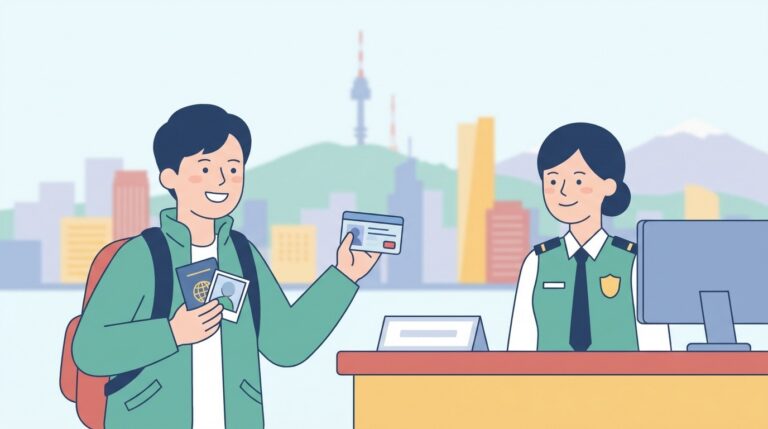
Phase 1: Empathy Opening
Annyeonghaseyo! Maeil Hangeul editeo-imnida. (안녕하세요! 매일한글 에디터입니다. — Hello! I’m your Daily Hangul editor.) Picture yourself cruising along Jeju Island’s emerald coast like a scene straight out of Welcome to Samdal-ri. You arrive at the Korean Driver’s License Examination Office, neatly clutching your paperwork, only to freeze when the clerk asks a rapid-fire question across the counter. That sudden DMV panic is real! Based on feedback from dozens of B1 learners who survived Korea’s license exchange, knowing how to present your documents clearly turns a stressful errand into a smooth 30-minute win. Let’s get you road-ready!
Phase 2: Deep Dive into 3 Essential Expressions
1. 출입국에 관한 사실증명서와 여권, 외국인등록증, 증명사진 3장을 준비했어요.
- Pronunciation: Chul-ip-gu-ge gwan-han sa-sil-jeung-myeong-seo-wa yeo-gwon, oe-gug-in-deung-nok-jeung, jeung-myeong-sa-jin se-jang-eul jun-bi-hae-sseo-yo. (Tip: Say se-jang like “seh-jahng,” not “sam-jang,” and let chul-ip blend smoothly like “chool-eep”!)
- Meaning: Literal: “I prepared a fact certificate regarding entry/exit, a passport, an alien registration card, and three ID photos.” | Natural Nuance: “Here is my complete document packet for the license exchange.”
- K-Culture Moment: Imagine an organized protagonist in an office K-drama like Misaeng sliding a spotless clear file across a desk, earning an instant nod of approval from a stern supervisor.
- Editor’s Insight: Notice the counter 장 (jang) used for flat items like photos and documents, which always pairs with the native Korean number 세 (se) instead of Sino-Korean 삼 (sam). Ending with -을/를 준비했어요 (-eul/reul junbihaesseoyo) makes you sound proactive, polite, and cooperative.
- Situation Spectrum: Casual 🚫 | Semi-formal ✅ | Formal ✅
- 🤔 Think About It: In English, “three” works for everything from apples to ID photos. In Korean, you change the number system and attach a shape-based counter like 장 (jang). How does categorizing objects by shape change the way you picture nouns when speaking Korean?
2. 외국 면허증을 한국 면허증으로 교환하고 싶어요.
- Pronunciation: Oe-guk myeon-heo-jeung-eul Han-guk myeon-heo-jeung-eu-ro gyo-hwan-ha-go si-peo-yo. (Tip: Myeon-heo flows gently like “myun-uh,” with a very soft “h” sound in the middle.)
- Meaning: Literal: “I want to exchange a foreign license into a Korean license.” | Natural Nuance: “I’d like to convert my overseas driver’s license to a Korean one.”
- K-Culture Moment: Think of a slice-of-life K-drama episode where a character finally conquers grown-up errands at a bustling municipal office (민원실 — minwonsil) and celebrates with an iced Americano afterward.
- Editor’s Insight: While 바꾸다 (bakkuda) means “to change or swap” in everyday chat, -(으)로 교환하다 (-(eu)ro gyohwanhada) is the crisp, official phrasing clerks expect at a government counter. You can also swap in 발급받고 싶어요 (balgeupbatgo sipeoyo) if you want to say “I’d like to get it issued.”
- Situation Spectrum: Casual ⚠️ | Semi-formal ✅ | Formal ✅
- 🤔 Think About It: Korean uses the particle -(으)로 to show one official item transforming into another. How does your native language express this kind of official conversion?
3. 적성검사는 어디에서 받나요?
- Pronunciation: Jeok-seong-geom-sa-neun eo-di-e-seo ban-na-yo? (Tip: Because ㄷ meets ㄴ in 받나요, it sounds like “bahn-nah-yo,” just like the smooth “n” flow in “banana”!)
- Meaning: Literal: “Where do I receive the aptitude test?” | Natural Nuance: “Where should I go for the vision and physical check?”
- K-Culture Moment: Picture a classic Running Man mission where cast members speed-walk down a hallway holding clipboards, frantically searching for the right room number.
- Editor’s Insight: 적성검사 (jeokseonggeomsa) sounds as intense as a college entrance exam, right? Don’t worry! For a license exchange, it is usually a quick vision test and basic physical check. Using -나요? (-nayo?) softens your question so it feels friendly rather than demanding.
- Situation Spectrum: Casual 🚫 | Semi-formal ✅ | Formal ✅
- 🤔 Think About It: In English, you “take” a test, whereas in Korean you “receive” (받다 — batda) a checkup or test. What does that subtle verb choice tell us about how Korean culture views official evaluations?
Phase 3: Textbook Korean vs. Real Korean
Situation 1: Handing over your prepared folder at the counter
- 📖 Textbook Korean: 여기 제가 준비한 모든 서류가 있습니다. (Yeogi jega junbihan modeun seoryuga itseumnida. — Here are all the documents I have prepared.)
- 🗣️ Real Korean: 서류 여기 다 챙겨 왔어요. (Seoryu yeogi da chaenggyeo wasseoyo. — I brought all the paperwork right here.)
- 💡 Why Is It Different?: 챙겨 오다 (chaenggyeo oda) carries a warm, diligent nuance—it means you carefully gathered everything so nothing would be left behind. Koreans use 챙기다 (chaenggida) all the time to show attentiveness.
Situation 2: Checking if you forgot a paper
- 📖 Textbook Korean: 부족한 서류가 있습니까? (Bujokhan seoryuga itseumnikka? — Are there any insufficient documents?)
- 🗣️ Real Korean: 혹시 빠진 거 있나요? (Hoksi ppajin geo innayo? — Is there anything missing by any chance?)
- 💡 Why Is It Different?: 부족하다 (bujokhada) sounds overly stiff and almost philosophical (“lacking in virtue”). Pairing 혹시 (hoksi — by any chance) with 빠진 거 (ppajin geo — something left out) sounds natural, polite, and effortlessly B1-fluent.
Phase 4: K-Culture Deep Dive & Non-Verbal Manners
4-1. Nunchi (눈치) & Gestures at the Counter
When the ticket screen chimes and calls your number, approach the counter with a slight bow of the head and hand over your 외국인등록증 (oegugindeungnokjeung) and 여권 (yeogwon) with both hands—or lightly support your right wrist with your left hand. Never slide papers across the counter like poker chips! Keep your 증명사진 3장 (jeungmyeongsajin se-jang) loose in a small sleeve rather than stapling them, because Korean clerks scan or glue them onto specific forms themselves. Trust me, I once paper-clipped mine too tightly and bent the corner right in front of the clerk!
4-2. Culture Code: Korea’s “Ppalli-Ppalli” (빨리빨리) Efficiency
If you have ever marveled at how fast characters in Korean dramas get medical results or legal approvals, welcome to Korea’s real-life 빨리빨리 (ppalli-ppalli — hurry-hurry) administrative magic! At a Korean Road Traffic Authority (도로교통공단) center, if your documents—especially the 출입국에 관한 사실증명서 (certificate of entry/exit records)—are complete, the whole process from eye exam to holding your brand-new plastic license can take under 45 minutes. Showing up prepared isn’t just polite; it lets you ride that ultra-efficient wave!
Phase 5: Interactive Roleplay Scenario
Setting: The Gangnam Driver’s License Examination Office (강남운전면허시험장) on a crisp Tuesday morning. The digital board dings softly: 대기번호 104번 (Queue #104). You walk up to Counter 5, where Staff Member Min-ji (민지 주무관)—sharp, brisk, and kind behind her glasses—looks up from her dual monitors.
- Min-ji: 🎭 (Glances at her screen, then offers a quick welcoming nod) 어서 오세요. 어떤 업무 때문에 오셨어요? (Eoseo oseyo. Eotteon eommu ttaemune osyeosseoyo? — Welcome. What brings you in today?)
- You: 🎭 (Places your folder gently on the counter with both hands) 안녕하세요. 외국 면허증을 한국 면허증으로 교환하고 싶어요. (Annyeonghaseyo. Oeguk myeonheojeungeul Hanguk myeonheojeungeuro gyohwanhago sipeoyo. — Hello. I’d like to exchange my foreign driver’s license for a Korean one.)
- Min-ji: 🎭 (Clicks her pen ready to check off items) 네, 구비서류 다 챙겨 오셨어요? (Ne, gubiseoryu da chaenggyeo osyeosseoyo? — Yes, did you bring all the required documents?)
- You: 🎭 (Hands over each item neatly one by one) 네, 출입국에 관한 사실증명서와 여권, 외국인등록증, 증명사진 3장을 준비했어요. (Ne, chulipguge gwanhan sasiljeungmyeongseowa yeogwon, oegugindeungnokjeung, jeungmyeongsajin se-jangeul junbihaesseoyo. — Yes, I prepared a certificate of entry/exit records, passport, ARC, and three ID photos.)
- Min-ji: 🎭 (Quickly flips through the dates on your entry/exit certificate) 좋아요, 대사관 공증 서류도 문제없네요. 이제 지하 1층에서 적성검사를 받으셔야 해요. (Joayo, daesagwan gongjeung seoryudo munjeeomneyo. Ije jiha il-cheungeseo jeokseonggeomsareul badeusyeoya haeyo. — Great, your embassy notarization looks good too. Now you need to take the aptitude test on basement floor B1.)
- You: 🎭 (Points slightly toward the elevator sign with a polite smile) 적성검사는 어디에서 받나요? 혹시 오래 걸리나요? (Jeokseonggeomsaneun eodieseo batnayo? Hoksi orae geollinayo? — Where do I take the aptitude test? Does it take long by any chance?)
- Min-ji: 🎭 (Hands you a stamped application sheet) 엘리베이터 타고 내려가셔서 왼쪽이에요. 금방 끝나요! 아, 마지막으로 외국 면허증 원본도 같이 주시겠어요? (Ellibeiteo tago naeryeogasyeoseo oenjjogieyo. Geumbang kkeutnayo! A, majimageuro oeguk myeonheojeung wonbondo gachi jusigesseoyo? — Take the elevator down and it’s on the left. It’ll be quick! Oh, lastly, could you also hand over your original foreign license?)
- You: (Time for your response! Choose your next move below.)
🔀 Interactive Branching Point
- Option A: 네, 여기 있습니다. 나중에 출국할 때 다시 돌려받을 수 있나요? (Ne, yeogi itseumnida. Najunge chulgukhal ttae dasi dollyeobadeul su innayo? — Yes, here it is. Can I get it back later when I leave Korea?)
- Feedback (Best!): Spot-on! In Korea, many foreign licenses are temporarily held at the center until you depart Korea with a flight ticket. Asking politely with 돌려받을 수 있나요? shows great B1 mastery and smart planning!
- Option B: 싫어요! 이건 내 거라서 못 줘요. (Sireoyo! Igeon nae georaseo mot jwoyo. — No! This is mine so I can’t give it to you.)
- Feedback (Bad!): Whoa, too blunt! Using 싫어요 (I don’t want to) in an official office sounds childish and confrontational, and skipping honorifics (내 거) creates instant awkwardness.
- Option C: 어… 여권은 줬는데요? (Eo… yeogwoneun jwonneundeyo? — Uh… didn’t I already give you my passport?)
- Feedback (Risk!): Close, the grammar is polite, but you mixed up 여권 (passport) and 외국 면허증 원본 (original foreign license). Double-checking key nouns keeps the line moving smoothly!
Phase 6: 10-Second Emotion Shadowing Drill
Read these aloud at natural speed, pausing briefly at each / to lock in the rhythm and feeling:
- [😊 Bright & Organized]
출입국에 관한 사실증명서와 / 여권, / 외국인등록증, / 증명사진 3장을 준비했어요.
(Chul-ip-gu-ge gwan-han sa-sil-jeung-myeong-seo-wa / yeo-gwon, / oe-gug-in-deung-nok-jeung, / jeung-myeong-sa-jin se-jang-eul jun-bi-hae-sseo-yo.) - [🤔 Polite & Curious]
적성검사는 / 어디에서 / 받나요?
(Jeok-seong-geom-sa-neun / eo-di-e-seo / ban-na-yo?) - [🥳 Relieved & Ready]
서류 / 여기 다 / 챙겨 왔어요!
(Seo-ryu / yeo-gi da / chaeng-gyeo wa-sseo-yo!)
Phase 7: K-Culture Mini Dictionary
- 외국인등록증 (Oegugindeungnokjeung) | Alien Registration Card (ARC) | Your golden key to daily life in Korea! You need it not just at the license center, but also for Korean banking, phone plans, and food delivery apps.
- 출입국에 관한 사실증명서 (Chulipguge gwanhan sasiljeungmyeongseo) | Certificate of Entry & Exit | An official government record proving when you entered and left Korea—essential to verify your residency status when exchanging a foreign license.
- 적성검사 (Jeokseonggeomsa) | Aptitude / Physical & Vision Test | Despite the intimidating name, at the DMV it mainly refers to a quick eyesight check and physical confirmation before issuing your card.
- 구비서류 (Gubiseoryu) | Required Documents | A high-frequency B1-level administrative word you will see on every Korean clinic, bank, and government checklist.
Phase 8: Traveler’s Survival Kit
Top 3 Survival Phrases
- 번호표 어디서 뽑아요? (Beonhopyo eodiseo ppobayo? — Where do I pull a queue ticket?)
- Pro Tip: Look for the kiosk near the entrance right when you walk in, or you might wait 20 minutes without a number!
- 잠시만요, 서류 확인 좀 할게요. (Jamsimanyo, seoryu hwagin jom halgeyo. — Just a moment, let me check my papers.)
- Pro Tip: Great way to buy yourself 5 calm seconds if your documents shift around in your bag.
- 수수료는 카드로 결제할 수 있나요? (Susuryoneun kadeuro gyeoljehal su innayo? — Can I pay the processing fee by card?)
- Pro Tip: Yes! Both domestic Korean cards and major credit cards work for the 적성검사 and card issuance fees.
Editor’s Travel Note
Before heading out, prep digitally like a Seoul local! Use the Naver Map App Download Guide to check real-time bus and subway routes to your nearest testing center—Google Maps doesn’t give full walking or driving directions in Korea. You can also preview required documents by country on the KoROAD Safe Driving Portal or request your entry/exit certificate online via the Government24 Official Portal before printing it out. And if you need fresh 증명사진 (ID photos), Korean subway stations have instant photo booths (즉석사진기) with surprisingly flattering K-beauty lighting!
Phase 9: One Step Deeper
In Korea, administrative culture revolves around 신뢰 (silloe — trust) built through verified paperwork rather than verbal promises. Presenting a neat, complete set of documents—from your ARC to your entry/exit records—signals respect for both the rules and the clerk’s time. Because everyone follows the exact same checklist, the system rewards preparation with incredible speed and fairness. Once you learn the rhythm of 서류 문화 (document culture), Korean bureaucracy stops feeling like a maze and starts feeling like clockwork.
💬 Your Turn: Have you ever tackled an official errand in Korea—or had a funny mix-up with Korean paperwork? Drop your story or your favorite Korean survival phrase in the comments below!
Phase 10: FAQ & Common Mistakes
Q: Do I really need a Certificate of Entry and Exit Records (출입국에 관한 사실증명서) if I already have my passport?
A: Yes! Your passport stamps don’t always show electronic e-gate entries in Korea. The license office uses the 출입국에 관한 사실증명서 to verify your exact stay dates when your foreign license was issued and during your time in Korea.
Q: Can I bring digital photos on my phone instead of 3 printed ID photos (증명사진 3장)?
A: No, you must bring physical printed 증명사진 3장 (typically 3.5cm x 4.5cm, taken within the last 6 months). Luckily, almost every Korean driver’s license center has a quick photo studio or booth right on site or in the nearest subway station!
Q: Is the 적성검사 (aptitude test) a written driving exam?
A: Not if your country has a reciprocity agreement with Korea! In that case, 적성검사 simply means a quick vision and physical check at the center’s medical room, not a written or road test.
🚨 Common Mistakes TOP 3
- Saying “삼 장 (sam jang)” instead of “세 장 (se jang)”
- Correct Action: Always pair counters like 장 (jang) with native Korean numbers: 한 장 (1), 두 장 (2), 세 장 (3).
- Forgetting to check whether your country requires Embassy Notarization (대사관 공증) or an Apostille (아포스티유)
- Correct Action: Check the KoROAD list for your specific country before visiting, as missing authentication means a second trip.
- Using casual endings like “준비했어” at a government counter
- Correct Action: Stick to polite -아요/어요 endings like 준비했어요 (junbihaesseoyo) or 싶어요 (sipeoyo).
Phase 11: Action Mission & Engagement
- 🥉 Bronze Mission (Solo Practice): Stand in front of a mirror with your actual passport, ARC, and an imaginary stack of photos. Say the full Phase 2 sentence three times out loud in under 10 seconds!
- 🥈 Silver Mission (Community Share): Share one new word from Phase 7 (like 적성검사 or 구비서류) on your Instagram story or study journal and explain what it means in your own words.
- 🥇 Gold Mission (Real-World Use): Next time you visit a bank, clinic, or community center (주민센터) in Korea, use “서류 여기 다 챙겨 왔어요” or “혹시 빠진 거 있나요?” with the staff!
🎮 K-Culture Mission
Watch a driving or office scene in a Korean drama like Crash Course in Romance or Queen of Tears (or a Korean travel vlog on YouTube). Listen closely whenever characters mention 면허증 (myeonheojeung — license), 운전 (unjeon — driving), or 서류 (seoryu — documents), and write down one verb they pair with it!
Phase 12: Interactive Quiz Challenge
Quiz 1: Situation Judgment
You handed over your passport, ARC, entry/exit certificate, and 3 ID photos, and want to politely ask if anything is missing. Which sounds most natural to a Korean clerk?
A) 부족한 거 말해 봐. (Bujokhan geo malhae bwa.)
B) 혹시 빠진 서류 있나요? (Hoksi ppajin seoryu innayo?)
C) 서류가 없습니까? (Seoryuga itseumnikka?)
Click to reveal Answer & Explanation
Answer: B) 혹시 빠진 서류 있나요?
Option A is far too casual and demanding. Option C literally asks “Do you have no documents?” Option B politely and naturally asks “Is there any missing document by any chance?”
Quiz 2: Fill in the Blank
Choose the right number + counter combination to complete the sentence:
“여권, 외국인등록증, 증명사진 ____ 준비했어요.” (I prepared 3 ID photos.)
A) 삼 장을 (sam jangeul)
B) 세 개를 (se gaereul)
C) 세 장을 (se jangeul)
Click to reveal Answer & Explanation
Answer: C) 세 장을 (se jangeul)
Flat objects like photos and paper take the counter 장 (jang), which must be paired with the native Korean number 세 (se)!
Quiz 3: True/False Culture Quiz
True or False: At a Korean Driver’s License Examination Office, you should staple your 3 ID photos together and hand your documents over with one hand to save time.
Click to reveal Answer & Explanation
Answer: False!
Keep your ID photos unstapled so they don’t get damaged, and always offer official documents with two hands (or support your right forearm with your left hand) as a sign of polite respect!
🎬 Watch Our Daily Videos! (Daily Hangul Official Instagram)
Review the expressions you learned in this article with our fun daily short videos! Check out native pronunciation and real-life nuances in action.
- Instagram @dailyhangul_en







