

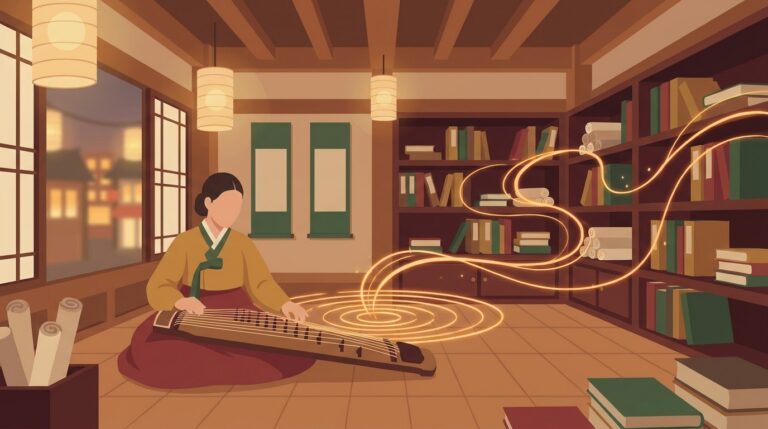
Phase 1: Empathy — Beyond Flawless, Into Unmistakable
안녕하세요! 매일한글 에디터입니다. (Annyeonghaseyo! Maeil Hangeul Editeo-imnida. — Hello! I am your Daily Hangul Editor.) Picture this: you are at an intimate Seochon bookshop talk in Seoul, praising a Korean novel. Your grammar is spotless, yet your Korean friend whispers, “You sound a bit like a flawless AI translator.” Ouch, right? I have seen brilliant C2 learners hit this exact wall—speaking “correct” Korean that lacks human pulse, texture, and shadow. Drawn from a decade of real learner coaching and feedback, this guide helps you ditch sterile textbook cadences and play Korean like your own signature instrument—so every sentence carries your unmistakable aura.
Phase 2: Deep Dive Into 3 Core Expressions
1. 행간을 읽다 (haengganeul ikda)
- Pronunciation: haeng-ga-neul ik-da (Think of hang in hangout, a soft g, neul like null with rounded lips, and a crisp ik-da where the k stops cleanly before da—like the sharp tap of a fountain pen on paper.)
- Meaning: Literally “to read the space between lines.” In lived C2 Korean, it means catching the unspoken ache, aesthetic restraint, or subtle irony hidden beneath polite words—something statistical AI models routinely miss.
- K-Culture Moment: Think of the quiet dining-table scenes in director Hong Sang-soo’s films or the understated heartbreak in Han Kang’s prose. Characters rarely spell out their pain; viewers and readers must 행간을 읽다 (haengganeul ikda — read between the lines) to feel the real tremor.
- Editor’s Insight: Machine translation treats language like a spreadsheet—every slot filled, zero ambiguity. Native Korean masters, however, leave emotional oxygen between clauses. Using this phrase signals that you appreciate silence as much as vocabulary.
- Situation Spectrum:
- Casual: ✅ 네 말의 행간을 읽었어. (Ne marui haengganeul ilgeosseo. — I caught what you weren’t saying.)
- Semi-formal: ✅ 그 문장의 행간을 읽는 재미가 있어요. (Geu munjangui haengganeul ingneun jaemiga isseoyo. — There is real joy in reading between the lines of that sentence.)
- Formal: ✅ 보고서의 행간을 꼼꼼히 읽어 주시기 바랍니다. (Bogoseoui haengganeul kkomkkomhi ilgeo jusigi baramnida. — Please read carefully between the lines of the report.)
- 🤔 Think About It: In English, clarity often means saying things explicitly. Why do you think Korean literary and conversational culture prizes what is deliberately left unsaid?
2. 결이 다르다 (gyeori dareuda)
- Pronunciation: gyeo-ri da-reu-da (Start with a quick gyuh like girl without the r, glide into a light rolled ri, then da-reu-da—flowing like silk brushing across wooden grain.)
- Meaning: Literally “the grain or texture is different.” Culturally, it describes an unmistakable sensibility, artistic temperament, or human aura that sets someone’s voice apart from generic competence.
- K-Culture Moment: When Korean music critics praise IU’s lyricism or RM’s introspective solo work on YouTube interviews, they rarely just say “good.” They lean forward and murmur, “이 아티스트는 확실히 결이 달라요 (I atiseuteuneun hwaksilhi gyeori dallayo — This artist genuinely has a different texture/sensibility).”
- Editor’s Insight: Honestly, if you use
독특하다 (dokteukada — unique), you sometimes sound like a polite brochure—or worse, like AI summarizing a restaurant review!결이 다르다 (gyeori dareuda)carries tactile warmth, implying you feel the fine grain of someone’s soul. - Situation Spectrum:
- Casual: ✅ 넌 글 쓰는 결이 완전 달라. (Neon geul sseuneun gyeori wanjeon dalla. — Your writing has a totally distinct grain to it.)
- Semi-formal: ✅ AI 문장이랑은 결이 다른 울림이 있네요. (AI munjangirangeun gyeori dareun ullimi inneyo. — It has a resonance of a completely different texture from AI prose.)
- Formal: ⚠️ 작품의 결이 다소 이질적입니다. (Jakpumui gyeori daso ijiljeogimnida. — Use carefully in formal critique so it sounds analytical rather than overly personal.)
- 🤔 Think About It: How does your native language talk about artistic “voice”—through sound, sight, or touch? Korean chooses wood and fabric grain (
결). What does that tell you about how Koreans perceive authenticity?
3. 자기만의 언어로 길어 올리다 (jagimanui eoneoro gireo ollida)
- Pronunciation: ja-gi-ma-nui eo-neo-ro gi-reo ol-li-da (Keep gi-reo ol-li-da rhythmic and rising, mimicking the steady hand-over-hand pull of drawing a bucket up from a deep stone well.)
- Meaning: Literally “to draw up from a well using one’s own language.” Idiomatically, it describes forging lived-in, deeply personal expression from memory and reflection rather than recycling clichés or algorithmic phrasing.
- K-Culture Moment: You will hear this exact phrasing at the Seoul International Book Fair or on literary podcasts when hosts ask a debut novelist how they found a voice that cuts through the noise of AI-generated content.
- Editor’s Insight: AI scrapes the surface of a million texts; a true stylist lowers a bucket into their own life. Dropping this metaphor in a book club or design pitch instantly elevates your Korean from “advanced learner” to “fellow wordsmith.”
- Situation Spectrum:
- Casual: ⚠️ 경험을 자기만의 언어로 길어 올렸구나. (Gyeongheomeul jagimanui eoneoro gireo ollyeotguna. — Slightly poetic for casual chat, great for heartfelt late-night talks.)
- Semi-formal: ✅ 감정을 자기만의 언어로 길어 올리는 힘이 대단해요. (Gamjeongeul jagimanui eoneoro gireo ollineun himi daedanhaeyo. — Your power to draw emotions up in your own language is remarkable.)
- Formal: ✅ 시대의 아픔을 자기만의 언어로 길어 올린 수작입니다. (Sidaeui apeumeul jagimanui eoneoro gireo ollin sujagimnida. — It is a masterpiece drawn up in the author’s own language from the ache of the era.)
- 🤔 Think About It: In the age of instant translation, when you speak Korean, are you translating your first-language thoughts—or drawing water from a new well you dug inside Korean itself?
Phase 3: Textbook Korean vs. Real Korean
Situation 1: Sharing Your Impression of a Film Without Sounding Like an AI Book Report
- 📖 교과서 한국어 (Textbook Korean): 이 영화는 매우 인상 깊었고 여운이 오래 남았습니다. (I yeonghwaneun maeu insang gipeotgo yeouni orae namatseumnida. — This film was very impressive and left a long-lasting aftertaste.)
- 🗣️ 진짜 한국어 (Real Korean): 영화가 끝났는데도 마음이 한참을 그 장면에 붙잡혀 있더라고요. (Yeonghwaga kkeutnanneundedo maeumi hanchameul geu jangmyeone butjapyeo itdeoragoyo. — Even after the movie ended, my heart stayed tethered to that scene for the longest time.)
- 💡 왜 다를까? (Why Is It Different?): Textbooks rely on abstract evaluation (
매우 인상 깊다), which mirrors how LLMs summarize sentiment. Native stylists anchor emotion in a physical image (붙잡혀 있다— tethered/held captive) and add-더라고요to invite the listener into a lived memory.
Situation 2: Offering a Nuanced Counterpoint in an Intellectual Discussion
- 📖 교과서 한국어 (Textbook Korean): 당신의 의견도 일리가 있지만 저는 조금 다르게 생각합니다. (Dangsinui uigyeondo illiga itjiman jeoneun jogeum dareuge saenggakamnida. — Your opinion has merit, but I think a little differently.)
- 🗣️ 진짜 한국어 (Real Korean): 그 지점도 참 흥미로운데, 저는 조금 다른 결로 읽어 보게 되네요. (Geu jijeomdo cham heungmirounde, jeoneun jogeum dareun gyeollo ilgeo boge doeneyo. — That point is fascinating, though I find myself reading it along a slightly different grain.)
- 💡 왜 다를까? (Why Is It Different?): Saying
당신and다르게 생각합니다draws a stiff adversarial line. Using~게 되네요softens agency—showing that your interpretation gently emerged through contemplation rather than stubborn debate.
Phase 4: K-Culture Deep Dive & Non-Verbal Manners
4-1. Nunchi & Gestures: Mastering the Art of the Pause
When you play Korean like an instrument, silence is your pedal. Instead of rushing through long, AI-smooth clauses at one steady volume, let your voice slow down right before a key noun or sentence ending (여백의 미, yeobaegeui mi — the beauty of empty space). Hold calm, warm eye contact when using reflective endings like -네요 (neyo) or -더라고요 (deoragoyo), and avoid the rapid-fire hand chopping of Western debate stages. A slight tilt of the head and an unhurried breath signal emotional depth and authentic Korean 눈치 (nunchi).
4-2. Cultural Code Analysis: Why Korean Prizes Resonance (여운) Over Closure
From K-Cinema endings that refuse tidy morals to K-Pop ballads that linger on a half-whispered final syllable, Korean aesthetics revolve around 여운 (yeoun)—the vibration left in the air after a bell is struck. AI writing loves symmetry: introduction, three neat arguments, tidy wrap-up. Human Korean style breaks symmetry on purpose. Leaving a thought slightly open—ending with ...그런 생각이 들더라고요 (geureon saenggagi deuldeoragoyo — that sort of thought crossed my mind)—invites your listener inside the music rather than lecturing them from a podium.
Phase 5: Practical Roleplay Scenario
Setting: Rain taps against the fogged glass of a cozy indie book café in Yeonnam-dong. Jazz hums softly. Across the wooden table sits Min-jae, a sharp-tongued indie literary magazine editor who can spot ChatGPT prose in three seconds flat.
Turn 1 — Min-jae: 🎭 Swirling his iced Americano, squinting playfully at your draft essay. 글이 참 매끈하긴 한데… 솔직히 조금 AI가 다듬어 준 느낌이 나네요. (Geuri cham maekkeunhagin hande… soljikhi jogeum AIga dadeumeo jun neukkimi naneyo. — Your essay is super polished, though… honestly, it feels a little like AI smoothed it out.)
Turn 2 — You: 🎭 Laughing lightly, leaning in without defensiveness. 아, 딱 걸렸나요? 문법 실수를 안 하려고 너무 힘줘서 썼나 봐요. (A, ttak geollyeonnayo? Munbeop silsureul an haryeogo neomu himjwoseo sseonna bwayo. — Ah, caught red-handed? I must have tensed up too much trying not to make grammar mistakes.)
Turn 3 — Min-jae: 🎭 Nodding with sudden warmth, tapping the page. 맞아요. 틀린 데가 하나도 없는데, 이상하게 글쓴이의 숨소리가 안 들려요. (Majayo. Teullin dega hanado eomneunde, isanghage geulsseuniui sumsoriga an deullyeoyo. — Exactly. There isn’t a single error, yet oddly I can’t hear the writer breathing.)
Turn 4 — You: 🎭 Glancing out at the rain-slicked alley, searching for a truer image. 사실 서울의 비 오는 골목을 걸으며 느낀 쓸쓸함을 자기만의 언어로 길어 올리고 싶었거든요. (Sasil Seourui bi oneun golmogeul georeumyeo neukkin sseulsseulhameul jagimanui eoneoro gireo olligo sipeotgeodeunyo. — Actually, I wanted to draw up the quiet ache I felt walking Seoul’s rainy alleys in my own language.)
Turn 5 — Min-jae: 🎭 Eyebrows lifting in genuine intrigue. 오, 방금 그 말투가 훨씬 살아 있네요. 그 쓸쓸함의 결이 어땠는데요? (O, banggeum geu maltuga hwolssin sara inneyo. Geu sseulsseulhamui gyeori eottaenneundeyo? — Oh, the way you just said that feels so much more alive. What was the grain of that ache like?)
Turn 6 — You: 🎭 Pausing a beat, letting the sentence land softly. 슬프다기보다는, 젖은 아스팔트에 번지는 가로등 불빛처럼 좀 먹먹하고 따뜻한 느낌이었어요. (Seulpeudagibodaneun, jeojeun aseupalteue beonjineun garodeung bulbitcheoreom jom meongmeokago ttatteutan neukkimieosseoyo. — Rather than sad, it felt muffled and warm, like streetlight bleeding across wet asphalt.)
Turn 7 — Min-jae: 🎭 Smiling broadly, picking up his pencil. 바로 이거죠! 이제야 행간에서 사람 온기가 느껴지네요. (Baro igeojyo! Ijeya haengganeseo saram ongiga neukkyeojineyo. — Now THIS is it! Finally, I can feel human warmth between the lines.)
Turn 8 — You: 🎭 Raising your teacup in a mock toast. 고맙습니다. 이제 문법이라는 악보 말고, 제 목소리로 연주해 볼게요. (Gomapseumnida. Ije munbeobiraneun akbo malgo, je moksoriro yeonjuhae bolgeyo. — Thank you. Now I’ll try playing with my own voice, not just the sheet music of grammar.)
🔀 Interactive Branching Point
Min-jae asks if you want to keep your original textbook-clean opening paragraph or replace it with your rainy streetlight image. How do you respond?
* Option A: “제가 쓴 문장이지만 조금 거칠어도 불빛 비유로 갈게요. 매끈한 것보다 제 결이 남는 게 좋으니까요.” (Jega sseun munjangijiman jogeum geochireodo bulbit biyuro galgeyo. Maekkeunhan geotboda je gyeori namneun ge joeunikkayo. — Even if it’s a bit raw, I’ll go with the streetlight image. I’d rather leave my own grain than stay sterile.)
* Feedback (Best!): Absolute C2 mastery! You embrace deliberate imperfection (거칠어도), own your 결, and sound like a confident literary peer.
* Option B: “아니요, 원어민처럼 완벽하게 들리려면 그냥 문법적으로 안전한 첫 문단이 나을 것 같아요.” (Aniyo, woneomincheoreom wanbyeokage deulliryeomyeon geunyang munbeopjeogeuro anjeonhan cheot mundani naeul geot gatayo. — No, to sound perfect like a native, I think the grammatically safe first paragraph is better.)
* Feedback (Bad): Classic C2 trap! Obsessing over zero-error safety strips away your soul and hands the microphone back to AI uniformity.
* Option C: “글쎄요, 두 문단을 번갈아 섞어서 인공지능도 쓰고 사람도 쓴 하이브리드 스타일로 가 볼까요?” (Geulsseyo, du mundaneul beongara seokkeoseo ingongjineungdo sseugo saramdo sseun haibeurideu seutaillo ga bolkkayo? — Well, shall I alternate both paragraphs for a human-AI hybrid style?)
* Feedback (Risk): Cleverly witty! Min-jae might laugh at the irony, though in literary writing, mixing sterile and organic voices can feel disjointed unless framed clearly as satire.
Phase 6: 10-Second Emotional Shadowing Drill
Read aloud with deliberate pauses at each / mark. Let the emotion carry the ending!
- [😌 Thoughtful & unhurried]
완벽한 문장보다 / 조금 서툴러도 / 나만의 숨결이 배어 있는 말이 / 훨씬 오래 남더라고요.
(Wanbyeokhan munjangboda / jogeum seotulleodo / namanui sumgyeori baeeo inneun mari / hwolssin orae namdeoragoyo. — More than a flawless sentence / even if a bit clumsy / words soaked with your own breath / linger far longer.) -
[✨ Quietly awestruck]
그 작가의 문장은 / 설명하지 않는데도 / 행간마다 바람 소리가 들리는 듯해요.
(Geu jakgaui munjangeun / seolmyeonghaji anneundedo / haengganmada baram soriga deullineun deuthaeyo. — That author’s sentences / even without explaining / make it feel as if you can hear wind between every line.) -
[🍷 Playfully self-aware]
남의 언어를 빌려 입는 게 아니라 / 이제는 내 몸에 맞게 / 조금씩 고쳐 입는 재미를 알겠어요.
(Namui eoneoreul billyeo imneun ge anira / ijeneun nae mome matge / jogeumssik gochyeo imneun jaemireul algesseoyo. — Rather than borrowing someone else’s language / now to fit my own frame / I finally get the joy of tailoring it bit by bit.)
Phase 7: K-Culture Mini Dictionary
- 여운 (yeoun) | Lingering emotional resonance | Used everywhere from film criticism and restaurant reviews to parting messages after an unforgettable night.
- 문체 (munche) | Writing or literary style | Crucial in publishing, essays, and brand storytelling when distinguishing human voice from uniform AI copy.
- 고유성 (goyuseong) | Singularity / unmistakable originality | A high-level keyword in art interviews, creative pitches, and cultural commentary.
- 어감 (eogam) | Nuance / sensory feel of a word | What writers debate when choosing between near-synonyms—like
푸르다 (pureuda)vs파랗다 (parata)—for emotional precision.
Phase 8: Survival Kit for Travelers
Top 3 Literary & Cultural Traveler Expressions
- 이 서점에서만 만날 수 있는 결이 특별한 책 한 권 추천해 주실래요? (I seojeomeseoman mannal su inneun gyeori teukbyeolhan chaek han gwon chucheonhae jusillaeyo?) — Pro Tip: Ask this in independent Seoul bookshops like Wit N Cynical or Your Mind; curators light up when you ask for a book with a distinct
결rather than just a bestseller. - 설명보다 여운이 정말 오래 남는 전시였어요. (Seolmyeongboda yeouni jeongmal orae namneun jeonsiyeosseoyo.) — Pro Tip: Perfect for galleries in Samcheong-dong or indie concerts; it shows deep appreciation without sounding like a tourist script.
- 잠깐 이 공간의 분위기를 좀 더 음미하고 싶어요. (Jamkkan i gongganui bunwigireul jom deo eummihago sipeoyo.) — Pro Tip:
음미하다 (eummihada — to savor slowly)turns a simple pause at a hanok teahouse into a poetic moment.
Editor’s Travel Note
To explore Seoul’s literary alleys and hidden cafés smoothly, Download the Naver Map App for Seoul Indie Bookshops before landing—Google Maps rarely displays smaller alleyways accurately. For reserving quiet evening book-bars or jazz lounges, Use the CatchTable App for Quiet Literary Wine Bars. Grab a Seoul Climate Card or T-money card at any convenience store for seamless subway hops between Seochon, Euljiro, and Yeonnam-dong, and remember Korea’s zero-tipping culture—your sincere, artfully chosen Korean thank-you is the finest gratuity you can give.
Phase 9: “One Step Deeper” (Thought Question)
Notice how Korean saves its emotional verdict for the very last syllable of a sentence—the 어미 (eomi), or sentence ending. Where English locks the speaker’s stance up front, Korean lets a sentence drift through scenery, memory, and sensory detail before softly landing on -더라고요, -거든요, or -나 봐요. Machine translation regularly flattens these tails into monotonous -습니다 or -요, erasing the temperature between speaker and listener. Learning to sculpt those final syllables is how you turn Korean from borrowed sheet music into your own breathing voice.
💬 Your Turn: Which Korean sentence ending or poetic metaphor makes you feel most “yourself” when speaking Korean? Drop your favorite phrase in the comments—I read every single one!
Phase 10: FAQ & Myth Busting
Q: Doesn’t using lots of advanced Sino-Korean (한자어) vocabulary make my C2 Korean sound more sophisticated?
A: Surprisingly, overloading on heavy 한자어 often makes you sound like an AI-translated legal brief! True C2 Korean masters balance crisp Sino-Korean concepts with earthy native Korean verbs (고유어), rhythmic onomatopoeia, and tactile imagery.
Q: How do I avoid sounding like ChatGPT when writing Korean emails or essays?
A: Break predictable symmetry! Instead of stacking three identical transitions (첫째, 둘째, 셋째) and ending with a generic summary, open with a concrete sensory moment, vary your sentence lengths, and use natural connective textures like ~다 보니 or ~는 한편.
Q: Is it okay to bend textbook word order for stylistic effect at the C2 level?
A: Yes—when done intentionally! Placing an emotional phrase after the verb (post-positioning, or 도치법) mirrors natural spoken emphasis and literary rhythm, signaling effortless ownership of the language.
🚨 Common Mistakes TOP 3
- Over-explaining subtext: Spelling out every logical link instead of letting
행간breathe. → Correct Action: Trim obvious summary sentences and trust your listener to connect the emotional dots. - Uniform sentence-ending temperature: Using only
-입니다or basic-아요/어요throughout an entire monologue. → Correct Action: Weave in-네요,-더라고요, and-거든요to shift smoothly between observation, memory, and gentle explanation. - Translating English idioms literally: Forcing clunky calques that clash with Korean imagery. → Correct Action: Borrow native tactile metaphors like
결이 다르다or여운이 남다instead.
Phase 11: Action Mission & Engagement
- 🥉 Bronze (Solo Practice): Take a 3-sentence English journal entry about your day, translate it mentally, and rewrite it in Korean—swapping at least one abstract adjective for a sensory image and ending with
-더라고요. - 🥈 Silver (SNS Share): Post a short Korean reflection about a favorite song or film using either
결이 다르다or여운and tag#DailyHangulso fellow stylists can cheer you on. - 🥇 Gold (Real-World Use): During your next conversation with a Korean friend or tutor, intentionally pause for half a second before delivering a nuanced compliment—and listen to how differently your words land.
- 🎮 K-Culture Mission: Watch a 5-minute interview with a Korean film director, novelist, or songwriter on YouTube (with Korean captions on) and hunt for
결,여운, or행간. Notice the facial expression and breathing right when they say it!
Phase 12: Interactive Quiz Challenge
1. Situational Judgment: Your Korean friend sends you a short poem they wrote—it is raw, slightly imperfect, and deeply moving. Which response best captures a warm C2 literary sensibility?
* A) 문법 오류가 두 개 있지만 전반적으로 훌륭한 시입니다.
* B) 조금 거친 부분도 있는데, 오히려 그래서 너만의 결이 살아 있고 여운이 오래 남네.
* C) 인공지능이 쓴 시보다 백 배는 더 정확하고 논리적이에요.
2. Fill in the Blank: Because Korean writers prize unspoken subtext, readers must learn to _______ (read between the lines).
3. True or False (Culture Quiz): At the C2 level, avoiding any pause or hesitation and maintaining uniform -습니다 endings makes your Korean sound more human and artistic than AI.
Click to Reveal Answers & Editor Explanations
- Answer: B! A sounds like an automated grading rubric, and C praises poetry for being “logical”—missing the soul completely! B (
조금 거친 부분도 있는데, 오히려 그래서 너만의 결이 살아 있고 여운이 오래 남네) honors both raw humanity and lasting resonance. - Answer: 행간을 읽다 (haengganeul ikda). Mastering subtext is what turns fluent grammar into living communication.
- Answer: False! AI thrives on monotonous uniformity. Intentional pauses (
여백의 미) and varied, warm sentence endings are what give Korean a living human pulse.
🎬 Watch Our Daily Videos! (Daily Hangul Official Instagram)
Review the expressions you learned in this article with our fun daily short videos! Check out native pronunciation and real-life nuances in action.
- Instagram @dailyhangul_en







