

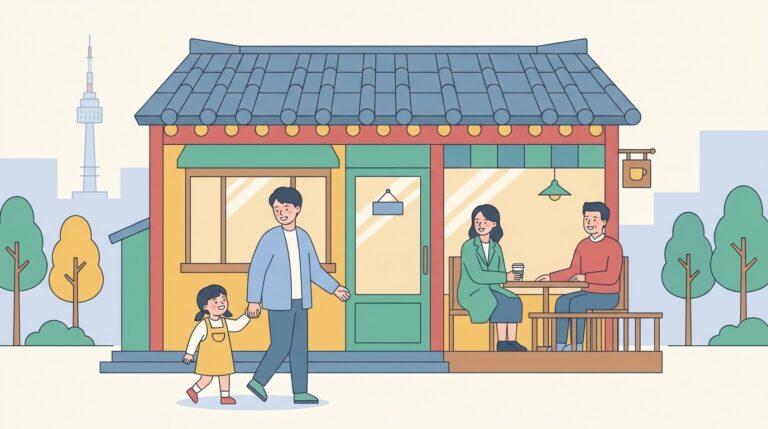
Phase 1: Welcome to the Seoul Cafe Debate
안녕하세요! 매일한글 에디터입니다. (Hello! I’m your Daily Hangul editor.) Picture this: you’re sipping an iced Americano at a trendy Seoul cafe featured in your favorite K-Drama, when you spot a small sign reading ‘No-Kids Zone’ on the glass door. Suddenly, a heated debate breaks out at the next table about kids, seniors, and public manners! Many B1 learners tell us they freeze up when trying to express balanced opinions on sensitive Korean social issues without sounding harsh. Based on real student feedback, today’s guide gives you the exact phrases to talk about active parenting and warm social tolerance in Korea—so you can join deep cafe conversations like a local!
Phase 2: Deep Dive into 3 Essential Expressions
1. 남에게 피해를 주다 (namaege pihaereul juda)
- Pronunciation: namaege pihaereul juda (Sounds like: nah-meh-geh pee-heh-reul joo-dah, where ‘eu’ is like the ‘oo’ in ‘good’ without rounding your lips)
- Meaning: Literally ‘to give damage to others.’ In real life, it means ‘to bother, inconvenience, or disturb others’ in shared spaces.
- K-Culture Moment: Think of a K-Drama scene on a crowded Seoul subway where a mom gently hushes her toddler, whispering, “남에게 피해를 주면 안 돼요 (namaege pihaereul jumyeon an dwaeyo – We must not bother others).”
- Editor’s Insight: In Korean culture, ‘피해 (pihae)’ doesn’t mean physical injury—it covers noise, blocking a walkway, or anything that disrupts collective peace. Using this phrase shows you understand Korean communal responsibility!
- Situation Spectrum: Casual ✅ | Semi-formal ✅ | Formal ✅
- 🤔 Think About It: In English, parents often say ‘use your indoor voice’ or ‘be polite.’ Why do you think Korean emphasizes avoiding ‘피해 (pihae – harm/inconvenience)’ to others as a core rule of growing up?
2. 따뜻하게 바라보다 (ttatteutage baraboda)
- Pronunciation: ttatteutage baraboda (Sounds like: ttah-tteut-hah-geh bah-rah-boh-dah — give the ‘tt’ a crisp, un-breathy pop like the ‘t’ in ‘stop!’)
- Meaning: Literally ‘to look at warmly.’ Actually means ‘to view someone with kindness, patience, and emotional warmth.’
- K-Culture Moment: Often heard in heartwarming family dramas like Reply 1988 or talk shows discussing how neighbors used to watch over children growing up together in a village.
- Editor’s Insight: This is your magic phrase for sounding empathetic! Instead of saying ‘be nice to kids,’ saying “사회를 따뜻하게 바라보다 (sahoereul ttatteutage baraboda)” or “아이들을 따뜻하게 바라보다 (aideureul ttatteutage baraboda)” elevates your Korean straight to a thoughtful B1+ level.
- Situation Spectrum: Casual ⚠️ (sounds slightly poetic with close friends) | Semi-formal ✅ | Formal ✅
- 🤔 Think About It: Does your native language use temperature metaphors like ‘warm gaze’ to describe social tolerance, or does it use different imagery?
3. 눈치가 보이다 (nunchiga boida)
- Pronunciation: nunchiga boida (Sounds like: noon-chee-gah boh-ee-dah)
- Meaning: Literally ‘Nunchi is seen.’ Actually means ‘to feel self-conscious, anxious about others’ reactions, or like you’re walking on eggshells.’
- K-Culture Moment: Imagine a young dad in a Korean variety show sweating nervously as his baby starts crying in a quiet restaurant—he sighs, “주변 눈치가 너무 보여요 (jubyeon nunchiga neomu boyeoyo – I’m so self-conscious about everyone around us).”
- Editor’s Insight: Koreans don’t just ‘have’ Nunchi (social awareness); when they feel judged, they say Nunchi ‘becomes visible’ to them! As your Korean bestie, I admit even I feel ‘눈치가 보이다’ if my phone rings loudly in a quiet cafe!
- Situation Spectrum: Casual ✅ | Semi-formal ✅ | Formal ⚠️ (use ‘주변 시선이 신경 쓰이다’ in very formal essays)
- 🤔 Think About It: Have you ever felt ‘눈치가 보이다’ in your own country, or is social pressure in public spaces felt differently back home?
Phase 3: Textbook Korean vs. Real Korean
Situation 1: Talking about guiding children in public
- 📖 Textbook Korean: “부모는 공공장소에서 아이를 엄격하게 교육해야 합니다.” (Bumoneun gonggongjangsoeseo aireul eomgyeokhage gyoyukaeya hamnida. — Parents must strictly educate their children in public places.)
- 🗣️ Real Korean: “부모가 옆에서 잘 챙기고 알려줘야죠.” (Bumoga yeopeseo jal chaenggigo allyeojwoyajyo. — Parents really need to stay by their side, look after them, and teach them.)
- 💡 Why the difference? Textbook Korean sounds like a stiff news anchor or legal rule! In real café chats, Koreans prefer softer verbs like ‘챙기다 (chaenggida – take care of/mind)’ and ‘알려주다 (allyeojuda – guide/let know)’ so they don’t sound overly judgmental.
Situation 2: Expressing support for kids and elders in society
- 📖 Textbook Korean: “우리는 노인과 어린이를 배려하는 태도를 가져야 합니다.” (Urineun noingwa eorinireul baeryeohaneun taedoreul gajyeoya hamnida. — We must adopt an attitude of consideration toward the elderly and children.)
- 🗣️ Real Korean: “우리 다 같이 조금만 더 이해해 주면 좋겠어요.” (Uri da gachi jogeumman deo ihaehae jumyeon jokesseoyo. — It’d be nice if we all just understood each other a little more.)
- 💡 Why the difference? Using ‘우리 다 같이 (all of us together)’ creates instant warmth and solidarity, softening a controversial topic like No-Kids Zones or No-Seniors Zones.
Phase 4: K-Culture Deep Dive & Non-Verbal Manners
4-1. Nunchi & Body Language in Public Spaces
When a child accidentally bumps into someone or gets loud in Korea, words alone aren’t enough—body language does half the talking! Korean parents immediately do a quick, slight bow (15 degrees) toward nearby customers, place a gentle hand on their child’s shoulder to guide them aside, and maintain an apologetic yet soft smile. Meanwhile, warm-hearted bystanders often respond by waving a hand lightly downward while smiling—a classic Korean gesture meaning ‘괜찮아요, 신경 쓰지 마세요 (Gwaenchanayo, singyeong sseuji maseyo – It’s okay, don’t worry about it!)’
4-2. Cultural Code: From Traditional ‘Jeong (정)’ to Trendy Zones
In recent years, Korea has seen lively debates over ‘노키즈존 (No-Kids Zones)’ in aesthetic Instagrammable cafes and even ‘노시니어존 (No-Seniors Zones)’ in some gyms or trendy bars. Why the tension? Korea is transforming rapidly from a traditional communal society built on ‘정 (Jeong – deep warm attachment)’—where neighbors raised kids together as seen in K-Dramas like Our Blues—into a hyper-busy, individualized urban society where people fiercely guard their quiet break time. Understanding both sides—the desire for peaceful rest and the need for warm patience toward growing children and seniors—is the key to navigating modern Korean social conversations.
Phase 5: Real-Life Roleplay Scenario
Setting: A sunlit specialty cafe in Seongsu-dong, Seoul. You and your Korean friend Minji (a thoughtful 29-year-old designer) are sitting near the window when a young mother enters with a lively 4-year-old boy.
- Minji: 저기 카페 입구에 ‘노키즈존’ 팻말 없는 거 보니까 여긴 예스키즈존인가 봐. (Jeogi kape ipgue ‘nokijeujon’ paenmal eomneun geo bonikka yeogin yeseukijeujoninga bwa.) — Seeing there’s no ‘No-Kids Zone’ sign at the entrance, this must be a Yes-Kids Zone.
🎭 Pointing subtly toward the glass door with her chin. - You: 맞아요. 요즘 한국에는 노키즈존이랑 노시니어존에 대한 의견이 정말 다양한 것 같아요. (Majayo. Yojeum hangugeneun nokijeujonirang nosinieojone daehan uigyeoni jeongmal dayanghan geot gatayo.) — Right. It seems opinions on No-Kids Zones and No-Seniors Zones in Korea are really diverse these days.
🎭 Stirring your iced latte thoughtfully. - Minji: 응, 사실 조용히 쉬고 싶은 손님 입장도 이해는 돼. (Eung, sasil joyonghi swigo sipeun sonnim ipjangdo ihaeneun dwae.) — Yeah, honestly, I do understand the perspective of customers who want to rest quietly.
🎭 Nodding slowly while glancing at a remote worker with headphones. - You: 그렇긴 하죠. 하지만 부모가 공공장소에서 아이가 남에게 피해를 주지 않도록 적극적으로 지도하는 게 먼저 아닐까요? (Geureokin hajyo. Hajiman bumoga gonggongjangsoeseo aiga namaege pihaereul juji antorok jeokgeukjeogeuro jidohaneun ge meonjeo anilkkayo?) — That’s true. Still, shouldn’t parents actively guide their kids not to bother others in public spaces first?
🎭 Leaning forward earnestly. - Minji: 맞아! 아까 저 어머님 봐. 아이가 뛰려고 하니까 바로 조용히 타일러 주시잖아. (Maja! Akka jeo eomeonim bwa. Aiga ttwiryeogo hanikka baro joyonghi tailleojusijana.) — Exactly! Look at that mom earlier. As soon as her kid tried to run, she gently calmed him down right away.
🎭 Smiling warmly as the mom kneels to talk softly to her son. - You: 보기 좋네요! 사회도 아이들의 성장을 조금 더 따뜻하게 바라봐 주면 좋을 텐데요. (Bogi jonneyo! Sahoedo aideureui seongjangeul jogeum deo ttatteutage barabwa jumyeon joeul tendeyo.) — It’s nice to see! It would be great if society could look upon growing children with a bit more warmth too.
🎭 Smiling softly at the boy sitting neatly with his cookie. - Minji: 완전 공감해. 서로 배려하면 굳이 누구를 출입 금지할 필요도 없을 텐데 말이야. (Wanjeon gonggamhae. Seoro baeryeohamyeon guji nugureul churip geumjihal piryodo eopseul tende mariya.) — I totally agree. If everyone is considerate of each other, there wouldn’t even be a need to ban anyone.
🎭 Taking a happy sip of coffee.
🔀 Interactive Branching Point
Just then, the little boy accidentally drops his plastic spoon, and it clatters near your table! The mother looks flustered and starts bowing repeatedly while saying “죄송합니다 (Joesonghamnida)”. How do you respond in Korean?
- Option A: “괜찮아요, 어머님! 아이가 아직 어리잖아요. 천천히 드세요.” (Gwaenchanayo, eomeonim! Aiga ajik eorijanayo. Cheoncheonhi deuseyo. — It’s okay, ma’am! He’s still little. Take your time eating.)
- Option B: “조심 좀 시키셔야죠. 여기 시끄러워지잖아요.” (Josim jom sikisyeoyajyo. Yeogi sikkeureowojijanayo. — You should make him be careful. It’s getting noisy here.)
- Option C: “이거 제가 주울게요!” (Igeo jega juulgeyo! — I’ll pick this up!) while picking up the spoon without saying anything else.
Feedback:
* Best (Option A): Gold-medal Korean empathy! Calling a young mother ‘어머님 (eomeonim)’ politely and reassuring her with warm words instantly melts her ‘눈치 (self-consciousness)’ and models the exact warmth we discussed.
* Bad (Option B): Too blunt and harsh! Even if you feel annoyed, scolding a stranger directly in Korea can escalate tension quickly, especially when the parent is already apologizing.
* Risk (Option C): Kind action, slightly risky delivery! Picking it up is sweet, though in Korea, saying nothing might leave the mom unsure if you’re annoyed or friendly. Pair it with a smile and “괜찮아요! (It’s okay!)” for perfection.
Phase 6: 10-Second Emotional Shadowing Drill
Read these aloud with feeling! Pause briefly at each /.
[🥺 Earnest & thoughtful]
부모는 / 공공장소에서 / 남에게 피해를 주지 않도록 / 잘 지도해야 해요.
(Bumoneun / gonggongjangsoeseo / namaege pihaereul juji antorok / jal jidohaeya haeyo. — Parents / in public places / so as not to bother others / must guide well.)-
[😊 Warm & encouraging]
우리 사회가 / 아이들의 성장을 / 조금 더 따뜻하게 / 바라봐 주면 좋겠어요.
(Uri sahoega / aideureui seongjangeul / jogeum deo ttatteutage / barabwa jumyeon jokesseoyo. — Our society / children’s growth / a little more warmly / I hope looks upon.) -
[😌 Relieved & friendly]
괜찮아요! / 너무 / 눈치 보지 마세요.
(Gwaenchanayo! / Neomu / nunchi boji maseyo. — It’s okay! / Too much / don’t worry about others’ reactions.)
Phase 7: K-Culture Mini Dictionary
- 노키즈존 / 예스키즈존 (Nokijeujon / Yeseukijeujon) | No-Kids Zone / Yes-Kids Zone | Widely used Konglish terms on cafe doors, news articles, and map apps to show whether children are permitted.
- 공공예절 (gonggongyejeol) | Public etiquette | Used in both school education and formal discussions about keeping shared spaces pleasant for everyone.
- 배려 (baeryeo) | Consideration / thoughtfulness | One of the most praised values in Korean personal and business culture—thinking of another’s comfort before your own.
- 세대 갈등 (sedae galdeung) | Generational conflict | A common news and essay keyword when discussing tensions between younger cafe-goers, parents, and seniors (like No-Seniors Zones).
Phase 8: Survival Kit for Travelers
Top 3 Survival Expressions
- 아이랑 같이 가도 돼요? (Airang gachi gado dwaeyo? — Can I bring a child along?) Pro Tip: Ask this at small trendy cafes before sitting down to avoid surprises.
- 조금만 조용히 해 주세요. (Jogeumman joyonghi hae juseyo. — Please keep it just a little quiet.) Pro Tip: Adding ‘조금만 (just a little)’ softens any request immediately.
- 죄송한데, 자리 좀 바꿀 수 있을까요? (Joesonghande, jari jom bakkul su isseulkkayo? — Excuse me, could we switch seats?) Pro Tip: A super polite way to move to a quieter corner without conflict.
Editor’s Travel Note
Before heading to hot spots like Seongsu or Yeonnam-dong with family, download local map apps—we recommend that you search cafe reviews on Naver Map or check Yes-Kids Zone tags on KakaoMap ahead of time, because Koreans frequently leave tags like ‘예스키즈존’ or ‘노키즈존’ in visitor reviews! Also, on Seoul subways and buses, remember to keep the pink ‘임산부 배려석 (Expectant Mother Seats)’ and end-row ‘노약자석 (Priority Seats for Seniors and Children)’ open even during rush hour—most locals leave them empty as a silent sign of respect. For payments, tap your T-money card at transit gates and look for quiet ‘study cafes (스터디카페)’ if you ever need guaranteed silence for work.
Phase 9: One Step Deeper — The Tightrope Between Freedom and Warmth
In Korea, public etiquette sits at a fascinating crossroads between rapid modern individualism and deep-rooted communal ‘정 (Jeong).’ For generations, Koreans believed ‘한 아이를 키우려면 온 마을이 필요하다’—it takes a whole village to raise a child. Yet in today’s hyper-dense cities, exhausted workers crave peaceful personal space, sparking debates over No-Kids Zones and No-Seniors Zones. True harmony emerges when parents actively teach consideration, and neighbors respond not with cold bans, but with patient warmth.
💬 Your Turn: Are there ‘No-Kids Zones’ or similar age-restricted spaces in your country? How do people in your culture balance quiet public spaces with welcoming children and seniors? Share your thoughts in the comments!
Phase 10: FAQ & Common Mistakes
Q: Is it rude to ask if a Korean cafe is a No-Kids Zone?
A: Not at all! Staff appreciate you asking politely beforehand with “여기는 아이 출입 가능한가요? (Yeogineun ai churip ganeunghangayo? — Are children allowed here?)” It prevents awkward moments for both you and the owner.
Q: Why do No-Seniors Zones even exist in Korea if respecting elders is so important?
A: Although Confucian respect for elders remains strong, a small number of trendy bars or fitness clubs introduced age caps citing noise, safety, or differing customer styles. However, many Koreans actively criticize No-Seniors Zones as unfair age discrimination.
Q: What is the polite Korean word to address a parent whose name I don’t know?
A: Calling a mother ‘어머님 (eomeonim)’ or a father ‘아버님 (abeonim)’ is warm, respectful, and very natural when talking about their child in public!
🚨 Common Mistakes Warning Board
- Mistake 1: Saying “아이가 나빠요 (Aiga nappayo – The child is bad)” when a kid is noisy. Correct Action: Focus on the behavior or situation gently, like “조금 시끄럽네요 (Jogeum sikkeureomneyo – It’s a bit loud).”
- Mistake 2: Translating ‘bother’ literally as ‘귀찮게 하다 (gwichanke hada)’ in formal discussions. Correct Action: Use ‘피해를 주다 (pihaereul juda)’ when talking about public etiquette—it sounds much more mature and B1-accurate.
- Mistake 3: Staring silently with a frown at a noisy table (giving ‘눈치’). Correct Action: Either smile gently if the parent is trying their best, or ask the staff politely for a quieter seat.
Phase 11: Action Mission & K-Culture Challenge
- 🥉 Bronze Mission (Solo Practice): Record yourself saying all 3 Phase 6 shadowing sentences on your phone and listen back to check your warm vs. earnest tone!
- 🥈 Silver Mission (Share Online): Post one opinion in Korean about public etiquette using “남에게 피해를 주다” or “따뜻하게 바라보다” in our community study thread.
- 🥇 Gold Mission (Real-World Use): Next time you talk with a Korean language partner or tutor, bring up the topic of No-Kids Zones and use at least two expressions from Phase 2!
🎮 K-Culture Mission: Watch an episode of a Korean family or slice-of-life drama (like Hospital Playlist or Our Blues) and listen closely for the words 피해 (pihae), 눈치 (nunchi), or 배려 (baeryeo)—spot how characters show care without raising their voices!
Phase 12: Interactive Quiz Challenge
1. Situation Judgment: You accidentally bump your stroller into a Korean stranger’s chair at a cafe, and they immediately smile and wave their hand saying, “괜찮아요, 어머님!” What should you do?
A) Ignore them and walk away.
B) Bow slightly and say “죄송합니다! 감사합니다.” (I’m sorry! Thank you.)
C) Ask them why they put their chair there.
2. Fill in the Blank: Fill in the natural B1 expression meaning ‘to bother others’:
“공공장소에서는 다른 사람에게 _______ 주면 안 돼요.” (Gonggongjangsoeseoneun dareun saramege _______ jumyeon an dwaeyo.)
3. True or False (Culture Quiz): In Korea, ‘눈치가 보이다’ means you are feeling proud and confident in front of a crowd.
Click here to reveal the answers & explanations!
- Answer: B! Returning a slight bow with “죄송합니다! 감사합니다.” matches the warm Korean exchange of mutual consideration. (Choosing A would seem cold, and C would escalate conflict unnecessarily.)
- Answer: 피해를 (pihaereul) — “남에게/다른 사람에게 피해를 주다” is the gold-standard B1 phrase for bothering or inconveniencing others in public spaces.
- Answer: False! ‘눈치가 보이다’ means feeling self-conscious or worried about what people around you might be thinking—the exact feeling parents get when their child cries in a quiet room.
🎬 Watch Our Daily Videos! (Daily Hangul Official Instagram)
Review the expressions you learned in this article with our fun daily short videos! Check out native pronunciation and real-life nuances in action.
- Instagram @dailyhangul_en







