

Phase 1: Getting Through That Heart-Pounding Moment
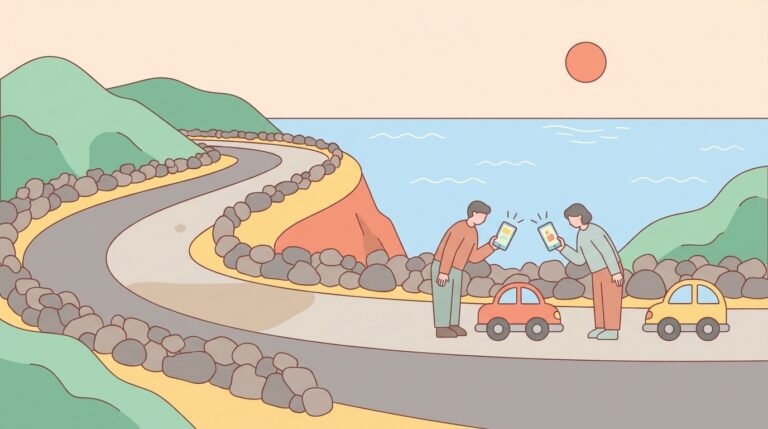
안녕하세요! 매일한글 에디터입니다. (Annyeonghaseyo! Maeil Hangeul editeoimnida.) Hello! I’m your Daily Hangul editor. Imagine cruising down Jeju’s scenic coastal road—just like a dreamy K-Drama scene—when suddenly, tap! You accidentally bump another car while parking. Your heart races! Calling the insurance company was stressful enough, and now you’re standing face-to-face with the other driver. Many of our B1 learners tell us the hardest part isn’t the driving—it’s knowing how to stay polite, exchange claim numbers, and wrap things up without awkward tension. Built from real traveler feedback, this guide equips you with natural Korean phrases to settle things smoothly and get back to your trip!
Phase 2: Top 3 Core Expressions Deep Dive
1. 보험 접수 번호 좀 알려주실래요? (Boheom jeopsu beonho jom allyeojusillaeyo?)
- Pronunciation: [Boheom jeopsu beonho jom allyeojusillaeyo?] (Sounds like: boh-hum jup-soo bun-ho jom al-lyuh-joo-shil-lae-yo — think of saying “bumper” without the “mp” for beon, and make jeop crisp like “cup” with a “j”!)
- Meaning: Literally “Will you let me know the insurance receipt number?” — Naturally means “Could you please share your insurance claim number?”
- K-Culture Moment: Picture a classic weekend K-Drama parking-lot fender-bender scene: both drivers step out looking stressed, check their phones after calling dispatch, and finally ask each other for the confirmation code to prove the claim is officially filed.
- Editor’s Insight: Adding 좀 (jom) right before the verb works like verbal bubble wrap—it softens a direct request so it never sounds demanding. At the B1 level, pairing 좀 (jom) with -(으)실래요? (-(eu)sillaeyo?) is your golden ticket for polite requests with strangers.
- Situation Spectrum: Casual 🚫 / Semi-formal ✅ / Formal ⚠️ (With older strangers or in very tense moments, upgrading to 알려주시겠어요? (allyeojusigesseoyo?) feels even more respectful.)
- 🤔 Think About It: In English, we often say “Give me your claim number” or “Can I have your claim number?” In Korean, we ask the other person to “inform/let me know” (알려주다). Why do you think Korean focuses on the listener’s generous action rather than the speaker’s need?
2. 서로 원만하게 처리하죠. (Seoro wonmanhage cheorihajyo.)
- Pronunciation: [Seoro wonmanhage cheorihajyo.] (Sounds like: suh-ro won-man-ha-gae chuh-ree-ha-jyo — remember seo sounds like the “u” in “cup,” not “so”!)
- Meaning: Literally “Let’s process it smoothly/roundly with each other.” — Naturally means “Let’s settle this amicably together.”
- K-Culture Moment: In Korean reality shows or everyday Seoul street clips, whenever a minor scrape happens without injuries, the calmer driver often uses 원만하게 (wonmanhage) to signal: “No need for a screaming match—let’s let the insurers handle it peacefully.”
- Editor’s Insight: The word 원만하다 (wonmanhada) comes from the idea of something being “round and smooth” without sharp edges. Using -죠 (-jyo) at the end creates a gentle, collaborative “shall we?” vibe instead of a blunt command.
- Situation Spectrum: Casual ⚠️ / Semi-formal ✅ / Formal ✅ (To sound extra formal, use 처리하시죠 (cheorihasijyo) or 처리합시다 (cheorihapsida) carefully, though 처리하죠 is warm and natural.)
- 🤔 Think About It: Notice how 서로 (seoro — each other) appears so often in Korean conflict resolution. How does framing an accident as a shared task compare to how people negotiate minor accidents in your home country?
3. 그럼 이만 가보겠습니다. (Geureom iman gabogesseumnida.)
- Pronunciation: [Geureom iman gabogesseumnida.] (Sounds like: geu-rum ee-man ga-bo-get-sseum-ni-da — geu is that relaxed “uh” sound you make when thinking!)
- Meaning: Literally “Then, up to here, I will try going.” — Naturally means “Well then, I’ll be on my way now.”
- K-Culture Moment: Just like when a character in Hospital Playlist or Business Proposal finishes an awkward roadside conversation and needs a clean, respectful exit line before hopping back into their car.
- Editor’s Insight: Notice the -겠- (-get-) + -습니다 (-seumnida) combo! Even if you spoke in -아요/어요 (-ayo/eoyo) earlier, closing an interaction with a stranger in -습니다 (-seumnida) shows maturity, finality, and sincere respect.
- Situation Spectrum: Casual 🚫 / Semi-formal ✅ / Formal ✅
- 🤔 Think About It: In Korean, simply saying “Bye!” (안녕) to a stranger after an accident is way too abrupt. Saying “I’ll try going now” softens the departure. What polite closing lines do you use in your native language after resolving an awkward situation?
Phase 3: Textbook Korean vs. Real Korean
Situation 1: Asking for the claim number via text
- 📖 Textbook Korean (교과서 한국어): 당신의 보험 접수 번호를 저에게 주세요. (Dangsin-ui boheom jeopsu beonho-reul jeo-ege juseyo.) — “Please give your insurance claim number to me.”
- 🗣️ Real Korean (진짜 한국어): 접수 번호 나오면 문자로 좀 보내주시겠어요? (Jeopsu beonho naomyeon munjaro jom bonaejusigesseoyo?) — “When the claim number comes out, could you text it to me?”
- 💡 Why the difference? (왜 다를까?): First, 당신 (dangsin — you) sounds confrontational in real life—Koreans avoid it unless they’re in a heated argument or a romantic poem! Second, instead of reading long numbers aloud on a noisy street, Koreans almost always exchange them via 문자 (munja — SMS) so there’s a written record.
Situation 2: Confirming everything is wrapped up
- 📖 Textbook Korean (교과서 한국어): 사고 처리가 모두 끝났으므로 저는 떠나겠습니다. (Sago cheoriga modu kkeutnasseumeuro jeoneun tteonagesseumnida.) — “Since the accident processing is all finished, I shall depart.”
- 🗣️ Real Korean (진짜 한국어): 연락처랑 번호 다 확인됐으니, 이제 가보셔도 될 것 같아요. (Yeollakcheorang beonho da hwagindwaesseuni, ije gabosyeodo doel geot gatayo.) — “Since we confirmed the contact info and claim numbers, I think you’re good to head out now.”
- 💡 Why the difference? (왜 다를까?): Using -(으)므로 (since/therefore) and 떠나다 (to depart) sounds like a formal news anchor! In real life, Koreans soften statements with -것 같아요 (I think/it seems) so the other person never feels bossed around.
Phase 4: K-Culture Deep Dive & Non-Verbal Manners
4-1. Nunchi (눈치) & Body Language on the Scene
When wrapping up a minor accident in Korea, your body language speaks louder than your grammar:
* The 15-Degree Head Nod: Even before insurance decides who is at fault, a slight 15-degree bow while saying 놀라셨죠? (Nollasyeotjyo? — You must have been startled) immediately melts tension. It shows empathy, not legal admission of guilt.
* Two-Handed Phone Etiquette: When showing your claim number on your phone or taking a photo of the other driver’s screen, hold your phone with both hands (or lightly touch your right forearm with your left hand). It signals respect.
* Keep Your Hands Relaxed: Never point at the scratch with your index finger while talking to the driver—use an open palm instead.
4-2. Culture Code: Blackbox & Calm Resolutions (K-Drama & K-Travel)
If you’ve watched slice-of-life K-Dramas or popular Korean YouTube dashcam channels, you might notice something surprising: Korean drivers rarely spend 30 minutes arguing about who was right on the roadside. Why? Almost every rental and private car in Korea has a 2-channel 블랙박스 (beullaekbakseu — dashcam), and streets are packed with CCTV. Because video evidence will settle the 과실 비율 (gwasil biyul — fault ratio) later, locals know there’s zero benefit in fighting on the spot. Your job at the scene is simply to check safety, take photos, swap 접수 번호 (jeopsu beonho), and part ways politely!
Phase 5: Real-Life Roleplay Scenario
Setting: A breezy afternoon outside a seaside café in Aewol, Jeju. You accidentally scraped the bumper of a white SUV while backing out of a tight spot. Both insurance companies have been called.
Characters: You (Alex), a traveler driving a rental car, and Mr. Kim, a calm local café owner.
- Mr. Kim:
🎭 Checking his phone with a polite nod저기요, 방금 제 보험사에서 접수 번호 문자로 왔어요. (Jeogiyo, banggeum je boheomsaeseo jeopsu beonho munjaro wasseoyo.) — “Excuse me, the claim number just came by text from my insurance company.” - Alex:
🎭 Showing relief and holding up your phone아, 네! 제 쪽 보험 접수 번호도 방금 떴습니다. (A, ne! Je jjok boheom jeopsu beonhodo banggeum tteotseumnida.) — “Oh, yes! My insurance claim number just popped up too.” - Mr. Kim:
🎭 Squinting at his screen in the sunlight제가 번호 불러드릴까요, 아니면 문자로 보내드릴까요? (Jega beonho bulleodeurilkkayo, animyeon munjaro bonaedeurilkkayo?) — “Should I read the number out to you, or text it to you?” - Alex:
🎭 Smiling politely and gesturing toward your phone헷갈릴 수 있으니까 문자로 좀 보내주시겠어요? (Hetgallil su isseunikka munjaro jom bonaejusigesseoyo?) — “Since it could get confusing, could you text it to me?” - Mr. Kim:
🎭 Tapping his screen for a few seconds네, 지금 보냈어요. 확인해 보세요. (Ne, jigeum bonaesseoyo. Hwaginhae boseyo.) — “Yes, I just sent it. Please check.” - Alex:
🎭 Checking the message with both hands and bowing slightly방금 확인했습니다. 저도 제 렌터카 회사 번호 보냈어요. (Banggeum hwaginhaetseumnida. Jeodo je renteoka hoesa beonho bonaesseoyo.) — “I just checked it. I sent my rental car company’s number too.” - Mr. Kim:
🎭 Putting his phone in his pocket calmly큰 사고 아니니까 보험사 통해서 원만하게 처리하죠. (Keun sago aninikka boheomsa tonghaeseo wonmanhage cheorihajyo.) — “Since it’s not a big accident, let’s handle it smoothly through our insurers.” - Alex:
🎭 Offering a sincere 15-degree bow before stepping toward your car네, 알겠습니다. 놀라셨을 텐데 조심히 가세요! (Ne, algesseumnida. Nollasyeosseul tende josimhi gaseyo!) — “Yes, understood. You must have been startled—please drive safely!”
🔀 Interactive Branching Point!
Right before you get into your car, Mr. Kim asks: “혹시 불편하신 데는 없으시죠? 이제 정리할까요?” (Hoksi bulpyeonhasin deneun eopseusijyo? Ije jeongnihalkkayo? — “You’re not hurt anywhere, right? Shall we wrap up now?”) How do you respond?
- Option A: 네, 괜찮습니다! 원만하게 처리해 주셔서 감사해요. 그럼 이만 가보겠습니다. (Ne, gwaenchanseumnida! Wonmanhage cheorihae jusyeoseo gamsahaeyo. Geureom iman gabogesseumnida.)
- Feedback (🏆 Best): Smooth, natural, and respectful! Thanking him for handling it amicably leaves a great final impression.
- Option B: 아뇨, 내일 경찰 부를 거예요. (Anyo, naeil gyeongchal bureul geoyeyo.)
- Feedback (❌ Bad): Saying you’ll call the police tomorrow out of nowhere when you’ve already exchanged insurance numbers will confuse and alarm the other driver!
- Option C: 제 잘못 아니니까 수리비 안 낼 거예요. (Je jalmot aninikka suribi an nael geoyeyo.)
- Feedback (⚠️ Risk): Arguing about repair costs or fault directly at the scene creates unnecessary conflict—remember, the insurance companies decide the fault ratio!
Phase 6: 10-Second Emotional Shadowing Drill
Read these aloud, pausing at / and channeling the emotion in brackets!
[😌 Calm & Polite]보험 접수 번호 / 좀 알려주실래요? (Boheom jeopsu beonho / jom allyeojusillaeyo?)[🤝 Warm & Cooperative]서로 / 원만하게 / 처리하죠. (Seoro / wonmanhage / cheorihajyo.)[😊 Sincere & Respectful]확인했습니다. / 그럼 이만 / 가보겠습니다. (Hwaginhaetseumnida. / Geureom iman / gabogesseumnida.)[🥺 Empathetic & Caring]놀라셨을 텐데 / 조심히 / 가세요! (Nollasyeosseul tende / josimhi / gaseyo!)
Phase 7: K-Culture Mini Dictionary
- 접수 번호 (jeopsu beonho) | Claim / Receipt Number | Used not only for car insurance claims, but also for customer service tickets, parcel deliveries, and visa applications.
- 원만하다 (wonmanhada) | Amicable / Smooth | Common in both daily conflict resolution and business emails when praising smooth negotiations or good teamwork.
- 과실 비율 (gwasil biyul) | Fault Ratio | A huge buzzword in Korean driving culture (e.g., “80 to 20”). Insurers calculate this using dashcam footage rather than roadside arguments.
- 문자 (munja) | Text Message (SMS) | While Koreans live on KakaoTalk for chatting, 문자 (munja) is still the go-to for official codes, delivery alerts, and exchanging claim numbers with strangers.
Phase 8: Traveler’s Survival Kit
TOP 3 Survival Phrases
- 사진 좀 찍어둘게요. (Sajin jom jjigeodulgeyo.) — “I’ll take a few photos.” (Pro Tip: Take wide shots showing road lanes AND close-ups of both cars before moving them!)
- 다친 데는 없으세요? (Dachin deneun eopseuseyo?) — “Are you hurt anywhere?” (Pro Tip: Asking this first shows great 눈치 and prevents unnecessary friction.)
- 연락처 교환해요. (Yeollakcheo gyohwanhaeyo.) — “Let’s exchange contact info.” (Pro Tip: If your roaming SIM only has data and no Korean phone number, let them know upfront and offer KakaoTalk!)
Editor’s Travel Note
Before hitting the road in Jeju or mainland Korea, save your rental agency’s 24/7 English emergency hotline in your favorites. Make sure to Download the Naver Map App for accurate speed-camera alerts and lane guidance, and Download the KakaoTalk App in case you need to share photos or contact info without an SMS plan. Also, keep a Korean debit/credit card or T-money card handy—some smaller parking lots don’t accept foreign cards at unmanned gates, and rental cars usually bill Hi-Pass highway tolls directly when you return the vehicle!
Phase 9: Going Deeper — Harmony on the Road
In Korean society, public interactions are deeply shaped by the desire to preserve 화합 (hwahap — harmony) and avoid losing face in front of onlookers. Even when something goes wrong—like a minor bumper scrape—escalating a situation with loud voices is often viewed negatively by bystanders, regardless of who caused the bump. That is why phrases like 서로 원만하게 (amicably with each other) and polite closing expressions carry so much social weight: they allow both strangers to protect their dignity and return to their day peacefully. Once you understand this cultural mindset, navigating stressful moments in Korea becomes way less intimidating!
💬 Your Turn: How do people usually act right after a minor fender-bender in your country? Drop a comment below and tell us how it compares to Korea!
Phase 10: FAQ & Common Mistakes
Q: Do I have to call the police for every minor rental car scratch in Korea?
A: Usually, no! If there are no injuries, no property damage to public structures, and neither driver is intoxicated or fleeing, exchanging insurance claim numbers and taking photos is standard. However, always follow your rental car company’s specific instructions first.
Q: What if I don’t have a Korean phone number to receive the claim number via SMS?
A: Don’t worry! Tell the other driver 제 번호가 외국 번호라서 카톡으로 받을 수 있을까요? (Je beonhoga oeguk beonhoraseo katogeuro badeul su isseulkkayo? — “Since my number is foreign, can I receive it via KakaoTalk?”) or simply take a clear photo of their text message screen with their permission.
Q: Should I pay cash on the spot to settle a small scratch quickly?
A: As a traveler driving a rental car, never hand over cash privately without consulting your rental agency first. Your rental insurance contract requires official reporting so you stay protected.
🚨 Common Mistakes TOP 3
- Mistake: Saying 미안해요 (Mianhaeyo) repeatedly in a panic even when you aren’t sure what happened. → Correct Action: Say 놀라셨죠? 괜찮으세요? (Nollasyeotjyo? Gwaenchaneuseyo? — “You must be startled. Are you okay?”) to show empathy without accidentally accepting 100% fault.
- Mistake: Dropping into casual 반말 (banmal), like saying 알려줘 (Allyeojwo) instead of 알려주실래요?. → Correct Action: Always stick to -요 (-yo) or -습니다 (-seumnida) with strangers on the road.
- Mistake: Driving off right after swapping phone numbers without taking photos of the claim text or license plates. → Correct Action: Always confirm the 접수 번호 (claim number) visually before saying 그럼 이만 가보겠습니다.
Phase 11: Action Mission & K-Culture Challenge
- 🥉 Bronze Mission (Solo Practice): Stand in front of a mirror and practice saying our 3 core expressions smoothly three times without looking at the romanization.
- 🥈 Silver Mission (Share It): Post your favorite phrase from Phase 2 on your Instagram Story or language-learning journal and tag a friend you want to do a Jeju road trip with!
- 🥇 Gold Mission (Real-World Use): Next time you wrap up a conversation with a Korean tutor, cafe staff, or friend, try using 그럼 이만 가보겠습니다 (Geureom iman gabogesseumnida) for a polished exit.
- 🎮 K-Culture Mission: Watch a Korean drama car-accident scene (or a Korean dashcam review clip on YouTube) and listen closely for words like 보험사 (insurance company), 접수 (claim filing), or 블랙박스 (dashcam)!
Phase 12: Interactive Quiz Challenge
1. Situation Judgment: You’ve just exchanged claim numbers with the other driver and want to suggest handling everything calmly through your insurers. Which sentence is best?
* A) 빨리 돈 주세요. (Ppalli don juseyo.)
* B) 서로 원만하게 처리하죠. (Seoro wonmanhage cheorihajyo.)
* C) 당신 잘못이에요. (Dangsin jalmosieyo.)
Check Answer & Explanation
Correct Answer: B! 서로 원만하게 처리하죠 politely proposes settling things smoothly together. Wrong Answer Feedback: Option A sounds aggressive (“Give me money quickly”), and Option C uses 당신 (dangsin) to blame them directly, which will instantly escalate tension!
2. Fill in the Blank: Fill in the missing Korean word to politely ask for the claim number:
“보험 ( ? ) 좀 알려주실래요?” (Boheom ___ jom allyeojusillaeyo?)
Check Answer & Explanation
Correct Answer: 접수 번호 (jeopsu beonho)! Put together, 보험 접수 번호 좀 알려주실래요? is the essential phrase for swapping insurance confirmation numbers.
3. True / False Cultural Quiz: In Korea, using 문자 (munja — text message) is preferred over shouting long claim numbers aloud on a busy street because it leaves a clear written record.
Check Answer & Explanation
Answer: TRUE! Almost everyone swaps claim numbers via 문자 (SMS) or KakaoTalk, or snaps a quick photo of the confirmation screen so there are zero typos.
🎬 Watch Our Daily Videos! (Daily Hangul Official Instagram)
Review the expressions you learned in this article with our fun daily short videos! Check out native pronunciation and real-life nuances in action.
- Instagram @dailyhangul_en







