

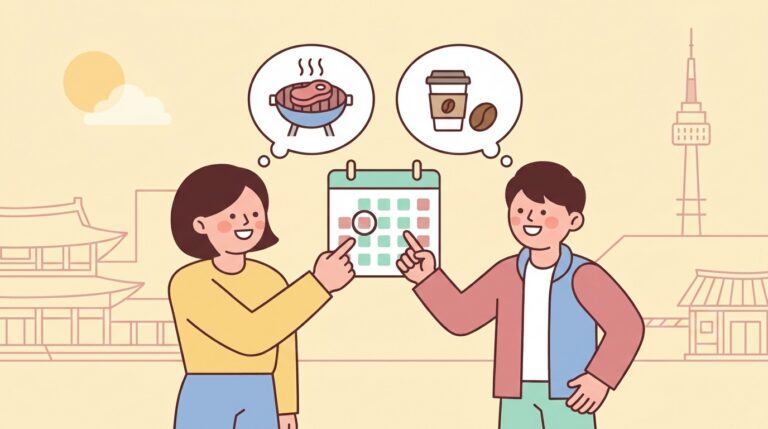
Phase 1: Why Making Weekend Plans in Korean Feels Tricky
안녕하세요! 매일한글 에디터입니다. (Annyeonghaseyo! Hello, this is your Daily Hangul Editor!) Have you ever stared at your KakaoTalk screen, wanting to ask your Korean friend out for delicious Korean BBQ, only to freeze up? You type “Are you free?” in English, delete it, and sigh. Just like that awkward pause before friends reunite in a K-Drama, making plans can feel tricky! Based on real feedback from over 500 A2 learners just like you, awkward literal translations often make casual invites sound like stiff job interviews. Don’t worry! Today, your Korean bestie is here to fix that. By mastering these warm, natural expressions, you will effortlessly set up weekend hangouts and bond over great food in no time!
Phase 2: Deep Dive into 3 Must-Know Expressions
1. 이번 주말에 시간 어때? (Ibeon jumare sigan eottae?)
- Pronunciation: [ee-buhn joo-mah-reh shee-gahn uh-tteh] (Tip: “eottae” sounds like “uh” in “uh-oh” plus “teh” in “teddy”!)
- Meaning: Literally “How is time this weekend?” / Actual Nuance: “How does this weekend look for you?” It is a soft, friendly way to check someone’s availability without putting pressure on them.
- K-Culture Moment: Imagine the main characters in a slice-of-life K-Drama texting in their group chat on a Wednesday night, ready to escape work stress with weekend plans.
- Editor’s Insight: Beginners often ask “시간 있어요? (Sigan isseoyo? / Do you have time?)” which can sound a bit too direct, like you are about to ask for a favor. Using “시간 어때? (Sigan eottae?)” feels much warmer and invites a relaxed conversation!
- Situation Spectrum: Casual (Friends) ✅ | Semi-formal (Add 요 -> 어때요?) ✅ | Formal (Boss/Elders) 🚫
- 🤔 Think About It: In English, we often ask “Are you free?” focusing on being empty or unoccupied. In Korean, asking “How is your time?” focuses on the flow and mood of their schedule. Why do you think Korean speakers prefer asking “how” instead of “yes or no”?
2. 우리 오랜만에 만나자! (Uri oraenmane mannaja!)
- Pronunciation: [oo-ree oh-ren-mah-neh mahn-nah-jah] (Tip: “oraen” glides like “oh-ren” in “orange” without the g!)
- Meaning: Literally “We, after a long time, let’s meet!” / Actual Nuance: “Let’s catch up soon! It’s been way too long!” It shows genuine affection and excitement to reconnect.
- K-Culture Moment: You will hear K-Pop idols say “오랜만에 만났어요! (Oraenmane mannasseoyo!)” to fans at concerts or variety show reunions when they haven’t seen each other in months.
- Editor’s Insight: Notice the word “우리 (uri / we)” at the start! Even when talking to just one friend, Koreans love using “우리 (uri)” to create instant closeness and warmth.
- Situation Spectrum: Casual (Friends) ✅ | Semi-formal (Change 자 to 요 -> 만나요!) ✅ | Formal (Boss/Elders) 🚫
- 🤔 Think About It: English uses “Long time no see” as a greeting after meeting, whereas Koreans use “오랜만에 (oraenmane)” even while planning the meetup! How does mentioning the time gap change the warmth of an invitation?
3. 맛있는 거 먹자! (Masitneun geo meokja!)
- Pronunciation: [mah-sheen-neun guh muhk-jah] (Tip: Because of Korean sound blending, “masitneun” flows smoothly like “mah-sheen-neun”, and “meokja” rhymes with “muck-jah”!)
- Meaning: Literally “Let’s eat a delicious thing!” / Actual Nuance: “Let’s grab something good to eat!” You don’t need to pick a specific restaurant right away—this is the universal Korean code for “let’s hang out!”
- K-Culture Moment: In food-loving K-Dramas like Hospital Playlist, friends rarely say “Let’s hang out.” Instead, they always say “맛있는 거 먹자! (Masitneun geo meokja!)” because good food is the heart of every meetup.
- Editor’s Insight: Never underestimate the power of “거 (geo)” (short for 것, meaning “thing”). Leaving the exact food open makes your friend feel included in choosing the menu!
- Situation Spectrum: Casual (Friends) ✅ | Semi-formal (Change 자 to 먹어요 -> 먹어요!) ✅ | Formal (Boss/Elders) 🚫
- 🤔 Think About It: Why do you think food is almost always the main goal of hanging out with Korean friends, rather than just “grabbing a quick coffee” or “chatting”?
Phase 3: Textbook Korean vs. Real Korean
Situation 1: Checking Your Friend’s Weekend Schedule
- 📖 Textbook Korean: 이번 토요일에 시간이 있습니까? (Ibeon toyoire sigani itseumnikka?) – “Do you have time this Saturday?”
- 🗣️ Real Korean: 이번 주 토요일 괜찮아? (Ibeon ju toyoil gwaenchana?) – “Is this Saturday good for you?”
- 💡 Why is it different? Textbook endings like “-습니까? (-seumnikka?)” sound like a news anchor interviewing a stranger! Between friends, using “괜찮아? (gwaenchana? / is it okay?)” feels relaxed and polite without being stiff.
Situation 2: Suggesting a Meal Together
- 📖 Textbook Korean: 우리 같이 맛있는 음식을 먹읍시다. (Uri gachi masitneun eumsigeul meogeupsida.) – “Let us eat delicious food together.”
- 🗣️ Real Korean: 우리 맛있는 거 먹으러 가자! (Uri masitneun geo meogeureo gaja!) – “Let’s go eat something tasty!”
- 💡 Why is it different? “먹읍시다 (meogeupsida)” sounds like a military commander giving an order! Real friends shorten “음식 (eumsik / food)” to “거 (geo / thing)” and use the playful “-자 (-ja / let’s)” ending.
Phase 4: K-Culture Deep Dive & Non-Verbal Manners
4-1. Nunchi (눈치) & Gestures
When suggesting plans in Korea, 눈치 (Nunchi)—reading the room and sensing someone’s feelings—is everything! If you ask “이번 주말에 시간 어때? (Ibeon jumare sigan eottae?)” in person and your friend tilts their head slightly, pauses, or says “음… (Eum…)”, don’t push too hard! They might be trying to say no gently. Give them an easy out with a warm smile and a light wave of your hand, saying “괜찮아, 다음 주에 보자! (Gwaenchana, daeum jue boja! / It’s okay, let’s see each other next week!)”. On KakaoTalk, Koreans love adding cute emoticons (이모티콘) after “먹자! (meokja!)” so the text feels extra cheerful.
4-2. Cultural Code Analysis: K-Food as Love Language
In K-Culture, sharing a meal is the ultimate sign of friendship. You have probably heard the famous Korean greeting “밥 먹었어? (Bap meogeosseo? / Have you eaten?)” in K-Dramas. Because Korea values community and sharing (Jeong), eating together around one sizzling Samgyeopsal grill or a bubbling pot of Kimchi-jjigae creates an instant bond. When a Korean friend tells you “오랜만에 맛있는 거 먹자! (Oraenmane masitneun geo meokja!)”, they aren’t just hungry—they are telling you they miss your company!
Phase 5: Real-Life Roleplay Scenario
Setting: It’s a sunny Thursday afternoon in Seoul. You open KakaoTalk and call your cheerful Korean friend Minji (민지), a total foodie who knows all the trendy spots in Seongsu-dong.
- You: 민지야, 잘 지냈어? (Minjiya, jal jinaesseo?) — “Minji, have you been well?” 🎭 Speaking brightly into your phone while walking down a breezy street.
- Minji: 응! 너는? 요즘 너무 바쁘지? (Eung! Neoneun? Yojeum neomu bappeuji?) — “Yeah! What about you? You’re super busy these days, right?” 🎭 Sipping iced Americano in her office breakroom.
- You: 맞아, 정신없었어. 우리 오랜만에 만나자! (Maja, jeongsineopseosseo. Uri oraenmane mannaja!) — “Right, it’s been crazy. Let’s meet up after a long time!” 🎭 Smiling warmly as you wait at a crosswalk.
- Minji: 좋아! 나도 너 보고 싶었어. 언제 만날까? (Joa! Nado neo bogo sipeosseo. Eonje mannalkka?) — “Sounds great! I missed you too. When should we meet?” 🎭 Clapping her hands softly in excitement.
- You: 이번 주말에 시간 어때? 토요일에 맛있는 거 먹자! (Ibeon jumare sigan eottae? Toyoire masitneun geo meokja!) — “How is your schedule this weekend? Let’s eat something delicious on Saturday!” 🎭 Leaning in eagerly, already thinking about spicy tteokbokki.
- Minji: 아, 토요일 오후에는 약속이 있어. 일요일은 어때? (A, toyoil ohueneun yaksogi isseo. Iryoireun eottae?) — “Ah, I have plans on Saturday afternoon. How about Sunday?” 🎭 Checking her calendar app with a slightly apologetic tone.
- You: 일요일 완전 좋아! 몇 시에 만날까? (Iryoil wanjeon joa! Myeot sie mannalkka?) — “Sunday is totally great! What time should we meet?” 🎭 Nodding happily and opening your notes app.
- Minji: 1시에 성수역에서 만나자! 내가 맛집 알아볼게. (Hansie Seongsuyeogeseo mannaja! Naega matjip arabolkke.) — “Let’s meet at Seongsu Station at 1 PM! I’ll look up a great restaurant.” 🎭 Sending a cute sticker on KakaoTalk right after hanging up.
🔀 Interactive Branching Point
Wait! In Line 6, Minji said she is busy on Saturday afternoon and suggested Sunday. What if you are also busy on Sunday morning? Choose your best response:
* A. “그럼 일요일 저녁 6시는 어때? (Geureom iryoil jeonyeok yeoseotsineun eottae? / Then how about Sunday at 6 PM?)” -> Best! Flexible, polite, and keeps the positive energy flowing!
* B. “안 돼. 무조건 토요일에 만나. (An dwae. Mujogeon toyoire manna. / No. We’re meeting on Saturday no matter what.)” -> Bad! Way too bossy and ignores her schedule. She might cancel completely!
* C. “이번 주말은 좀 어려워. 다음 주에 다시 정하자! (Ibeon jumareun jom eoryeowo. Daeum jue dasi jeonghaja! / This weekend is a bit tough. Let’s reschedule for next week!)” -> Risk! Polite and natural, though you’ll have to wait another week for that tasty food!
Phase 6: 10-Second Emotion Shadowing Drill
Read these lines out loud! Pause briefly at every / and channel the emotion in the brackets:
[😊 Bright & Excited]이번 주말에 / 시간 어때? (Ibeon jumare / sigan eottae?) — “How is your schedule this weekend?”[🥰 Warm & Affectionate]우리 / 오랜만에 / 만나자! (Uri / oraenmane / mannaja!) — “Let’s meet after a long time!”[😋 Playful & Hungry]맛있는 거 / 먹자! (Masitneun geo / meokja!) — “Let’s eat something delicious!”[🥺 Gently Apologetic]미안, / 토요일은 / 약속이 있어. (Mian, / toyoireun / yaksogi isseo.) — “Sorry, I have plans on Saturday.”
Phase 7: K-Culture Mini Dictionary
- 주말 (Jumal) | Weekend | Used constantly in daily chats and work small talk on Fridays (“주말 잘 보내세요! / Have a great weekend!”).
- 약속 (Yaksok) | Promise / Appointment / Plans | In Korean, hanging out with friends is called a “약속 (yaksok)”, showing that keeping time with friends is a meaningful promise.
- 맛집 (Matjip) | Famous delicious restaurant | A combination of 맛 (taste) + 집 (house). Young Koreans love searching Instagram for “성수 맛집” before weekend meetups.
- 번개 (Beongae) | Impromptu meetup | Literally means “lightning”! Used when friends suddenly decide to meet up on the same day with zero prior planning.
Phase 8: Survival Kit for Travelers
Top 3 Survival Phrases
- 몇 시에 만날까? (Myeot sie mannalkka?) — “What time shall we meet?” | Pro Tip: Remember Korea uses native Korean numbers for hours (1시 = han-si, 2시 = du-si, 3시 = se-si)!
- 어디서 만날까? (Eodiseo mannalkka?) — “Where shall we meet?” | Pro Tip: Subway exits are Korea’s favorite meeting spots! Say “2번 출구 (ibeon chulgu / Exit 2)”.
- 조금 늦을 것 같아요. (Jogeum neujeul geot gatayo.) — “I think I’ll be a little late.” | Pro Tip: Always send a quick KakaoTalk message 10 minutes before if the bus is stuck in traffic!
Editor’s Travel Note
Before you meet friends in Korea, make sure to Download Naver Map App because Google Maps doesn’t give full walking directions in South Korea! Also, Download KakaoTalk Messenger so you can easily coordinate subway exits and share restaurant links. If you are riding the subway to meet your friend, tap your T-money card smoothly at the gate and check the exit number on the yellow signs overhead before walking up the stairs.
Phase 9: One Step Deeper
Why do Koreans say “우리 (uri / we)” even when talking about “my” weekend or “my” plans with just one friend? In Korean society, relationships are built on 정 (Jeong)—a deep, warm feeling of connectedness and loyalty. Instead of drawing strict borders around “my time” and “your time,” phrases like “우리 오랜만에 만나자! (Let’s meet after a long time!)” remind both people that they belong to a shared circle of care. Even adjusting your schedule for a friend isn’t seen as an inconvenience; it’s a sweet way of showing you value the bond.
💬 Your Turn: What is the very first Korean dish you want to eat with a friend when you say “맛있는 거 먹자!”? Drop your dream menu in the comments below!
Phase 10: FAQ & Myth-Busting
Q: Can I use “시간 어때?” with my Korean teacher or boss?
A: No! Without “요 (-yo)”, “어때?” is casual speech (반말/Banmal) strictly for close friends of the same age or younger. For teachers, coworkers, or acquaintances, politely say “시간 어떠세요? (Sigan eotteoseyo?)”.
Q: Is it rude to cancel or change a weekend plan in Korea?
A: Changing plans happens, especially if you give notice at least a day before. Just be warm and apologetic (“미안해, 일정이 생겼어 / Sorry, something came up”) and immediately suggest a new day so your friend knows you still want to meet!
Q: Why did my Korean friend suggest meeting at a subway exit instead of a restaurant?
A: Seoul is huge and busy! Meeting at a specific subway exit like “홍대입구역 9번 출구 (Hongdae Station Exit 9)” makes it super easy for everyone to find each other before walking together to the restaurant.
🚨 Common Mistakes Alert!
- Mistake 1: Saying “이번 주말에 무료예요?” (Using 무료/free-of-charge instead of free time!). Correct Action: Use “시간 어때? (Sigan eottae?)” or “시간 괜찮아? (Sigan gwaenchana?)”!
- Mistake 2: Forgetting to add “에 (-e)” after time words when needed. Correct Action: Practice saying “이번 주말에 (ibeon jumar-e)” as one chunk!
- Mistake 3: Waiting until Friday night to make Saturday plans if your friend is a planner. Correct Action: Koreans love booking trendy 맛집 in advance, so text on Wednesday or Thursday!
Phase 11: Action Mission & Engagement
- 🥉 Bronze Mission (Solo Practice): Look in the mirror and say all 3 key expressions out loud three times while smiling!
- 🥈 Silver Mission (Share Online): Post a picture of your favorite Korean food on Instagram or X with the caption: “우리 맛있는 거 먹자! (Uri masitneun geo meokja!)”
- 🥇 Gold Mission (Real Life): Text a Korean friend or language partner today and ask: “이번 주말에 시간 어때? (Ibeon jumare sigan eottae?)”
- 🎮 K-Culture Mission: Watch an episode of a slice-of-life K-Drama (like Reply 1988 or Welcome to Samdal-ri) and listen closely whenever characters plan a meal—see if you catch “오랜만에 (oraenmane)” or “먹자 (meokja)”!
Phase 12: Interactive Quiz Challenge
Test your new Korean hangout skills! Try answering these three quick questions before checking the answers.
1. Situational Judgment: You haven’t seen your close friend Jisoo in 3 months. Which text sounds the warmest and most natural?
A) 이번 주에 시간이 있습니까?
B) 지수야! 우리 오랜만에 만나서 맛있는 거 먹자!
C) 지수야, 토요일에 무료야?
Click to Reveal Answer & Feedback
Correct Answer: B!
Why? Option B uses warm casual speech, “우리 오랜만에 (after a long time)”, and “맛있는 거 먹자 (let’s eat something delicious)”. Option A is way too stiff for a friend, and Option C mistakenly uses “무료 (free of charge)” instead of free time!
2. Fill in the Blank: Complete the sentence to ask about your friend’s schedule this weekend:
“이번 주말에 ___ 어때?” (Ibeon jumare ___ eottae?)
Click to Reveal Answer & Feedback
Correct Answer: 시간 (sigan)
Full sentence: “이번 주말에 시간 어때?” (How is your schedule this weekend?)
3. True or False (Culture Quiz): In Korea, saying “맛있는 거 먹자!” means you must already have a specific restaurant picked out before texting your friend.
Click to Reveal Answer & Feedback
Correct Answer: False!
In Korea, “맛있는 거 먹자! (Let’s eat something tasty!)” is a friendly, open invitation to hang out. Friends usually pick the exact menu or 맛집 together afterward!
🎬 Watch Our Daily Videos! (Daily Hangul Official Instagram)
Review the expressions you learned in this article with our fun daily short videos! Check out native pronunciation and real-life nuances in action.
- Instagram @dailyhangul_en







