

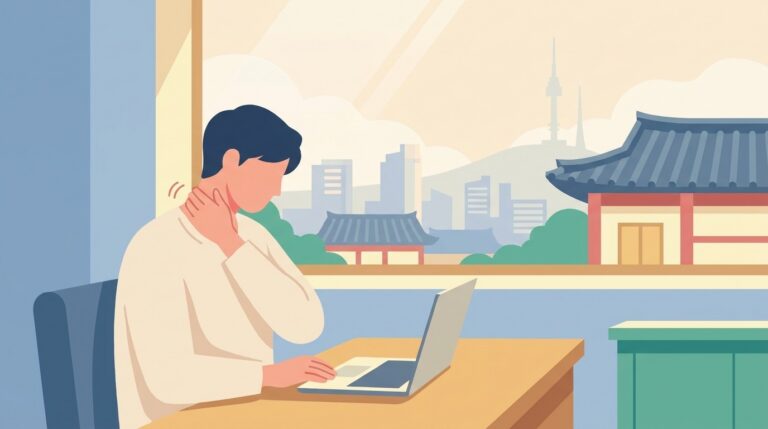
Phase 1: Why Does My Neck Hurt After One More Episode?
안녕하세요! 매일한글 에디터입니다. (Annyeonghaseyo! Maeil Hangul Editeo-imnida. — Hello! This is your Daily Hangul Editor.) Have you ever binged a whole K-drama on your laptop until 3 AM, or worked at a Seoul cafe for hours, only to wake up with a neck stiff as a wooden board? Just like those K-drama office workers grabbing their necks in slow motion, sitting too long hurts! Based on real feedback from our A2 learners who panicked when trying to explain muscle pain at a Korean clinic, today we will master easy, practical Korean phrases so you can walk into an orthopedic clinic and get relaxing physical therapy with total confidence!
Phase 2: Top 3 Must-Know Expressions Deep Dive
1. 담 걸렸어요 (Dam geollyeosseoyo)
- Pronunciation: Dam geol-lyeo-sseo-yo (Sounds like “Dahm gull-yuh-ssuh-yo” — imagine saying “dam” followed by a smooth “gull” like a seagull!)
- Meaning: Literal: “A dam/wall got caught (in my body).” / Real Nuance: “I pulled a muscle” or “I have a painful crick/stiff cramp in my neck or shoulder.”
- K-Culture Moment: In K-Dramas like Business Proposal or Misaeng, exhausted characters tilt their heads sideways, tap their shoulders, and sigh “아이고, 담 걸렸어” (Aigo, dam geollyeosseo — Oh no, I got a crick) after sleeping on their desk.
- Editor’s Insight: Unlike “아파요” (apayo — it hurts), “담” (dam) specifically describes that sudden, tight, locked-up muscle spasm you get from bad posture or sleeping awkwardly. Koreans use it every single day!
- Situation Spectrum: Casual (담 걸렸어 / Dam geollyeosseo) ✅ | Semi-formal (담 걸렸어요 / Dam geollyeosseoyo) ✅ | Formal (담이 걸렸습니다 / Dami geollyeotseumnida) ✅
- 🤔 Think About It: English describes this as “sleeping wrong” or a “crick,” while Korean says something “got caught” (걸리다 – geollida) inside you, like a traffic jam! How does your native language describe sudden muscle stiffness?
2. 어깨가 뻐근해요 (Eokkaega ppeogeunhaeyo)
- Pronunciation: Eo-kkae-ga ppeo-geun-hae-yo (Sounds like “Uh-kkeh-gah ppuh-guhn-heh-yo” — give that “kk” and “pp” a tiny, bouncy pop like popping bubble wrap!)
- Meaning: Literal: “My shoulders are stiff.” / Real Nuance: “My shoulders feel tight, heavy, and sore” (from sitting too long).
- K-Culture Moment: In K-Pop behind-the-scenes vlogs, idols often stretch their arms after intense choreography or long flights and say “어깨가 너무 뻐근해요” (Eokkaega neomu ppeogeunhaeyo — My shoulders are so stiff) while asking a member for a quick shoulder tap.
- Editor’s Insight: This is the ultimate word for “computer posture” soreness. If it feels sharp like a knife, use “쑤셔요” (ssusyeoyo); if it feels heavy, dull, and tight from sitting at your desk, “뻐근해요” (ppeogeunhaeyo) is pure perfection.
- Situation Spectrum: Casual (어깨가 뻐근해 / Eokkaega ppeogeunhae) ✅ | Semi-formal (어깨가 뻐근해요 / Eokkaega ppeogeunhaeyo) ✅ | Formal (어깨가 뻐근합니다 / Eokkaega ppeogeunhamnida) ✅
- 🤔 Think About It: Korean has dozens of sensory adjectives just for types of pain (뻐근하다, 찌릿하다, 시큰하다). Why do you think describing the exact texture of pain matters so much in Korean doctor-patient communication?
3. 물리치료 받고 싶어요 (Mullichiryo batgo sipeoyo)
- Pronunciation: Mul-li-chi-ryo bat-go si-peo-yo (Sounds like “Mool-lee-chee-ryo baht-go shee-puh-yo” — notice how the “n” sound in mun-li melts into a smooth double “L” like in “million”!)
- Meaning: Literal: “I want to receive physical therapy.” / Real Nuance: “Could I get physical therapy treatment?” (Very normal and polite to request at a Korean orthopedic clinic!)
- K-Culture Moment: On Korean travel and lifestyle YouTube vlogs, expats are always amazed at how fast and affordable Korean “정형외과” (jeonghyeong-oegwa — orthopedic clinics) are, where getting hot packs and electric therapy feels like a mini spa day.
- Editor’s Insight: In many countries, you need a special referral weeks in advance for physical therapy. In Korea, you can walk straight into a neighborhood clinic, see the doctor for 3 minutes, and immediately head to the physical therapy room for 30 minutes of bliss!
- Situation Spectrum: Casual (물리치료 받고 싶어 / Mullichiryo batgo sipeo) ⚠️ (Only with friends) | Semi-formal (물리치료 받고 싶어요 / Mullichiryo batgo sipeoyo) ✅ | Formal (물리치료를 받고 싶습니다 / Mullichiryoreul batgo sipseumnida) ✅
- 🤔 Think About It: In Korea, patients often actively suggest treatments like physical therapy or IV drips (링거 – ringgeo) to their doctor. Is asking directly for a specific treatment common in your home country, or is it seen as impolite?
Phase 3: Textbook Korean vs. Real Korean
Situation 1: Explaining why your neck hurts at the clinic
- 📖 Textbook Korean: 컴퓨터를 오래 사용해서 목에 근육통이 생겼습니다. (Keompyuteoreul orae sayonghaeseo moge geunyuktongi saenggyeotseumnida. — Because I used the computer for a long time, muscle pain occurred in my neck.)
- 🗣️ Real Korean: 컴퓨터 앞에 오래 앉아 있었더니 뒷목이 뻐근해요. (Keompyuteo ape orae anja isseotdeoni dwinmogi ppeogeunhaeyo. — I sat in front of the computer for so long, and now the back of my neck is stiff.)
- 💡 Why the difference? Textbook Korean uses stiff medical nouns like “근육통” (geunyuktong — myalgia/muscle pain) and formal endings. Real Koreans paint a clear picture of what happened (앉아 있었더니 — sat there and then…) and how it feels (뻐근해요 — stiff/sore) so the doctor instantly gets it!
Situation 2: Reacting when the therapist presses a tight spot
- 📖 Textbook Korean: 그 부분이 매우 아픕니다. 조금 약하게 해 주세요. (Geu bubuni maeu apeumnida. Jogeum yakhage hae juseyo. — That part hurts very much. Please do it a little softly.)
- 🗣️ Real Korean: 어우, 거기 좀 아파요! 살살 해 주세요. (Eou, geogi jom apayo! Salsal hae juseyo. — Ooh, that spot hurts! Please go gently.)
- 💡 Why the difference? “살살” (salsal — gently/softly) is an adorable, friendly mimetic word Koreans use everywhere—from massages to patting a puppy. Saying “살살 해 주세요” sounds natural, warm, and immediately tells your physical therapist to ease up!
Phase 4: K-Culture Deep Dive & Non-Verbal Manners
4-1. Nunchi (눈치) & Clinic Gestures
When you sit in front of a Korean orthopedic doctor (의사 선생님 – uisa seonsaengnim), actions speak louder than words! Here is how to show great Nunchi:
* Point & Rub Gently: While saying “뒷목이랑 어깨가 뻐근해요” (Dwinmogirang eokkaega ppeogeunhaeyo — The back of my neck and shoulders are stiff), gently place your open palm on the back of your neck or squeeze your own shoulder. Avoid pointing with a single stiff finger directly at the doctor’s face.
* The Polite Mini-Bow: When entering the doctor’s office and when leaving the physical therapy bed, give a gentle 15-degree nod while saying “감사합니다” (Gamsahamnida — Thank you). Nurses and therapists work fast, and a warm nod builds instant goodwill!
* Phone on Silent: Korean clinic waiting rooms are super quiet. Keep your phone on vibration mode (진동 모드 – jindong modeu) while waiting for your name to be called.
4-2. Cultural Code: Korea’s “Turtle Neck” & Physical Therapy Obsession
Have you heard of 거북목 (Geobukmok — Turtle Neck)? Because South Korea has one of the highest smartphone and PC usage rates in the world, “Turtle Neck Syndrome” (forward head posture) is practically a national meme! K-dramas constantly show overworked characters sticking cool soothing patches called 파스 (Paseu) on their necks or visiting a local 정형외과 (Jeonghyeong-oegwa) on their lunch break. A typical Korean physical therapy session includes a warm 핫팩 (Hatpaek — hot pack), rhythmic 전기치료 (Jeongichiryo — TENS electrotherapy), and an 초음파 치료 (Choeumpa chiryo — ultrasound)—and with insurance, it often costs less than a fancy brunch!
Phase 5: Real-Life Roleplay Scenario
- Setting: A bright, clean neighborhood orthopedic clinic (정형외과) in Gangnam, Seoul. The smell of herbal soothing patches fills the air. Dr. Kim, a warm, fast-talking doctor in a crisp white coat, is looking at his monitor while you sit on the round patient stool.
1. Dr. Kim: 어디가 불편해서 오셨어요? (Eodiga bulpyeonhaeseo osyeosseoyo?) — Where are you feeling uncomfortable today?
🎭 Dr. Kim spins his chair toward you with a friendly smile.
2. You: 선생님, 뒷목이랑 어깨가 너무 뻐근해요. (Seonsaengnim, dwinmogirang eokkaega neomu ppeogeunhaeyo.) — Doctor, the back of my neck and my shoulders are so stiff.
🎭 You tilt your head slightly and gently rub the back of your neck.
3. Dr. Kim: 언제부터 그러셨어요? 혹시 발목이나 다른 데도 아파요? (Eonjebuteo geureosyeosseoyo? Hoksi balmokina dareun dedo apayo?) — Since when has it been like this? Do your ankles or other areas hurt too?
🎭 Dr. Kim leans in and gently presses your shoulder muscle to check the tension.
4. You: 어제 컴퓨터 앞에 오래 앉아 있었더니 담 걸린 것 같아요. (Eoje keompyuteo ape orae anja isseotdeoni dam geollil geot gatayo.) — I sat in front of the computer for so long yesterday, and now it feels like I have a muscle cramp.
🎭 You wince slightly when he presses the tight knot.
5. Dr. Kim: 아, 여기 근육이 많이 뭉쳤네요. 일자목이 조금 있어요. (A, yeogi geunyugi mani mungchyeonneyo. Iljamogi jogeum isseoyo.) — Ah, the muscles here are very knotted. You have a bit of straight-neck posture.
🎭 Dr. Kim types quickly on his keyboard and nods understandingly.
6. You: 물리치료 받고 싶어요. 오늘 바로 할 수 있어요? (Mullichiryo batgo sipeoyo. Oneul baro hal su isseoyo?) — I want to get physical therapy. Can I do it right away today?
🎭 You look hopeful, rolling your stiff shoulder slightly.
7. Dr. Kim: 네, 당연하죠! 지금 바로 물리치료실로 가세요. (Ne, dangyeonhajyo! Jigeum baro mullichiryosillo gaseyo.) — Yes, of course! Go straight to the physical therapy room right now.
🎭 Dr. Kim hands you a small printed slip and points toward the hallway.
8. You: 감사합니다, 선생님! (Gamsahamnida, seonsaengnim!) — Thank you, doctor!
🎭 You bow politely and walk toward the cozy physical therapy room.
🔀 Interactive Branching Point: Inside the Physical Therapy Room!
The physical therapist attaches suction cups for electrotherapy (전기치료) and turns up the dial. Suddenly, it tingles way too strongly! What do you say?
* Choice A: “선생님, 조금 세요. 약하게 해 주세요!” (Seonsaengnim, jogeum seyo. Yakhage hae juseyo! — Therapist, it is a bit strong. Please turn it down!)
* 🏆 Best! Polite, crystal clear, and natural A2 Korean! The therapist smiles, lowers the dial right away, and asks if it feels comfortable now.
* Choice B: “야! 아파! 꺼!” (Ya! Apa! Kkeo! — Hey! It hurts! Turn it off!)
* ❌ Bad! Using casual/rude Banmal (반말) like “야!” and “꺼!” to a medical professional will shock everyone in the room. Always add “-요” (-yo) or “주세요” (juseyo)!
* Choice C: (Says nothing and silently suffers for 15 minutes with tears in your eyes)
* ⚠️ Risk! In Korea, physical therapists expect you to speak up! They always ask “괜찮으세요?” (Gwaenchaneuseyo? — Is it okay?), and staying silent out of shyness can leave you sore instead of relaxed.
Phase 6: 10-Second Emotion Shadowing Drill
Read these lines out loud! Pause briefly at every / and channel the emotion in brackets!
- [😣 Tired & Groaning] 컴퓨터 앞에 / 오래 앉아 있었더니 / 뒷목이 뻐근해요. (Keompyuteo ape / orae anja isseotdeoni / dwinmogi ppeogeunhaeyo. — Sitting at the computer for so long made the back of my neck stiff.)
- [😟 Worried & Explaining] 어제부터 / 어깨에 / 담 걸렸어요. (Eojebuteo / eokkaee / dam geollyeosseoyo. — Since yesterday, I have had a cramp in my shoulder.)
- [🥺 Hopeful & Polite] 선생님, / 물리치료 / 받고 싶어요! (Seonsaengnim, / mullichiryo / batgo sipeoyo! — Doctor, I want to get physical therapy!)
- [😌 Relieved & Grateful] 아, / 시원해요! / 감사합니다. (A, / siwonhaeyo! / Gamsahamnida. — Ah, that feels so refreshing! Thank you.)
Phase 7: K-Culture Mini Dictionary (4 Key Words)
- 정형외과 (Jeonghyeong-oegwa) | Orthopedic clinic | The exact clinic you visit in Korea for a sprained ankle (발목 삐임), stiff neck, back pain, or physical therapy—not just broken bones!
- 근육통 (Geunyuktong) | Muscle pain / soreness | Useful at pharmacies (약국 – yakguk) when buying painkillers or soothing patches after hiking or working out.
- 파스 (Paseu) | Medicated pain-relief patch | Korea’s iconic cooling or warming sticky patches! Every office worker and hiker keeps a pack in their bag.
- 시원하다 (Siwonhada) | Refreshing / relieving | Normally means “cool” (like iced coffee), but Koreans say “시원해요!” when a hot massage or physical therapy melts their muscle knots away!
Phase 8: Survival Kit for Travelers
Top 3 Clinic Survival Phrases
- 여기가 아파요. (Yeogiga apayo.) — It hurts right here. Pro Tip: Even if you forget every body part word, pointing gently and saying this phrase saves the day 100% of the time!
- 발목을 삐었어요. (Balmogeul ppieosseoyo.) — I sprained my ankle. Pro Tip: Going to the same orthopedic clinic for a twisted ankle after walking 20,000 steps in Seoul? This is your magic sentence!
- 파스 주세요. (Paseu juseyo.) — Please give me a pain-relief patch. Pro Tip: Say this at any Korean pharmacy (약국) or convenience store if your neck tightens up late at night.
Editor’s Travel Note
- Find a Clinic Fast: Use the Naver Map App Download for Korean Clinics guide before your trip and search 정형외과 (Jeonghyeong-oegwa). Google Maps does not work well for walking directions in Korea, so Naver Map or KakaoMap is essential!
- Bring Your Passport & Card: If you are visiting without Korean National Health Insurance (건강보험 – geongang boheom), bring your passport for registration. Even without insurance, a basic doctor consultation + physical therapy session usually costs only 20,000 to 40,000 KRW ($15–$30 USD), and T-money or international credit cards are widely accepted at clinic counters!
Phase 9: One Step Deeper — Why Do Koreans Say “It’s Refreshing” When It Hurts?
If you ever get physical therapy or a shoulder massage in Korea, you will hear people sigh “아, 시원하다!” (A, siwonhada! — Ah, that’s so refreshing!) even while wincing in pain. In Korean culture, healing is deeply connected to releasing blocked energy and tension (뭉친 걸 풀다 — mungchin geol pulda). Whether it is eating hot spicy soup on a freezing day or pressing out a tight shoulder knot from hours of hard work, Koreans value that satisfying rush of relief after discomfort. Language reflects how a society cares for itself—and in Korea, taking quick care of a tired body so you can bounce back together is an everyday art form.
💬 Your Turn: Does your country have a funny phrase like “siwonhada” for “pain that feels good,” or a go-to home remedy for a stiff neck? Drop a comment below and tell us your story!
Phase 10: FAQ & Myth Busting
Q: Can I go to a Korean orthopedic clinic (정형외과) without an appointment?
A: Yes! Almost all neighborhood orthopedic clinics in Korea welcome walk-ins (당일 접수 – dangil jeopsu). Just walk up to the reception desk, hand over your ID or passport, and wait 10 to 20 minutes.
Q: What is the difference between “뻐근하다” (ppeogeunhada) and “담 걸리다” (dam geollida)?
A: “뻐근하다” describes a heavy, tight soreness from overuse or sitting too long, while “담 걸리다” means a sharp, sudden muscle cramp or crick where turning your head feels locked and painful.
Q: Will the clinic staff speak English?
A: Clinics in central Seoul areas (like Gangnam, Itaewon, or Hongdae) often have basic English-speaking staff, while small neighborhood clinics may not. Using simple A2 Korean phrases plus pointing works smoothly everywhere!
🚨 Common Mistakes Warning Board
- Mistake: Saying “목이 부러졌어요” (Mogi bureojyeosseoyo) for a stiff neck. -> Wait! That means “My neck is broken!” Correct Action: Use “목이 뻐근해요” (Mogi ppeogeunhaeyo — My neck is stiff) or “담 걸렸어요” (Dam geollyeosseoyo).
- Mistake: Asking for “내과” (Naegwa) for muscle pain. -> Why? Naegwa is internal medicine (for colds or stomachaches). Correct Action: Search for 정형외과 (Jeonghyeong-oegwa — Orthopedic clinic)!
- Mistake: Staying silent when electrotherapy feels too strong. -> Correct Action: Speak up politely right away with “조금 약하게 해 주세요” (Jogeum yakhage hae juseyo — Please turn it down a little).
Phase 11: Action Mission & Engagement
- 🥉 Bronze Mission (Solo Practice): Stand up from your desk right now, stretch your neck side to side, and say “어깨가 뻐근해요” (Eokkaega ppeogeunhaeyo) and “물리치료 받고 싶어요” (Mullichiryo batgo sipeoyo) out loud 3 times!
- 🥈 Silver Mission (Share with Friends): Post a quick stretch selfie on your SNS with the Korean caption “컴퓨터 앞에 오래 앉아 있었더니 뒷목이 뻐근해요 😭” and tag a friend who needs a posture check!
- 🥇 Gold Mission (Real-Life Action): Next time you visit a Korean clinic, pharmacy, or massage shop, use at least one phrase from today—like “여기가 뻐근해요” or “살살 해 주세요”!
- 🎮 K-Culture Mission: Watch your favorite K-drama tonight and spot a tired character grabbing the back of their neck! Listen closely—did they say “담” (dam), “뻐근해” (ppeogeunhae), or reach for a “파스” (paseu)?
Phase 12: Interactive Quiz Challenge
Test your new A2 skills! Try answering before opening the spoiler box below.
Quiz 1 (Situation Judgment): You sat at your laptop for 6 hours and your shoulders feel super tight and heavy. What is the most natural thing to tell the doctor?
A) 어깨가 시원해요. (Eokkaega siwonhaeyo.)
B) 어깨가 뻐근해요. (Eokkaega ppeogeunhaeyo.)
C) 배가 고파요. (Baega gopayo.)
Quiz 2 (Fill in the Blank): Complete the polite request to get physical therapy: “________ 받고 싶어요.” (________ batgo sipeoyo.)
Quiz 3 (True or False Culture Quiz): In Korea, you usually need to book a specialist weeks in advance before you can receive physical therapy at a neighborhood orthopedic clinic.
👇 Click here to reveal the answers and explanations!
- Quiz 1 Answer: B) 어깨가 뻐근해요. (If you chose A, you told the doctor your shoulders feel wonderfully refreshed! If you chose C, you told the doctor you are hungry—maybe grab some tteokbokki after your appointment!)
- Quiz 2 Answer: 물리치료 (Mullichiryo). Full sentence: “물리치료 받고 싶어요.” (I want to get physical therapy.)
- Quiz 3 Answer: False! Walk-in visits and same-day physical therapy are super common, fast, and convenient at neighborhood orthopedic clinics (정형외과) all across Korea.
🎬 Watch Our Daily Videos! (Daily Hangul Official Instagram)
Review the expressions you learned in this article with our fun daily short videos! Check out native pronunciation and real-life nuances in action.
- Instagram @dailyhangul_en







