

Phase 1: Empathy & Story Opening
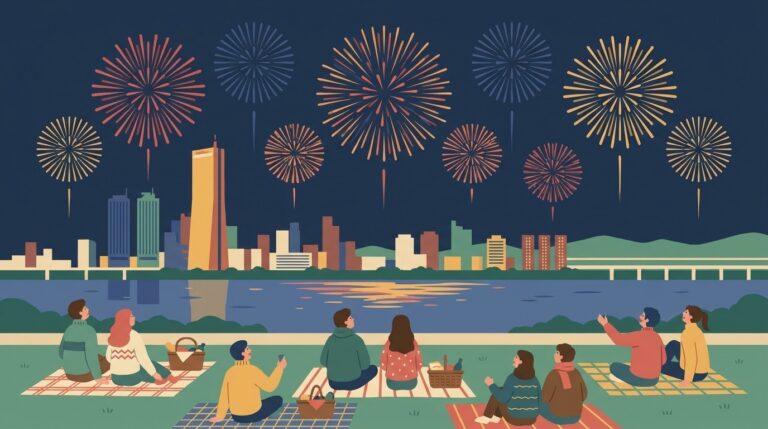
안녕하세요! 매일한글 에디터입니다. (Hello! I am your Daily Hangul editor.) Imagine sitting by the Han River on a crisp autumn evening as colorful fireworks burst across the dark Seoul sky. Every October, over a million people gather for the Yeouido World Fireworks Festival! Last year, one of my students tried to go alone. They got overwhelmed by the huge crowd, couldn’t ask if a picnic spot was free, and froze up when buying warm snacks! Based on real feedback from travelers like you, I created this A2 survival guide. Master these easy phrases, and you won’t just watch the show—you’ll enjoy the magic like a true local!
Phase 2: Deep Dive into 3 Essential Expressions
1. 자리 있어요? (Jari isseoyo?)
- Pronunciation: Jah-ree ee-ssuh-yo (Think of “jah-ree” like “jar” + “ee”, and “ssuh-yo” like “saw” without the W, ending with “yo”.)
- Meaning: Literal: “Does a seat/spot exist?” | Real Nuance: “Is this spot free?” or “Do you have room here?”
- K-Culture Moment: Picture the opening scene of a slice-of-life K-Drama where the main character arrives late to a packed Han River park, holding snacks, scanning the grass for a tiny space to spread a mat.
- Editor’s Insight: Koreans rarely say a long sentence like “Can I sit here?” in a noisy festival crowd. Just pointing gently toward an empty patch of grass next to someone’s mat and saying “자리 있어요? (Jari isseoyo?)” with a warm smile works like magic!
- Situation Spectrum: Casual ⚠️ (Add “여기” / yeogi without “-yo” for friends) | Semi-formal ✅ (Perfect for strangers at festivals!) | Formal ⚠️ (Use “자리 있나요?” / Jari innayo? in upscale restaurants)
- 🤔 Think About It: In English, we often ask “Is anyone sitting here?” focusing on the person. In Korean, we ask if the space exists. Why do you think Korean focuses on the space rather than the person?
2. 불꽃놀이가 정말 화려해요! (Bulkkonnoriga jeongmal hwaryeohaeyo!)
- Pronunciation: Bool-kkon-no-ree-ga jung-mal hwa-ryuh-hae-yo (“Bool” like “bull”, double “kk” pops sharply like the “k” in “sky”, “jung-mal” rhymes with “young pal”, and “hwa” sounds like “wham” without the M.)
- Meaning: Literal: “The fire-flower play is truly splendid!” | Real Nuance: “The fireworks are so gorgeous!”
- K-Culture Moment: Remember those romantic autumn festival scenes in Korean romance dramas? The leads look up as golden sparks reflect in their eyes, whispering about how dazzling the night sky looks.
- Editor’s Insight: Look at the word “불꽃 (bulkkot)” — it literally means “fire flower”! Isn’t that poetic? Also, “화려해요 (hwaryeohaeyo)” is your go-to A2 upgrade from just saying “예뻐요 (yeppeoyo / pretty)” when something looks grand, colorful, and dazzling.
- Situation Spectrum: Casual ⚠️ (Drop “-요” with close friends) | Semi-formal ✅ (Great for chatting with locals or posting on social media!) | Formal ✅ (Polite enough for elders too)
- 🤔 Think About It: Many languages use words like “fireworks” (focusing on work/craft). Korean calls it “fire-flower play” (불꽃놀이). How does that playful word change the feeling of the event?
3. 날씨가 좀 쌀쌀하네요! (Nalssiga jom ssalssalhaneyo!)
- Pronunciation: Nal-sshi-ga jom ssal-ssal-ha-ne-yo (“Nal” like “doll” with an N, “sshi” like “she” with extra hiss, “jom” like “job” with an M, and “ssal” like a sharp “psalm” without the P.)
- Meaning: Literal: “The weather is a bit chilly, I notice!” | Real Nuance: “Ooh, it’s getting chilly tonight!”
- K-Culture Moment: Classic K-Drama trope! The wind blows by the river, someone says this exact phrase, and the other person immediately drapes a warm jacket over their shoulders.
- Editor’s Insight: Confession time: I once wore just a thin t-shirt to Yeouido in October and shivered like a chihuahua! The “-네요 (-neyo)” ending shows you just noticed the cool river breeze in real time. Koreans love talking about the weather as an instant icebreaker!
- Situation Spectrum: Casual ⚠️ (Change to “쌀쌀하네” with besties) | Semi-formal ✅ (Super friendly small talk with anyone!) | Formal ⚠️ (Best with polite “-요” among coworkers or strangers)
- 🤔 Think About It: In Korea, commenting on how chilly it is often invites care—like offering a hot drink or a blanket. How do people use weather small talk to show care in your culture?
Phase 3: Textbook Korean vs. Real Korean
Situation 1: Reacting when the biggest firework explodes!
- 📖 Textbook Korean: 와, 불꽃놀이가 매우 아름답습니다. (Wa, bulkkonnorika maeu areumdapseumnida.) — Wow, the fireworks are very beautiful.
- 🗣️ Real Korean: 헐, 대박! 진짜 예쁘다! (Heol, daebak! Jinjja yeppeuda!) — Whoa, epic! So pretty!
- 💡 Why the difference? No one talks like a news anchor while golden sparks rain over the Han River! “대박 (daebak)” and “진짜 (jinjja)” capture raw, excited emotion in the moment.
Situation 2: Asking a friend to take your photo with the fireworks
- 📖 Textbook Korean: 저에게 사진을 한 장 찍어 주시겠습니까? (Jeoege sajineul han jang jjigeo jusigesseumnikka?) — Would you please take one photograph for me?
- 🗣️ Real Korean: 나 불꽃 배경으로 사진 좀 찍어 줘! (Na bulkkot baegyeongeuro sajin jom jjigeo jwo!) — Snap a pic of me with the fireworks behind me!
- 💡 Why the difference? Textbooks teach hyper-formal requests, but at a lively festival with friends, adding “좀 (jom / just a bit)” softens the request naturally without sounding stiff.
Phase 4: K-Culture Deep Dive & Non-Verbal Manners
4-1. Nunchi (눈치) & Gestures at the Festival
- Shoes Off on the Mat: When you step onto someone’s picnic mat (돗자리 / dotjari)—even a friend’s—take your shoes off first! Wearing muddy sneakers on a mat is a major nunchi fail.
- The Polite Half-Bow: Yeouido gets packed. When squeezing between mats to reach the restroom, bend your upper body slightly forward, hold one hand gently in front of you as if slicing the air, and say “잠시만요 (Jamsimanyo / Excuse me for a moment).”
- Pack Your Trash: Koreans take pride in keeping Hangang Park clean. Always bring a plastic bag for your snack wrappers and throw them away at designated stations.
4-2. Cultural Code Analysis: K-Travel & Han River Chimaek
You cannot talk about Korean autumn festivals without Han River Chimaek (한강 치맥)—fried chicken and beer! You will see delivery scooters zooming to designated “Delivery Zones” near the park entrance. Even better? Stop by a park convenience store to make Hangang Ramyeon (한강 라면) in special foil bowls on instant-cook machines. Slurping hot, spicy noodles while watching multi-million-dollar fireworks light up the sky is peak Seoul magic.
Phase 5: Practical Roleplay Scenario
Setting: Saturday, 7:20 PM at Yeouido Hangang Park. The autumn air smells like crispy fried chicken and sweet roasted chestnuts. Glowing smartphones and colorful picnic mats cover the grass. You arrive with your mat and spot a small open space next to Minji (민지), a cheerful Korean university student wearing a cozy beige cardigan.
- You: 저기요, 혹시 여기 자리 있어요? (Jeogiyo, hoksi yeogi jari isseoyo?) Excuse me, is this spot here free? 🎭 (Pointing politely to the open grass next to her mat with a friendly smile.)
- Minji: 네, 아무도 없어요! 여기 앉으세요. (Ne, amudo eopseoyo! Yeogi anjeuseyo.) Yes, nobody is here! Please sit here. 🎭 (Smiling warmly and shifting her tote bag slightly to give you more room.)
- You: 감사합니다! 사람이 정말 많네요. (Gamsahamnida! Sarami jeongmal manneyo.) Thank you! There are really so many people. 🎭 (Spreading out your mat and slipping off your sneakers neatly.)
- Minji: 맞아요, 가을이라서 더 많아요. 어, 시작한다! (Majayo, gaeuriraso deo manayo. Eo, sijakhanda!) Right, because it’s autumn there are even more. Oh, it’s starting! 🎭 (Pointing excitedly toward the dark river as a low boom echoes.)
- You: 와! 불꽃놀이가 정말 화려해요! (Wa! Bulkkonnoriga jeongmal hwaryeohaeyo!) Whoa! The fireworks are really gorgeous! 🎭 (Looking up wide-eyed as bright gold and violet sparks fill the sky.)
- Minji: 진짜 예쁘죠? 근데 강바람이 불어서 날씨가 좀 쌀쌀하네요. (Jinjja yeppeujyo? Geunde gangbarami bureoseo nalssiga jom ssalssalhaneyo.) Really pretty, right? By the way, because the river breeze is blowing, the weather is a bit chilly. 🎭 (Rubbing her hands together and reaching into her bag.)
- You: 네, 밤공기가 차가워요. (Ne, bamgonggiga chagawoyo.) Yes, the night air is cold. 🎭 (Pulling your jacket zipper up to your chin.)
- Minji: 저 핫팩 두 개 있어요. 하나 드릴까요? (Jeo hatpaek du gae isseoyo. Hana deurilkkayo?) I have two hot packs. Would you like one? 🎭 (Holding out a warm pocket hand warmer toward you.)
🔀 Interactive Branching Point: How do you reply to Minji’s kindness?
- Option A: “와, 정말 감사해요! 잘 쓸게요!” (Wa, jeongmal gamsahaeyo! Jal sseulgaeyo!) — Whoa, thank you so much! I’ll use it well!
- Feedback (Best!): 10/10! Warm, natural, and polite. Saying “잘 쓸게요 (I’ll use it well)” is the sweetest Korean way to thank someone for a small item like a hot pack.
- Option B: “괜찮습니다. 저는 춥지 않습니다.” (Gwaenchanseumnida. Jeoneun chupji anseumnida.) — It is fine. I am not cold.
- Feedback (Bad): Ouch, way too robotic! Refusing a kind gesture in ultra-formal textbook speech might accidentally make Minji feel awkward or rejected.
- Option C: “오, 고마워! 너 진짜 착하다!” (O, gomawo! Neo jinjja chakhada!) — Oh, thanks! You’re really nice!
- Feedback (Risk): Danger zone! Dropping into casual banmal (고마워 / 너) with a stranger you just met—even if they look your age—can feel rude in Korea unless you both agree to speak casually first.
Phase 6: 10-Second Emotion Shadowing Drill
Read these aloud! Pause briefly at each / and step fully into the emotion:
- [😊 Warm & Polite] 저기요, / 혹시 여기 / 자리 있어요? (Jeogiyo, / hoksi yeogi / jari isseoyo?) — Excuse me, is this spot here free?
- [🤩 Total Awe & Excitement] 와! / 불꽃놀이가 / 정말 화려해요! (Wa! / Bulkkonnoriga / jeongmal hwaryeohaeyo!) — Whoa! The fireworks are really gorgeous!
- [🥶 Shivering Slightly & Friendly] 어휴, / 날씨가 / 좀 쌀쌀하네요! (Eohyu, / nalssiga / jom ssalssalhaneyo!) — Whew, the weather is a bit chilly!
Phase 7: K-Culture Mini Dictionary
| Korean Word | Translation | Real Daily & Cultural Usage |
|---|---|---|
| 1. 돗자리 (Dotjari) | Picnic mat | Essential festival gear! Convenience stores near Hangang Park sell cheap mats right before the show. |
| 2. 치맥 (Chimaek) | Chicken & Beer | A compound of Chicken + Maekju (beer). The undisputed king of Han River night snacks. |
| 3. 명당 (Myeongdang) | Prime viewing spot | Originally a feng-shui term for lucky land, now used for the best seat at concerts or fireworks! |
| 4. 인파 (Inpa) | Huge crowd | You’ll hear this on every Seoul news broadcast on festival night (e.g., “100만 인파” = a million-person crowd). |
Phase 8: Survival Kit for Travelers
Top 3 Survival Phrases
- 화장실 어디예요? (Hwajangsil eodiyeyo?) — Where is the restroom?
- Pro Tip: Portable restrooms have huge lines during the festival. Use the subway station restroom before heading to the park!
- 잠시만요, 지나갈게요! (Jamsimanyo, jinagalgeyo!) — Excuse me, I’m passing through!
- Pro Tip: Say this gently with a nod when navigating through crowded picnic mats.
- 여기 쓰레기통 어디 있어요? (Yeogi sseuregitong eodi isseoyo?) — Where is the trash can here?
- Pro Tip: Carry a small tote bag for trash until you spot a main collection zone.
Editor’s Travel Note
- Essential Navigation: Before leaving your hotel, Download the Naver Map app for real-time Seoul subway routes and Check the KakaoMap festival crowd updates, since Google Maps walking directions don’t work well in Korea.
- Subway Hack: Yeouinaru Station (Exit 3) gets so crowded during the festival that trains sometimes skip it! Instead, get off at Yeouido Station (Line 5/9) or Saetgang Station (Line 9) and enjoy a 15-minute autumn walk to the river.
- Payment: Load your T-Money card with at least 10,000 KRW before evening so you don’t get stuck in ticket machine lines on the way home.
Phase 9: One Step Deeper
Have you ever noticed how Koreans turn crowded public spaces into cozy living rooms? At the Yeouido Fireworks Festival, a million strangers sit shoulder-to-shoulder on tiny dotjari mats, sharing snacks, handing out extra hot packs, and cheering together at the exact same spark in the sky. This reflects Jeong (정)—a uniquely warm Korean sense of communal affection and unspoken care. Even in a bustling mega-city like Seoul, sitting under the same autumn stars brings people closer together.
💬 Your Turn: Have you ever been to a big fireworks festival in your country? What snack do people love eating outdoors at night where you live? Drop a comment below!
Phase 10: FAQ & Common Mistakes
Q: When is the best time to arrive at Yeouido Hangang Park for the fireworks?
A: The fireworks usually start around 7:20 PM, but locals arrive as early as 2:00 PM to 4:00 PM to claim a prime spot (명당 / myeongdang). Bring snacks, a power bank, and a warm jacket!
Q: Can I order food delivery right to my picnic mat during the festival?
A: During normal weekends, yes! However, on Fireworks Festival night, delivery apps often pause orders to the park because of heavy traffic, so it’s smarter to buy convenience store food or street snacks beforehand.
Q: Is “화려해요 (hwaryeohaeyo)” only used for fireworks?
A: Not at all! You can use it for stage outfits at a K-Pop concert, holiday street lights, or dramatic makeup.
🚨 Common Mistakes Warning Board
- Mistake: Stepping onto someone’s dotjari (mat) with your shoes on.
- Correct Action: Always walk on the grass around mats, or slip your shoes off before stepping onto a friend’s mat.
- Mistake: Saying “춥다 (Chupda)” or “예쁘다 (Yeppeuda)” directly to a Korean stranger.
- Correct Action: Add “-요 (-yo)” or “-네요 (-neyo)” to keep things friendly and polite: “쌀쌀하네요 (Ssalssalhaneyo)” or “예뻐요 (Yeppeoyo)”.
- Mistake: Dressing for daytime autumn weather.
- Correct Action: River wind drops the temperature fast after sunset! Bring a windbreaker, scarf, or hot pack (핫팩 / hatpaek).
Phase 11: Action Mission & Engagement
- 🥉 Bronze Mission (Solo Practice): Stand in front of your mirror and say all 3 Phase 6 shadowing sentences out loud with full facial expressions!
- 🥈 Silver Mission (Share): Screenshot your favorite phrase from Phase 2 and share it on Instagram or with a study buddy who loves Korea.
- 🥇 Gold Mission (Real Life): Next time you see a pretty sunset, city lights, or a cool show, say “정말 화려해요! (Jeongmal hwaryeohaeyo!)” out loud in Korean!
- 🎮 K-Culture Mission: Watch a Seoul autumn vlog or a K-Drama festival episode on YouTube this week and see if you can catch someone saying “자리 있어요?” or “쌀쌀하네요!” in the wild.
Phase 12: Interactive Quiz Challenge
Test your festival instincts! Click below each question to check the answer.
Quiz 1 (Situation Judgment): You arrive at Yeouido Park and see an empty patch of grass next to a friendly group of Korean friends. What is the best thing to say?
* A) 여기 앉을게요! (Yeogi anjeulgeyo! / I will sit here!)
* B) 혹시 여기 자리 있어요? (Hoksi yeogi jari isseoyo? / Excuse me, is this spot free?)
* C) 비켜 주세요! (Bikyeo juseyo! / Please move aside!)
Click to reveal Quiz 1 Answer & Feedback
Answer: B! Asking “혹시 여기 자리 있어요?” shows great nunchi and politeness. (Option A sounds too pushy without asking first, and Option C sounds like you’re kicking them out!)
Quiz 2 (Fill in the Blank): Complete the sentence to say “The fireworks are really gorgeous!”
“불꽃놀이가 정말 _______!” (Bulkkonnoriga jeongmal _______!)
Click to reveal Quiz 2 Answer & Explanation
Answer: 화려해요 (hwaryeohaeyo)! Remember: 불꽃 (fire-flower) + 놀이 (play) = fireworks, and 화려해요 means gorgeous/splendid!
Quiz 3 (True or False): On Yeouido Fireworks Festival night, you should keep your sneakers on when sitting on a friend’s dotjari (picnic mat) so your feet stay warm.
Click to reveal Quiz 3 Answer & Explanation
Answer: False! Even if it’s chilly, Koreans always take their shoes off on picnic mats to keep them clean. Wear thick socks instead!
🎬 Watch Our Daily Videos! (Daily Hangul Official Instagram)
Review the expressions you learned in this article with our fun daily short videos! Check out native pronunciation and real-life nuances in action.
- Instagram @dailyhangul_en







