

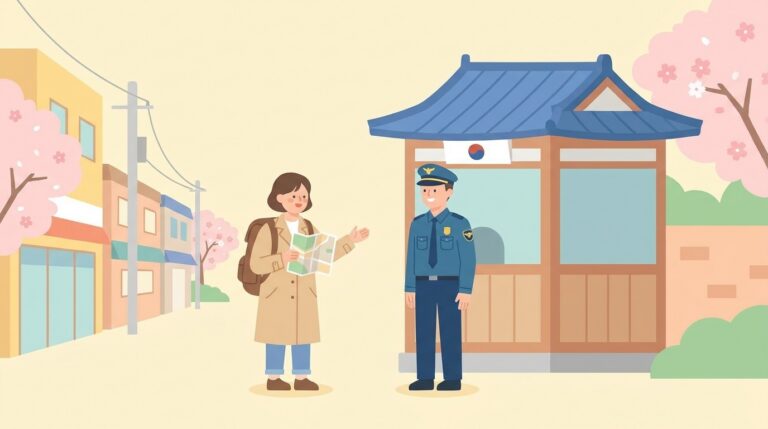
Phase 1: Empathy — When Your Dream K-Travel Turns Into a Panic
Annyeonghaseyo! Hello, this is your Daily Hangul Editor! Imagine walking down vibrant Hongdae after buying K-Pop albums and eating spicy tteokbokki, just like a fun travel scene in your favorite K-Drama. Suddenly, your heart drops. Your bag is gone, along with your passport! Panic sets in, and you need to reach your embassy fast. Many beginner learners tell us that freezing up during an emergency is their biggest travel fear. That is why we created this A1 survival guide based on real student feedback. Master these simple, life-saving Korean phrases today so you can explore Korea with total confidence and peace of mind!
Phase 2: Deep Dive Into 3 Core Survival Expressions
1. 대사관에 연락해 주세요 (Daesagwane yeollakhae juseyo)
- Pronunciation: Daesagwane yeollakhae juseyo (Sounds like: “Day-sah-gwan-eh yul-lak-hay joo-say-yo” — notice how “yeollak” glides smoothly like saying “yul-lock”!)
- Meaning: Literally “Please do contact to the embassy” vs. Actual Nuance: A polite, urgent request asking someone like a police officer or hotel staff to call your embassy for you.
- K-Culture Moment: Picture an intense K-Drama thriller scene where a traveler gets into sudden trouble in Itaewon and urgently asks a kind detective for help.
- Editor’s Insight: Adding “해 주세요 (hae juseyo)” turns a noun into a polite request. Even if your voice shakes in a panic, this ending sounds respectful and clear!
- Situation Spectrum: Casual 🚫 / Semi-formal ✅ / Formal ✅
- 🤔 Think About It: In English, we might yell “Call my embassy!” when stressed. Why do Koreans still attach “주세요 (juseyo — please do for me)” even during an emergency?
2. 여권을 잃어버렸어요 (Yeogwoneul ireobeoryeosseoyo)
- Pronunciation: Yeogwoneul ireobeoryeosseoyo (Sounds like: “Yuh-gwon-eul ee-ruh-buh-ryuh-ssuh-yo” — say “yuh-gwon” followed by “ear-uh-buh-ryuh-ssuh-yo”!)
- Meaning: Literally “I have completely lost my passport” vs. Actual Nuance: Expresses regret and finality—it is truly gone, not just hiding in your coat pocket.
- K-Culture Moment: In popular Korean travel variety shows, cast members often pat their pockets in total shock at Incheon Airport right before boarding!
- Editor’s Insight: The grammar pattern “-어 버렸어요 (-eo beoryeosseoyo)” carries an emotional “oh no!” feeling. Koreans immediately hear your distress and rush to help.
- Situation Spectrum: Casual ⚠️ / Semi-formal ✅ / Formal ✅
- 🤔 Think About It: Korean verbs pack emotions like regret right inside the grammar! How do you express that sudden “oh no” feeling in your native language?
3. 도와주세요 (Dowajuseyo)
- Pronunciation: Dowajuseyo (Sounds like: “Doh-wah-joo-say-yo” — super smooth, almost like “dough-wah-juice-say-yo”!)
- Meaning: Literally “Please give help” vs. Actual Nuance: The ultimate universal SOS phrase on Korean streets.
- K-Culture Moment: Classic K-Drama hero moments where someone drops their belongings or gets lost in Gangnam and calls out this exact phrase.
- Editor’s Insight: Short, loud, and impossible to misunderstand. If your mind goes completely blank in a crisis, start with this one word!
- Situation Spectrum: Casual 🚫 / Semi-formal ✅ / Formal ✅
- 🤔 Think About It: Even when calling out to strangers in a rush, Korean keeps the polite “-요 (-yo)” ending. How does urgency change politeness in your home culture?
Phase 3: Textbook Korean vs. Real Korean
Situation 1: Stopping a stranger on the street for help
- 📖 교과서 한국어 (Textbook Korean): 실례지만, 저를 좀 도와주시겠습니까? (Sillyejiman, jeoreul jom dowajusigetseumnikka? — Excuse me, would you be so kind as to assist me?)
- 🗣️ 진짜 한국어 (Real Korean): 저기요! 죄송한데 좀 도와주세요! (Jeogiyo! Joesonghande jom dowajuseyo! — Excuse me! Sorry, please help me!)
- 💡 왜 다를까? (Why is it different?): Textbook sentences are way too long when your heart is racing. Real Koreans use “저기요 (Jeogiyo)” to catch attention fast and “죄송한데 (Joesonghande)” to soften the sudden interruption.
Situation 2: Reporting a missing passport
- 📖 교과서 한국어 (Textbook Korean): 저는 저의 여권을 분실하였습니다. (Jeoneun jeoui yeogwoneul bunsilhayeotseumnida. — I have misplaced my passport.)
- 🗣️ 진짜 한국어 (Real Korean): 저 여권 잃어버렸어요… (Jeo yeogwon ireobeoryeosseoyo… — I lost my passport…)
- 💡 왜 다를까? (Why is it different?): “분실하다 (bunsilhada)” sounds like a stiff legal report. Everyday speakers drop “my” and use “잃어버렸어요 (ireobeoryeosseoyo)” so the listener feels your urgency right away.
Phase 4: K-Culture Deep Dive & Non-Verbal Manners
4-1. Nunchi (눈치) & Gestures
When asking for urgent help on a Korean street, your body language speaks before your words do. Give a quick, slight nod or bow of your head as you approach someone—this signals respect and immediately lowers their guard. Keep your palms open and relaxed rather than waving your hands too wildly or pointing a finger at someone (pointing directly is considered rude in Korea). Maintain gentle, sincere eye contact so the person knows it is a genuine emergency and not a sales pitch.
4-2. Culture Code: K-Travel & Neighborhood Safety
Have you noticed small, brightly lit police stations on busy Korean corners in K-Dramas? They are called 파출소 (Pachulso), or neighborhood police boxes, and they are everywhere in tourist hotspots like Myeongdong, Hongdae, and Gangnam! Thanks to Korea’s warm community spirit called 정 (Jeong), locals rarely walk away from a panicked traveler. If you ask a café worker or shopkeeper for help, they will often walk you straight to the nearest Pachulso or dial your embassy themselves!
Phase 5: Real-Life Roleplay Scenario
Setting: Neon signs glow above bustling Hongdae Exit 9 while upbeat K-Pop plays from nearby clothing stores. You check your crossbody bag and freeze—your passport pouch is missing! You spot a cozy neighborhood police box (파출소) and hurry inside.
Character: Officer Kim (김 순경 / Gim Sungyeong), a calm, friendly young officer who looks straight out of a heartwarming K-Drama.
- You: 🎭 (Rushing through the glass door, looking worried) 저기요! 도와주세요! (Jeogiyo! Dowajuseyo! — Excuse me! Please help me!)
- Officer Kim: 🎭 (Standing up immediately with a reassuring nod) 네, 무슨 일이에요? 천천히 말씀하세요. (Ne, museun irieyo? Cheoncheonhi malsseumhaseyo. — Yes, what happened? Please speak slowly.)
- You: 🎭 (Pointing gently to your empty bag) 저 여권을 잃어버렸어요. (Jeo yeogwoneul ireobeoryeosseoyo. — I lost my passport.)
- Officer Kim: 🎭 (Grabbing a notepad right away) 아이고, 어디에서 잃어버렸어요? (Aigo, eodieseo ireobeoryeosseoyo? — Oh dear, where did you lose it?)
- You: 🎭 (Looking stressed and shaking your head) 잘 모르겠어요. 대사관에 연락해 주세요. (Jal moreugesseoyo. Daesagwane yeollakhae juseyo. — I am not sure. Please contact the embassy.)
- Officer Kim: 🎭 (Picking up the desk phone with a calm smile) 네, 알겠습니다. 어느 나라 사람이에요? (Ne, algetseumnida. Eoneu nara saramieyo? — Yes, understood. Which country are you from?)
- You: 🎭 (Pulling out a photo of your ID on your phone) 여기 있어요. 감사합니다! (Yeogi isseoyo. Gamsahamnida! — Here it is. Thank you!)
- Officer Kim: 🎭 (Dialing the number for you) 걱정하지 마세요. 지금 바로 전화할게요. (Geokjeonghaji maseyo. Jigeum baro jeonhwahalgeyo. — Do not worry. I will call right now.)
🔀 Interactive Branching Point: What do you say next if the officer asks for your phone number?
- A. “제 전화번호예요!” (Je jeonhwabeonhoyeyo! — Here is my phone number!) (Showing your phone screen politely)
- B. “전화번호 몰라!” (Jeonhwabeonho molla! — I don’t know my number!) (Said loudly in casual speech without -yo)
- C. “그냥 가고 싶어요.” (Geunyang gago sipeoyo. — I just want to leave.) (Turning toward the door)
Branch Feedback:
* Choice A (Best!): Fantastic! Keeping the polite “-예요 (-yeyo)” ending and showing your screen makes communication fast, clear, and respectful.
* Choice B (Bad!): Oops! Using casual “몰라 (molla)” with a police officer sounds rude and aggressive. Always add “-요 (-yo)” like “몰라요 (mollayo — I don’t know)”!
* Choice C (Risk!): Careful! Leaving before filing a police report or contacting your embassy can delay getting a temporary passport.
Phase 6: 10-Second Emotion Shadowing Drill
Read these out loud! Pause briefly at every / mark and match the emotion tag.
- [😰 Urgent and slightly panicked] 저기요! / 좀 도와주세요! (Jeogiyo! / Jom dowajuseyo! — Excuse me! / Please help me!)
- [🥺 Worried and sincere] 저 / 여권을 잃어버렸어요. (Jeo / yeogwoneul ireobeoryeosseoyo. — I / lost my passport.)
- [🙏 Polite and pleading] 대사관에 / 연락해 주세요. (Daesagwane / yeollakhae juseyo. — To the embassy / please make contact.)
- [😮💨 Relieved and grateful] 정말 / 감사합니다! (Jeongmal / gamsahamnida! — Thank you / so much!)
Phase 7: K-Culture Mini Dictionary
- 대사관 (Daesagwan) | Embassy | Used in news, travel guides, and emergency situations when citizens need official help abroad.
- 여권 (Yeogwon) | Passport | One of the very first words you hear at Incheon Airport check-in counters and duty-free shops!
- 파출소 (Pachulso) | Neighborhood Police Box | Small local police stations seen in countless K-Dramas where officers help lost travelers and neighbors.
- 긴급 (Gingeup) | Emergency | Often spotted on Korean subway signs, phone alerts (긴급재난문자), and hospital doors.
Phase 8: Survival Kit for Travelers
Top 3 Street Survival Phrases
- 경찰을 불러 주세요 (Gyeongchareul bulleo juseyo) — Please call the police. (Pro Tip: In Korea, dial 112 directly for police, or 119 for fire/ambulance!)
- 영어를 할 수 있어요? (Yeongeoreul hal su isseoyo?) — Can you speak English? (Pro Tip: Many younger Koreans understand basic English, especially near major subway stations.)
- 여기가 어디예요? (Yeogiga eodiyeyo?) — Where is this place? (Pro Tip: Say this while showing your phone so you can tell your embassy your exact location!)
Editor’s Travel Note
Before your flight lands, take two minutes to Download Naver Map App for Accurate Korean Directions because global map apps have limited walking routes in Korea. Save the Korea Travel Hotline 1330 Multilingual Guide in your contacts—friendly operators speak English 24/7 and can translate for you with police or embassies! Also, keep a photo of your passport bio page in a cloud album and keep a small backup emergency fund separate from your T-money transit card.
Phase 9: One Step Deeper — Why Politeness Matters Even in a Panic
You might wonder why Koreans keep adding polite endings like “-주세요 (-juseyo)” even when everything is going wrong. In Korean society, language builds an instant bridge of respect between strangers. Even a tiny polite syllable signals that you are asking for kindness as a community member rather than barking orders. When you pair your urgent request with respectful speech, Korea’s warm 정 (Jeong) culture kicks in—turning everyday passersby into helpful allies.
💬 Your Turn: Have you ever lost something important while traveling abroad? How did locals help you? Share your story in the comments below!
Phase 10: FAQ & Common Mistakes
Q: Can I just say “Embassy” in English if I panic?
A: Many Koreans recognize basic English words like “passport” or “police,” but “embassy” is often much harder for non-English speakers to catch! Knowing 대사관 (Daesagwan) will save you precious minutes.
Q: What is the difference between “연락해 주세요 (Yeollakhae juseyo)” and “전화해 주세요 (Jeonhwahae juseyo)”?
A: “전화해 주세요 (Jeonhwahae juseyo)” specifically means “please call,” while 연락해 주세요 (Yeollakhae juseyo) means “please contact” (by phone, text, or message). Both work wonderfully at a police box!
Q: Is it okay to ask a convenience store clerk for help?
A: Yes! Korean convenience stores (like CU or GS25) are open 24/7 and are safe, bright spots to pause, ask “도와주세요 (Dowajuseyo),” and call 1330 or your embassy.
🚨 Common Mistakes TOP 3
- Saying “도와줘! (Dowajwo!)” to strangers: This drops the polite “-요 (-yo)” and sounds like you are talking down to a child. Correct Action: Always use 도와주세요 (Dowajuseyo)!
- Confusing “여권 (Yeogwon – passport)” with “지갑 (Jigap – wallet)”: In a rush, learners mix these up! Correct Action: Practice both words separately so you know if you lost your ID or your cash.
- Forgetting to save your embassy’s Korean address: Saying the name in English might confuse a taxi driver. Correct Action: Screenshot your embassy’s Hangul name and address before your trip.
Phase 11: Action Mission & Engagement
- 🥉 Bronze Mission: Stand in front of a mirror and say “대사관에 연락해 주세요 (Daesagwane yeollakhae juseyo)” three times in under 10 seconds!
- 🥈 Silver Mission: Write down your own country’s name in Korean plus “대사관 (Daesagwan)” (e.g., 미국 대사관 — U.S. Embassy) and save it as a note on your phone.
- 🥇 Gold Mission: Roleplay Phase 5 out loud with a study buddy or language partner without looking at the Romanization.
- 🎮 K-Culture Mission: Watch an airport or travel episode of your favorite Korean variety show or K-Drama and listen closely—can you catch anyone shouting “여권 (Yeogwon)” or “도와주세요 (Dowajuseyo)”?
Phase 12: Interactive Quiz Challenge
Quiz 1: Situational Judgment
You realize your passport is gone in Myeongdong and run up to a friendly officer. Which sentence is best?
A. 여권을 잃어버렸어요. 대사관에 연락해 주세요. (Yeogwoneul ireobeoryeosseoyo. Daesagwane yeollakhae juseyo.)
B. 여권을 잃어버렸어! 대사관에 연락해! (Yeogwoneul ireobeoryeosseo! Daesagwane yeollakhae!)
Click here to reveal the answer and feedback!
Correct Answer: A!
Feedback: Option A uses polite “-요 (-yo)” and “-주세요 (-juseyo)” endings, which sound clear and respectful. Option B uses casual speech (banmal), which sounds rude to a stranger or police officer!
Quiz 2: Fill in the Blank
Fill in the missing Korean word for “passport”:
“저 ____을 잃어버렸어요.” (Jeo ____eul ireobeoryeosseoyo. — I lost my passport.)
Click here to reveal the answer!
Correct Answer: 여권 (Yeogwon)
Full sentence: 저 여권을 잃어버렸어요. (Jeo yeogwoneul ireobeoryeosseoyo.)
Quiz 3: True or False Culture Quiz
True or False: In Korea, small neighborhood police boxes called 파출소 (Pachulso) can help tourists who lose their passports.
Click here to reveal the answer!
Correct Answer: True!
Neighborhood police boxes (파출소) are located all over major Korean cities and are one of the safest, fastest places to get help contacting your embassy.
🎬 Watch Our Daily Videos! (Daily Hangul Official Instagram)
Review the expressions you learned in this article with our fun daily short videos! Check out native pronunciation and real-life nuances in action.
- Instagram @dailyhangul_en







