

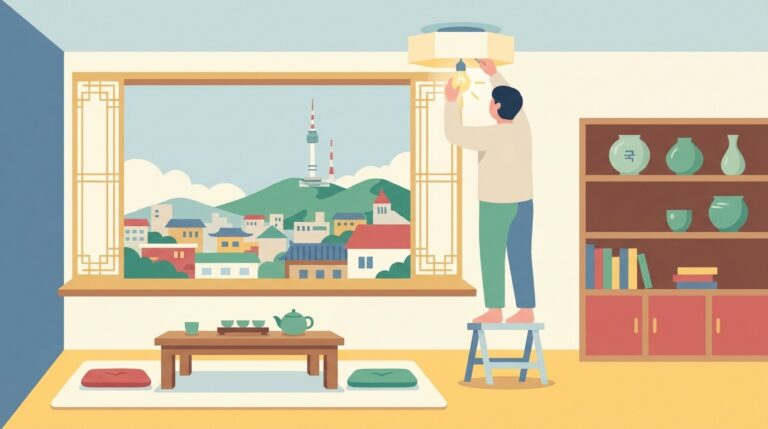
Phase 1: Why Your Landlord Won’t Change That Flickering Lightbulb
안녕하세요! 매일한글 에디터입니다. (Annyeonghaseyo! Hello, this is the Daily Hangul Editor.) Imagine this: it is late at night in your cozy Seoul officetel. You just finished boiling spicy ramyeon like your favorite K-drama protagonist, and suddenly—buzz, flicker, darkness. The kitchen fluorescent tube just died. Your first instinct might be to text your landlord right away, just like you would for a broken boiler or a leaking pipe. Wait—before you send that message! In Korea, knowing the difference between landlord-covered repairs and tenant-paid consumables can save you from an awkward conversation. Based on real stories from our B1 learners living in Korea, today’s guide gives you the exact Korean expressions to handle repairs smoothly and figure out what you need to replace yourself!
Phase 2: Deep Dive into 3 Essential Expressions
1. 소모품은 세입자가 직접 교체해야 해요 (Somopumeun seipjaga jikjeop gyochehaeya haeyo)
- Pronunciation: [so-mo-pu-meun se-ip-jja-ga jik-jjeop gyo-che-hae-ya hae-yo] (Sounds like: so-mo-poo-mun say-eep-jah-gah jeek-jup gyo-cheh-hay-yah hay-yo, with a crisp, doubled jj like the j in “jet” right after a pause)
- Meaning: Literal: “Consumables must be replaced directly by the tenant.” / Real nuance: This is the standard, polite rule landlords or real estate agents cite to draw a clear boundary on maintenance costs.
- K-Culture Moment: In Korean slice-of-life dramas like Because This Is My First Life, young renters constantly deal with strict lease rules. When a lightbulb goes out, characters don’t call the landlord—they sigh and head straight to Daiso.
- Editor’s Insight: Notice the verb 교체하다 (gyochehada, to replace) vs. 갈다 (galda, to change/swap). While 갈아 끼우다 (gara kkiuda, to swap and plug in) is super natural for bulbs, 교체하다 sounds more official and is what you will hear from landlords or building managers.
- Situation Spectrum: Casual 🚫 (Too stiff for close friends) / Semi-formal ✅ (Perfect with roommates or neighbors) / Formal ✅ (Standard when speaking with landlords or agents)
- 🤔 Think About It: In your home country, who is responsible for small things like lightbulbs or showerhead hoses? Korea draws a sharp line between “structural fixtures” (집주인 책임, landlord’s duty) and “consumables” (소모품, tenant’s duty).
2. 형광등이 나가서 새 걸로 갈아 끼워야 해요 (Hyeonggwangdeungi nagaseo sae geollo gara kkiwoya haeyo)
- Pronunciation: [hyeong-gwang-deung-i na-ga-seo sae geol-lo ga-ra kki-wo-ya hae-yo] (Sounds like: hyung-gwahng-dung-ee nah-gah-suh seh gull-lo gah-rah kee-woh-yah hay-yo, where kki is tight and sharp like “key” without a puff of air)
- Meaning: Literal: “The fluorescent light went out, so I have to swap it with a new one.” / Real nuance: Using 나가다 (nagada, to go out) for appliances or lights is the ultimate native way to say something burned out or stopped working.
- K-Culture Moment: You will often hear this exact phrasing in Korean variety shows like I Live Alone (나 혼자 산다) when celebrities struggle with DIY home maintenance on a weekend afternoon.
- Editor’s Insight: B1 learners often say 형광등이 죽었어요 (the light died), which sounds funny to Koreans! Remember: lights and electricity “go out” (나가다, nagada), and you “fit/plug in” (끼우다, kkiuda) the new bulb.
- Situation Spectrum: Casual ✅ (Drop 요 to make it 해요 -> 해) / Semi-formal ✅ (Natural with anyone) / Formal ⚠️ (Use 새로운 것으로 교체해야 합니다 for very formal situations)
- 🤔 Think About It: Why do Koreans say a light “went out” (나갔다) instead of “broke”? Thinking about energy or function “leaving” an object helps you remember phrases like 전기가 나갔다 (the power went out) or 목소리가 나갔다 (I lost my voice)!
3. 혹시 이건 집주인분이 고쳐주시는 건가요? (Hoksi igeon jipjuinbuni gochyeojusineun geongayo?)
- Pronunciation: [hok-ssi i-geon jip-jju-in-bu-ni go-chyeo-ju-si-neun geon-ga-yo] (Sounds like: hohk-shee ee-gun jeep-jjoo-een-boo-nee goh-chuh-joo-shee-nun gun-gah-yo)
- Meaning: Literal: “By any chance, is this something the homeowner fixes for me?” / Real nuance: A polite, non-confrontational way to check if a repair (like a boiler error, water leak, or clogged pipe) falls under the landlord’s responsibility.
- K-Culture Moment: When tenants face a leaking ceiling in dramas like My Mister, they gently use 혹시 (hoksi, by any chance) + ~는 건가요? to avoid sounding demanding while still protecting their rights.
- Editor’s Insight: Adding 분 (bun, honorific for person) after 집주인 (landlord) and using 주시다 (jusida, honorific “to do for someone”) turns a potentially tense money question into a super respectful, friendly inquiry.
- Situation Spectrum: Casual 🚫 (Way too polite for friends) / Semi-formal ✅ (Great for asking a Korean roommate) / Formal ✅ (Gold standard for texting or calling your landlord)
- 🤔 Think About It: Notice how Korean softens financial requests with indirect phrasing (~는 건가요? instead of “Fix this!”). How does softening a request change the landlord’s willingness to help quickly in your culture?
Phase 3: Textbook Korean vs. Real Korean
Situation 1: Telling someone a lightbulb burned out
- 📖 Textbook Korean: 전구가 고장 나서 새 전구로 교체해야 합니다. (Jeonguga gojang naseo sae jeonguro gyochehaeya hamnida. – The lightbulb broke, so I must replace it with a new lightbulb.)
- 🗣️ Real Korean: 전구 나가서 새 거 사 와서 갈아야 돼요. (Jeongu nagaseo sae geo sa waseo garaya dwaeyo. – The bulb went out, so I gotta buy a new one and swap it.)
- 💡 Why the difference? Textbooks overuse 고장 나다 (to break mechanically) and 교체하다 (to replace). In real daily life, Koreans distinguish between mechanical breakdowns (보일러 고장, boiler breakdown) and burnt-out bulbs (전구 나감), and simply say 갈다 (to swap) for bulbs!
Situation 2: Asking for a serious repair (leak/clogged drain)
- 📖 Textbook Korean: 배수관이 막혔으니 빨리 수리해 주세요. (Baesugwani makhyeosseuni ppalli surihae juseyo. – The drain is clogged, so please repair it quickly.)
- 🗣️ Real Korean: 죄송한데 싱크대 물이 안 내려가서요. 혹시 기사님 불러주실 수 있나요? (Joesonghande singkeudae muri an naeryeogaseoyo. Hoksi gisanim bulleojusil su innayo? – Sorry to bother you, but the sink water isn’t going down. Could you possibly call a technician?)
- 💡 Why the difference? Saying “repair it quickly” directly sounds like an order. Real Koreans describe the symptom (물이 안 내려가요 – the water isn’t going down) and politely ask the landlord to call a technician (기사님, gisanim) using ~아/어서요 and 혹시.
Phase 4: K-Culture Deep Dive & Non-Verbal Manners
4-1. Nunchi (눈치) & Gestures
When talking to a landlord (집주인) or building manager (관리인) in person or via KakaoTalk, evidence and humility are key to good Nunchi. Before asking “Is this my job or yours?”, always snap a clear photo or short video of the broken part—whether it is a blinking boiler error code, a leak under the sink, or the label on a dead fluorescent tube. If you meet them in person, slightly tilt your head, keep your palms open when pointing toward the issue, and avoid crossing your arms. Crossing your arms while discussing housing issues is perceived as aggressive in Korea.
4-2. Cultural Code Analysis: The Korean Daiso & Self-Repair Culture
In Korea, almost every neighborhood has a multi-story Daiso (다이소) or a local hardware store (철물점, cheolmuljeom). Because Korean Jeonse (전세) and Wolse (월세) contracts clearly state that minor consumables (소모품, somopum) like LED bulbs, fluorescent tubes, batteries for digital door locks (도어락 건전지), and sink strainers are the tenant’s responsibility, Koreans rarely bother their landlords for small things. In fact, taking a quick picture of the old bulb’s wattage and socket type (like FPL 36W or E26) and showing it to a Daiso or hardware store clerk is a classic Korean survival ritual!
Phase 5: Practical Roleplay Scenario
Setting: A warm Tuesday evening at a cozy neighborhood hardware store (철물점) near your apartment in Mangwon-dong. The friendly owner, Mr. Kim (김 사장님), is wiping down a counter surrounded by neatly stacked LED tubes and plumbing tools. You walk in holding a photo of your dead kitchen light.
- You: 사장님, 저기… 주방 형광등이 나갔는데요. (Sajangnim, jeogi… jubang hyeonggwangdeungi naganneundeyo.)
Translation: Excuse me, owner… my kitchen fluorescent light went out.
🎭 Stage Direction: (Hold up your phone politely with both hands to show the photo of the ceiling light.) - Mr. Kim: 아이고, 어두워서 불편하시겠네. 사진 좀 봅시다. 어, 이건 길쭉한 LED 등이네요. (Aigo, eoduwoseo bulpyeonhasigenne. Sajin jom bopsida. Eo, igeon giljjukan LED deungineyo.)
Translation: Oh my, it must be uncomfortable in the dark. Let me see the photo. Oh, this is a long LED tube.
🎭 Stage Direction: (Puts on his reading glasses and leans over the counter with a warm smile.) - You: 네, 월세방인데 집주인분이 형광등은 제가 직접 갈아 끼워야 한대요. (Ne, wolsebanginde jipjuinbuni hyeonggwangdeungeun jega jikjeop gara kkiwoya handaeyo.)
Translation: Yes, I’m renting monthly, and the landlord says I have to replace the fluorescent light myself.
🎭 Stage Direction: (Shrug slightly with a friendly, relatable sigh.) - Mr. Kim: 맞아요, 전구나 형광등 같은 소모품은 원래 세입자가 사서 가는 거예요. 보일러나 누수 같은 큰 고장만 집주인 몫이죠. (Majayo, jeonguna hyeonggwangdeung gateun somopumeun wollae seipjaga saseo ganeun geoyeyo. Boilleona nusu gateun keun gojangman jipjuin moksijyo.)
Translation: That’s right, consumables like lightbulbs or fluorescent tubes are originally bought and changed by the tenant. Only big breakdowns like boilers or leaks are the landlord’s responsibility.
🎭 Stage Direction: (Nods knowingly while walking toward the lighting aisle.) - You: 그렇군요. 혹시 이거랑 똑같은 걸로 하나 주시겠어요? (Geureokunyo. Hoksi igeorang ttokgateun geollo hana jusigesseoyo?)
Translation: I see. Could you possibly give me one that’s exactly like this?
🎭 Stage Direction: (Follow him to the shelf, pointing gently at your phone screen again.) - Mr. Kim: 여기 있어요. 색상은 하얀 불빛이 좋아요, 아니면 따뜻한 노란 불빛이 좋아요? (Yeogi isseoyo. Saeksangeun hayan bulbichi joayo, animyeon ttatteutan noran bulbichi joayo?)
Translation: Here it is. Do you prefer a white light color, or a warm yellow light color?
🎭 Stage Direction: (Holds up two boxes, one labeled 주광색 and one labeled 전구색.) - You: 음… 주방이니까 밝은 하얀 불빛으로 주세요! (Eum… jubanginikka balgeun hayan bulbicheuro juseyo!)
Translation: Hmm… since it’s the kitchen, please give me the bright white light!
🎭 Stage Direction: (Smile brightly and tap the white-light box lightly.) - Mr. Kim: 알겠습니다. 두꺼비집 내리고 조심해서 끼우세요! (Algesseumnida. Dukkeobijip naerigo josimhaeseo kkiuseyo!)
Translation: Got it. Turn down the circuit breaker and put it in carefully!
🎭 Stage Direction: (Hands you the bag with a caring, fatherly nod.)
🔀 Interactive Branching Point
Before leaving the store, you suddenly remember your bathroom sink has also been dripping water underneath the pipe! How do you ask Mr. Kim if that is also something you have to fix yourself?
* A: 아저씨, 싱크대 밑에 물 새는 것도 제가 고쳐야 돼요? (Ajeossi, singkeudae mite mul saeneun geotdo jega gochyeoya dwaeyo?)
* B: 사장님, 혹시 욕실 세면대 밑에 누수가 있는데, 그것도 소모품이라 제가 해야 하나요? (Sajangnim, hoksi yoksil semyeondae mite nusuga inneunde, geugeotdo somopumira jega haeya hanayo?)
* C: 집주인이 안 고쳐주면 제가 그냥 테이프로 감을까요? (Jipjuini an gochyeojumyeon jega geunyang teipeuro gameulkkayo?)
Feedback:
* Option A (Risk ⚠️): Calling an older male shopkeeper “아저씨” (Ajeossi) isn’t terrible, but “사장님” (Sajangnim, Boss/Owner) is much friendlier and more respectful in Korean customer interactions!
* Option B (Best ✅): Spot on! Using “사장님”, the accurate B1 word “누수” (water leak), and politely double-checking whether it counts as a “소모품” (consumable) sounds natural and smart.
* Option C (Bad 🚫): Never fix a real pipe leak with just tape! Water damage (누수 피해) can affect the downstairs neighbor and cost you your security deposit—always tell your landlord immediately.
Phase 6: 10-Second Emotional Shadowing Drill
Read these aloud, pausing briefly at / and matching the emotional cue!
- [😮 Slightly panicked, pointing at the ceiling]
어? / 갑자기 / 형광등이 나갔어요! (Eo? / Gapjagi / hyeonggwangdeungi nagasseoyo! – Huh? Suddenly the fluorescent light went out!) - [🤔 Curious and polite, texting your landlord]
혹시 / 소모품 교체는 / 제가 직접 해야 하나요? (Hoksi / somopum gyocheneun / jega jikjeop haeya hanayo? – By any chance, do I need to replace consumables myself?) - [😌 Relieved and determined, walking to Daiso]
그럼 / 다이소에서 / 새 전구 사 와서 / 갈아 끼워야겠다! (Geureom / Daisoeseo / sae jeongu sa waseo / gara kkiwoyagetda! – Then I’ll buy a new bulb at Daiso and swap it in!)
Phase 7: K-Culture Mini Dictionary
- 소모품 (Somopum) | Consumables | Items that naturally wear out or run out with daily use (bulbs, batteries, shower hoses, filter cartridges). Crucial word in Korean lease agreements!
- 누수 (Nusu) | Water leak | Used when water leaks from pipes, boilers, or ceilings. Unlike bulbs, 누수 is almost always an urgent repair handled by the landlord.
- 배수관 막힘 (Baesugwan makhim) | Clogged drain | Used when sink or bathroom floor drains back up. Minor hair clogs are the tenant’s job, while deep structural pipe clogs are the landlord’s.
- 두꺼비집 (Dukkeobijip) | Circuit breaker / Fuse box | Literally “toad house” because old Korean fuse boxes looked like a cute toad! Always flip this off before changing a ceiling light.
Phase 8: Survival Kit for Travelers & Expats
Top 3 Survival Expressions
- 전구 어디에 있어요? (Jeongu eodie isseoyo?) – Where are the lightbulbs? Pro Tip: Show a photo of the old bulb’s base (소켓) so the staff matches the exact pins!
- 물이 안 내려가요. (Muri an naeryeogayo.) – The water isn’t going down. Pro Tip: Use this instantly for a clogged sink or toilet.
- 보일러 에러 코드가 떠요. (Boilleo ereo kodeuga tteoyo.) – A boiler error code is popping up. Pro Tip: Take a photo of the digital number (e.g., E1, 03) on the wall controller before calling your landlord.
Editor’s Travel & Living Note
If you just moved into a Korean studio or Airbnb for a long stay, finding the nearest hardware store or Daiso is essential. You can quickly locate one by using the Naver Map app download and searching “철물점” (hardware store) or “다이소” (Daiso). Most local hardware stores accept KakaoPay or Korean debit cards, and at Daiso you can easily grab a new LED bulb for just 2,000 to 5,000 KRW using self-checkout!
Phase 9: One Step Deeper
In Korea, the boundary between what a landlord fixes and what a tenant fixes reflects the unique concept of “책임의 명확화” (clear division of responsibility) built around the deposit-heavy housing system (전세/월세). Because tenants hold huge security deposits (보증금) and landlords expect the house returned in good condition, knowing how to maintain daily consumables like lightbulbs or sink strainers shows you are a responsible, trustworthy tenant. At the same time, Korean landlords are usually very responsive when it comes to serious infrastructure issues like boiler breakdowns or leaks—because a small leak today can ruin the downstairs neighbor’s ceiling tomorrow! Understanding this balance turns stressful housing hiccups into smooth cultural navigation.
💬 Your Turn: Have you ever had a funny or confusing moment replacing a bulb, fixing a boiler, or dealing with a drain in Korea (or your home country)? Drop a comment below and tell us your story!
Phase 10: FAQ & Common Mistakes
Q: Who pays if the entire fluorescent light fixture (등기구), not just the bulb, is broken?
A: If replacing a brand-new bulb still doesn’t turn the light on, the internal ballast (안정기) or fixture itself is likely broken. Since the fixture is a fixed structural part of the house, contact your landlord politely—they are generally responsible for replacing the fixture.
Q: Are digital door lock batteries (도어락 건전지) also the tenant’s responsibility?
A: Yes! Batteries are classic consumables (소모품). If your door lock plays a weird warning melody when opening, buy fresh alkaline AA batteries right away so you don’t get locked out.
Q: What if my kitchen drain gets clogged right after I move in?
A: If a clog happens within the first week or two of moving in, it is usually leftover buildup from the previous tenant. Take a video immediately and politely explain to your landlord that it was already clogged upon move-in.
🚨 Common Mistakes TOP 3
- Mistake: Saying “형광등이 고장 났어요” (The fluorescent light broke) to your landlord and waiting for them to come fix a dead bulb. -> Correct Action: Say “형광등이 나갔는데 제가 갈아 끼워도 될까요?” (The light went out; is it okay if I swap it myself?) or just buy the same bulb and swap it!
- Mistake: Throwing away the old lightbulb before going to the store. -> Correct Action: Korean bulbs come in many shapes (pin types, twist types, tube lengths). Take a clear photo of the printed text on the old bulb or bring it with you!
- Mistake: Ignoring a slow leak under the sink because you’re shy to speak Korean. -> Correct Action: Send a photo via KakaoTalk immediately with “혹시 여기 누수가 있는 것 같아서 연락드렸어요.” (I’m contacting you because it looks like there’s a leak here.) Fast reporting protects your deposit!
Phase 11: Action Mission & Engagement
- 🥉 Bronze Mission (Solo Practice): Look up at your room’s ceiling light right now and say aloud three times: “형광등이 나가면 제가 직접 사서 갈아 끼워야 해요.” (If the light goes out, I have to buy and swap it myself.)
- 🥈 Silver Mission (Share It): Screenshot Phase 7’s Mini Dictionary and share it on your Instagram Story or language study group with a caption about Korean Daiso life!
- 🥇 Gold Mission (Real-World Use): Next time you visit a Daiso or hardware store in Korea, check out the lighting aisle (조명 코너) and read the Korean labels for “주광색” (cool white) vs. “전구색” (warm yellow).
🎮 K-Culture Mission
Watch an episode of I Live Alone (나 혼자 산다) or a Korean moving vlog on YouTube! Listen closely whenever a host buys household supplies or checks their new apartment—see if you can catch words like 전구 (bulb), 소모품 (consumables), or 보일러 (boiler) in real action!
Phase 12: Interactive Quiz Challenge
Test your Korean housing survival instincts! Click the toggles below to check your answers.
Quiz 1 (Situation Judgment): Your bathroom sink pipe is dripping water onto the floor, and turning the faucet off doesn’t stop it. What is the best thing to text your landlord?
A. 사장님, 소모품이라 제가 테이프로 고칠게요.
B. 집주인분, 혹시 세면대 밑에 누수가 있는데 확인해 주실 수 있나요?
C. 형광등이 나갔어요.
👉 Click to reveal Answer & Explanation for Quiz 1
Answer: B!
A pipe drip is a 누수 (water leak), not a consumable! Texting politely with “혹시… 확인해 주실 수 있나요?” (Could you possibly check this?) lets your landlord handle it before water damage happens.
Quiz 2 (Fill in the Blank):
“형광등 같은 ______은 세입자가 직접 사서 갈아 끼워야 해요.”
(Consumables like fluorescent tubes must be bought and swapped by the tenant.)
👉 Click to reveal Answer & Explanation for Quiz 2
Answer: 소모품 (somopum)
Remember: items that naturally run out or burn out—bulbs, batteries, water filters—are 소모품 (consumables)!
Quiz 3 (True / False Cultural Quiz):
In Korea, if your boiler displays an error code and stops heating your floor, you have to pay a technician yourself because heating is a consumable.
👉 Click to reveal Answer & Explanation for Quiz 3
Answer: False!
A 보일러 고장 (boiler breakdown) is a major structural/appliance repair covered by the landlord (unless caused by clear tenant negligence, like turning it off completely during a deep freeze and bursting the pipes). Always contact your landlord right away for boiler errors!
🎬 Watch Our Daily Videos! (Daily Hangul Official Instagram)
Review the expressions you learned in this article with our fun daily short videos! Check out native pronunciation and real-life nuances in action.
- Instagram @dailyhangul_en







