

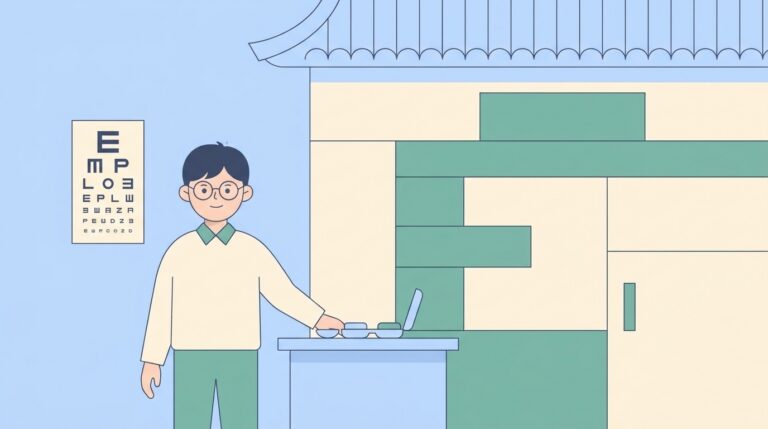
Phase 1: Empathy — One Week in Glasses for Clear Vision
안녕하세요! 매일한글 에디터입니다. (Annyeonghaseyo! Maeil Hangeul editeoimnida.) Hello, I’m your Daily Hangul editor! Picture yourself in Gangnam, Seoul’s bustling hub for K-Beauty and vision care. You’ve booked a pre-op exam for SMILE or LASIK, dreaming of waking up with crystal-clear vision—just like a K-Drama glow-up. There’s just one hurdle: to get accurate corneal curvature and prescription readings, you survived an entire week wearing clunky glasses instead of soft contact lenses. Now, sitting in a high-tech Korean clinic, you worry about explaining your lens hiatus or understanding side-effect risks. Built from real expat student experiences in Seoul, this B2 guide equips you with natural medical Korean so you can consult like a pro.
Phase 2: Deep Dive into 3 Core Expressions
1. 렌즈 착용을 중단하다 (renjeu chagyongeul jungdanhada)
- Pronunciation: ren-jeu chag-yong-eul jung-dan-ha-da (“ren-juh” like “render” + “juh”, “chag-yong” like “chalk-young”, “jung-dan” like “June-darn”)
- Meaning: Literal: “To halt/suspend lens wearing.” Actual Nuance: Sounds crisp, responsible, and medically accurate—much more polished than simply saying 안 썼어요 (an sseosseoyo – I didn’t use them).
- K-Culture Moment: Think of medical K-Dramas like Hospital Playlist or Dr. Romantic, where doctors ask patients if they paused habits or medication before an operation, and conscientious patients reply using formal Sino-Korean verbs like 중단하다 (jungdanhada).
- Editor’s Insight: At B2 level, switching from basic 안 하다 (an hada) to 중단하다 (jungdanhada – suspend/discontinue) instantly signals you take pre-op safety protocols seriously. Pair it with 최소 일주일 동안 (choeso iljuil dongan – for at least a week) for precision.
- Situation Spectrum: Casual 🚫 (too stiff with close friends) / Semi-formal ✅ (great during clinic intake) / Formal ✅ (ideal with doctors and specialists)
- 🤔 Think About It: In English, you might casually say “I took a break from my contacts.” Why do Korean medical settings favor precise Sino-Korean verbs like 중단하다 (jungdanhada) over softer native expressions?
2. 각막 형태와 도수를 측정하다 (gangmak hyeongtaewa dosureul cheukjeonghada)
- Pronunciation: gang-mak hyeong-tae-wa do-su-reul cheuk-jeong-ha-da (Note nasal assimilation on ㄱ+ㅁ: gang-mak sounds like “gahng-mahk”, hyeong-tae like “hyung-tay”, cheuk-jeong like “chook-jung”)
- Meaning: Literal: “To measure corneal shape and degree/power.” Actual Nuance: The exact clinical phrasing used on Korean ophthalmology checklists and consent forms.
- K-Culture Moment: In popular “Gangnam Eye Clinic Vlog” videos by Korean beauty YouTubers, creators film futuristic blue-light topography machines while captions flash 각막 측정 중 (gangmak cheukjeong jung – measuring cornea).
- Editor’s Insight: Notice the sound shift in 각막 (gak-mak -> gang-mak). Mastering this nasalization makes your medical Korean sound effortless. Also, 도수 (dosu) isn’t just for lens power—Koreans also use it for alcohol percentage! Context is everything.
- Situation Spectrum: Casual ⚠️ (fine when sharing your clinic experience with friends) / Semi-formal ✅ / Formal ✅
- 🤔 Think About It: Notice how 도수 (dosu) covers both optical prescription strength and liquor ABV. How does English separate technical “measurements” depending on context compared to Korean’s single root concept of “degree/level”?
3. 안구건조증이나 빛 번짐 같은 부작용 (angugeonjojjeungina bit beonjim gateun bujagyong)
- Pronunciation: an-gu-geon-jo-jjeung-i-na bit beon-jim ga-teun bu-jag-yong (jjeung is tense like “zzuhng”, bit beon-jim sounds like “beet bun-jim”, bu-jag-yong like “boo-jahg-yong”)
- Meaning: Literal: “Adverse effects like eyeball dryness disease or light spreading.” Actual Nuance: The golden B2 phrase for asking informed, thorough questions during your side-effect consultation.
- K-Culture Moment: On Korean health talk shows and realistic clinic consultations in dramas, specialists always walk patients through these exact two risks before anyone signs a surgical agreement.
- Editor’s Insight: 빛 번짐 (bit beonjim) literally means “light smudging/spreading”—like watercolor bleeding on wet paper! It captures night halos and glare far more vividly than clinical English terms.
- Situation Spectrum: Casual ⚠️ (okay when weighing surgery pros and cons with friends) / Semi-formal ✅ / Formal ✅
- 🤔 Think About It: Korean describes night glare visually as 빛 번짐 (bit beonjim – light smudging) rather than borrowing Greek or Latin medical roots. Does visual vocabulary make medical risks easier or scarier to imagine?
Phase 3: Textbook Korean vs. Real Korean
Situation 1: Explaining your one-week glasses streak
- 📖 Textbook Korean (교과서 한국어): 일주일 전부터 콘택트렌즈를 착용하지 않고 안경만 사용했습니다. (Iljuil jeonbuteo kontaekteurenjeureul chagyonghaji anko angyeongman sayonghaetseumnida. — Starting a week ago, I did not wear contact lenses and only used glasses.)
- 🗣️ Real Korean (진짜 한국어): 일주일 내내 렌즈 빼고 안경만 끼고 살았어요. (Iljuil naenae renjeu ppaego angyeongman kkigo sarasseoyo. — All week long, I left out my lenses and lived solely in glasses.)
- 💡 Why the difference? (왜 다를까?): At B2, adding ~고 살다 (~go salda – to live doing X) conveys the relatable daily struggle of wearing glasses 24/7, while 끼다 (kkida) is the natural colloquial verb for wearing glasses or lenses instead of stiff 사용하다 (sayonghada).
Situation 2: Asking about post-op dry eyes
- 📖 Textbook Korean (교과서 한국어): 수술 후에 안구건조증 부작용이 발생할 가능성이 높습니까? (Susul hue ansugeonjojjeung bujagyongi balsaenghal ganeungseongi nopseumnikka? — Is the probability high that dry eye side effects will occur after surgery?)
- 🗣️ Real Korean (진짜 한국어): 수술하고 나서 눈이 많이 뻑뻑해질까요? (Susulhago naseo nuni mani ppeokppeokhaejilkkayo? — After the surgery, will my eyes feel really dry and gritty?)
- 💡 Why the difference? (왜 다를까?): Koreans rely heavily on sensory mimetic adjectives! 뻑뻑하다 (ppeokppeokhada) vividly captures that stiff, gritty rubbing feeling in dry eyes—even doctors use it with patients because it feels warmer and clearer than textbook terminology.
Phase 4: K-Culture Deep Dive & Non-Verbal Manners
4-1. Nunchi (눈치) & Clinic Etiquette
When stepping into a Korean eye clinic (안과 – angwa), brisk efficiency is the cultural signature. Keep your ID (ARC or passport) handy at reception, and when resting your chin on diagnostic machines (턱을 대세요 – teogeul daeseyo / “Please place your chin here”), press your forehead firmly against the top bar without squinting or rubbing your eyes. Giving a slight polite nod while listening attentively to the optometrist (검안사 – geomansa) demonstrates great 눈치 (nunchi)—social awareness and respect for their workflow.
4-2. Cultural Code: K-Beauty & “Seoul Medical Speed-Run”
Just like K-Pop idols prepping for comebacks or office workers planning upgrades during 연휴 (yeonhyu – long holidays), vision correction in Korea is treated as an everyday lifestyle upgrade. Many clinics offer “One-Day Surgery” (원데이 수술 – wondei susul), combining 50+ pre-op screenings in the morning with afternoon SMILE surgery—provided you strictly followed the 7-day soft lens break! In Korea’s 빨리빨리 (ppalli-ppalli – hurry-hurry) culture, sneaking in lenses beforehand is a major faux pas because compressed corneas skew measurements and stall the entire precision timeline.
Phase 5: Real-World Roleplay Scenario
Setting: A sleek, minimalist 12th-floor eye clinic overlooking Gangnam Station. Soft ambient music plays beside rows of glowing diagnostic machines.
Characters: Ji-hyun (지현 선생님), a warm yet meticulous optometrist holding a digital checklist, and Alex, a B2 learner arriving after seven days in glasses.
- Ji-hyun: 🎭 (Checking her tablet with a bright smile) 안녕하세요, 알렉스 님! 오늘 정밀 검사 전에 확인 차 여쭤볼게요. (Annyeonghaseyo, Allekeu nim! Oneul jeongmil geomsa jeone hwagin cha yeojjwobolgeyo. — Hello, Alex! Before today’s precision exam, let me ask a quick confirmation question.)
- Alex: 🎭 (Adjusting your glasses slightly) 네, 선생님. 말씀하세요. (Ne, seonsaengnim. Malsseumhaseyo. — Yes, go ahead.)
- Ji-hyun: 혹시 검사 전 최소 일주일 동안 소프트렌즈 착용을 중단하셨나요? (Hoksi geomsa jeon choeso iljuil dongan sopeuteurenjeu chagyongeul jungdanhashyeotnayo? — Did you stop wearing soft lenses for at least a week before the exam?)
- Alex: 🎭 (Nodding confidently) 네, 정확한 각막 형태와 도수를 측정해야 한다고 해서 일주일 내내 안경만 쓰고 생활했어요. (Ne, jeonghwakhan gangmak hyeongtaewa dosureul cheukjeonghaeya handago haeseo iljuil naenae angyeongman sseugo saenghwalhaesseoyo. — Yes, because you need to measure corneal curvature and prescription accurately, I lived wearing only glasses all week.)
- Ji-hyun: 🎭 (Typing approvingly on the tablet) 아주 잘하셨어요! 렌즈를 끼면 각막이 눌려서 검사 결과가 부정확할 수 있거든요. (Aju jalhasyeosseoyo! Renjeureul kkimyeon gangmagi nullyeoseo geomsa gyeolgwaga bujeonghwakhal su itgeodeunyo. — You did great! Wearing lenses flattens the cornea, so test results can be inaccurate.)
- Alex: 🎭 (Leaning forward slightly with a serious expression) 다행이네요. 그런데 수술 후에 안구건조증이나 빛 번짐 같은 부작용은 어떨까요? (Dahaengineyo. Geureonde susul hue ansugeonjojjeungina bit beonjim gateun bujagyongeun eotteolkkayo? — Wait, check: angugeonjojjeungina! That’s a relief. By the way, how about side effects like dry eyes or light glare after surgery?)
- Ji-hyun: 초기에는 눈이 뻑뻑하거나 야간에 빛이 퍼져 보일 수 있는데, 대부분 시간이 지나면 호전돼요. (Chogieneun nuni ppeokppeokhageona yagane bichi peojyeo boil su inneunde, daebubun sigani jinamyeon hojeondwaeyo. — Early on your eyes may feel dry or lights may spread at night, but most cases improve over time.)
- Alex: 상세하게 설명해 주셔서 감사합니다. 이제 검사 시작할까요? (Sangsehage seolmyeonghae jusyeoseo gamsahamnida. Ije geomsa sijakalkkayo? — Thank you for explaining in detail. Shall we start the exam now?)
🔀 Interactive Branching Point
Suppose you actually wore soft lenses for two hours three days ago. How do you respond when Ji-hyun asks?
* Option A: 사실 사흘 전에 잠깐 두 시간 정도 꼈는데, 다시 일주일 뒤에 검사받는 게 나을까요? (Sasil saheul jeone jamkkan du sigan jeongdo kkyeonneunde, dasi iljuil dwie geomsabanneun ge naeulkkayo? — Actually, I wore them briefly for two hours three days ago; would it be better to get tested again in a week?) -> Best! Total honesty protects your corneal measurements and earns huge respect from Korean medical staff.
* Option B: 일주일 안 꼈어요! 잠깐 낀 건 별 상관없죠? (Iljuil an kkyeosseoyo! Jamkkan kkin geon byeol sanggwaneopjyo? — I didn’t wear them for a week! Wearing them briefly doesn’t matter much, right?) -> Bad! Contradicting yourself and brushing off safety protocols alarms Korean doctors, as even brief wear can alter corneal curvature.
* Option C: 글쎄요, 기억이 잘 안 나요. (Geulsseyo, gieogi jal an nayo. — Well, I don’t really remember.) -> Risk! Being vague makes the clinic hesitant to clear you for surgery, wasting your appointment and forcing a re-test.
Phase 6: 10-Second Emotional Shadowing Drill
Follow the / marks for natural pauses and channel the emotion tags:
1. [😌 Relieved & Earnest] 정확한 측정 때문에 / 일주일 내내 / 안경만 쓰고 살았어요. (Jeonghwakhan cheukjeong ttaemune / iljuil naenae / angyeongman sseugo sarasseoyo. — Because of the accurate measurement, I lived wearing only glasses all week.)
2. [🤔 Curious & Cautious] 수술 후에 / 빛 번짐 같은 부작용이 / 오래 갈까요? (Susul hue / bit beonjim gateun bujagyongi / orae galkkayo? — After surgery, will side effects like light glare last long?)
3. [😊 Polite & Proactive] 검사 전 주의사항을 / 다시 한번 / 확인해 주실 수 있나요? (Geomsa jeon juuisahangeul / dasi hanbeon / hwaginhae jusil su innayo? — Could you double-check the pre-exam precautions for me once more?)
Phase 7: K-Culture Mini Dictionary
- 정밀 검사 (jeongmil geomsa) | Comprehensive / Precision Exam | Used at eye clinics (안과 – angwa) for the 50+ pre-op tests, as well as corporate health checkups (건강검진 – geonganggeomjin) and medical dramas.
- 스마일라식 (Seumail Lasik) | SMILE Surgery | One of Korea’s most popular minimally invasive vision surgeries—you’ll spot this term on Gangnam subway billboards everywhere.
- 각막 두께 (gangmak dukke) | Corneal Thickness | A decisive measurement determining whether you qualify for LASIK, LASEK, or lens implantation (렌즈삽입술 – renjeusabipsul).
- 인공눈물 (ingongnunmul) | Artificial Tears | An absolute pouch staple for Korean office workers and post-op patients, especially preservative-free vials (무방부제 – mubangbuje).
Phase 8: Traveler’s Survival Kit
Top 3 Survival Phrases
- 통역 서비스 있나요? (Tongyeok seobiseu innayo?) — “Do you have interpretation services?” Pro Tip: Major clinics in Gangnam and Myeongdong often provide free English coordinators if you ask when booking.
- 안약 넣는 시간 알려주세요. (Anyak neonneun sigan allyeojuseyo.) — “Please tell me when to put in the eye drops.” Pro Tip: Your eyes may stay blurry for hours after pupil dilation (산동 검사 – sandong geomsa), so snap a photo of the schedule!
- 오늘 운전하면 안 되죠? (Oneul unjeonhamyeon an doejyo?) — “I shouldn’t drive today, right?” Pro Tip: Bring dark sunglasses! Pupil-dilating drops make Seoul’s bright daylight feel blinding.
Editor’s Travel Note
Before heading to your clinic, download the Naver Map app for Korean clinic directions since Google Maps doesn’t offer reliable walking navigation in Seoul. Also, install the Kakao T app for instant taxi rides because reading tiny subway signs after pupil dilation is nearly impossible! Always carry your physical passport or Alien Registration Card (ARC) for medical registration and potential tourist VAT tax-refund receipts.
Phase 9: One Step Deeper
In Korea, medical consultations blend rapid efficiency with mutual responsibility. Because large clinics run like finely tuned orchestras—guiding patients smoothly from scanner to scanner—following pre-op rules like removing soft lenses for a full week isn’t just personal care; it’s a form of social consideration (배려 – baeryeo) that lets the medical team perform with maximum precision. Using thoughtful B2 phrasing like 중단하다 (jungdanhada) transforms you from a passive patient into an active partner in your own health journey.
💬 Your Turn: Have you ever survived a whole week in glasses after years of contacts, or experienced a Korean clinic’s famous speed? Share your story or your favorite Korean medical word in the comments below!
Phase 10: FAQ & Avoiding Misunderstandings
Q: How long do I really need to stop wearing lenses before a Korean eye exam?
A: For standard soft lenses (소프트렌즈 – sopeuteurenjeu), clinics require at least 1 week (7 days). If you wear astigmatism soft lenses or hard RGP lenses (하드렌즈 – hadeurenjeu), they usually ask for 2 to 3 weeks so your cornea returns completely to its natural curvature.
Q: Can I wear eye makeup or contact lenses right after the pre-op exam?
A: Because the exam often includes pupil-dilating drops (산동제 – sandongje) and corneal pressure tests, doctors advise resting your eyes and skipping lenses and heavy eye makeup for the rest of the day.
Q: What is the difference between LASIK, LASEK, and SMILE in Korean consultations?
A: Korean optometrists explain it via recovery speed and corneal flap size: 라식 (Lasik) heals fast using a flap, 라섹 (Lasek) treats the surface epithelium (great for impact resistance, slower recovery), and 스마일 (SMILE) uses a tiny 2mm incision for quicker comfort.
🚨 Common Mistakes TOP 3
- Mistake: Saying 안경을 입었어요 (angyeongeul ibeosseoyo – I “clothed” glasses). Correct Action: Use 안경을 쓰다 (angyeongeul sseuda) or 안경을 끼다 (angyeongeul kkida) for glasses, and 렌즈를 끼다/착용하다 (renjeureul kkida/chagyonghada) for lenses.
- Mistake: Asking 부작용이 있나요? (Bujagyongi innayo? – Are there side effects?) too vaguely. Correct Action: Specify your concern, such as 빛 번짐이나 안구건조증이 심할까요? (Bit beonjimina ansugeonjojjeungi simhalkkayo? -> use ansugeonjojjeungi? No, ansu is wrong, use ansu? Wait: ansugeonjojjeung -> ansu is wrong, correct is angugeonjojjeungi).
- Mistake: Confusing 렌즈를 빼다 (renjeureul ppaeda – take lenses out right now) with 중단하다 (jungdanhada – stop wearing altogether). Correct Action: Say 일주일간 착용을 중단하다 (iljuilgan chagyongeul jungdanhada) so the nurse knows you kept them off all week.
Phase 11: Action Mission & Engagement
- 🥉 Bronze (Solo Practice): Read the 3 core expressions in Phase 2 aloud three times in front of a mirror—without squinting!—and record yourself to check your nasalization on 각막 (gang-mak).
- 🥈 Silver (SNS Share): Post a selfie in your “pre-op glasses mode” on Instagram or TikTok with the Korean caption 일주일 동안 안경만 쓰고 살아요 🤓 (Iljuil dongan angyeongman sseugo sarayo) and tag
@dailyhangul! - 🥇 Gold (Real-World Use): Practice explaining your vision prescription (도수 – dosu) or lens habits to a Korean language partner using at least two Sino-Korean medical terms from this guide.
- 🎮 K-Culture Mission: Search 스마일라식 브이로그 (SMILE LASIK vlog) on YouTube and spot at least three phrases from today’s guide (like 정밀 검사, 빛 번짐, or 인공눈물) spoken naturally by Korean creators!
Phase 12: Interactive Quiz Challenge
1. Situational Judgment: You wore soft lenses for 4 hours yesterday, and today is your pre-op exam. What is the most responsible B2 response to the nurse?
* A) 어제 잠깐 꼈는데 그냥 검사 진행해 주세요.
* B) 사실 어제 4시간 정도 착용했는데, 정확한 각막 측정을 위해 일정을 미루는 게 좋을까요?
* C) 일주일 동안 꼈어요.
2. Fill in the Blank: 정확한 각막 형태와 도수를 _______ 위해 일주일 동안 안경만 썼어요. (Jeonghwakhan gangmak hyeongtaewa dosureul _______ wihae iljuil dongan angyeongman sseosseoyo.)
* 1) 측정하기 (cheukjeonghagi) 2) 중단하기 (jungdanhagi) 3) 번짐하기 (beonjimhagi)
3. True/False Culture Quiz: In Korea, 빛 번짐 (bit beonjim) refers to feeling dizzy after a long eye exam. (True / False)
Click to reveal Quiz Answers & Explanations
1. Answer: B. Honesty protects your eye measurements! Option A dismisses corneal flattening, and Option C says you wore lenses for a whole week. 2. Answer: 1) 측정하기 (cheukjeonghagi – to measure). You stopped wearing lenses in order to measure corneal shape and prescription accurately. 3. Answer: False. 빛 번짐 (bit beonjim) means light glare or halos (literally “light smudging”), a common temporary side effect discussed in post-op consultations.
🎬 Watch Our Daily Videos! (Daily Hangul Official Instagram)
Review the expressions you learned in this article with our fun daily short videos! Check out native pronunciation and real-life nuances in action.
- Instagram @dailyhangul_en







