

Phase 1: Empathy & Opening Story
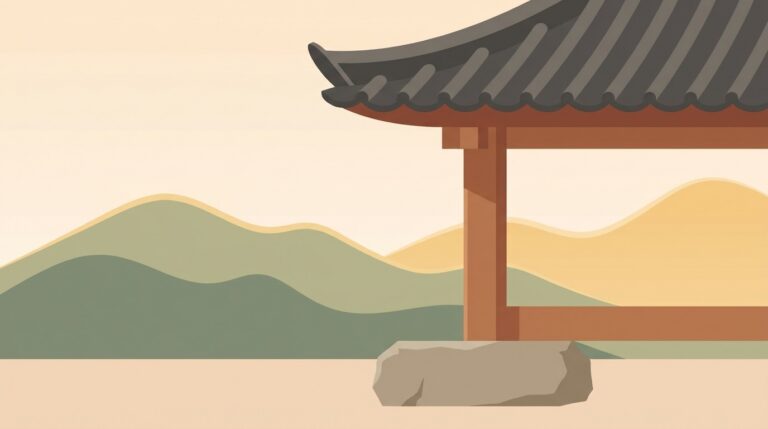
안녕하세요! 매일한글 에디터입니다. (Annyeonghaseyo! Maeil Hangeul editeo-imnida. — Hello! I’m your Daily Hangul Editor.) Picture yourself wandering through a quiet mountain temple in Korea. You look down at a towering wooden pillar and notice something astonishing: the stone underneath isn’t flat at all! Instead, the carpenter carved the wood’s base to hug every bump of the raw rock. Many B2 learners visiting historic hanoks struggle to move beyond basic words like 예쁘다 (yeppeuda — pretty) when describing this deep craftsmanship. Built from real student feedback on our heritage tours, this guide gives you the exact vocabulary to express architectural awe like a local!
Phase 2: Deep Dive into 3 Essential Expressions
1. 자연에 순응하다 (jayeon-e sun-eunghada)
- Pronunciation: jayeon-e sun-eunghada (Think: jah-yuhn-eh soon-eung-ha-da — the eu sounds like the short, relaxed “uh” when you’re gently surprised, and ng flows softly like the end of “sing.”)
- Meaning: Literally “to yield/comply with nature.” In everyday nuance, it means gracefully adapting to nature’s flow rather than forcing your will onto it.
- K-Culture Moment: You’ll hear narrators use this in architectural documentaries or healing variety shows like Three Meals a Day (삼시세끼, Samsi Sekki) whenever cast members embrace sudden rain or build around existing trees instead of chopping them down.
- Editor’s Insight: Unlike “surrendering” (굴복하다, gulbokhada), which carries a negative tone of defeat in Korean, 순응하다 (sun-eunghada) sounds poetic, wise, and deeply respectful—especially in B2-level discussions about art and ecology.
- Situation Spectrum: Casual ⚠️ (a bit literary for texting friends) / Semi-formal ✅ / Formal ✅
- 🤔 Think About It: In English, we often celebrate “conquering” nature or “taming” the wild. Why do you think Korean architecture celebrates “adapting” to a rough stone instead of chiseling it flat?
2. 정교하게 맞물리다 (jeonggyohage manmullida)
- Pronunciation: jeonggyohage manmullida (Think: jung-gyo-ha-geh mahn-mool-lee-da — notice how the t sound in 맞 assimilates into an m sound before 물, flowing smoothly like “mahn-mool” with zero pause!)
- Meaning: Literally “to bite/lock together intricately.” Practically, it describes two completely different pieces fitting together so tightly that not even a sheet of paper could slip between them.
- K-Culture Moment: Imagine a close-up shot in the historical K-Drama Mr. Sunshine or a museum curator explaining how the curved wooden base of a pillar locks onto a jagged boulder during an earthquake.
- Editor’s Insight: This verb is pure B2 gold! You can use 맞물리다 (manmullida) for geurengijil carpentry, clockwork gears, or even two busy schedules lining up perfectly.
- Situation Spectrum: Casual ✅ (when admiring craftsmanship) / Semi-formal ✅ / Formal ✅
- 🤔 Think About It: When you look at a geurengijil pillar resting on a wild stone, does the word “interlock” feel mechanical to you, or does it feel organic in this context?
3. 조화롭게 어우러지다 (johwaropge eoureojida)
- Pronunciation: johwaropge eoureojida (Think: jo-hwa-rop-geh uh-oo-ruh-ji-da — the eo sounds like the “aw” in “saw” with an unrounded mouth, and let the vowels glide smoothly like ripples in water.)
- Meaning: Literally “to mingle harmoniously.” It captures the visual feeling when distinct colors, shapes, or elements—like dancheong paint, chagyeong mountain views, and baeheullim pillars—blend into one breathtaking whole.
- K-Culture Moment: Travel vloggers and K-Drama characters standing on a hanok maru (wooden veranda) often sigh and say this as autumn foliage frames the curved roof eaves.
- Editor’s Insight: Beginners say 잘 어울리다 (jal eoullida — goes well together), which is great for outfits. Leveling up to 어우러지다 (eoureojida) instantly signals refined B2 taste, evoking landscapes, architecture, and culture blending effortlessly.
- Situation Spectrum: Casual ⚠️ (poetic) / Semi-formal ✅ / Formal ✅
- 🤔 Think About It: Notice how Korean has separate verbs for clothes matching (어울리다) versus elements melting into a larger scenery (어우러지다). What words does your language use to capture that subtle difference?
Phase 3: Textbook Korean vs. Real Korean
Situation 1: Pointing out how seamlessly a wooden pillar fits its rough stone base.
* 📖 교과서 한국어 (Textbook Korean): 이 나무 기둥은 자연석 주춧돌과 빈틈없이 일치합니다. (I namu gidung-eun jayeonseok juchutdol-gwa binteumeopsi ilchihamnida. — This wooden pillar matches the natural foundation stone without any gaps.)
* 🗣️ 진짜 한국어 (Real Korean): 와, 거친 돌이랑 기둥이 완전 딱 들어맞네! (Wa, geochin dorirang gidung-i wanjeon ttak deureomanne! — Whoa, the rough rock and the pillar fit together like a glove!)
* 💡 왜 다를까? (Why is it different?) While 일치하다 (ilchihada) sounds like checking data on a spreadsheet, native speakers instinctively use 딱 들어맞다 (ttak deureomatda) to express satisfying, tactile precision in real life.
Situation 2: Appreciating the wisdom of leaving nature untouched.
* 📖 교과서 한국어 (Textbook Korean): 자연의 원형을 훼손하지 않고 그대로 두는 것이 바람직합니다. (Jayeon-ui wonhyeong-eul hwesonhaji anko geudaero duneun geos-i baramjikhamnida. — It is desirable to leave nature’s original form undamaged as it is.)
* 🗣️ 진짜 한국어 (Real Korean): 억지로 깎지 않고 자연 그대로 살린 게 진짜 멋스럽지 않아요? (Eokjiro kkakji anko jayeon geudaero sallin ge jinjja meotseureopji anayo? — Isn’t it genuinely classy how they brought out nature as-is without forcing a cut?)
* 💡 왜 다를까? (Why is it different?) Koreans love the adjective 멋스럽다 (meotseureopda — effortlessly stylish/tasteful) and the verb 살리다 (sallida — to keep alive/highlight), shifting the focus from strict rules to soulful appreciation.
Phase 4: K-Culture Deep Dive & Non-Verbal Manners
4-1. 눈치 (Nunchi) & Gestures at Historic Spaces
When admiring geurengijil pillars at a Korean temple or historic hanok village, your body language matters just as much as your vocabulary:
* Hands Off, Eyes On: Never tap or kick a wooden pillar or foundation stone to “test” its sturdiness—ancient wood is fragile! Instead, crouch slightly with your hands clasped behind your back or gently resting on your knees, tilting your head to trace the curved wood-to-stone seam with your gaze.
* Soft Voice & Measured Pace: Temple courtyards carry sound easily. Keep your tone warm and hushed, nodding slowly (고개를 끄덕이다, gogaereul kkeudeogida) when a local or tour guide explains the craftsmanship. Showing quiet curiosity earns instant warmth!
4-2. Cultural Code Analysis: K-Travel & Architectural Aesthetics
If you’ve watched the Netflix hit Kingdom or historical K-Dramas like The Red Sleeve, you’ve seen the iconic trio of Korean architecture in action: 차경 (chagyeong), where open wooden doors frame distant mountains like a living painting; 배흘림기둥 (baeheullim-gidung), pillars that swell slightly in the middle like an optical illusion so they look steady and strong; and 단청 (dancheong), vibrant mineral paints protecting the wood from rain and insects. Yet geurengijil is the quiet hero underneath it all—using a compass-like scribing tool (geurengi) to transfer every bump of an uncarved stone onto timber. Why? Because in Korean philosophy, the boulder was already there; the human structure is merely a polite guest.
Phase 5: Interactive Roleplay Scenario
Setting: A crisp autumn afternoon at Buseoksa Temple in Yeongju. Golden ginkgo leaves drift across the stone courtyard. You’re exploring with Min-jun (민준), a witty 30-something Korean architect friend who carries a sketchbook everywhere and gets way too excited about wooden joints.
- Min-jun: 여기 무량수전 앞 기둥 밑을 좀 자세히 봐 봐. 돌이 울퉁불퉁하지? (Yeogi Muryangsujeon ap gidung mit-eul jom jasehi bwa bwa. Dor-i ultungbultunghaji? — Take a close look at the bottom of the pillar here in front of Muryangsujeon. The rock is bumpy, right?)
🎭 (Crouching low beside the veranda and tapping his sketchbook excitedly toward the base of a towering pillar.) - You: 어, 그러네요! 주춧돌을 평평하게 안 깎고 그대로 뒀네요? (Eo, geureoneyo! Juchutdor-eul pyeongpyeonghage an kkakko geudaero dwonneyo? — Oh, you’re right! They didn’t carve the foundation stone flat and just left it as is?)
🎭 (Squinting closely in amazement, careful not to touch the aged wood.) - Min-jun: 맞아. 대신 나무 기둥 아랫부분을 돌 모양에 맞춰서 정교하게 깎은 거야. 이걸 ‘그렝이질’이라고 해. (Maja. Daesin namu gidung araetbubun-eul dol moyang-e matcwoseo jeonggyohage kkakkeun geoya. Igeol ‘geurengijil’-irago hae. — Exactly. Instead, they intricately carved the bottom of the wooden pillar to match the stone’s shape. This is called ‘geurengijil’.)
🎭 (Tracing an invisible curve in the air with his pencil to show how the wood hugs the rock.) - You: 세상에, 돌이랑 나무가 한 치의 오차도 없이 정교하게 맞물려 있네요! (Sesang-e, dorirang namuga han chi-ui ochado eopsi jeonggyohage manmullyeo inneyo! — Goodness, the stone and wood are interlocked intricately without a hair’s breadth of error!)
🎭 (Letting out an impressed whistle while leaning slightly closer to admire the seam.) - Min-jun: 그치? 게다가 이렇게 기둥을 세우면 지진이 나도 돌의 굴곡 덕분에 쉽게 안 미끄러진대. (Geuchi? Gedaga ireoke gidung-eul seumyeon jijin-i nado dor-ui gulgok deokbun-e swipge an mikkeureojindae. — Right? Plus, when you set a pillar like this, even in an earthquake it doesn’t slip easily thanks to the stone’s contours.)
🎭 (Standing up, brushing dust off his jeans, and grinning proudly like he built it himself.) - You: 미적인 감각뿐만 아니라 과학적인 지혜까지 담긴 거군요. (Mijeogin gamgakppunman anira gwahakjeogin jihyekkaji damgin geogunyo. — So it holds not only an aesthetic sense, but scientific wisdom too.)
🎭 (Looking up at the sweeping curved eaves framed against the mountain ridge.) - Min-jun: 완벽한 요약이야! 저 멀리 보이는 산이랑 단청 색감도 너무 잘 어우러지지 않아? (Wanbyeokhan yoyagiya! Jeo meolli boineun sanirang dancheong saekgamdo neomu jal eoureojiji ana? — Perfect summary! Don’t the distant mountains and the dancheong colors blend together so well too?)
🎭 (Gesturing widely toward the valley view stretched out beneath the temple pavilion.) - You: [YOUR TURN TO RESPOND!]
🔀 Interactive Branching Point: Choose Your Response!
- Option A: “네! 자연을 이기려 들지 않고 자연에 순응하는 모습이 정말 감동적이에요.” (Ne! Jayeon-eul igiryeo deulji anko jayeon-e sun-eunghaneun moseub-i jeongmal gamdongjeogieyo. — Yes! Not trying to beat nature, and instead harmonizing with it, is truly moving.)
- Feedback (Best): 🌟 10/10 B2 Mastery! You tied geurengijil and chagyeong together using 자연에 순응하다 seamlessly. Min-jun will probably offer to buy you traditional tea after this!
- Option B: “돌이 너무 울퉁불퉁해서 좀 어지러워요. 그냥 시멘트로 덮으면 편할 텐데요.” (Dor-i neomu ultungbultunghaeseo jom eojireowoyo. Geunyang simenteuro deopeumyeon pyeonhal tendeyo. — The rock is so bumpy it makes me dizzy. Just covering it with cement would be easier.)
- Feedback (Bad): 😬 Ouch—Cultural Faux Pas! Min-jun’s architect heart just broke a little. While practical, suggesting modern concrete over centuries-old sustainable engineering misses the entire point of Korean heritage.
- Option C: “이 건물은 진짜 예쁘고 크네요. 사진 찍어도 돼요?” (I geonmureun jinjja yeppeugo keuneyo. Sajin jjigeodo dwaeyo? — This building is really pretty and big. Can I take a photo?)
- Feedback (Risk): 🤔 Safe, but Missed Opportunity! Politely asking before taking photos is great etiquette, and Min-jun won’t mind, but using simple A1 adjectives like 예쁘다 feels a bit flat after such a poetic conversation.
Phase 6: 10-Second Emotional Shadowing Drill
Read these aloud twice, pausing sharply at each / and matching the emotional cue:
- [😊 Wonderstruck & Warm]
돌을 억지로 깎지 않고 / 자연에 순응하다니, / 정말 지혜롭지 않아요? (Dor-eul eokjiro kkakji anko / jayeon-e sun-eunghadani, / jeongmal jihyeropji anayo? — To yield to nature instead of forcing the stone—isn’t that truly wise?) - [😲 Impressed by Precision]
거친 주춧돌과 / 나무 기둥이 / 빈틈없이 정교하게 맞물려 있어요! (Geochin juchutdol-gwa / namu gidung-i / binteumeopsi jeonggyohage manmullyeo isseoyo! — The rough foundation stone and the wooden pillar interlock intricately without a single gap!) - [😌 Calm & Reflective]
화려한 단청과 / 먼 산의 풍경이 / 조화롭게 어우러지네요. (Hwaryeohan dancheong-gwa / meon san-ui punggyeong-i / johwaropge eoureojineyo. — The vibrant dancheong and the distant mountain scenery harmonize so gracefully.)
Phase 7: K-Culture Mini Dictionary
- 그렝이질 (geurengijil) | Natural-contour scribing | Used in heritage documentaries, museum tours, and design talks to describe fitting two uneven surfaces—or even metaphorically, two stubborn people adapting to each other!
- 주춧돌 (juchutdol) | Foundation stone | Beyond literal hanok architecture, Koreans constantly use this in business and speeches to mean “a cornerstone” (e.g., 회사의 주춧돌 — the cornerstone of the company).
- 배흘림기둥 (baeheullim-gidung) | Entasis pillar (swelling in the middle) | A classic K-Travel keyword at places like Buseoksa Temple; locals love pointing out how this subtle curve makes heavy roofs feel weightless.
- 차경 (chagyeong) | Borrowed scenery | Popular among modern Korean interior designers and trendy hanok cafes in Bukchon or Seochon that frame city trees or mountains through a single window.
Phase 8: Traveler’s Survival Kit
TOP 3 Survival Expressions for Architectural & Temple Tours
1. 이 기법 이름이 뭐예요? (I gippeop ireum-i mwoyeyo? — What is the name of this technique?) Pro Tip: Point gently with an open palm rather than one finger when asking a museum docent.
2. 여기에 담긴 의미가 궁금해요. (Yeogi-e damgin uimiga gunggeumhaeyo. — I’m curious about the meaning behind this.) Pro Tip: Saying “의미가 궁금해요” makes cultural guides light up and share secret stories!
3. 풍경을 정말 잘 살렸네요. (Punggyeong-eul jeongmal jal sallyeonneyo. — They really brought out the scenery well.) Pro Tip: Works equally well at historic palaces and aesthetic hanok cafes!
Editor’s Travel Note: Planning a trip to iconic geurengijil sites like Buseoksa Temple or Changdeokgung Palace? Before heading out, grab the Naver Map app download on your phone since Google Maps walking routes can struggle in mountainous temple areas. For deeper historical background in English, bookmark the Korea Heritage Service official guide before boarding your KTX train, and remember that T-money transit cards work seamlessly on intercity local buses leading right up to temple gates!
Phase 9: One Step Deeper
In Western monumental architecture, we often see human triumph carved straight into marble and granite—flattening hills and squaring stones to obey a rigid blueprint. Traditional Korean architecture flips that relationship upside down through geurengijil. Instead of forcing the earth to obey human geometry, the carpenter bows to the stone’s original shape, carving the timber to meet it halfway. This echoes Korea’s broader social values of harmony (조화, johwa) and flexibility (유연함, yuyeonham), where lasting strength comes not from rigid dominance, but from adapting gracefully to your surroundings.
💬 Your Turn: Think about a famous historic building in your home country. Does it conquer its landscape, or blend into it? Drop a comment below and tell us which Korean architectural feature—geurengijil, chagyeong, baeheullim-gidung, or dancheong—you want to see in person first!
Phase 10: FAQ & Common Mistakes
Q: Why didn’t traditional Korean carpenters use nails or glue for geurengijil pillars?
A: Wood naturally expands and contracts with Korea’s humid summers and freezing winters. By using interlocking wooden joints and geurengijil gravity-fit bases without metal nails, the building “breathes” flexibly and withstands earthquakes far better over centuries.
Q: Can I use the word ‘주춧돌’ (juchutdol) in everyday business Korean?
A: Yes! Just like “cornerstone” in English, it’s frequently used in formal speeches and workplace compliments, such as saying a veteran colleague is “우리 팀의 주춧돌” (the cornerstone of our team).
Q: What is the difference between ‘어울리다’ and ‘어우러지다’?
A: 어울리다 (eoullida) means two things suit or match each other (like shoes and a jacket, or two friends). 어우러지다 (eoureojida) is deeper and more atmospheric—it means multiple elements melt together to create one harmonious scene or flavor.
🚨 Common Mistakes Warning Board
- Mistake: Saying “자연을 복종하다” (obeying nature like a servant) instead of “자연에 순응하다”.
- Correct Action: Use 자연에 순응하다 (yielding gracefully) to keep the poetic, respectful B2 tone.
- Mistake: Pronouncing 맞물리다 with a hard “t” stop (mat-mul-li-da).
- Correct Action: Remember nasal assimilation! Let the ㅈ merge into ㅁ so it glides smoothly as [만물리다 / man-mul-li-da].
- Mistake: Using 예쁘다 (pretty) for grand temple architecture.
- Correct Action: Swap in B2 gems like 멋스럽다 (tasteful/refined), 고즈넉하다 (tranquil/serene), or 웅장하다 (majestic).
Phase 11: Action Mission & Participation
- 🥉 Bronze Mission (Solo Practice): Record yourself doing the Phase 6 shadowing drill on your phone, focusing on the smooth manmullida pronunciation, and listen back once.
- 🥈 Silver Mission (SNS Share): Post a photo of a wooden building, tree, or local landmark on Instagram or Threads with a short Korean caption using 자연에 순응하다 or 조화롭게 어우러지다.
- 🥇 Gold Mission (Real-World Use): Next time you talk with a Korean language partner or visit a hanok cafe, point out how a view or material fits its surroundings using 딱 들어맞다 or 잘 살렸다!
- 🎮 K-Culture Mission: Rewatch a scene from a historical K-Drama (Kingdom, Mr. Sunshine, or Under the Queen’s Umbrella) and pause when characters step onto a wooden veranda—spot the juchutdol stones, chagyeong window view, or dancheong eaves in the background!
Phase 12: Interactive Quiz Challenge
Quiz 1 (Situational Judgment): You’re visiting Bukchon Hanok Village with your Korean friend, and they point out how a modern glass window frames a pine tree perfectly without blocking it. Which response sounds most natural and B2-level?
A) 이 유리는 자연에 복종했어요.
B) 바깥 풍경이랑 창문이 정말 조화롭게 어우러지네요!
C) 나무가 너무 커서 시멘트로 막아야겠어요.
👉 Click to reveal Answer & Explanation for Quiz 1
Answer: B! “조화롭게 어우러지네요” naturally praises how the window and outdoor pine scenery blend together (chagyeong aesthetic). Option A uses the awkward/harsh verb 복종하다 (to obey), and Option C misses the charm completely!
Quiz 2 (Fill in the Blank): Complete the sentence describing how geurengijil wood fits an uncarved rock: “돌의 굴곡에 맞춰 나무 기둥이 한 치의 오차도 없이 정교하게 ________ 있어요.” (Hint: To interlock tightly)
👉 Click to reveal Answer & Explanation for Quiz 2
Answer: 맞물려 (manmullyeo) — From the verb 맞물리다 (to interlock seamlessly). Remember to pronounce it smoothly as [만물려 / man-mul-lyeo]!
Quiz 3 (True/False Culture Check): True or False — In traditional Korean geurengijil carpentry, builders flatten rough natural boulders with chisels first so every wooden pillar can have a flat, identical base.
👉 Click to reveal Answer & Explanation for Quiz 3
Answer: False! It’s the exact opposite! Carpenters leave the natural foundation stone (주춧돌) uncarved and instead carefully carve the bottom of the wooden pillar to hug every natural bump of the rock, embodying harmony with nature.
🎬 Watch Our Daily Videos! (Daily Hangul Official Instagram)
Review the expressions you learned in this article with our fun daily short videos! Check out native pronunciation and real-life nuances in action.
- Instagram @dailyhangul_en







