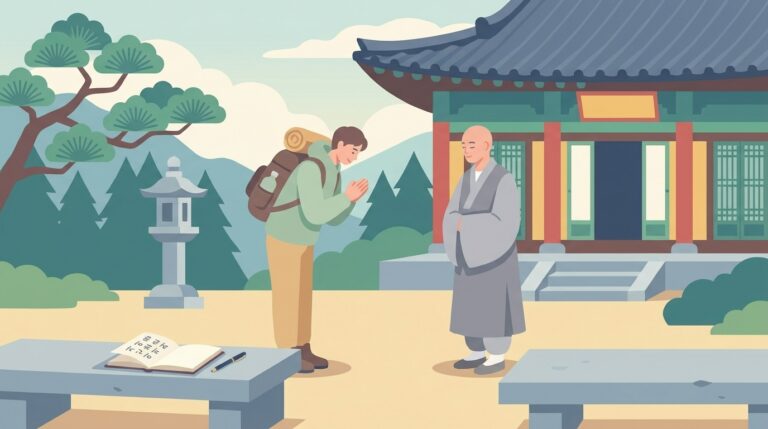
Phase 1: Empathy — Freezing at the Temple Gate
안녕하세요! 매일한글 에디터입니다. (Annyeonghaseyo! Maeil Hangeul editeo-imnida.) Hello, this is your Daily Hangul editor!
Have you ever watched K-Pop idols or Korean healing variety shows and dreamed of escaping the city for a peaceful mountain Templestay (템플스테이)? Staying overnight at an ancient Korean temple, trying mindful monastic meals (balwoo gongyang / 발우공양), and meditating at dawn has become one of Korea’s most beloved travel experiences.
Yet the moment many travelers step onto the temple grounds (gyeongnae / 경내), they hit an awkward freeze: a Buddhist monk (seunim / 스님) walks toward them down the stone path. “Wait—should I bow? Where do my hands go? Is it okay to say 안녕하세요?” Many of our Daily Hangul learners tell us they panicked and stood stiffly like a statue! Today, you will master the graceful B1 Korean phrases and temple manners—from the mindful Chasu (차수) walking posture to Hapjang (합장) greetings—so you can walk through any Korean temple with calm confidence.
Phase 2: Top 3 Key Expressions Deep Dive
1. 성불하세요 (Seongbulhaseyo)
- Pronunciation: Seong-bul-ha-se-yo — Let the ng in seong resonate softly, and let ha glide smoothly so it sounds almost like “Seong-bul-ra-se-yo.”
- Meaning: Literally “May you attain Buddhahood,” but in everyday temple life it is a warm, respectful greeting meaning “Peace be with you” or “May you find enlightenment and serenity”—used in place of “Hello” or “Goodbye.”
- K-Culture Moment: You will often hear this on Korean healing shows like You Quiz on the Block or travel vlogs whenever guests meet a monk in the courtyard and press their palms together.
- Editor’s Insight: Saying “attain Buddhahood” might sound intense in English, but in Korean temples it is the warmest, most natural everyday blessing. Offer a gentle smile as you say it, and the monk will warmly reply “성불하세요” right back!
- Situation Spectrum: Casual 🚫 | Semi-formal ✅ (between fellow guests) | Formal ✅ (to monks)
- 🤔 Think About It: Instead of asking “Are you at peace?” (안녕하세요), Korean temple culture wishes spiritual fulfillment upon the listener. How does greeting someone with a blessing change the mood of an encounter?
2. 차수 자세를 하고 걸어요 (Chasu jasereul hago georeoyo)
- Pronunciation: Cha-su ja-se-reul ha-go geo-reo-yo — Give cha a crisp puff of air (like “cha!” in “chart”), and keep ja-se light and unaspirated.
- Meaning: Literally “Walk while doing the chasu posture.” Practically, it means walking calmly across the temple grounds with both hands folded neatly in front of your lower abdomen.
- K-Culture Moment: Think of BTS’s RM strolling peacefully through ancient Korean temples, or the orientation staff (bosalnim / 보살님) demonstrating proper temple walking posture at the start of a Templestay.
- Editor’s Insight: Chasu isn’t just folding your arms—it’s a physical anchor that quiets restless movement and keeps you present. At the B1 level, pairing it with 두 손을 가지런히 모으다 (du soneul gajireonhi moeuda, “to gather both hands neatly”) will make your Korean sound remarkably natural.
- Situation Spectrum: Casual ⚠️ (when explaining the posture) | Semi-formal ✅ | Formal ✅
- 🤔 Think About It: Just like tea ceremonies or shrines in other cultures, Korean temples link hand posture directly to mental stillness. Why do you think calming your hands helps calm your mind?
3. 합장하고 반배해요 (Hapjanghago banbaehaeyo)
- Pronunciation: Hap-jang-ha-go ban-bae-hae-yo — Close your lips briefly on the p in hap, which makes jang pop slightly (“hap-jjang-ha-go ban-bae-hae-yo”).
- Meaning: Literally “Do hapjang (palms together) and do a banbae (half-bow).” It means pressing your palms together at chest level and bowing your upper body about 45 degrees in respectful greeting.
- K-Culture Moment: Seen in nearly every historical K-Drama (sageuk) when a character visits a mountain hermitage to seek wisdom from a monk, or in modern dramas when characters bow silently before entering a dharma hall (beopdang / 법당).
- Editor’s Insight: While full prostrations (keunjeol / 큰절) are done on cushions inside the hall, a crisp 45-degree 반배 (banbae) with 합장 (hapjang) is the exact etiquette when passing a monk outside!
- Situation Spectrum: Casual 🚫 | Semi-formal ✅ | Formal ✅
- 🤔 Think About It: A casual nod in Western countries is barely 10–15 degrees, whereas Korean banbae is a deliberate 45-degree bow with lowered eyes. What does that deeper angle communicate without a single word?
Phase 3: Textbook Korean vs. Real Korean
Situation 1: Greeting a monk as you pass on the temple path
- 📖 Textbook Korean: 스님, 안녕하십니까? (Seunim, annyeonghasimnikka?) — “Monk, how do you do?”
- 🗣️ Real Korean: 스님, 성불하세요! (Seunim, seongbulhaseyo!) — “Peace be with you, Seunim!”
- 💡 Why the difference? While annyeonghasimnikka is polite, using the Buddhist greeting 성불하세요 shows genuine cultural awareness and immediately creates a warm, respectful connection.
Situation 2: Checking if your hand posture is right during orientation
- 📖 Textbook Korean: 손을 이렇게 모으는 것이 맞습니까? (Soneul ireoke moeuneun geosi matseumnikka?) — “Is gathering the hands like this correct?”
- 🗣️ Real Korean: 저기, 차수할 때 손을 이렇게 모으면 되나요? (Jeogi, chasuhal ttae soneul ireoke moeumyeon doenayo?) — “Excuse me, when doing chasu, is it okay if I fold my hands like this?”
- 💡 Why the difference? Rigid -습니까? endings feel like an interrogation. Using the soft B1 pattern -(으)면 되나요? (“is it okay if I…?”) fits the serene, friendly atmosphere of a Templestay.
Phase 4: K-Culture Deep Dive & Non-Verbal Manners
4-1. Nunchi (눈치) & Gestures: Mindful Movement
At a Korean temple, your posture speaks louder than your words:
* Proper Chasu Form: Place your hands just below your navel, with your left hand gently resting over your right hand (the standard Jogye Order style; if your host temple teaches a slightly different style, follow their lead—that’s great nunchi!). Keep your elbows relaxed as if holding a small egg, lower your gaze gently toward the path a few steps ahead, and never walk with your hands in your pockets or arms crossed behind your back.
* Timing Your Hapjang and Banbae: When a monk approaches, pause your steps or slow down, bring both palms cleanly together at chest height, bow 45 degrees from the waist (banbae), and say “성불하세요” with a calm smile as you rise. Stopping briefly rather than bowing on the run shows true respect.
4-2. Cultural Code Analysis: Why Templestay Is Booming (K-Travel)
In Korea’s hyper-connected, fast-paced ppalli-ppalli (빨리빨리) culture, Templestays have surged in popularity among young Koreans and international travelers alike as the ultimate digital detox and healing travel (힐링 여행). Stepping away from smartphones to eat zero-waste monastic meals (balwoo gongyang), practice 108 bows (108배), or sit in silent meditation (chamseon / 참선) offers rare mental clarity.
Phase 5: Real-Life Roleplay Scenario
Setting & Characters
- Setting: A crisp autumn morning at a quiet Jogye Order mountain temple near Seoul. Pine needles rustle overhead while the rhythmic moktak (wooden fish) echoes softly in the distance.
- Characters: You (Alex / 알렉스), a friendly Templestay coordinator (지혜 보살님 / Jihye Bosalnim), and Sunim Seonu (선우 스님).
Dialogue (8 Turns)
- 지혜 보살님: 알렉스 씨, 수련복이 정말 잘 어울리네요! 이제 경내를 천천히 둘러볼까요?
(Allekseu ssi, suryeonbogi jeongmal jal eoullineyo! Ije gyeongnaereul cheoncheonhi dulleobolkkayo?)
🎭 Smiling warmly as she greets Alex in the comfortable temple uniform
“Alex, the Templestay uniform looks great on you! Shall we take a slow walk around the temple grounds?” - 알렉스: 네, 좋아요! 그런데 보살님, 경내를 걸을 때 지켜야 할 예절이 있나요?
(Ne, joayo! Geureonde bosalnim, gyeongnaereul georeul ttae jikyeoya hal yejeori innayo?)
🎭 Curious and eager to be respectful
“Yes, I’d love to! By the way, Bosalnim, is there any etiquette I should follow while walking around the grounds?” - 지혜 보살님: 네, 걸을 때는 두 손을 배 아래로 가지런히 모으는 ‘차수’ 자세를 하면 돼요.
(Ne, georeul ttaeneun du soneul bae araero gajireonhi moeuneun ‘chasu’ jasereul hamyeon dwaeyo.)
🎭 Gently resting her left hand over her right hand below her waist to demonstrate
“Yes, when walking, you can do the ‘chasu’ posture by neatly gathering both hands below your stomach.” - 알렉스: 아, 이렇게 손을 모으고 조용히 걸으면 되나요? 마음이 차분해지는 것 같아요.
(A, ireoke soneul moeugo joyonghi georeumyeon doenayo? Maeumi chabunhaejineun geot gatayo.)
🎭 Mirroring her posture and softening his pace
“Ah, so I just fold my hands like this and walk quietly? It already makes my mind feel calmer.” - 지혜 보살님: 아주 잘하셨어요! 어, 저기 선우 스님이 오시네요. 함께 합장 인사해요.
(Aju jalhasyeosseoyo! Eo, jeogi Seonu seunimi osineyo. Hamkke hapjang insahaeyo.)
🎭 Lowering her voice slightly as a monk appears along the stone path
“You’re doing wonderfully! Oh, look, Sunim Seonu is coming. Let’s greet him together with hapjang.” - 알렉스: 스님, 성불하세요!
(Seunim, seongbulhaseyo!)
🎭 Stopping smoothly, pressing palms together at his chest, and bowing 45 degrees
“Peace be with you, Sunim!” - 선우 스님: 네, 성불하세요. 멀리서 오셨는데 편안하게 쉬다 가세요.
(Ne, seongbulhaseyo. Meolliseo osyeonneunde pyeonanhage swida gaseyo.)
🎭 Pressing his palms together with a serene smile and returning the bow
“Peace be with you. Since you’ve come from afar, please rest comfortably while you’re here.” - 알렉스: 감사합니다, 스님! 덕분에 좋은 시간 보내고 있습니다.
(Gamsahamnida, seunim! Deokbune joeun sigan bonaego itseumnida.)
🎭 Offering one more gentle nod with hands still in hapjang
“Thank you, Sunim! Thanks to you, I’m having a wonderful time.”
🔀 Interactive Branching Point
Later that afternoon, you are carrying a tea tray with both hands through a quiet corridor marked 묵언 (Mugeon / Silence). Suddenly, another monk walks toward you! What is the best move?
* A: Pause your steps, lower your gaze, and offer a quiet head bow (mongnye / 목례) without speaking.
* B: Shout “스님, 성불하세요!!” loudly and try to balance the tray with one hand so you can do a one-handed hapjang.
* C: Avoid eye contact and hurry past as quickly as possible so you don’t have to greet them.
💡 Feedback:
* A (Best!): Spot-on! When both hands are full, never force a hapjang. Simply stop, offer a respectful silent bow (mongnye), and honor the mugeon silence zone.
* B (Risk): Well-meaning, but a one-handed hapjang is improper etiquette, risking a spilled tray—and shouting breaks the silence of a mugeon zone.
* C (Bad): Dodging eye contact and rushing past looks cold and awkward. A calm pause and gentle bow communicates full respect without words.
Phase 6: 10-Second Emotion Shadowing Drill
Read aloud, pausing briefly at / to match the calm rhythm and emotion:
- [😊 Calm and mindful]
경내를 걸을 때는 / 차수 자세를 하고 / 조용히 걸어요.
(Gyeongnaereul georeul ttaeneun / chasu jasereul hago / joyonghi georeoyo.)
“When walking the temple grounds / do the chasu posture / and walk quietly.” -
[🙏 Respectful and poised]
스님과 마주치면 / 멈춰 서서 / 합장 인사해요.
(Seunimgwa majuchimyeon / meomchwo seoseo / hapjang insahaeyo.)
“When you meet a monk / stop walking / and greet with hapjang.” -
[🤔 Politely double-checking]
손을 이렇게 / 가지런히 모으면 / 되나요?
(Soneul ireoke / gajireonhi moeumyeon / doenayo?)
“Is it okay / if I gather my hands neatly / like this?”
Phase 7: K-Culture Mini Dictionary
- 차수 (Chasu) | Folded-hands posture | Resting both hands neatly in front of your lower abdomen while walking in temples or traditional settings—also frequently seen in historical K-Dramas.
- 합장 (Hapjang) | Pressing palms together | Joining both palms at chest level for temple greetings and prayer; in casual life, Koreans also playfully press their palms together when begging a friend for a huge favor!
- 경내 (Gyeongnae) | Temple grounds | The entire precinct inside a temple gate; you will see signs like 경내에서는 정숙해 주세요 (“Please keep quiet inside the temple grounds”).
- 묵언 (Mugeon) | Noble silence | Practicing complete silence during meditation (chamseon) or monastic meals (balwoo gongyang) to focus your senses inward.
Phase 8: Survival Kit for Temple Visitors
Top 3 Temple Survival Phrases
- 사진 찍어도 되나요? (Sajin jjigeodo doenayo? / May I take a photo?)
- Pro Tip: Never photograph Buddha statues head-on or snap photos of monks without asking first. Always check with staff!
- 묵언 시간이에요? (Mugeon siganieyo? / Is it silent time right now?)
- Pro Tip: If everyone suddenly goes quiet, whisper this gently or use a soft gesture to check.
- 이건 어떻게 하면 돼요? (Igeon eotteoke hamyeon dwaeyo? / How should I do this?)
- Pro Tip: Your lifesaver during 108 bows or when learning the exact bowl-washing order of balwoo gongyang!
Editor’s Travel Note
- Booking & Navigation: Reserve English-friendly temple programs directly through the Official Korean Templestay Website. Since Google Maps doesn’t provide reliable walking or rural bus routing in Korea, Download Naver Map before your trip, and keep Papago Translator handy for reading temple notices.
- What to Pack & Pay With: Bring a T-money card for intercity/local buses plus a bit of small cash (1,000–10,000 KRW bills) for temple donations (siju) or traditional tea houses. Wear slip-on sneakers or easy-to-remove shoes since you will take them off every time you enter a temple hall!
Phase 9: “One Step Deeper” — Care Woven Into Posture
In Korean temples, chasu and hapjang are not rigid rules meant to intimidate visitors—they are gentle commitments to protect the peace of everyone sharing the space. Folding your hands quiets your own restlessness, while bringing your palms together silently tells the person in front of you, “I honor your presence.” At the heart of Korean etiquette (yejeol / 예절) is the belief that composing yourself is the purest form of care (baeryeo / 배려) for others.
💬 Your Turn: Which Korean temple would you love to visit—Jogyesa in the heart of Seoul, or a quiet mountain sanctuary like Haeinsa or Bulguksa? Share your dream Templestay activity in the comments!
Phase 10: FAQ & Myth-Busting
Q: Is it rude if I accidentally say “안녕하세요?” to a monk?
A: Not at all! Monks warmly welcome international visitors who greet them politely with annyeonghaseyo. Learning 성불하세요 simply adds a thoughtful cultural touch that delights them even more.
Q: What if my knees hurt during 108 bows or sitting meditation?
A: Don’t push through pain! You are always welcome to use a meditation chair (uija / 의자) or extra cushion, or switch to standing half-bows (banbae). Just tell the coordinator 다리가 조금 아파요 (Dariga jogeum apayo, “My legs hurt a little”).
Q: Which hand goes on top during chasu?
A: In Korea’s Jogye Order, the standard is left hand gently over right hand below the navel (though some orders or funeral settings differ). Following the orientation guide’s demonstration at your specific temple is always the best approach.
🚨 Common Mistakes TOP 3 & How to Fix Them
- Reaching out to shake a monk’s hand or handing items with one hand
- Correct Action: Never initiate a handshake with a monk—use hapjang and banbae instead. When offering tea or items, always use both hands (du son / 두 손).
- Walking through the center doorway of a Dharma Hall or stepping on the threshold
- Correct Action: The central doors (eoganmun) are reserved for Buddha and the head monk. Enter through the side doors (hyeongmun) and step cleanly over—never on—the wooden threshold (munjibang).
- Leaving food behind or clattering bowls during balwoo gongyang
- Correct Action: Monastic meals are zero-waste. Serve yourself only what you can finish and eat quietly in gratitude.
Phase 11: Action Mission & Engagement
- 🥉 Bronze Mission (Solo Practice): Stand in front of a mirror, fold your hands in chasu, then bring them to hapjang while practicing “스님, 성불하세요!” smoothly three times.
- 🥈 Silver Mission (Social Share): Save or share today’s three temple etiquette words (차수, 합장, 성불하세요) with a friend planning a trip to Korea.
- 🥇 Gold Mission (Real-Life Use): On your next visit to a Korean temple like Jogyesa or Bongeunsa, try walking in chasu and greeting a passing monk with hapjang and “성불하세요!”
- 🎮 K-Culture Mission: Next time you watch a historical K-Drama (sageuk), pay attention to how characters fold their hands (chasu) while walking through palace courtyards—it’s the exact same traditional grace!
Phase 12: Interactive Quiz Challenge
Test your temple etiquette before checking the answers below!
- Situational Judgment: You are walking empty-handed through a Korean temple courtyard when a monk walks toward you. What is the most natural, respectful response?
- A) Wave cheerfully and say “안녕!”
- B) Pause, press your palms together (hapjang), bow 45 degrees (banbae), and say “성불하세요.”
- C) Extend your right hand for a firm handshake.
- Fill-in-the-Blank: Complete the sentence with the correct Korean noun:
경내를 걸을 때는 두 손을 가지런히 모으는 ( ) 자세를 해요.
(“When walking the temple grounds, we do the ( ) posture by gathering both hands neatly.”) -
True or False (Cultural Quiz): When entering a Korean temple’s main Dharma Hall, it is polite to step firmly on the wooden threshold (munjibang) of the center door. (True / False)
Click to Reveal Quiz Answers & Detailed Explanations
- Answer: B.
- Explanation: Stopping briefly to press your palms together (hapjang), bow 45 degrees (banbae), and say 성불하세요 is the gold standard of Korean temple etiquette. Option A is far too casual, and handshakes (C) are not used with monks.
- Answer: 차수 (Chasu).
- Explanation: 차수 refers to folding both hands neatly in front of your lower abdomen while walking mindfully. Pairing it with 가지런히 모으다 (gajireonhi moeuda, “to gather neatly”) is a great B1 expression to remember!
- Answer: False.
- Explanation: Always use the side doors rather than the center door (eoganmun), and always step over the wooden threshold (munjibang) rather than stepping on it—a timeless rule in both Korean temples and traditional hanok houses!
🎬 Watch Our Daily Videos! (Daily Hangul Official Instagram)
Review the expressions you learned in this article with our fun daily short videos! Check out native pronunciation and real-life nuances in action.
- Instagram @dailyhangul_en