

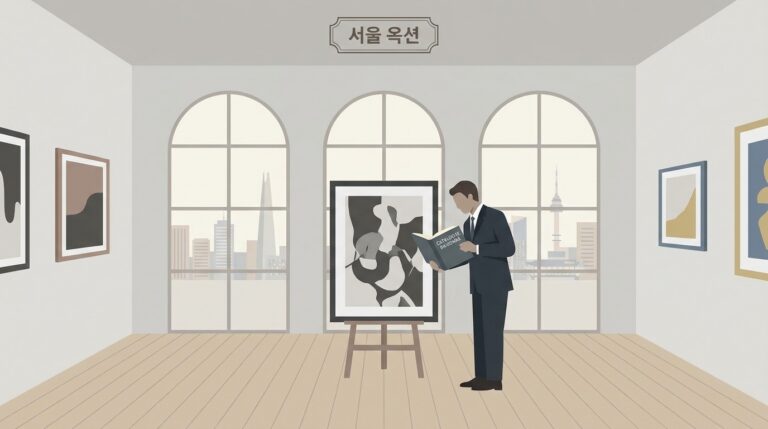
The Collector’s Secret: How to Authenticate Masterpieces at Korean Art Auctions Like a Pro
Phase 1: Empathy (Storytelling Opening)
안녕하세요! 매일한글 에디터입니다. (Annyeonghaseyo! It’s your Daily Hangul editor.)
Imagine stepping into the hushed, velvet-carpeted preview room of a prestigious auction house in Pyeongchang-dong or Gangnam. Around you, discreet collectors, blue-chip fund managers, and seasoned connoisseurs converse in hushed, precise tones. Before you hangs a transcendent 1970s monochrome masterpiece by a luminary of Dansaekhwa—perhaps Kim Whanki or Park Seo-bo. Millions of dollars hang in the balance. As an international collector or high-level advisor, asking simply “Is this real?” marks you immediately as an amateur. In the high-stakes realm of Korean fine art auctions, the ultimate question hinges on institutional legitimacy: Has this piece been documented in the artist’s Catalogue Raisonné (전작 도록)?
Navigating Korea’s elite secondary market requires far more than basic honorifics; it demands the linguistic dexterity to discuss connoisseurship (안목 감정), scientific analysis (과학 감정), and unbroken provenance (소장 이력). Learners at the C2 level often tell us that while they can read academic essays, speaking the rarefied code of Korean auction houses and appraisal committees feels like learning another language entirely. This masterclass bridges that gap, giving you the authoritative lexicon and sociolinguistic poise used by Seoul’s top specialists.
Phase 2: Core Expressions Deep Dive
1. 작가의 전작 도록(카탈로그 레조네)에 정식 등재되어 있는지 확인하는 게 최우선 과제입니다.
- Pronunciation: [Jak-ga-ui jeon-jak do-rok(ka-tal-lo-geu re-jo-ne)-e jeong-sik deung-jae-doe-eo in-neun-ji hwa-gin-ha-neun ge choe-u-seon gwa-je-im-ni-da.] (Sounds like: *chahk-gah-ui jeon-jahk doh-rohk eh jung-sheek deung-jeh-dweh-uh een-neun-jee hwah-geen-hah-neun geh chweh-oo-suhn gwah-jeh-eem-nee-dah)*
- Meaning: “Confirming whether the work is officially cataloged in the artist’s catalogue raisonné is our paramount priority.”
- K-Culture Moment: Seen in prestige corporate dramas like Reborn Rich or Mine, where family trustees consult gallery directors behind vault doors to verify ancestral holdings before public bidding.
- Editor’s Insight: “전작 도록 (Jeonjak dorok)” is the formal Korean art historical term for catalogue raisonné (a comprehensive, annotated listing of all known artworks by an artist). Pairing it with “최우선 과제 (paramount priority)” communicates strategic gravity without sounding adversarial.
- Situation Spectrum:
- Casual: 🚫 (Too rigid for everyday chats)
- Semi-formal: ⚠️ (Acceptable among fellow art historians over tea)
- Formal: ✅ (The quintessential standard for boardroom advisory and auction houses)
- 🤔 Think About It: Notice how Korean institutions privilege the compound noun phrase “등재되어 있는지 확인하는 것” over direct action verbs. How does this structural distancing convey objectivity?
2. 소장 이력(프로비넌스)이 단절 없이 투명해야 위작 시비를 원천 차단할 수 있습니다.
- Pronunciation: [So-jang i-ryeok(peu-ro-bi-neon-seu)-ga dan-jeol eop-si tu-myeong-hae-ya wi-jak si-bi-reul won-cheon cha-dan-hal su it-seum-ni-da.] (Sounds like: *soh-jahng ee-ryuhk-ee dahn-juhl uhp-shee too-myung-heh-yah wee-jahk shee-bee-reul wuhn-chuhn chah-dahn-hahl soo eet-seum-nee-dah)*
- Meaning: “The provenance must be transparent and unbroken to preemptively eliminate any authenticity disputes at their root.”
- K-Culture Moment: Reminiscent of investigative documentaries (like PD Notebook) or art-heist thrillers (Insadong Scandal), where missing bills of sale from 1980s Insadong galleries trigger multimillion-dollar court battles.
- Editor’s Insight: “원천 차단하다 (woncheon chadanhada)” means to block or resolve something completely at the source. “위작 시비 (wijak sibi)” refers to public or academic disputes over forgery.
- Situation Spectrum:
- Casual: 🚫
- Semi-formal: ⚠️
- Formal: ✅ (Critical for legal due diligence and art fund prospectuses)
- 🤔 Think About It: “시비 (Sibi)” derives from Sino-Korean roots meaning “right and wrong” (是非). Why do Koreans refer to controversy as “judging right from wrong” rather than merely “a fight”?
3. 감정위원회의 안목 감정과 과학적 정밀 분석이 병행되어야 공신력을 확보할 수 있습니다.
- Pronunciation: [Gam-jeong-wi-won-hoe-ui an-mok gam-jeong-gwa gwa-hak-jeok jeong-mil bun-seo-gi byeong-haeng-doe-eo-ya gong-sin-ryeo-geul hwak-bo-hal su it-seum-ni-da.] (Sounds like: *gahm-juhng-wee-wuhn-hweh-ui ahn-mohk gahm-juhng-gwah gwah-hahk-juhk juhng-meel boon-suh-gee byung-heng-dweh-uh-yah gohng-sheen-ryuh-geul hwahk-boh-hahl soo eet-seum-nee-dah)*
- Meaning: “Public credibility can only be secured when the appraisal committee’s connoisseurship is paired in tandem with rigorous scientific analysis.”
- K-Culture Moment: Used by chief curators during press briefings at the National Museum of Modern and Contemporary Art (MMCA) when unveiling newly authenticated historical artifacts.
- Editor’s Insight: “안목 (Anmok)” literally translates to “eye-sight,” but culturally embodies an expert’s cultivated aesthetic acumen and instinct honed over decades.
- Situation Spectrum:
- Casual: 🚫
- Semi-formal: ⚠️
- Formal: ✅ (Standard in appraisal certificates and auction whitepapers)
- 🤔 Think About It: In your culture, is a specialist’s intuitive connoisseurship valued equally alongside technical spectrometry and pigment sampling?
Phase 3: Textbook vs. Real Korean
Situation 1: Inquiring about a painting’s authenticity during an auction preview
- 📖 교과서 한국어 (Textbook): 이 그림은 진짜가 맞습니까? 가짜일 가능성은 없습니까? (I geurimeun jinjjaga matseumnikka? Gajjail ganeungseongeun eopseumnikka? / “Is this painting real? Is there no possibility it’s fake?”)
- 🗣️ 진짜 한국어 (Real-World C2): 혹시 이번 출품작, 작가 재단 공식 레조네 수록 번호와 출처 증빙이 완비되어 있나요? (Hoksi ibeon chulpumjak, jakga jaedan gongsik rejone surok beonhogiwa chulcheo jeungbing-i wanbidoeeo innayo? / “By any chance, does this lot come fully accompanied by its official foundation catalogue raisonné entry number and complete provenance documentation?”)
- 💡 왜 다를까? Asking “진짜/가짜” (real/fake) in high-end galleries is considered crude and offensive. Framing your query around catalog entry numbers and documentary records assumes professionalism while demanding the exact same certainty.
Situation 2: Noting the risk of an uncataloged artwork
- 📖 교과서 한국어 (Textbook): 책에 안 나오면 위험하니까 안 사는 게 좋아요. (Chaege an naomyeon危险hanikka an saneun ge joayo. / “If it’s not in the book, it’s dangerous, so it’s better not to buy it.”)
- 🗣️ 진짜 한국어 (Real-World C2): 전작 도록 미수록본은 차후 2차 시장 유통 시 유동성 리스크와 감정가 감액 요인이 될 수 있습니다. (Jeonjak dorok misurokboneun chahu 2-cha sijang yutong si yudongseong riseukeuwa gamjeongga gamaek yoini doel su itseumnida. / “Works omitted from the catalogue raisonné carry severe liquidity risks and valuation discounts during secondary-market circulation.”)
- 💡 왜 다를까? Elite buyers and wealth managers speak in financial and market risk terminology rather than simplistic cautionary advice.
Phase 4: K-Culture Deep Dive & Non-Verbal Manners
4-1. Nunchi (눈치) & Auction House Decorum
In Korean high-end art previews, silence speaks louder than words. When assessing a million-dollar canvas at Seoul Auction or K Auction:
* The Distance Rule: Never lean closer than 30 centimeters unless accompanied by a white-gloved specialist. If using a magnifying loupe (루페), request permission first: “실례지만 표면 상태를 조금 더 근접 확인해도 되겠습니까?” (Silryejiman pyomyeon sangtaereul jogeum deo geunjeop hwaginhaedo doegesseumnikka? / May I examine the surface condition more closely?)
* Subdued Reactions: Shouting admiration or gasping breaks decorum. Seasoned collectors use a subtle nod, slightly tilted head, and a quiet “필치가 대단히 견고하네요” (Pilchiga daedanhi gyeongohaneyo / The brushwork is exceptionally grounded).
* Discreet Inquiries: Discuss pricing and catalogue credentials away from other gallery visitors. Lower your voice and speak directly to your designated senior specialist (스페셜리스트).
4-2. Cultural Code Analysis: The BTS Effect on Modern Art
The explosion of Korea’s modern art market isn’t just driven by corporate magnates; it has been revitalized by pop culture icons. BTS’s RM (Kim Nam-joon) is widely celebrated for frequenting exhibitions of Dansaekhwa pioneers like Yun Hyong-keun and Kim Whanki. His public dedication sparked a domestic cultural shift: Korean young collectors view collecting not merely as asset diversification, but as a form of intellectual patriotism and philosophical contemplation. When communicating with Korean galleries, demonstrating genuine respect for the philosophical underpinnings of Korean modernism creates instant rapport.
Phase 5: Real-Life Roleplay Scenario
Setting: A private viewing salon at an art auction house in Pyeongchang-dong, Seoul.
Characters:
* Elena (You): International Art Fund Portfolio Director.
* Specialist Park Min-jun (NPC): Senior Vice President of Modern Art Appraisals.
Specialist Park: 이번 경매의 하이라이트인 1974년작 단색화 점화입니다. 보시다시피 보존 상태가 대단히 훌륭합니다.
(Ibeon gyeongmae-ui ha-i-ra-i-teu-in 1974-nyeon-jak dan-saek-hwa jeom-hwa-im-ni-da. Bo-si-da-si-pi bo-jon sang-tae-ga dae-dan-hi hul-lyung-ham-ni-da.)
“This is the highlight of this auction, a 1974 monochrome point-painting. As you can see, the state of preservation is exemplary.”
🎭 [Gently gestures toward the canvas with both open hands, palms upward]
Elena: 작가 특유의 청색 안료 깊이감이 압도적이군요. 혹시 이 작품의 소장 이력은 어떻게 됩니까?
(Jak-ga teu-gyu-ui cheong-saek an-ryo gip-i-gam-i ap-do-jeok-i-gun-yo. Hok-si i jak-pum-ui so-jang i-ryeok-eun eo-tteo-ke doem-ni-kka?)
“The depth of the artist’s signature blue pigment is overwhelming. May I ask what the provenance of this piece looks like?”
🎭 [Maintains calm eye contact, notebook held upright with measured poise]
Specialist Park: 1975년 도쿄 개인전 직후 일본 개인 컬렉터가 소장해 오다, 재작년 국내로 환수된 점화입니다.
(1975-nyeon Do-kyo gae-in-jeon jik-hu Il-bon gae-in keol-rek-teo-ga so-jang-hae o-da, jae-jak-nyeon guk-nae-ro hwan-su-doen jeom-hwa-im-ni-da.)
“It was acquired by a Japanese private collector right after the 1975 Tokyo solo exhibition and repatriated to Korea two years ago.”
🎭 [Offers a polite, reassuring micro-nod]
Elena: 일본 소장기 동안의 전시 출품 내역이나 유통 영수증 같은 객관적 물증도 보존되어 있나요?
(Il-bon so-jang-gi dong-an-ui jeon-si chul-pum nae-yeok-i-na yu-tong yeong-su-jeung gat-eun gaek-gwan-jeok mul-jeung-do bo-jon-doe-eo in-na-yo?)
“Are documentary evidences—such as exhibition exhibition records during the Japanese ownership or original transaction receipts—also preserved?”
🎭 [Speaks in a soft, non-confrontational but precise cadence]
Specialist Park: 네, 도쿄 화랑의 오리지널 스티커와 당시 인보이스 사본이 액자 후면에 원형 그대로 보존되어 있습니다.
(Ne, Do-kyo hwa-rang-ui o-ri-ji-neol seu-ti-keo-wa dang-si in-bo-i-seu sa-bon-i aek-ja hu-myeon-e won-hyeong geu-dae-ro bo-jon-doe-eo it-seum-ni-da.)
“Yes, the original gallery label from Tokyo and a duplicate of the invoice from that period remain intact on the verso of the frame.”
Elena: 무엇보다 가장 결정적인 건 작가 재단의 전작 도록(카탈로그 레조네) 수록 여부입니다. 등재 번호 확인이 가능할까요?
(Mu-eot-bo-da ga-jang gyeol-jeong-jeok-in geon jak-ga jae-dan-ui jeon-jak do-rok(ka-tal-lo-geu re-jo-ne) su-rok yeo-bu-im-ni-da. Deung-jae beon-ho hwa-gin-i ga-neung-hal-kka-yo?)
“Above all, the decisive factor is inclusion in the artist foundation’s catalogue raisonné. May I verify the catalogue entry number?”
🎭 [Takes out a discreet stylus, signaling due-diligence execution]
Specialist Park: 물론입니다. 2012년에 완간된 공식 레조네 제3권 142번에 명시되어 있으며, 과학 감정 리포트도 동봉됩니다.
(Mul-ron-im-ni-da. 2012-nyeon-e wan-gan-doen gong-sik re-jo-ne je-3-gwon 142-beon-e myeong-si-doe-eo it-seu-myeo, gwa-hak gam-jeong ri-po-teu-do dong-bong-doem-ni-da.)
“Certainly. It is indexed as No. 142 in Volume 3 of the definitive catalogue completed in 2012, and a scientific pigment analysis report is enclosed.”
🎭 [Presents the leather-bound documentation folio with both hands]
Elena: 레조네 수록과 완벽한 프로비넌스 덕분에 펀드 투자 심의 위원회를 무난히 설득할 수 있겠군요.
(Re-jo-ne su-rok-gwa wan-byeok-han peu-ro-bi-neon-seu deok-bun-e peon-deu tu-ja si-mui wi-won-hoe-reul mu-nan-hi seol-deuk-hal su it-get-gun-yo.)
“Thanks to the catalogue inclusion and flawless provenance, we will be able to convince our fund’s investment committee without difficulty.”
🔀 Interactive Decision Point
How should Elena respond to initiate contract inquiries?
- Option A: “이거 위작이면 전액 환불 각서 써주실 수 있죠?” (If this is fake, you can write a full-refund memorandum, right?)
- Option B: “컨디션 리포트와 감정서 일체를 검토한 후, 서면 비딩 한도액을 책정해 전달하겠습니다.” (After reviewing the complete condition report and appraisal certificate, I will establish our written bidding ceiling and submit it.)
- Option C: “도록에 있으니까 가격 좀 파격적으로 깎아주세요.” (Since it’s in the catalogue, please give me a massive discount.)
Feedback:
* Option A (Risk): Demanding an ad-hoc refund memorandum questions the house’s established guarantee protocols and displays a lack of auction literacy.
* Option B (Best!): Professional, sophisticated, and adheres to secondary-market terminology (“서면 비딩 한도액”).
* Option C (Bad): High-end auction prices are set by public consensus and reserve thresholds, not negotiated like flea-market goods.
Phase 6: 10-Second Emotional Shadowing Drill
Practice these lines with rhythm markers (/) and distinct emotion signposts:
[🧐 진중하고 날카롭게 / Serious & Penetrating]
소장 이력에 단절이 있다면 / 아무리 대작이라도 / 투자를 유보할 수밖에 없습니다.
(Sojang iryeoge danjeori itdamyeon / amuri daejakirado / tujareul yubohalsubakke eopseumnida.)
“If there is a break in provenance, / no matter how great the masterpiece, / we have no choice but to withhold investment.”-
[💼 프로페셔널하고 단호하게 / Professional & Firm]
전작 도록 등재 여부는 / 2차 시장에서 / 진위와 가격을 결정짓는 절대 기준입니다.
(Jeonjak dorok deungjae yeobuneun / 2-cha sijang-eseo / jinwiwa gagyeogeul gyeoljeongjinneun jeoldae gijunimnida.)
“Inclusion in the catalogue raisonné / is the absolute benchmark / that determines authenticity and price in the secondary market.” -
[🤝 정중하면서도 여유롭게 / Courteous & Poised]
도판과의 일치 여부와 / 액자 후면의 라벨 상태를 / 함께 대조해 주시겠습니까?
(Dopangwa-ui ilchi yeobuwa / aekja humyeon-ui rabel sangtaereul / hamkke daejohae jusigesseumnikka?)
“Would you mind cross-referencing / the match against the catalogue plate / with the condition of the labels on the reverse?”
Phase 7: K-Culture Mini Dictionary
-
전작 도록 (Jeonjak dorok) [Catalogue Raisonné]:
The ultimate bibliographic reference containing an exhaustive inventory of an artist’s lifework verified by the artist, estate, or scholar committee.
Usage: “전작 도록에 미수록된 작품은 감정 평가액이 크게 하향 조정됩니다.” (Works not listed in the catalogue raisonné face severe downward valuation adjustments.) -
소장 이력 / 프로비넌스 (Sojang iryeok / Peurobineonseu) [Provenance]:
The traceable chronology of ownership, exhibition inclusion, and gallery representation.
Usage: “유명 미술관 전시 출품 이력이 있는 작품은 프리미엄이 붙습니다.” (Works with exhibition history at prominent museums command a premium.) -
안목 감정 (Anmok gamjeong) [Connoisseurship Appraisal]:
Visual and stylistic authentication conducted by established master appraisers based on decades of sensory expertise.
Usage: “안목 감정과 함께 성분 분석 등의 과학 감정이 수반되어야 합니다.” (Connoisseurship must be accompanied by scientific analysis such as pigment composition.) -
블루칩 거장 (Beulluchip geojang) [Blue-Chip Master]:
Artists whose market value and institutional significance are firmly stabilized (e.g., Kim Whanki, Lee Ufan, Park Seo-bo, Chun Kyung-ja).
Usage: “국내 경매 시장은 여전히 단색화 블루칩 거장들의 거래 비중이 높습니다.” (The domestic auction market remains heavily weighted toward monochrome blue-chip masters.)
Phase 8: Traveler & Professional Survival Kit
Top 3 Field Expressions for Korean Galleries
-
“컨디션 리포트(상태 보고서)를 열람할 수 있을까요?”
(Keon-di-syeon ri-po-teu(sang-tae bo-go-seo)-reul yeol-ram-hal su iss-eul-kka-yo?)
Pro Tip: Use this at auction previews to review UV-light luminescence, relining, or pigment in-painting details. -
“추정가 범위(호가)와 리저브 프라이스(최저 낙찰가) 기준이 어떻게 됩니까?”
(Chu-jeong-ga beom-wi(ho-ga)-wa ri-jeo-beu peu-ra-i-seu(choe-jeo nak-chal-ga) gi-jun-i eo-tteo-ke doem-ni-kka?)
Pro Tip: Inquires about estimates and confidential floor prices politely. -
“해당 작품의 진품 보증서 발급 주체는 어디입니까?”
(Hae-dang jak-pum-ui jin-pum bo-jeung-seo bal-geup ju-che-neun eo-di-im-ni-kka?)
Pro Tip: Essential for identifying whether authentication comes from the artist’s estate foundation or an independent association.
Editor’s Travel Note
- Navigating Art Hubs: Download the Naver Map Application to seamlessly explore gallery clusters in Samcheong-dong, Hannam-dong, and Cheongdam-dong. Subway stations often lack direct connections to Pyeongchang-dong hilltop auction houses, so calling a taxi via the Kakao T app using the destination “서울옥션 본사 (Seoul Auction Headquarters)” is highly recommended.
- Auction Registration: Foreign collectors must bring their passport and proof of international funds when registering for a paddle (응찰 패들) at major Korean auction houses.
Phase 9: A Step Deeper (Reflective Insight)
In Western art markets, provenance is often recorded via individual bills of sale and legal deeds. In Korea, however, historical upheavals—such as the Korean War and rapid industrialization—disrupted institutional record-keeping for many mid-20th-century works. Consequently, authenticity in the Korean secondary market relies deeply on collective scholarly consensus and the definitive authority of the Catalogue Raisonné. When a Korean collector emphasizes inclusion in a jeonjak dorok, they are not just checking a box; they are honoring a lineage of trust and scholastic verification that protects Korean art history from collective erasure.
💬 Your Turn: How does your home country’s secondary art market balance the weight of historical documentation versus scientific spectrometry? Share your thoughts below!
Phase 10: FAQ & Common Pitfalls
Q: Can an artwork still be authentic if it is missing from the Catalogue Raisonné?
A: In rare cases, yes. It may be designated as a “미발굴작” (rediscovered/unrecorded work). However, in high-end auction houses, an omission creates an immediate valuation penalty (감가) until an estate committee issues a supplementary addendum.
Q: What is the difference between “소장 이력” and “전시 이력”?
A: “소장 이력 (Sojang iryeok)” refers to the chronological ownership history (collectors, galleries, estates), whereas “전시 이력 (Jeonsi iryeok)” refers to instances where the painting was publicly exhibited in institutional biennials or retrospective showcases.
Q: Is scientific pigment analysis common in Korean auctions?
A: Yes, especially for works dating between 1950 and 1980. X-ray fluorescence (XRF) and infrared reflectography are regularly paired with “안목 감정 (connoisseurship)” to resolve contested attributions.
🚨 Common Mistakes Warning Board
| 외국인 학습자의 흔한 실수 (Mistake) | 왜 어색할까? (Why it fails) | 올바른 대처법 (Correct Action) |
|---|---|---|
| “이 그림 진퉁이에요?” | Uses street slang (jintung) in an elite, institutional setting. | “공식 감정서가 구비되어 있습니까?” |
| Saying “카탈로그 있어요?” for Catalogue Raisonné. | Sounds like you are asking for a free sales brochure or flyer. | Use “전작 도록(카탈로그 레조네)” clearly. |
| Touching the frame while inspecting. | Severe breach of auction house etiquette. | Keep hands behind your back while leaning. |
Phase 11: Action Missions
- 🥉 Bronze Mission (Solo Mastery): Practice saying “전작 도록에 정식 등재되어 있는지 확인하는 게 최우선 과제입니다” three times aloud within 6 seconds.
- 🥈 Silver Mission (Social/Study): Write a 2-sentence market appraisal in Korean evaluating a favorite artwork and post it in your study notes or online study forum.
- 🥇 Gold Mission (Real-World Execution): Visit a contemporary art gallery preview (e.g., at MMCA or an auction house) and ask a specialist for the artwork’s provenance record using the phrase “소장 이력을 확인할 수 있을까요?”.
- 🎮 K-Culture Mission: Watch an episode of a high-society K-drama featuring an art gallery (e.g., Mine or Her Private Life) and spot whether they use the terms “위작 (forgery)” or “진위 감정 (authentication)”.
Phase 12: Interactive Quiz Challenge
Test your connoisseurship vocabulary below!
1. Situational Judgment:
You want to ask an auction specialist if a painting has complete ownership records without offending the seller. Which phrase is best?
* A) 가짜 그림 아니라는 증거 있나요?
* B) 소장 이력(프로비넌스)의 단절 여부와 출처 증빙을 확인하고 싶습니다.
* C) 사기당하기 싫으니 보증서부터 써주세요.
👉 View Answer & Explanation
Correct Answer: B
Explanation: Option B uses sophisticated art market vocabulary (“소장 이력”, “단절 여부”, “출처 증빙”) that demonstrates profound professional literacy without making rude accusations.
2. Fill in the Blank:
블루칩 거장 작품의 진위 여부를 공인받기 위해서는 작가 사후 재단이 발행한 ( ________ ) 수록 여부가 필수적이다.
* A) 찌라시 (Chirasi)
* B) 팜플렛 (Pampeullet)
* C) 전작 도록 (Jeonjak dorok)
👉 View Answer & Explanation
Correct Answer: C
Explanation: 전작 도록 (Jeonjak dorok) is the definitive Korean term for Catalogue Raisonné.
3. True or False:
In Korean art market vernacular, the term “안목 감정” refers exclusively to computerized spectrometer testing without human involvement. (True / False)
👉 View Answer & Explanation
Correct Answer: False
Explanation: “안목 감정” refers to human connoisseurship based on aesthetic expertise, style comparison, and brushstroke mastery. Computerized analysis is called “과학 감정” (scientific appraisal).
🎬 Watch Our Daily Videos! (Daily Hangul Official Instagram)
Review the expressions you learned in this article with our fun daily short videos! Check out native pronunciation and real-life nuances in action.
- Instagram @dailyhangul_en







