

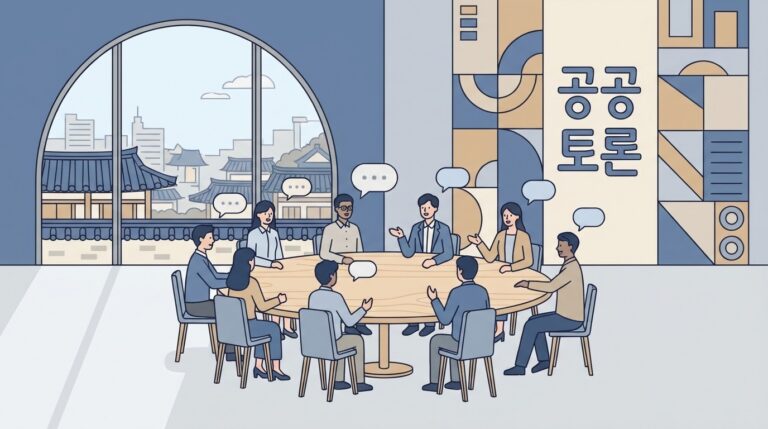
Phase 1: 공감 (Story Immersion Opening)
안녕하세요! 매일한글 에디터입니다. (Hello! I’m your Daily Hangul editor!)
Have you ever watched a gripping scene in a K-drama like Queenmaker or Stranger (비밀의 숲) where a heated public town hall (주민 공청회) erupts into absolute chaos? Picture this: a packed auditorium in Mapo-gu, Seoul. Residents are waving printouts, shouting over microphones, terrified that a proposed smart transit depot will lower neighborhood safety and plummet housing values. The district representative looks overwhelmed. But then, a skilled mediator steps up to the lectern, bows slightly, and calmly says:
“주민 여러분의 염려는 충분히 이해합니다. 다만 사실관계 확인과 가치관의 차이를 분리해, 공인된 제3자 검증 데이터부터 함께 짚어보겠습니다.”
(I fully understand the residents’ concerns. However, let us separate factual verification from differences in values, and first examine verified data from certified third parties together.)
Within minutes, the fever-pitch tension drops. The exaggerated panic evaporates, not because the mediator dismissed their anger, but because they expertly separated unfounded rumors from genuine value judgments.
When foreign professionals, diplomats, and civic leaders reach the C1 level in Korean, the biggest hurdle isn’t grammar—it is mastering the delicate art of facilitation (퍼실리테이션). In high-stakes Korean meetings, using the wrong tone or blunt refutations like “그건 틀렸습니다” (That’s wrong) will provoke defensive confrontation. Over the past decade coaching foreign NGO directors and corporate strategists in Seoul, I have compiled this battle-tested guide to help you de-escalate public panic, dismantle misinformation with elegance, and steer heated public forums toward actionable social consensus. Let’s elevate your Korean into the realm of statesmanship.
Phase 2: 핵심 표현 3선 심층 분석 (In-Depth Analysis of 3 Key Expressions)
1. 사실관계와 가치 판단을 잠시 분리해서 살펴보겠습니다. (Sasilgwangyewa gachi pandaneul jamsi bunrihaeseo salpyeobogesseumnida.)
- Pronunciation: [Sa-sil-gwan-gye-wa ga-chi pan-da-neul jam-si bul-li-hae-seo sal-pyeo-bo-get-seum-ni-da] (Think of ‘sasil’ like ‘fossil’ with an ‘s’, and ‘bunri’ rolling smoothly into ‘bul-li’ like the word ‘bull-leap’)
- Meaning: Literal: “We will separate the factual relationship and value judgment for a moment and look into them.” | Contextual: “Let’s pause and untangle verified empirical facts from differing philosophical viewpoints.”
- K-Culture Moment: Commonly heard in investigative current affairs panels like SBS’s Curious Stories Y (궁금한 이야기 Y) or JTBC political debates when the moderator halts escalating personal attacks.
- Editor’s Insight: In Korean deliberation, conflating facts (사실) with value beliefs (가치관) is considered the root of unproductive mudslinging (진흙탕 싸움). Using
잠시 분리해서(separating for a moment) creates a neutral cooling-off zone without invalidating anyone’s deeply held convictions. - Situation Spectrum: Casual: 🚫 | Semi-formal: ⚠️ | Formal: ✅
- 🤔 Think About It: In English, mediators often say “Let’s stick to the facts.” How does framing it as “separating facts from values” in Korean offer more face-saving dignity to an emotional speaker?
2. 우려하시는 지점은 충분히 공감하며, 제3자 검증 데이터를 바탕으로 짚어보겠습니다. (Uryeohasineun jijeomeun chungbunhi gomgamhamyeo, jesamja geomjeung deiteoreul batang-euro jipeobogesseumnida.)
- Pronunciation: [U-ryeo-ha-si-neun ji-jeo-meun chung-bun-hi gong-gam-ha-myeo, je-sam-ja geom-jeung de-i-teo-reul ba-tang-eu-ro ji-peo-bo-get-seum-ni-da] (Pronounce ‘geomjeung’ with a crisp, firm ‘k-um-jeung’ sound, like ‘gum’ + ‘jung’)
- Meaning: Literal: “I thoroughly empathize with the point you worry about, and I will examine it based on third-party verification data.” | Contextual: “I completely validate your legitimate concern, so let us address it directly using independent, verified findings.”
- K-Culture Moment: Used by crisis management team leaders in dramas like Agency (대행사) when presenting empirical safety studies to skeptical board members.
- Editor’s Insight: Never skip
충분히 공감하며(thoroughly empathizing). In Korean collective psychology, moving directly to technical data without emotional validation makes you appear cold and arrogant (공감 능력이 결여된 관료 – a bureaucrat lacking empathy). Establish emotional solidarity before deploying statistical defense. - Situation Spectrum: Casual: 🚫 | Semi-formal: ⚠️ | Formal: ✅
- 🤔 Think About It: Notice how Korean prioritizes the relational buffer (
공감) prior to the cognitive anchor (검증 데이터). Does your native language prioritize data first or emotion first?
3. 막연한 불안감을 해소하기 위해 공인된 통계 지표를 먼저 확인해 주시겠습니까? (Magyeonhan burangameul haesohagi wihae gong-indoen tonggye jipyoreul meonjeo hwaginhae jusigesseumnikka?)
- Pronunciation: [Mang-yeon-han bu-ran-ga-meul hae-so-ha-gi wi-hae gong-in-doen tong-gye ji-pyo-reul meon-jeo hwa-gin-hae ju-si-get-seum-ni-kka?] (Note the nasalization: ‘magyeon’ sounds like ‘mang-yeon’)
- Meaning: Literal: “In order to resolve vague anxiety, will you please check certified statistical indicators first?” | Contextual: “To dispel exaggerated fears, could we first review the officially certified benchmark metrics?”
- K-Culture Moment: Uttered by civic forum chairs or local government ombudsmen during environmental conflict hearings (환경영향평가 주민설명회).
- Editor’s Insight: The adjective
막연한(vague, unfounded) subtly disarms panic by labeling the fear as undefined rather than ridiculous. By pairing it with해주시겠습니까?(honoric deferential request), you hand autonomy back to the audience rather than lecturing them. - Situation Spectrum: Casual: 🚫 | Semi-formal: ⚠️ | Formal: ✅
- 🤔 Think About It: Why is framing misinformation as “vague anxiety” (막연한 불안감) socially safer than calling it “false rumors” (유언비어) in a public setting?
Phase 3: 교과서 한국어 vs 진짜 한국어 (Textbook vs. Real Korean)
Situation 1: Correcting an exaggerated rumor regarding public infrastructure
- 📖 교과서 한국어 (Textbook Korean):
그 소문은 거짓말입니다. 공식 자료를 보면 사실이 아닙니다.
(Geu somuneun geojinmarimnida. Gongsik jaryoreul bomyeon sasiri animnida.)
“That rumor is a lie. If you look at official materials, it is not true.” - 🗣️ 진짜 한국어 (Real Public Discourse):
온라인상에 퍼진 과도한 우려와 달리, 국책 연구기관의 교차 검증 결과 위험 수치는 기준치 미만으로 확인되었습니다.
(Onrain-sang-e peojin gwadohan uryeowa dalli, gukchaek yeongugigwaneui gyocha geomjeung gyeolgwa wiheom suchineun gijunchi mimaneuro hwagindoeeotseumnida.)
“Contrary to exaggerated anxieties circulating online, cross-verification by national research institutes confirms that hazard levels remain well below statutory safety thresholds.” - 💡 왜 다를까? (Why is it different?):
Calling a citizen’s concern a “lie” (거짓말) triggers instant hostility and loss of face. Real Korean forum discourse uses objective third-party institutions (국책 연구기관,공인 연구원) and passive evidential constructions (확인되었습니다) to remove individual blame.
Situation 2: Pivoting from ideological shouting to concrete policy calibration
- 📖 교과서 한국어 (Textbook Korean):
화내지 마시고 이제 대책을 이야기합시다.
(Hwanaeji masigo ije daechaegeul iyagihapsida.)
“Do not get angry, and let us discuss countermeasures now.” - 🗣️ 진짜 한국어 (Real Public Discourse):
상호 간의 가치 지향점 차이는 존중하되, 오늘은 실질적인 피해 예방을 위한 실무 지표 마련에 집중해 주시길 부탁드립니다.
(Sangho gan-eui gachi jihyangjeom chaineun jonjunghadoe, oneureun siljiljeogin pihae yebang-eul wihan silmu jipyo maryeone jipjunghae jusigil butakdeurimnida.)
“While we fully respect each other’s differing value orientations, I request that we focus today on establishing pragmatic administrative metrics for substantive risk prevention.” - 💡 왜 다를까? (Why is it different?):
Telling an emotional Korean speaker not to get angry (화내지 마세요) is patronizing. Acknowledging their fundamental values first (가치 지향점 차이는 존중하되) gives them moral credit, making them willing to accept pragmatic focus.
Phase 4: K-Culture 딥다이브 & 비언어적 매너 (K-Culture Deep Dive & Non-verbal Etiquette)
4-1. 눈치(Nunchi) & 제스처 (Gestures & Physical Presence)
- Open Palm Direction (두 손 모아 펼치기): When indicating presentation slides or independent audit charts, never point with an index finger. Use both hands or a relaxed single open hand with fingers together, palm tilted upwards at a 45-degree angle. This signifies transparent disclosure (투명한 공개).
- The Empathetic Nod and Low Pitch (정중한 끄덕임과 저음 억양): When an interlocutor raises their voice out of fear, maintain steady, gentle eye contact (avoiding an unblinking, aggressive stare). Nod slowly three times while lowering your vocal pitch. In Korean public forums, dropping your pitch demonstrates emotional stability (안정감) and authoritative composure.
- Body Angle (상체 5도 기울임): Tilt your upper torso slightly forward (around 5 degrees) while listening to grievances. It signals 경청 (active, humble listening), indicating that you view the public not as subordinates, but as civic equals.
4-2. 문화 코드 분석: 주민 공청회 (Jumin Gongcheonghoe) and Korea’s Civic Transparency
South Korea’s modern democracy is distinguished by extraordinary civic energy and digital scrutiny. Local forums—such as 주민 공청회 (Town Hall Hearings) regarding municipal development, environmental regulations, or corporate safety policies—are fiercely contested spaces. Because historical incidents like real estate speculation scandals or bureaucratic top-down governance have fostered public skepticism, citizens often suspect hidden agendas (밀실 행정).
Therefore, successful facilitators rely on 제3자 공인 기구 (Third-party certified organizations) such as the Board of Audit and Inspection (감사원), Korea Environment Institute (한국환경연구원), or university consortiums. In Korean culture, data from the government alone is often branded “official propaganda,” but data validated by independent external scholars holds high consensus power (사회적 공신력).
Phase 5: 실전 롤플레이 시나리오 (Real-Life Roleplay Scenario)
Setting: A packed auditorium in Seongdong-gu, Seoul. A fierce public forum regarding the construction of an AI-driven automated waste processing plant.
Characters:
* 최민석 (Choi Min-seok): Representative of the Local Residents’ Alliance (주민비상대책위원장), visibly agitated and gripping the microphone.
* Elena (You): Chief Facilitator and Senior Policy Mediator for the Metropolitan Consensus Committee.
- Turn 1 (최민석):
우리 아이들이 유독가스를 마시며 살 수는 없습니다! 인터넷 커뮤니티에 이미 다 떴어요! 암 발생률이 3배나 치솟는다는데, 관청은 왜 거짓말로 주민들을 기만합니까?!
(Uri aideuri yudokgaseureul masimyeo sal suneun eopseumnida! Inteonet keomyunitie imi da tteosseoyo! Am balsaengnyuri sebaena chisotneundaneunde, gwancheong-eun wae geojinmallo jumindeureul gimanamnikka?!)
“Our children cannot live breathing toxic gas! It’s already all over internet forums! Cancer rates will surge threefold, so why is the district deceiving residents with lies?!”
🎭 (Stamps foot on the platform, waving a sheaf of printed forum posts at the audience) -
Turn 2 (Elena):
위원장님과 주민 여러분께서 자녀분들의 건강을 최우선으로 염려하시는 마음, 깊이 공감합니다.
(Wiwonjangnim-gwa jumin yeoreobunkkeseo janyeobundeureui geon-gangeul choe-useon-euro yeomryeohasineun maeum, gipi gonggamhamnida.)
“I deeply empathize with your concern, Mr. Chairman, and that of all residents whose utmost priority is the health of their children.”
🎭 (Bows head slightly, holding the microphone with both hands in a calm, grounded posture) -
Turn 3 (Elena):
다만, 현재 온라인에 유포된 수치는 해외 구형 소각장 사례가 무분별하게 혼재된 것으로 파악되었습니다. 사실관계 확인과 주민분들의 안전 가치 수호를 분리하여 살펴보고자 합니다.
(Daman, hyeonjae onraine yupodoen suchineun hae-oe guhyeong sogakjang saryega mubunbyeolhage honjaedoen geoseuro pa-akdoeeotseumnida. Sasilgwangye hwagilgwa juminbundeureui anjeon gachi suhoreul bunrihayeo salpyeobogoja hamnida.)
“However, the figures currently circulating online have been identified as an unvetted mix of cases from obsolete overseas incinerators. I would like to separate the verification of facts from the protection of our shared value of resident safety.”
🎭 (Gently gestures with an open palm toward the presentation screen displaying certified source links) -
Turn 4 (최민석):
그럼 저 자료들이 전부 가짜 뉴스라는 말입니까? 공무원들이 만든 수치를 우리가 어떻게 믿어요?!
(Geureom jeo jaryodeuri jeonbu gajja nyuseuraneun marimnikka? Gongmuwondeuri mandeun suchireul uriga eotteoke mideoyo?!)
“So are you saying all those materials are fake news? How are we supposed to trust numbers manufactured by public officials?!”
🎭 (Glances around the crowd, seeking consensus murmurs) -
Turn 5 (Elena):
주민분들의 불신 또한 그간의 소통 부족에서 기인한 것임을 겸허히 인정합니다. 따라서 이번 조사는 행정기관이 아닌, 주민 대책위가 직접 추천하신 대학 연구진과 환경시민단체가 공동으로 검증했습니다.
(Juminbundeureui bulsin ttohan geugan-eui sotong bujog-eseo gi-inhan geoseimeul gyeomheohi injeonghamnida. Ttaraseo ibeon josaneun haengjeonggigwani anin, jumin daechaekwiga jikjeop chucheonhasin daehak yeongujin-gwa hwan-gyeongsimindanchega gongdong-euro geomjeunghaesseumnida.)
“We humbly acknowledge that the residents’ distrust also stems from past lapses in communication. Therefore, this audit was conducted not by administrative agencies, but jointly by university researchers and environmental civic groups directly recommended by your committee.”
🎭 (Maintains warm, reassuring eye contact without showing defensive tension) -
Turn 6 (Elena):
여기 독립된 제3자 검증 기관이 6개월간 실측한 대기질 데이터 지표를 함께 확인해 주시겠습니까? 법적 허용치의 50분의 1 수준입니다.
(Yeogi dongnipdoen jesamja geomjeung gigwani yukkyeowolgan silcheukhan daegijil deiteo jipyoreul hamkke hwaginhae jusigesseumnikka? Beopjeok heoyongchieui osipbune il sujunimnida.)
“Could we look together at the air quality data metrics measured on-site over six months by this independent third-party verification body? It sits at one-fiftieth of statutory legal limits.”
🎭 (Steps smoothly to the side of the lectern to ensure an unobstructed view of the data projection) -
Turn 7 (최민석):
…우리가 추천한 연구소에서도 같은 결과가 나왔단 말입니까?
(…Uriga chucheonhan yeon-gusoyoeseodo gateun gyeolgwaga nawattan marimnikka?)
“…Are you saying the research lab we recommended came up with the exact same findings?”
🎭 (Frown softens slightly, lowering the microphone to chest height) -
Turn 8 (Elena):
네, 맞습니다. 과장된 공포를 걷어내고 객관적 지표를 토대로 삼는다면, 주민 안전 담보 장치를 더욱 정밀하게 설계할 수 있습니다. 상설 안전감시단 구성을 함께 논의해 주시겠습니까?
(Ne, matseumnida. Gwadohan gongporeul geodeonaego gaekgwanjeok jipyoreul todaero samneundamyeon, jumin anjeon dambo jangchireul deouk jeongmilhage seolgyehal su itseumnida. Sangseol anjeongamsidan guseong-eul hamkke non-uihae jusigesseumnikka?)
“Yes, precisely. By sweeping away exaggerated fear and anchoring ourselves in objective metrics, we can engineer resident safety guarantees with even greater precision. Would you join us in discussing the establishment of a permanent safety monitoring committee?”
🎭 (Extends an open hand toward the podium table in an inviting, collaborative gesture)
🔀 인터랙티브 분기점 (Interactive Decision Point)
At Turn 8, what would happen if you chose a different facilitation tactic?
- Option A: “인터넷 괴담에 현혹되지 마시고, 과학적 상식을 가지고 대화합시다.” (Do not be swayed by internet ghost stories; let’s talk with scientific common sense.)
- Outcome: Bad ❌. Disastrous breakdown. Labeling citizen concerns as “괴담” (ghost stories) and accusing them of lacking common sense will ignite an instant walkout and media backlash.
- Option B: “주민 여러분이 걱정하시니 사업을 전면 백지화하겠습니다.” (Since residents worry, we will scrap the project entirely.)
- Outcome: Risk ⚠️. Avoidance trap. Sacrificing strategic civic infrastructure to emotional pushback damages municipal credibility and shifts conflict downstream rather than mediating it.
- Option C: “객관적 검증 지표를 공유했으니, 이를 바탕으로 주민 참여형 안전 대책을 수립합시다.” (Now that we have shared objective verification metrics, let us establish resident-led safety safeguards on this basis.)
- Outcome: Best ✅. Brilliant consensus building. It validates the data while empowering the community to take part in governance through institutional oversight.
Phase 6: 10초 감정 섀도잉 드릴 (10-Second Emotion Shadowing Drill)
Practice these high-level mediation deliveries aloud. Notice the deliberate pause breaks (/) and embody the emotional anchor cues.
Drill 1: Validating panic while pivoting to empirical data
[🤝 침착하고 신뢰감 넘치는 어조]- 주민 여러분의 / 정당한 불안감을 / 충분히 인지하고 있습니다. / 다만 감정적 대립을 넘어 / 공인된 전문 기관의 검증 수치를 / 먼저 차분히 확인해 주십시오.
- (Jumin yeoreobuneui / jeongdanghan burangameul / chungbunhi injihago itseumnida. / Daman gamjeongjeok daeribeul neomeo / gong-indoen jeonmun gigwaneui geomjeung suchireul / meonjeo chabunhi hwaginhae jusipsio.)
- “We fully recognize / the legitimate anxiety / of our residents. / However, rising above emotional confrontation, / please calmly examine / the verified metrics of certified professional agencies first.”
Drill 2: Separating values from rumors
[🏛️ 단호하면서도 품격 있는 중재 어조]- 근거 없는 추측으로 인한 / 과도한 공포는 배제하고, / 공동체의 안전이라는 / 본질적인 가치를 지키기 위한 / 실질적 논의를 시작하겠습니다.
- (Geun-geo eomneun chucheuk-euro inan / gwadohan gongponeun baejehago, / gongdongche-eui anjeon-iraneun / bonjiljeogin gachireul jikigi wihan / siljiljeok non-uireul sijakhagesseumnida.)
- “Setting aside / exaggerated fear born from baseless conjecture, / we will initiate substantive discourse / dedicated to protecting / the quintessential value of community safety.”
Phase 7: K-Culture 미니 사전 (Key Vocabulary)
- 공론화 (Gongronhwa)
- Translation: Public deliberation / Bringing an issue to open public forum.
- Usage: Used when transforming a clandestine back-room conflict into an open, institutionalized citizen debate (e.g., “원전 건설 여부를 공론화위원회에 부치다” – To submit the issue of nuclear power plant construction to a public deliberation committee).
- 교차 검증 (Gyocha Geomjeung)
- Translation: Cross-verification / Independent triangulation.
- Usage: Critical in mediation contexts. Indicates comparing multiple independent reports to establish empirical credibility (e.g., “학계와 시민사회의 교차 검증을 거쳤습니다” – It has undergone cross-verification by academia and civil society).
- 이해관계자 (Ihaegwangyeja)
- Translation: Stakeholder.
- Usage: Essential for formal facilitation. Encompasses all affected parties—residents, government officials, corporate sponsors, and civic groups (e.g., “모든 이해관계자의 합의를 도출하다” – To draw out consensus among all stakeholders).
- 기우 (Giu)
- Translation: Groundless worry / Baseless anxiety (Derived from the ancient idiom ‘기인지우’).
- Usage: A sophisticated C1 way to describe unfounded fears gracefully, usually phrased gently as “단순한 기우에 그치도록 철저히 대비하겠습니다” (We will prepare meticulously so that your concerns remain mere groundless worries).
Phase 8: 여행자 & 체류자를 위한 생존 키트 (Resident Survival Kit)
Survival Expressions TOP 3
- “회의 자료의 출처를 명확히 짚고 넘어가도 되겠습니까?”
(Hoe-ui jaryoeui chulcheoreul myeonghwakhi jipgo neomeogado doegesseumnikka?)- Meaning: “May we clearly verify the sources of these meeting materials before moving forward?”
- Pro Tip: Use this in company board meetings or community councils when a colleague presents dubious anecdotal slides.
- “상호 오해를 방지하기 위해 중립적인 조사 결과를 확인해 보시지요.”
(Sangho ohaereul bangjihagi wihae jungnipjeogin josa gyeolgwareul hwaginhae bosijiyo.)- Meaning: “To prevent mutual misunderstanding, let us review neutral audit findings.”
- Pro Tip: A smooth, diplomatic phrase when two Korean team members are locked in a passive-aggressive deadlock.
- “원활한 진행을 위해 발언 순서를 정중히 정리해 드리겠습니다.”
(Wonhwalhan jinhaeng-eul wihae bareon sunseoreul jeongjunghi jeongrihae deurigesseumnida.)- Meaning: “For smooth proceeding, I will respectfully coordinate the floor’s speaking order.”
- Pro Tip: Utter this with an authoritative, calm smile when multiple attendees speak over one another.
Editor’s Field Note: Accessing Verified Public Data in Korea
If you reside in Korea or participate in municipal consultations, don’t rely on rumor mills in Naver Cafe forums. Leverage institutional open databases. You can verify municipal budgets, zoning decisions, and environmental impact assessments directly via the Seoul Open Data Plaza (서울 열린데이터광장) or the nationwide administrative transparency portal CleanSys Real-time Stack Emission System (클린시스 대기배출원 관리). Having these apps bookmarked establishes you as a credible, data-literate participant in any Korean forum.
Phase 9: “한 발 더 깊이” (Cultural Essay: Consensus over Coercion)
In Western public debate traditions influenced by Greco-Roman rhetoric, public debate is frequently framed as an intellectual battleground where opposing arguments clash until one prevails through superior logic. In South Korea, however, a public forum (공론장) is fundamentally understood through the dual lens of 체면 (Social Face) and 화합 (Harmonious Accommodation). Direct contradiction in public causes public humiliation, converting intellectual disagreements into deep relational grudges (한 / 恨 or 감정 싸움).
Skilled Korean facilitators therefore never say “You are factually incorrect.” Instead, they split the person’s emotional validity from the technical fact. They acknowledge the human dignity and emotional investment (공감) while externalizing the error onto “imprecise data” or “cross-border misinterpretation.” By resolving the exaggerated anxiety with third-party verified facts, the mediator preserves the community’s social fabric without alienating anyone.
💬 Your Turn: Have you ever experienced a situation in your home country where an argument exploded simply because people confused emotional values with empirical facts? How would you handle it using the Korean facilitation mindset? Share your thoughts below!
Phase 10: FAQ & 오해 방지 (FAQ Schema)
Q: Can I use the phrase “그것은 가짜 뉴스입니다” (That is fake news) when moderating a heated Korean forum?
A: Strictly avoid this. While the term 가짜 뉴스 is pervasive in Korean media, uttering it as a mediator directly labels the speaker as a malicious propagandist or a gullible dupe. Instead, use high-register phrasing such as: "해당 내용은 공식적으로 교차 검증되지 않은 정보로 파악됩니다" (That content appears to be information that has not been officially cross-verified).
Q: What is the best way to pause someone who is yelling and hijacking the microphone?
A: Never raise your voice to shout over them. Interject by utilizing the collective honorific imperative: "잠시 장내를 정돈하겠습니다. 원활한 의사진행과 모든 참석자의 균등한 발언권 보장을 위해 정숙해 주시길 당부드립니다." (We will briefly restore order to the room. I urge silence to ensure smooth proceeding and equal speaking rights for all attendees.)
Q: Why is third-party data (제3자 검증 데이터) favored over ministry or district office data?
A: Historical administrative shifts and high political awareness have made local communities wary of “self-audits” (셀프 검증). Bringing in data verified by recognized universities, independent think tanks, or certified joint commissions neutralizes accusations of municipal bias.
🚨 흔한 실수 (Common Mistakes) 경고판
| Mistake | Why It Backfires | Correct Action (C1 Korean) |
|---|---|---|
| Saying “진정하세요!” (Calm down!) | Perceived as patronizing; implies the speaker is being irrational. | “말씀하신 취지를 충분히 이해하고 있으니, 차분히 다음 절차를 밟겠습니다.” (I fully comprehend your intent, so we will calmly proceed to the next step.) |
| Directly refuting: “그 통계는 틀렸습니다.” (That statistic is wrong.) | Causes severe loss of face (체면 손상) and provokes immediate defensiveness. | “인용하신 지표와 더불어, 최근 공인된 학술 데이터도 함께 대조해 보실 필요가 있습니다.” (Alongside the metrics you cited, it is necessary to cross-examine recently certified academic data.) |
| Dismissing fear: “별일 아닙니다.” (It’s no big deal.) | Makes the mediator appear callous and aligned with corporate/bureaucratic interests. | “우려하시는 위험 가능성을 선제적으로 차단하기 위해 실시간 측정망을 가동하겠습니다.” (To preemptively shut down the potential risks you worry about, we will operate real-time monitoring networks.) |
Phase 11: 액션 미션 & 참여 유도 (Action Missions)
- 🥉 Bronze Mission (Solo Shadowing):
Record yourself delivering Drill 1 from Phase 6 on your smartphone. Focus on maintaining a calm, unhurried cadence and lowering your voice pitch on the phrase차분히 확인해 주십시오. - 🥈 Silver Mission (SNS / Discussion Board Practice):
Find an online Korean article regarding a community policy dispute. Write a 2-sentence formal comment in Korean separating the factual misunderstandings from the residents’ emotional values using the phrase사실관계와 가치 지향점을 분리하여. - 🥇 Gold Mission (Real-life / Mock Facilitation):
In your next workplace meeting or Korean study group discussion where opinions clash, step in as the mediator using:"두 분의 우려는 충분히 공감하며, 객관적인 지표를 먼저 확인해 보겠습니다."Report the reaction in our comment section! - 🎮 K-Culture Mission:
Watch an episode of the political K-drama Queenmaker (Netflix) or Stranger Season 2. Identify at least one scene where a spokesperson addresses a press conference or public forum, and note down how non-verbal body language is utilized to convey institutional authority.
Phase 12: 인터랙티브 퀴즈 챌린지 (Interactive Quiz Challenge)
Question 1: Situational Judgment
You are facilitating a contentious public hearing regarding a new district school zone. An angry parent shouts that the district is prioritizing construction vehicles over children’s safety. Which of the following responses represents the most effective C1 mediation discourse?
- A) “어머님, 너무 과민 반응하시는 것 같습니다. 법적으로 문제없습니다.”
- B) “자녀분들의 통학로 안전에 대한 깊은 염려에 전적으로 공감합니다. 제3자 교통안전기관의 위험도 실측 데이터를 함께 검토해 주시겠습니까?”
- C) “가짜 뉴스에 속으신 것 같은데, 교육청 홈페이지를 다시 보고 오세요.”
👉 정답 및 해설 보기 (Click to reveal answer)
정답: B
해설:
* Option A is disastrously dismissive and patronizing (과민 반응).
* Option C attacks the citizen’s intelligence and dignity (가짜 뉴스에 속으신 것).
* Option B flawlessly executes C1 facilitation: it first validates the core emotional value (자녀 통학로 안전에 대한 깊은 염려에 전적으로 공감), and then pivots politely to certified external verification (제3자 교통안전기관 실측 데이터).
Question 2: Fill-in-the-Blank
Fill in the missing technical term:
“근거 없는 소문으로 인한 막연한 ( )을 해소하기 위해 공인된 제3자 검증 데이터를 제시하겠습니다.”
- A) 공론화
- B) 불안감
- C) 이해관계자
👉 정답 및 해설 보기 (Click to reveal answer)
정답: B (불안감 – anxiety/fear)
해설:
막연한 불안감 (vague anxiety/fear) is the set collocation used in public mediation to describe irrational public panic respectfully without directly accusing the citizens of being foolish.
Question 3: True / False Cultural Check
In a formal Korean town hall meeting, pointing directly at a presenter’s incorrect chart with your forefinger while raising your voice demonstrates sharpness and leadership.
- [ ] True
- [ ] False
👉 정답 및 해설 보기 (Click to reveal answer)
정답: False
해설:
Pointing with an index finger is perceived as physically aggressive and accusatory (지적질). Skilled facilitators and diplomats use an open palm gesture (손바닥을 펴서 가리키기) and lower their vocal tone to project composure, transparency, and supreme cultural authority.
🎬 Watch Our Daily Videos! (Daily Hangul Official Instagram)
Review the expressions you learned in this article with our fun daily short videos! Check out native pronunciation and real-life nuances in action.
- Instagram @dailyhangul_en







