

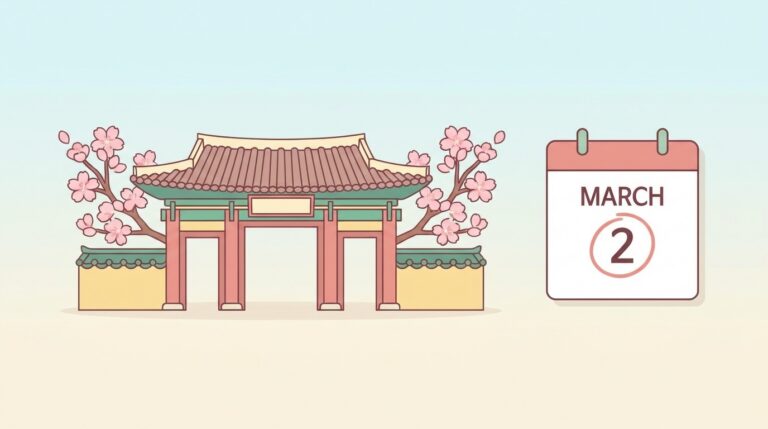
Phase 1: Empathy & Story-Immersive Opening
안녕하세요! 매일한글 에디터입니다. (Hello! I’m your Daily Hangul editor.)
Picture this: You are curled up watching your favorite campus K-drama—maybe Weightlifting Fairy Kim Bok-joo or Cheese in the Trap. The cherry blossom petals are beginning to swirl through the brisk air, university seniors are greeting eager freshmen in matching varsity jackets, and everyone keeps chattering excitedly about one big milestone: “3월 2일에 개강해요 (The semester starts on March 2nd)!”
If you grew up outside of South Korea, your brain probably hit pause right there. Wait, why March? In North America and Europe, school kicks off in the golden warmth of August or September. And why March second instead of the first? Even more baffling: when you try to read dates on Korean booking websites, concert tour posters, or flight itineraries, you suddenly encounter two different counting systems, quirky pronunciation shifts like Yu-wol instead of Yuk-wol, and particles that scramble your brain.
Getting dates mixed up in Korea isn’t just an academic quiz problem. It can mean showing up to a sold-out K-Pop concert on the wrong night, missing your KTX express train to Busan, or greeting an empty university lecture hall on a national holiday! At Daily Hangul, we surveyed hundreds of beginner learners who told us that calendar dates were their number one source of “accidental booking anxiety.” Don’t worry—by the end of this guide, you will breeze through Korean months, days, and campus timelines like a seasoned Seoulite.
Phase 2: Core 3 Expressions In-Depth
1. 3월 2일에 개강해요 (Sam-wol i-il-e gaeganghaeyo)
- Pronunciation:
[Sam-wol i-il-e gae-gang-hae-yo](Sounds like: Sahm-woll ee-ill-eh geh-gahng-heh-yo) - Meaning: Literal: “On March 2nd, semester begins.” | Real Nuance: “The semester starts on March 2nd.”
- K-Culture Moment: Heard constantly in late February across university towns like Sinchon and Hongdae when students return to campus to pick up textbooks and find their new lockers.
- Editor’s Insight: Notice the time particle -에 (-e) attached directly to the day. It functions just like “on” or “at” in English. Why March 2nd? March 1st is Samiljeol (삼일절, Independence Movement Day), a revered national holiday where everything closes down. Thus, Korean universities and schools inaugurate their academic year on March 2nd!
- Situation Spectrum: Casual: ⚠️ (Use 3월 2일에 개강해) | Semi-formal: ✅ (3월 2일에 개강해요) | Formal: ✅ (3월 2일에 개강합니다)
- 🤔 Think About It: English uses ordinal words like “second” or “third” for dates. Korean simply takes the base Sino-Korean number (2 = 이 [i]) and adds “day” (일 [il]). How does this make counting days easier once you memorize numbers 1 to 31?
2. 몇 월 며칠이에요? (Myeot-wol myeochil-ieyo?)
- Pronunciation:
[Myeod-wol myeo-chil-i-e-yo](Sounds like: Myud-woll myuh-chill-ee-eh-yo) - Meaning: Literal: “What month what day is it?” | Real Nuance: “What is today’s date?” / “What month and day is it?”
- K-Culture Moment: In K-dramas, whenever a protagonist wakes up in an emergency room or realizes they forgot their couple anniversary, they grab a calendar and stammer this exact question.
- Editor’s Insight: Spelling alert! While month is written with a space as 몇 월 (myeot-wol), the word for “what day of the month” is spelled phonetically as one word: 며칠 (myeochil), never 몇 일. Even native Koreans get this wrong in text messages, so getting it right shows top-tier Korean mastery!
- Situation Spectrum: Casual: ⚠️ (몇 월 며칠이야?) | Semi-formal: ✅ (몇 월 며칠이에요?) | Formal: ✅ (몇 월 며칠입니까?)
- 🤔 Think About It: Why do you think Korean culture asks for both the month and day in one phrase rather than a vague “What’s the date?”
3. 이번 주 금요일 (Ibeon ju geumyoil)
- Pronunciation:
[I-beon ju geum-yo-il](Sounds like: Ee-bun joo geum-yoh-ill) - Meaning: Literal: “This turn week Gold-day” | Real Nuance: “This Friday”
- K-Culture Moment: Friday night in Korea is affectionately called 불금 (Bul-geum)—”Burning Friday”! Friends text this phrase when arranging plans for Korean barbecue, fried chicken, and noraebang sessions.
- Editor’s Insight: 이번 (ibeon) means “this (current)”, and 주 (ju) means “week”. Days of the week in Korean are poetic: each one is named after natural elements rooted in East Asian cosmology (화=Fire, 수=Water, 목=Wood, 금=Metal/Gold). Friday is the day of Metal/Gold!
- Situation Spectrum: Casual: ✅ | Semi-formal: ✅ | Formal: ✅
- 🤔 Think About It: In English, Friday comes from the Norse goddess Frigg, while Korean uses ancient cosmic elements. How does linking days to natural elements change how you visualize your week?
Phase 3: Textbook Korean vs Real Korean
Situation 1: Asking when classes or semesters begin
- 📖 교과서 한국어 (Textbook Korean): 대학교 학기가 언제 시작합니까? (Daehakgyo hakgiga eonje sijakhamnikka?) — “When does the university semester commence?”
- 🗣️ 진짜 한국어 (Real Korean): 언제 개강해요? (Eonje gaeganghaeyo?) — “When is the first day of class?”
- 💡 왜 다를까? Textbook Korean relies on clunky literal translations like ‘학기’ (semester) and ‘시작하다’ (to start). Real college students and professors always use the crisp Sino-Korean compound 개강 (gaegang) paired with the conversational ‘-해요’ ending.
Situation 2: Asking someone for the date
- 📖 교과서 한국어 (Textbook Korean): 오늘은 몇 월 며칠입니까? (Oneureun myeot-wol myeochirimnikka?) — “What month and what day is today?”
- 🗣️ 진짜 한국어 (Real Korean): 오늘 며칠이에요? (Oneul myeochirieyo?) — “What’s the date today?”
- 💡 왜 다를까? If you are already living in the middle of March, everyone around you already knows what month it is! Dropping the month and simply asking 오늘 며칠이에요? is what 99% of native speakers say in real life.
Phase 4: K-Culture Deep Dive & Non-Verbal Manners
4-1. 눈치 (Nunchi) & Calendar Gestures
When discussing dates, schedules, or calendars with someone older, a professor, or a senior student (sunbae), physical manners matter:
* Two-Handed Coordination: If you are pointing at a date in someone’s notebook or on a shared paper schedule, never point aggressively with a single index finger. Instead, gesture gently with an open palm or lean in while keeping both hands politely resting in front of your body.
* Checking Your Smartphone: If you need to verify a date on your phone calendar during a conversation with a professor or boss, do not pull out your device abruptly. Say, “잠시 달력 확인해 보겠습니다 (Let me check my calendar for a moment)” with a polite head nod before looking down at your screen.
4-2. Cultural Code: The Magic of March 2nd (3월의 설렘)
In Western calendars, January 1st is the emotional reset. In South Korea, however, March 2nd is the true dawn of new beginnings.
Because the winter season in Seoul is bitterly cold and dry, social energy stays dormant until late February. When March arrives, the weather softens, cherry blossom buds appear, and the entire nation transitions simultaneously. Elementary kids, high schoolers, and college freshmen all start their brand-new school year. Corporations kick off their spring recruitment cohorts, and department stores fill with pastel stationery.
Why not March 1st? March 1st is Samiljeol (삼일절), commemorating the peaceful 1919 nationwide demonstration against colonial occupation. Out of respect for history, it is a protected national holiday. Therefore, life officially roars to life on March 2nd!
Phase 5: Real-Life Roleplay Scenario
Setting: A sunlit campus cafe near the university library. The aroma of freshly pressed waffles and roasted espresso fills the room. K-indie music hums in the background.
Character: Min-ho (민호), a cheerful third-year student assigned as your campus orientation buddy.
- Min-ho: 민지 씨, 한국 대학교 캠퍼스는 처음이죠? (Minji ssi, Hanguk daehakgyo kaempeoseuneun cheoeum-ijyo?) — “Minji, this is your first time on a Korean university campus, right?” 🎭 Smiling warmly while setting down two iced Americanos on the table.
- Learner: 네! 캠퍼스가 진짜 예뻐요. 그런데 다들 왜 이렇게 바빠요? (Ne! Kaempeoseuga jinjja yeppeoyo. Geureonde dadeul wae ireoke bappayo?) — “Yes! The campus is so pretty. But why is everyone so busy?” 🎭 Looking around wide-eyed at students hurrying with backpacks.
- Min-ho: 곧 개강이잖아요! 이번 주에 수강신청 확인해야 해요. (Got gaegang-ijanh-ayo! Ibeon jue sugangsincheong hwaginhaeya haeyo.) — “Classes start soon, you know! We have to verify our course registration this week.” 🎭 Chuckling as he taps his smart watch.
- Learner: 아! 정확히 언제 개강해요? (A! Jeonghwakhi eonje gaeganghaeyo?) — “Ah! Exactly when does the semester start?” 🎭 Leaning in with genuine curiosity.
- Min-ho: 3월 2일에 개강해요. 원래 3월 1일은 공휴일이거든요. (Sam-wol i-il-e gaeganghaeyo. Wonrae sam-wol irireun gonghyuirigeodeunyo.) — “The semester starts on March 2nd. Originally March 1st is a public holiday, you see.” 🎭 Turning his phone calendar toward you and pointing at the date.
- Learner: 아하, 3월 2일이요! 혹시 금요일이에요? (Aha, sam-wol i-ir-iyo! Hoksi geumyoil-ieyo?) — “Aha, March 2nd! Is that by any chance a Friday?” 🎭 Tilting head slightly while checking your own calendar.
- Min-ho: 아니요, 이번에는 목요일이에요. 첫날부터 수업 있어요! (Aniyo, ibeoneneun mogyoil-ieyo. Cheonnalbuteo sueop isseoyo!) — “No, this time it’s Thursday. We have real lectures from day one!” 🎭 Playfully winking while crossing arms.
- Learner: 와, 첫날부터요? 열심히 준비할게요! (Wa, cheonnalbuteoyo? Yeolsimhi junbi-halgeyo!) — “Wow, right from the first day? I will prepare hard!” 🎭 Clenching both fists into a cheerful ‘Fighting!’ gesture.
🔀 Interactive Branching Point
Min-ho asks with a smile: “그럼 개강 전날인 3월 1일에 같이 도서관 갈래요, 아니면 맛있는 거 먹으러 갈래요?” (Then on March 1st before classes start, should we go to the library together or go eat something delicious?)
- Option A: “3월 1일은 휴일이니까 푹 쉬고, 3월 2일에 만나요!” (March 1st is a holiday so let’s rest well, and meet on March 2nd!)
- 👉 [Best Choice 🌟]: Shows great understanding of Korean holiday etiquette while maintaining friendly and confident boundaries.
- Option B: “싫어요. 공부 안 해요.” (I hate that. I don’t study.)
- 👉 [Bad Choice ❌]: Way too harsh and blunt for Korean interpersonal culture (nunchi failure). It sounds rude to an upperclassman trying to help.
- Option C: “아무 때나 괜찮아요. 그냥 알아서 하세요.” (Whenever is fine. Just do whatever you want on your own.)
- 👉 [Risk Choice ⚠️]: ‘알아서 하세요’ often carries a passive-aggressive or dismissive tone in Korean, creating unintended friction.
Phase 6: 10-Second Emotion Shadowing Drill
Read these aloud, pausing at the slashes (/) and matching the emotional cues:
[😊 설레고 밝게 - Excited & Bright]
“3월 2일에 / 드디어 / 개강해요!”
(Sam-wol i-il-e / deudieo / gaeganghaeyo!)
“Classes finally start / on March 2nd!”-
[🤔 궁금하고 조심스럽게 - Curious & Polite]
“실례지만, / 오늘이 / 몇 월 며칠이에요?”
(Sillyejiman, / oneuri / myeot-wol myeochil-ieyo?)
“Excuse me, / but what month and day / is it today?” -
[🥳 신나고 기대에 차서 - Energetic & Eager]
“이번 주 금요일에 / 우리 / 맛있는 거 먹어요!”
(Ibeon ju geumyoire / uri / masinneun geo meogeoyo!)
“This Friday, / let’s eat / something delicious together!”
Phase 7: K-Culture Mini Dictionary
- 개강 (Gaegang) | Semester Opening: The official start of classes at universities and academies (hagwon). The opposite is 종강 (Jonggang), the euphoric last day of exams.
- 수강신청 (Sugangsincheong) | Course Registration: A legendary, high-stress online battle where university students flock to high-speed internet PC Bangs at 8:59 AM to secure popular classes before they fill up in 0.5 seconds.
- MT (Membership Training) | College Retreat: An overnight weekend getaway (often to riverside spots like Gapyeong or Daeseong-ri) where freshmen and upperclassmen play games, grill pork belly, and bond.
- 공강 (Gong-gang) | Empty Class Period / Gap Hours: The free time between two university lectures on your timetable. Students love finding cozy cafes to study or take naps during gong-gang.
Phase 8: Traveler’s Survival Kit
Top 3 Survival Expressions for Dates
- 오늘 며칠이에요? (Oneul myeochirieyo?) — “What’s the date today?”
Pro Tip: Essential whenever you fill out tax-free refund papers, customs declaration cards, or museum sign-in sheets. - 몇 시까지 해요? (Myeot sikkaji haeyo?) — “Until what time are you open?”
Pro Tip: Lifesaver when visiting dynamic pop-up stores in Seongsu-dong or night markets in Dongdaemun. - 예약 날짜를 바꿀 수 있어요? (Yeyak naljjareul bakkul su isseoyo?) — “Can I change my reservation date?”
Pro Tip: Invaluable if your travel plans shift and you need to reschedule a hair salon visit or a KTX express train.
Editor’s Travel Note
When navigating Korea, global map apps frequently fail to give accurate local transit timetables. Be sure to check the [Naver Map app download for real-time bus and subway navigation] so you never miss train departure dates. Also keep in mind that train tickets on the Korail Talk app sell out weeks in advance right before major holidays like March 1st or Chuseok, so always reserve early!
Phase 9: One Step Deeper (Reflection)
In many Western cultures, time is perceived as an unrelenting linear arrow stretching from January 1st onward. But in South Korea, time has an organic, seasonal communal pulse. While January 1st marks the legal flip of the calendar, Koreans feel their communal awakening on March 2nd.
When the winter wind calms down, students assemble into new cohorts, colleagues gather for spring kickoffs, and trees along the Han River prepare to bloom. Datekeeping in Korean is not simply an administrative duty—it is an invitation to coordinate your own steps with the communal harmony of those around you.
💬 Your Turn: In your home country, does your school or fiscal year start in spring or autumn? How does that season influence the energy and mood of your culture? Let us know in the comments below!
Phase 10: FAQ & Avoiding Misunderstandings
Q: Why do Korean months use Sino-Korean numbers instead of Native Korean numbers?
A: In Korean, calendar dates (both months and days) strictly use the Sino-Korean number system (일, 이, 삼, 사… / Il, I, Sam, Sa…). You simply attach -월 (wol, month) to numbers 1 through 12, and -일 (il, day) to numbers 1 through 31. Native Korean numbers (하나, 둘, 셋…) are reserved for counting durations (e.g., 한 달 = one month, 이틀 = two days) or counting hours on a clock.
Q: Why are June (6월) and October (10월) pronounced differently?
A: In standard Sino-Korean, 6 is ‘육’ (yuk) and 10 is ‘십’ (sip). However, to prevent harsh consonant stops and allow effortless pronunciation, the final consonant (받침) is dropped! June is pronounced 유월 (Yu-wol), NOT Yuk-wol. October is pronounced 시월 (Si-wol), NOT Sip-wol.
Q: Is 개강 (gaegang) used for elementary, middle, and high schools too?
A: No! 개강 (gaegang) is specifically used for universities, colleges, and adult academies (hagwon). For elementary, middle, and high schools, Koreans use the term 개학 (gaehak).
🚨 Common Mistakes Warning Box
- ❌ Mistake 1: Saying 삼월 둘일 for March 2nd.
✅ Correct Action: Never mix Native numbers into calendar dates. Always say 3월 2일 (Sam-wol i-il). - ❌ Mistake 2: Writing 몇 일 in text messages.
✅ Correct Action: The correct standard Korean spelling is always the single word 며칠 (myeochil). - ❌ Mistake 3: Pronouncing October as 십월 (Sip-wol).
✅ Correct Action: Drop the bottom consonant and say 시월 (Si-wol).
Phase 11: Action Mission & Engagement
- 🥉 Bronze Mission (Solo Vocal Drill): Look up your own birthday on your phone. Write it down in Korean ([Number]월 [Number]일) and say it out loud three times with natural intonation.
- 🥈 Silver Mission (Social Media): Post a photo of today’s view on Instagram or X with the Korean caption: “오늘은 [Month]월 [Day]일이에요!” and tag @DailyHangul.
- 🥇 Gold Mission (Real Interaction): Send a message to a Korean language partner or friend asking: “혹시 우리 몇 월 며칠에 만날까요? (What month and day shall we meet?)” to schedule your next chat.
- 🎮 K-Culture Mission: Watch the opening episode of any campus K-drama (like Weightlifting Fairy Kim Bok-joo or My ID is Gangnam Beauty) and spot when students mention the word 개강 (gaegang)!
Phase 12: Interactive Quiz Challenge
Test your calendar mastery below!
1. Situational Judgment: You want to ask your Korean university exchange buddy when college classes start this semester. Which sentence is most natural?
* A) 언제 출근해요? (Eonje chulgeunhaeyo?)
* B) 언제 개강해요? (Eonje gaeganghaeyo?)
* C) 언제 개학해요? (Eonje gaehakhaeyo?)
2. Fill-in-the-Blank: How do you write and say “October 15th” in Korean? (Watch out for the sound-change rule!)
* [ _____ ] 15일
3. True or False: In South Korea, university spring semester starts on March 1st because it is the very first day of the month.
* (True / False)
👉 Click here to reveal answers & explanations!
- Answer: B) 언제 개강해요?
Explanation: University and college semester start dates are called 개강 (gaegang). Choice A (출근) means going to work at a company, and Choice C (개학) is used for grade school / high school. -
Answer: 시월 (Si-wol)
Explanation: 10 is ‘십’, but before ‘월’ (month), the final consonant drops to form 시월 (Si-wol). So October 15th is 시월 십오일 (Si-wol sibo-il)! -
Answer: False
Explanation: March 1st is Samiljeol (Independence Movement Day), a major national public holiday. University classes officially begin on March 2nd (3월 2일)!
🎬 Watch Our Daily Videos! (Daily Hangul Official Instagram)
Review the expressions you learned in this article with our fun daily short videos! Check out native pronunciation and real-life nuances in action.
- Instagram @dailyhangul_en







