

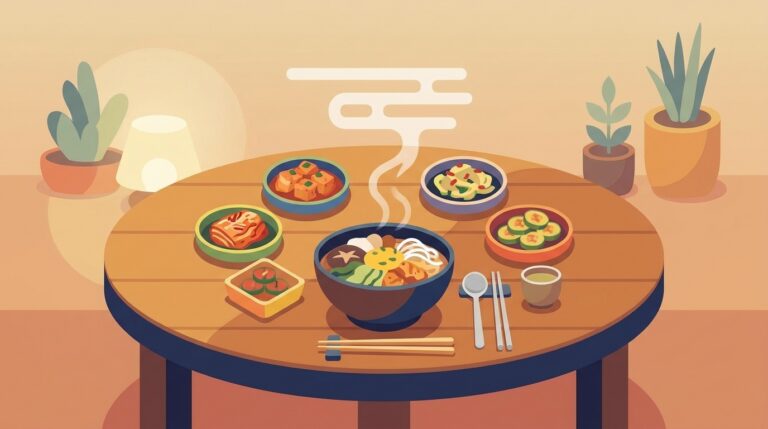
Why Aren’t You Eating? Master Basic Korean Question Words at the Dinner Table
Phase 1: Empathy (Story-Driven Opening)
안녕하세요! I’m your Daily Hangul editor and your personal Korean cultural navigator.
Picture this: You are sitting in a vibrant, bustling Korean BBQ spot in Hongdae. Slices of savory samgyeopsal are sizzling on the grill, surrounded by an endless rainbow of banchan (side dishes) and bubbling stew. Everyone at the table is chatting and enjoying the feast. You pause for a quick moment—maybe you’re full, trying to process all the flavors, or just figuring out how to construct the perfect lettuce wrap.
Suddenly, your Korean dining buddy leans in, tilts their head with deep, caring eyes, and asks: “왜 안 먹어요? (Wae an meogeoyo?)”
If you’re an absolute beginner, your heart might skip a beat. “Wait, did I do something wrong? Are they judging my appetite? Is this a test?”
Take a deep breath! Far from being an interrogation, this question is one of the warmest expressions of Korean care and hospitality. Over the past decade tutoring global learners, I’ve seen countless beginners freeze when confronted with fast-firing Korean question words at the dining table. Today, we’re unlocking the superpower behind “왜” (Why) and other essential basic question words so you never feel lost at a Korean meal again. Let’s dig in!
Phase 2: Top 3 Core Expressions in Depth
1. 왜 안 먹어요? (Wae an meogeoyo?)
- Pronunciation: [Wae an meo-geo-yo?] (Think of English: Way + Ahn + Mug + Uh + Yo)
- Meaning: Literal: “Why don’t you eat?” | Real Nuance: “Is everything okay with the food? Please feel comfortable and eat plenty!”
- K-Culture Moment: The iconic K-Drama mom who constantly stacks meat on a visitor’s rice bowl while urging them to eat heartily.
- Editor’s Insight: ‘왜’ (wae) means “why,” ‘안’ (an) indicates negative “not,” and ‘먹어요’ (meogeoyo) is the polite present form of “to eat.”
- Situation Spectrum: Casual (왜 안 먹어?): ⚠️ (friends only) | Semi-formal (왜 안 먹어요?): ✅ | Formal (왜 안 드세요?): ✅
- 🤔 Think About It: In many Western cultures, asking why someone isn’t eating can feel private or pushy. In Korea, why is checking on someone’s plate viewed as the ultimate sign of affection?
2. 뭐 먹고 싶어요? (Mwo meokgo sipeoyo?)
- Pronunciation: [Mwo meok-go si-peo-yo?] (Think of English: Mwah + Muck + Go + She + Per + Yo)
- Meaning: Literal: “What do you want to eat?” | Real Nuance: “What are you craving? I want to make sure you enjoy our meal together!”
- K-Culture Moment: A thoughtful senior (sunbae) or your date asking before picking a dinner venue on a Friday night in Gangnam.
- Editor’s Insight: ‘뭐’ (mwo) is the everyday conversational shortcut for “what” (무엇). Paired with ‘-고 싶어요’ (-go sipeoyo, “want to do”), it’s the friendliest opening line for any hangout.
- Situation Spectrum: Casual (뭐 먹고 싶어?): ⚠️ | Semi-formal (뭐 먹고 싶어요?): ✅ | Formal (어떤 음식을 드시겠어요?): ✅
- 🤔 Think About It: Notice how Koreans often decide meals collaboratively rather than picking completely separate dishes for each person. How does language shape that shared dining habit?
3. 배불러요? (Baebulleoyo?)
- Pronunciation: [Bae-bul-leo-yo?] (Think of English: Bae [like baby] + Bull + Law + Yo)
- Meaning: Literal: “Are you full?” | Real Nuance: “Did you get enough? You don’t have to force yourself if you are satisfied!”
- K-Culture Moment: An auntie at a street market food stall smiling warmly as you gently lay your chopsticks down.
- Editor’s Insight: In Korean, the same word ‘배불러요’ means “I am full” with falling intonation, and “Are you full?” when spoken with a rising tone at the end.
- Situation Spectrum: Casual (배불러?): ⚠️ | Semi-formal (배불러요?): ✅ | Formal (배부르십니까?): ✅
- 🤔 Think About It: English questions almost always require a subject pronoun (“Are you full?”). Why does Korean smoothly drop pronouns without creating confusion?
Phase 3: Textbook Korean vs Real Korean
Situation 1: Explaining you cannot eat anymore
- 📖 교과서 한국어 (Textbook): “저는 배가 부르기 때문에 더 이상 음식을 섭취할 수 없습니다.” (Jeoneun baega bureugi ttaemune deo isang eumsigeul seopchwihal su eopseumnida.)
- 🗣️ 진짜 한국어 (Real Korean): “진짜 배불러요! 정말 잘 먹었습니다.” (Jinjja baebulleoyo! Jeongmal jal meogeotseumnida.)
- 💡 왜 다를까?: Textbook Korean sounds like an official medical report. Real native Korean focuses on thanking the host and cheerfully declaring fullness with warmth.
Situation 2: Asking what someone is currently snacking on
- 📖 교과서 한국어 (Textbook): “당신은 현재 무엇을 먹고 있습니까?” (Dangsineun hyeonjae mueoseul meokgo itseumnikka?)
- 🗣️ 진짜 한국어 (Real Korean): “지금 뭐 먹어요?” (Jigeum mwo meogeoyo?)
- 💡 왜 다를까?: Native speakers avoid the awkward pronoun “당신” (you) and streamline “무엇을” into the breezy, punchy syllable “뭐”.
Phase 4: K-Culture Deep Dive & Non-Verbal Manners
4-1. 눈치 (Nunchi) & Table Gestures
- The Two-Hand Reassurance: If an older companion asks “왜 안 먹어요?”, don’t wave your hand dismissively. Lightly place a hand over your stomach, smile, and nod gently to show you are comfortably satisfied.
- Chopstick Rest Etiquette: Never stick your chopsticks straight up into your white rice bowl. This resembles incense burned during memorial rites (jesa) and is considered bad luck. Rest them flat across your side plate or ceramic rest.
- Receiving with Both Hands: When someone passes a dish or serves you side dishes, support your right wrist or forearm with your left hand as a sign of mutual respect.
4-2. Culture Code: “Jeong” (정) & Eating Together
In Korea, eating together is not simply refueling; it is building Jeong (정)—a sticky, affectionate communal bond. Historically, the Korean word for family is 식구 (Sik-gu), which literally translates to “mouths that eat together.” When someone asks “왜 안 먹어요?”, they aren’t questioning your diet—they are making sure you feel nourished and included.
Phase 5: Real-Life Roleplay Scenario
Setting: Minji (your friendly Korean buddy) and Alex (you) are having street food snacks at a cozy pojangmacha in Myeongdong.
- Turn 1 (Minji): “알렉스, 왜 안 먹어요? 매워요?” (Alex, wae an meogeoyo? Maewoyo? – Alex, why aren’t you eating? Is it spicy?)
🎭 Tilts head with concern, eyeing the bright red tteokbokki - Turn 2 (Alex): “조금 매워요. 하지만 맛있어요!” (Jogeum maewoyo. Hajiman masisseoyo! – It’s a little spicy. But it’s delicious!)
🎭 Smiles warmly while taking a sip of water - Turn 3 (Minji): “진짜요? 물 더 줄까요?” (Jinjjayo? Mul deo julkkayo? – Really? Shall I pour you more water?)
🎭 Picks up the water bottle with both hands - Turn 4 (Alex): “네, 고마워요. 민지 씨는 매운 거 잘 먹어요?” (Ne, gomawoyo. Minji ssineun maeun geo jal meogeoyo? – Yes, thank you. Minji, do you eat spicy food well?)
🎭 Holds cup with both hands to receive water - Turn 5 (Minji): “네, 저는 엄청 좋아해요! 이거 튀김도 먹어봐요.” (Ne, jeoneun eomcheong joahaeyo! Igeo twigimdo meogeobwayo. – Yes, I love it so much! Try this fried food too.)
🎭 Gently slides the crispy tempura dish closer - Turn 6 (Alex): “우와, 이건 뭐예요?” (Uwa, igeon mwoyeyo? – Wow, what is this?)
🎭 Points chopsticks politely toward the crispy roll - Turn 7 (Minji): “김말이 튀김이에요. 소스에 찍어 먹어요!” (Gimmari twigim-ieyo. Soseue jjigeo meogeoyo! – It’s fried seaweed noodle roll. Dip it in the sauce!)
🎭 Demonstrates by dipping a piece happily - Turn 8 (Alex): “네, 잘 먹겠습니다!” (Ne, jal meokgetseumnida! – Yes, I will enjoy this meal!)
🎭 Takes a bite enthusiastically
🔀 Interactive Decision Point
When Minji asks, “왜 안 먹어요?”, how should you react if you are already super stuffed?
- Option A: “배불러요, 진짜 잘 먹었어요!” (Baebulleoyo, jinjja jal meogeosseoyo!)
- Outcome (Best): Perfect! Reassures her that you loved the food and simply reached your physical limit with gratitude.
- Option B: “맛없어요.” (Maseopseoyo.)
- Outcome (Bad): Bluntly saying “It tastes bad” will immediately cause awkward silence and hurt your friend’s feelings.
- Option C: “싫어요.” (Sireoyo.)
- Outcome (Risk): Saying “I dislike it / I don’t want to” sounds childlike and abrupt in an adult dining setting.
Phase 6: 10-Second Emotion Shadowing Drill
Practice these with natural rhythm and feelings! The / mark indicates a brief natural pause.
[🥺 조심스럽고 다정하게 / Gentle and caring]
“왜 / 안 먹어요? / 입맛에 안 맞아요?”
(Wae / an meogeoyo? / Immase an majayo?)
“Why aren’t you eating? Does it not suit your taste?”-
[😊 배부르고 활기차게 / Full and content]
“진짜 / 배불러요! / 정말 / 맛있었어요.”
(Jinjja / baebulleoyo! / Jeongmal / masisseosseoyo.)
“I’m really full! It was truly delicious.” -
[😋 호기심 가득하고 밝게 / Curious and excited]
“이거 / 뭐예요? / 저도 / 먹고 싶어요!”
(Igeo / mwoyeyo? / Jeodo / meokgo sipeoyo!)
“What is this? I want to eat it too!”
Phase 7: K-Culture Mini Dictionary
- 밥 (Bap): Literal: Steamed rice | Everyday Context: Means “meal” in general. Asking “밥 먹었어요?” (Did you eat rice?) is Korea’s beloved everyday greeting equivalent to “How are you doing?”.
- 반찬 (Banchan): Literal: Side dishes | Everyday Context: All small complimentary dishes provided on the table. In virtually all casual Korean eateries, refilling banchan is free of charge.
- 정 (Jeong): Literal: Affection / Emotional bond | Everyday Context: The unique cultural concept of warm connection fostered through sharing space, time, and food.
- 식구 (Sikgu): Literal: Eating mouth | Everyday Context: Family or close community members who regularly share meals under one roof.
Phase 8: Survival Kit for Travelers
TOP 3 Dining Survival Phrases
- 덜 맵게 해주세요 (Deol maepge hae-juseyo): Please make it less spicy.
- Pro Tip: Indispensable if you want to enjoy tteokbokki or dakgalbi without crying tears of fire!
- 물 좀 주세요 (Mul jom juseyo): Please give me some water.
- Pro Tip: Water is often self-service (물은 셀프입니다), but if the bottle isn’t at your table, this phrase works like magic.
- 계산해 주세요 (Gyesanhae juseyo): Check, please!
- Pro Tip: Walk to the counter near the exit with your bill card rather than asking the server to bring the machine to your seat.
Editor’s Travel Note
- Local Navigation: Google Maps has limited walking directions in South Korea. Be sure to check the [Naver Map Navigation App on Official Store] for pinpoint restaurant locations and public transit routes.
- Smart Payment: Korea is nearly cashless. Have a debit card ready, or load up a [T-Money Transit Card for Subways and Convenience Stores] for quick tap-and-pay transactions.
Phase 9: One Step Deeper
Food in Korea is never just calories; it is relational currency. When someone asks you “왜 안 먹어요?”, it stems from a shared memory of times when food was scarce and ensuring your neighbor had eaten was the utmost duty of care. When your Korean companion notices your resting chopsticks, they aren’t monitoring your plate—they are making sure you feel welcomed, safe, and happy.
💬 Your Turn: In your home country, what do people say when they want to make sure their guests are eating well? Drop your native phrase in the comments below!
Phase 10: FAQ & Avoiding Misunderstandings
Q: Does asking “왜 안 먹어요?” mean my host feels offended?
A: No! It is virtually always an expression of concern. They want to check if the food is too spicy, if you have dietary restrictions, or if you simply need more water or another dish.
Q: How do I tell someone I am vegetarian when asked why I am not eating?
A: You can say: “저 고기 못 먹어요” (Jeo gogi mot meogeoyo – I cannot eat meat) or “저 채식주의자예요” (Jeo chaesikju-uijayeyo – I am a vegetarian).
Q: Can I just respond with “안 먹어”?
A: Avoid this unless speaking to someone younger or a very close peer. “안 먹어” is informal banmal. Always attach -요 (안 먹어요) to maintain friendly politeness.
🚨 Common Mistakes Board
- Mistake 1: Answering “왜요?” (Why?) defensively.
- Correct Action: Reassure them gently with “배불러요” (I’m full) or “조금 매워요” (It’s a little spicy).
- Mistake 2: Leaving your chopsticks plunged vertically into a rice bowl.
- Correct Action: Place them horizontally across your bowl or on the napkin/chopstick holder.
- Mistake 3: Assuming Korean questions without pronouns are rude commands.
- Correct Action: Listen for the soft, rising intonation at the end of the sentence; context carries the warmth!
Phase 11: Action Missions
- 🥉 Bronze Mission (Solo Practice): Stand in front of your mirror and repeat “왜 안 먹어요?” and “진짜 배불러요!” five times with warm facial expressions.
- 🥈 Silver Mission (Social Share): Snap a photo of your lunch today, post it with the caption “뭐 먹고 싶어요?”, and tag @DailyHangul.
- 🥇 Gold Mission (Real Life): Next time you dine with a Korean acquaintance or visit a Korean restaurant, greet your server with “잘 먹겠습니다!” before taking your first bite.
- 🎮 K-Culture Mission: Watch any episode of a food-centric K-Drama (like Let’s Eat or Hospital Playlist) and listen for the characters checking on each other’s plates!
Phase 12: Interactive Quiz Challenge
1. Situation Decision: Your Korean host notices you have paused eating and asks, “왜 안 먹어요?”. You are completely stuffed. What is the best response?
👉 Click to Reveal the Correct Answer & Explanation
Answer: “배불러요, 정말 맛있게 먹었습니다!” (Baebulleoyo, jeongmal masitge meogeotseumnida!)
Explanation: This confirms you are pleasantly full while offering high praise for the meal, putting your host completely at ease!
2. Fill in the Blank: Complete this question asking a friend what they want to eat:
“______ 먹고 싶어요?”
👉 Click to Reveal the Correct Answer & Explanation
Answer: 뭐 (Mwo)
Explanation: “뭐 먹고 싶어요?” translates directly to “What do you want to eat?”—your go-to beginner dining question!
3. True or False: Sticking chopsticks vertically into a bowl of white rice is a traditional sign of gratitude toward the chef in Korea.
👉 Click to Reveal the Correct Answer & Explanation
Answer: False!
Explanation: Sticking chopsticks upright mimics the incense offered during ancestral memorial rites. Always rest your chopsticks flat on the table or side plate.
🎬 Watch Our Daily Videos! (Daily Hangul Official Instagram)
Review the expressions you learned in this article with our fun daily short videos! Check out native pronunciation and real-life nuances in action.
- Instagram @dailyhangul_en







