

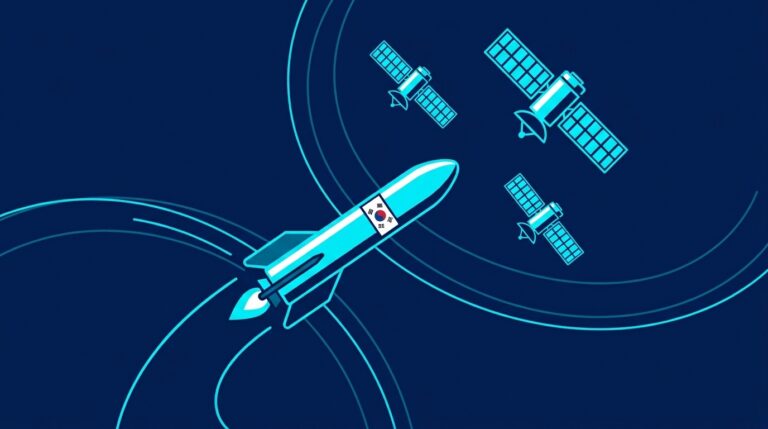
Phase 1: 공감 (Story-Driven Opening)
안녕하세요! 매일한글 에디터입니다.
Picture this: You are sitting at a sleek tech summit in Pangyo Techno Valley or attending an international aerospace forum at the National Assembly in Yeouido. Surrounding you are top Korean researchers from KARI (Korea Aerospace Research Institute), venture capitalists, and defense policymakers passionately debating the next decade of national security. Someone turns to you and asks: “우리나라가 글로벌 뉴 스페이스 경쟁에서 자체 발사체와 저궤도 위성망을 통해 궁극적으로 달성해야 할 전략적 지향점은 무엇이라고 보십니까?” (Where do you think South Korea’s strategic focal point should lie in the global New Space race through sovereign launch vehicles and LEO satellite constellations?)
At an intermediate level, you might manage: “우주 개발은 돈이 많이 들지만 중요해요” (Space development costs a lot of money, but it is important). But you are reaching for CEFR C2—the realm where you don’t merely communicate facts, but articulate high-stakes diplomacy, strategic autonomy, and technological industrialization with effortless gravitas.
Many advanced Korean learners hit a wall when transitioning from polite daily conversation to executive-level strategic discourse. Space is no longer just the romantic starry backdrop of K-dramas or the nostalgic fantasy of retro Korean animations; it has emerged as the definitive 21st-century geopolitical continent where telecommunications, sovereign defense, semiconductor manufacturing, and resource supremacy intersect. As someone who has coached ambassadors, venture partners, and defense analysts navigating Korean boardrooms, I’ve designed this masterclass to arm you with the precise lexicon and rhetorical sophistication needed to command authority when discussing Korea’s sovereign ascent into the cosmos.
Phase 2: 핵심 표현 3선 심층 분석 (Core Expressions in Depth)
1. 우주 주권을 확보하다 (Uju jugwon-eul hwakbohada)
- Pronunciation: [U-ju ju-gwon-eul hwak-bo-ha-da] (Think of ‘ju-gwon’ like the decisive beat in ‘judo’ combined with ‘gwon’ rhyming with ‘one’, and ‘hwak-bo’ with an energetic snap on the double-k sound)
- Meaning: Literal: “To secure space sovereignty” / Nuanced: To achieve autonomous, uncompromised national self-reliance in launch capacity, orbit allocations, and orbital defense without subservience to foreign superpowers.
- K-Culture Moment: Evoking the real-life national pride witnessed during the successful launch of the Nuri (KSLV-II) rocket or referenced in defense policy dramas where ministers declare that relying on foreign rockets turns Korea into an orbital vassal.
- Editor’s Insight: In Korean political discourse, the word 주권 (jugwon – sovereignty) carries heavy historical trauma and pride. Using “확보하다” (to secure/procure) elevates this phrase from technical jargon to an existential national imperative.
- Situation Spectrum: Casual 🚫 | Semi-formal ⚠️ | Formal ✅
- 🤔 Think About It: Why does Korean strategic language place such immense cultural weight on “sovereignty” (주권) compared to Western terminology that often favors commercial terms like “orbital independence” or “market dominance”?
2. 패러다임의 대전환 (Paereodaim-ui daejeonhwan)
- Pronunciation: [Pae-reo-da-im-ui dae-jeon-hwan] (Rhymes smoothly: ‘dae’ as in ‘day’, and ‘jeon-hwan’ pronounced with an articulate, rolling cadence like ‘turn-around’)
- Meaning: Literal: “Great transition of paradigm” / Nuanced: A seismic, irrevocable tectonic shift in how an entire industry, economy, or strategic doctrine operates.
- K-Culture Moment: Frequently used in business op-eds and high-level tech documentaries analyzing how SpaceX and commercial private space ventures disrupted legacy government-monopolized programs.
- Editor’s Insight: Don’t just say “변화” (change). At the C2 level, “대전환 (grand transformation)” establishes historical magnitude. When paired with “패러다임,” it signals to native speakers that you grasp macro-level historical vectors.
- Situation Spectrum: Casual ⚠️ | Semi-formal ✅ | Formal ✅
- 🤔 Think About It: How does framing industrial disruption as a “대전환” influence stakeholders to feel an urgency that mundane technological upgrades fail to inspire?
3. 미래 먹거리를 선점하다 (Mirae meokgeori-reul seonjeomhada)
- Pronunciation: [Mi-rae meok-geo-ri-reul seon-jeom-ha-da] (The ‘meok’ snaps quickly like ‘muck’, and ‘seon-jeom’ hits clearly like ‘sun-jump’)
- Meaning: Literal: “To preemptively occupy future food/sustenance” / Nuanced: To capture dominant first-mover advantage in high-growth next-generation industries that will feed the nation’s economy for the next 50 years.
- K-Culture Moment: Used constantly in Korea’s economic ministries and chaebol boardroom strategy meetings, echoing the legacy of how Korea conquered semiconductors, EV batteries, and shipbuilding.
- Editor’s Insight: “먹거리” literally translates to “edible food,” but in Korean socio-economic vernacular, it symbolizes industrial lifeblood. Coupling it with “선점하다” (preemptively seize) captures Korea’s intense “fast follower turned first mover” mindset.
- Situation Spectrum: Casual ⚠️ | Semi-formal ✅ | Formal ✅
- 🤔 Think About It: What does using a visceral survival metaphor like “food/sustenance (먹거리)” reveal about Korea’s post-war economic development psyche?
Phase 3: 교과서 한국어 vs 진짜 한국어 (Textbook vs. Elite Native Korean)
Scenario 1: Discussing the necessity of sovereign space defense and industry
- 📖 교과서 한국어 (Textbook): 우주 산업은 미래에 매우 중요하며 국방을 위해 투자를 많이 해야 합니다. (Uju saneob-eun miraee maeu jung-yohamyeo gukbang-eul wihae tuja-reul mani haeya hamnida. / Space industry is very important in the future and we need to invest a lot for national defense.)
- 🗣️ 진짜 한국어 (Executive Native): 우주는 단순한 과학적 호기심의 영역이 아니라, 통신망과 국방 인프라가 직결된 안보의 최전선이자 미래 먹거리의 핵심축입니다. (Ujuneun dansunhan gwahakjeok hogisim-ui yeong-yeog-i anira, tongsinmang-gwa gukbang impeura-ga jikgyeol-doen anbo-ui choejeonseon-ija mirae meokgeori-ui haeksimchug-imnida. / Space is not merely a realm of scientific curiosity; it is the front line of national security directly coupled with telecommunications and defense infrastructure, and the core axis of our future economic sustenance.)
- 💡 왜 다를까?: The textbook version sounds like an elementary school essay. The elite native version utilizes antithesis (“단순한 A가 아니라 B”), compound geopolitical nouns (“안보의 최전선”), and industrial metaphors (“핵심축”).
Scenario 2: Emphasizing the cost revolution of reusable launch vehicles
- 📖 교과서 한국어 (Textbook): 로켓을 다시 쓰면 발사 비용을 많이 아낄 수 있어서 경제적입니다. (Roket-eul dasi sseumyeon balsa biyong-eul mani akkil su isseoseo gyeongjejeog-imnida. / If we reuse rockets, we can save a lot of launch costs, so it is economical.)
- 🗣️ 진짜 한국어 (Executive Native): 재사용 발사체 기술을 통한 궤도 진입 단가 절감 없이는, 글로벌 상용 우주 시장에서 명함조차 내밀기 힘든 구조적 전환기에 직면해 있습니다. (Jaesayong balsache gisul-eul tonghan gwedo jin-ip danga jeolgam eopsineun, geullobeol sang-yong uju sijang-eseo myeonghamjocha naemilgi himdeun gujojeok jeonhwangie jikmyeonhae itseumnida. / Without reducing orbital insertion costs via reusable launch vehicle technology, we face a structural watershed where we cannot even introduce ourselves in the commercial global space market.)
- 💡 왜 다를까?: C2 discourse integrates idiomatic expressions like “명함조차 내밀지 못하다” (cannot even hand out a business card / utterly uncompetitive) seamlessly into rigorous economic analysis.
Phase 4: K-Culture 딥다이브 & 비언어적 매너 (Deep Dive & Non-Verbal Protocol)
4-1. 눈치 (Nunchi) & Geopolitical Body Language
When engaging in high-level defense or technology policy discussions in South Korea:
* The Steady, Measured Nod (고개 끄덕임): When a senior scholar or vice-ministerial official details national vulnerability, nodding slowly with closed lips signals deep comprehension of national gravity, not just passive agreement.
* Controlled Pitch Modulation: Lower your vocal register by half an octave when uttering words like “우주 주권” (space sovereignty) or “국가 안보” (national security). In Korean professional culture, high vocal inflection can be perceived as superficial or excitable; gravitas is communicated through a grounded, resonant delivery.
* Two-Handed Laser Pointer / Document Presentation: When presenting satellite telemetry or orbit mapping slides, anchor your gestures with two hands or support your right elbow slightly with your left hand, honoring traditional boardroom hierarchy while conveying intellectual humility.
4-2. The K-Sci-Fi & Defense Paradigm
From the dystopian gritty realism of Korea’s blockbuster Space Sweepers (승리호) to the real-world deployment of the military reconnaissance satellite 425 Project, Korea’s view of outer space is fundamentally pragmatic. While American discourse often frames space through the romantic lens of “the final frontier” or billionaire leisure, Korean narrative identity frames it through survival, technological self-reliance, and fierce industrialization. Space is perceived as a zero-sum geopolitical battlefield where being left behind means losing sovereignty over data, broadband, and military deterrents.
Phase 5: 실전 롤플레이 시나리오 (Executive Simulation)
- Setting: The VIP Briefing Lounge at KARI (Korea Aerospace Research Institute) in Daejeon.
- Character: Dr. Park Min-woo (박민우 박사), Chief Strategist of Satellite Constellation Programs.
Turn 1: Dr. Park
“외교안보 워킹그룹에서 저궤도 위성통신망 구축 사업의 경제성에 대해 회의적인 시각이 적지 않습니다. 단순 연구개발을 넘어 민관 합작으로 대규모 자본을 투입할 명분이 부족하다는 지적인데요.”
(Oegyoanbo wokinggeurub-eseo jeogwedo wiseongtongsinmang guchuk saeob-ui gyeongjeseong-e daehae hoe-uijeokin sigag-i jeokji anseumnida. Dansun yeongugaeber-eul neomeo min-gwan hapjag-euro daegyumo jabon-eul tu-iphal myeongbun-i bujokhada-neun jijeog-indeyo.)
“There is considerable skepticism within the foreign affairs and security working group regarding the economic feasibility of our LEO satellite network project. They argue we lack justification for pouring massive public-private capital beyond simple R&D.”
🎭 Frowning slightly, reviewing a classified budget dossier on his tablet.
Turn 2: You
“그것은 단견에 불과합니다. 저궤도 군집위성은 단순한 통신 수단이 아니라, 유사시 국가 지휘통제망을 담보하는 우주 주권의 핵심 기저입니다.”
(Geugeoseun dangyeon-e bulgwahamnida. Jeogwedo gunjibwiseong-eun dansunhan tongsin sudan-i anira, yusasi gukga jihwitongjemang-eul dambohaneun uju jugwon-ui haeksim gijeo-imnida.)
“That is mere shortsightedness. LEO satellite constellations are not simple communication tools; they are the fundamental bedrock of space sovereignty that guarantees national command-and-control networks during contingencies.”
🎭 Maintaining steady eye contact, speaking in a firm, resolute baritone.
Turn 3: Dr. Park
“하지만 스페이스X 같은 글로벌 독점 기업의 스타링크 서비스를 임차해 쓰는 편이 단기 예산 측면에서는 훨씬 합리적이지 않겠습니까?”
(Hajiman seupeiseu-ekseu gateun geullobeol dokjeom gi-eob-ui seutalinkeuseobiseu-reul imchahae sseuneun pyeon-i danggi yesan cheungmyeon-eseoneun hwolssin hamnijeog-iji ankkesseumnikka?)
“Yet wouldn’t leasing Starlink services from a global monopoly like SpaceX be far more rational from a short-term budgetary standpoint?”
🎭 Leaning forward, testing your geopolitical conviction with a sharp gaze.
Turn 4: You
“외산 플랫폼에 국가 핵심 신경망을 종속시키는 것은 지정학적 위기 상황에서 치명적인 안보 공백을 자초하는 처사입니다.”
(Oesan peullaetpom-e gukga haeksim singyeongmang-eul jongsoksikineun geoseun jijeonghakjeok wigi sanghwang-eseo chimyeongjeokin anbo gongbaeg-eul jachohaneun cheosa-imnida.)
“Subordinating the nation’s critical neural network to a foreign platform is an act that invites fatal security vacuums during geopolitical crises.”
🎭 Shaking your head calmly with an unyielding, serious expression.
Turn 5: Dr. Park
“타당한 지적입니다. 결국 독자적인 재사용 발사체와 위성 양산 인프라가 동시에 맞물려 돌아가야 승산이 있다는 뜻이군요.”
(Tadanghan jijeog-imnida. Gyeolguk dokjajeokin jaesayong balsache-wa wiseong yangsan impeura-ga dongsie matmullyeo doragaya seungsan-i itdaneun tteusi-gunyo.)
“A valid point. In the end, you mean we stand a chance only if indigenous reusable launch vehicles and mass-production satellite infrastructure operate in tandem.”
🎭 Nodding thoughtfully, noting down your key points with a stylus.
Turn 6: You
“정확하십니다. 발사 단가를 혁신하지 못하면 제조 경쟁력이 뛰어난 우리 기업들도 글로벌 밸류체인에서 배제될 수밖에 없습니다.”
(Jeonghwakhasimnida. Balsa danga-reul hyeoksinhaji mothamyeon jejo gyeongjaengnyeog-i ttwieonan uri gi-eopdeuldo geullobeol baellyuchein-eseo baejedoel subakke eopseumnida.)
“Precisely. If we fail to revolutionize launch unit costs, even our companies with world-class manufacturing competitiveness will inevitably be excluded from the global value chain.”
🎭 Gesturing open palms downward to signal structural reality.
Turn 7: Dr. Park
“그렇다면 이번 대통령 직속 우주항공청 정책 세미나 기조연설에서 우리가 가장 먼저 던져야 할 핵심 어젠다는 무엇입니까?”
(Geureotamyeon ibeon daetongnyeong jiksok ujuang-gongcheong jeongchaek semina gijoyeonseor-eseo uriga gajang meonje deonjyeoya hal haeksim eojendaneun mueos-imnikka?)
“In that case, what is the foremost agenda we must table in the keynote address at the upcoming presidential Korea AeroSpace Administration policy seminar?”
🎭 Folding his hands on the desk, eagerly anticipating your synthesis.
Turn 8: You
“우주를 경제와 안보가 통합된 21세기 신대륙으로 규정하고, 독자 기술 기반의 발사 생태계 구축을 선포해야 합니다.”
(Uju-reul gyeongje-wa anbo-ga tonghapdoen isibilsegi sindaeryug-euro gyujeonghago, dokja gisul giban-ui balsa saengtae-gye guchuk-eul seonpohaeya hamnida.)
“We must define space as the new 21st-century continent where economy and security merge, and declare the establishment of an indigenous launch ecosystem.”
🎭 Concluding with resolute tone and dignified composure.
🔀 Decision Point (Your Turn to React)
At Turn 4, if Dr. Park asked about the budget trade-off, how would you respond?
- Option A: “돈은 나중에 벌면 되니까 일단 무조건 발사체부터 쏘아 올리고 봅시다.” (Bad: Lacks policy sophistication; dismisses fiscal discipline recklessly.)
- Option B: “외산 플랫폼에 국가 핵심 신경망을 종속시키는 것은 지정학적 위기 상황에서 치명적인 안보 공백을 자초하는 처사입니다.” (Best: Flawlessly combines geopolitical strategy, national sovereignty, and elevated vocabulary.)
- Option C: “스타링크가 성능은 좋으니 기술 제휴만 맺고 우리 개발은 잠시 보류하는 건 어떨까요?” (Risk: Undermines sovereignty; shows defeatist strategy contrary to Korea’s New Space mission.)
Phase 6: 10초 감정 섀도잉 드릴 (Executive Shadowing Drill)
Practice these high-level rhetorical deliveries using the slash (/) for tactical breathing points:
[🔥 단호하고 결연하게 - Resolute & Strategic]
“우주 주권은 / 타협할 수 없는 안보 자산이며, / 독자 발사체 역량이야말로 / 그 출발점입니다.”
(Uju jugwon-eun / tahyeophal su eomneun anbo jasan-imyeo, / dokja balsache yeongnyang-iyamallo / geu chulbaljeom-imnida.)
“Space sovereignty / is an uncompromising security asset, / and indigenous launch capability / is its very starting point.”-
[🧐 날카롭고 분석적으로 - Incisive & Analytical]
“재사용 발사체를 통한 / 발사 단가 혁신 없이는, / 저궤도 군집위성망 구축은 / 밑 빠진 독에 물 붓기입니다.”
(Jaesayong balsache-reul tonghan / balsa danga hyeoksin eopsineun, / jeogwedo gunjibwiseongmang guchug-eun / mit ppajin dog-e mul butgi-imnida.)
“Without launch cost innovation / via reusable launch vehicles, / building an LEO satellite constellation / is pouring water into a bottomless jar.” -
[🚀 미래지향적이고 웅장하게 - Visionary & Grand]
“우주는 이제 / 동경의 대상이 아닌, / 통신과 국방, 자원이 융합되는 / 거대한 신대륙입니다.”
(Ujuneun ije / dong-gyeong-ui daesang-i anin, / tongsin-gwa gukbang, jawon-i yunghapdoeneun / geodaehan sindaeryug-imnida.)
“Space is no longer / a realm of wistful wonder, / but a massive new continent / where telecom, defense, and resources coalesce.”
Phase 7: K-Culture 미니 사전 (Core Lexicon)
- 우주 주권 (Uju jugwon): Space Sovereignty. The unalienable strategic right and indigenous technological capability of a state to operate in orbital domains without foreign veto or reliance.
- 뉴 스페이스 (Nyu seupe-i-seu): New Space. The commercial transition from legacy, government-led, cost-plus space programs (올드 스페이스) to private enterprise, venture-backed, cost-disruptive aerospace ecosystems.
- 저궤도 군집위성 (Jeogwedo gunjibwiseong): Low-Earth Orbit (LEO) Constellation Satellites. Swarms of small satellites deployed between 300km to 1,500km altitude to facilitate ultra-low latency telecommunications and real-time military surveillance.
- 독자 기술 (Dokja gisul): Sovereign / Proprietary Indigenous Technology. The ideological Holy Grail of Korean industrial policy, referring to homegrown IP that prevents technological subjugation.
Phase 8: 여행자를 위한 생존 키트 (Diplomatic & Tech Survival Kit)
Professional Survival Expressions TOP 3
- “이 기술의 국산화율은 어느 정도 수준입니까?”
(I gisul-ui guksan-hwa-yur-eun eoneu jeongdo sujun-imnikka?)
Pro Tip: Essential when touring aerospace expos (like ADEX at Seoul Airport). Asking about the “domestic localization rate” instantly marks you as an industry insider. - “글로벌 공급망 재편 속에서 한국의 입지는 어떻습니까?”
(Geullobeol gong-geubmang jaepyeon sog-eseo han-guk-ui ipji-neun eotteoseumnikka?)
Pro Tip: A golden conversation starter at Pangyo or Yeouido geopolitical networking receptions. - “민관 매칭 펀드 조성을 통한 스케일업이 시급합니다.”
(Min-gwan maeching peondeu joseong-eul tonghan seukeil-eob-i sigeuphamnida.)
Pro Tip: Use this during venture capital panels to emphasize public-private scaling for aerospace startups.
Editor’s Travel Note: Visiting Korea’s Aerospace Epicenters
If you want to witness Korea’s space ambitions firsthand, visit the Goheung Naro Space Center in Jeollanam-do or tour Daedeok Innopolis (대덕연구개발특구) in Daejeon. For seamless domestic rail transit between Seoul and Daejeon, make sure to consult the Korail Talk official reservation platform rather than third-party re-sellers. If navigating research parks in Daejeon, the Naver Map navigation application provides far superior pedestrian and building entrance accuracy for research campuses compared to foreign mapping platforms.
Phase 9: “한 발 더 깊이” (Cultural Essay)
To truly grasp why South Korea pursues space launch independence with such fierce urgency, one must understand the Korean historical concept of 자립 (Jarip – Self-Reliance) and the lingering phantom of being a “새우 (shrimp) caught between whales.” For centuries, Korean peninsula geopolitics was dictated by continental and maritime super-empires. When the space age dawned, Korea was decades behind. But just as the country conquered memory chips and steel through sheer national will, space is viewed not merely as a business vertical, but as the final insurance policy of national survival. When a Korean engineer speaks of “우리 발사체 (our own launch vehicle),” the emphasis is rarely on the metal casing—it is on the collective pride of never again having to beg an ally for satellite imagery or launch clearance.
💬 Your Turn: Does your home country perceive space exploration primarily as a private commercial venture, a scientific luxury, or an urgent geopolitical shield? Let’s dissect this perspective in advanced Korean in the comments below!
Phase 10: FAQ & 오해 방지 (FAQ Schema)
Q: Can I use the phrase “미래 먹거리” in academic defense research papers?
A: Absolutely, but with style. In spoken panels and executive summaries, “미래 먹거리” is universally embraced by ministers and CEOs. In strictly formal peer-reviewed academic manuscripts, you can alternate it with “미래 신성장 동력” (future new growth engine) or “차세대 전략 산업” (next-generation strategic industry).
Q: What is the semantic difference between “우주 개발” and “우주 경제”?
A: “우주 개발 (Space Development)” belongs to the Old Space vocabulary—emphasizing scientific research, state prestige, and exploration. “우주 경제 (Space Economy)” reflects New Space reality: orbital manufacturing, satellite servicing, downstream broadband profits, and supply chains.
Q: Why do Korean commentators use “자체 발사체” and “독자 발사체” interchangeably?
A: Both signify domestic rockets, but “자체 (Jache)” emphasizes the entity itself (e.g., our company’s or our nation’s own vehicle), while “독자 (Dokja)” carries an ideological nuance of independence, asserting complete freedom from foreign technological leverage.
🚨 Common Mistakes (흔한 실수)
- Mistake: Using “우주 여행” (space travel) when discussing executive orbital strategy.
Correction: Use 유인 우주 탐사 (crewed space exploration) or 상용 우주 운송 (commercial space transport). - Mistake: Saying “위성을 많이 던지다” (throwing lots of satellites).
Correction: Say 군집위성을 궤도에 전개하다 (deploying satellite constellations into orbit). - Mistake: Translating “sovereignty” simply as “힘” (power/strength).
Correction: Always utilize 주권 (jugwon) when national strategic self-determination is at stake.
Phase 11: 액션 미션 & 참여 유도 (Action Missions)
- 🥉 Bronze Mission (Solo Mastery): Stand before a mirror and record yourself delivering the Phase 6 Shadowing Drill #1 with full diplomatic authority, keeping your gaze fixed and hands controlled.
- 🥈 Silver Mission (Social Synthesis): Post a short reflection on LinkedIn or your study blog summarizing the difference between “올드 스페이스” and “뉴 스페이스” using at least three keywords from Phase 7.
- 🥇 Gold Mission (Real-World Deployment): Watch a YouTube briefing from Korea’s KASA (우주항공청) or KARI, transcribe one sentence containing “독자 기술” or “주권,” and synthesize your own critical counter-argument in formal Korean (
~ㅂ니다/습니까style). - 🎮 K-Culture Mission: Watch the film Space Sweepers (승리호) or a documentary on the Nuri rocket launch; observe how Korean engineers emotionally react to the phrase “자력 발사” (launching with our own strength).
Phase 12: 인터랙티브 퀴즈 챌린지 (Quiz Challenge)
Test your C2 mastery. Answer the questions, then click the toggle to evaluate your linguistic and geopolitical precision!
- Context Judgment: You are addressing the National Assembly Aerospace Committee. Which phrasing sounds most authoritative?
- (A) 우주 로켓 쏘는 건 돈 낭비니까 외국 회사 거 빌립시다.
- (B) 저궤도 위성망과 발사체 독자 역량은 국가 안보와 직결된 타협 불가능한 우주 주권입니다.
- (C) 우주는 너무 멀어서 우리 경제와는 아무 상관이 없습니다.
- Fill in the Blank: “발사 비용의 획기적인 절감 없이는 글로벌 상용 시장에서 미래 먹거리를 ( ) 어렵습니다.”
- (A) 선점하기
- (B) 요리하기
- (C) 구걸하기
- True / False: In Korean geopolitical terminology, “우주 주권 (Space Sovereignty)” is treated merely as commercial marketing jargon without legal or national defense implications. (T / F)
👉 Click to reveal answers & deep explanations
- Answer: (B). Option B employs elevated register (“국가 안보와 직결된 타협 불가능한 우주 주권”). Option A is defeatist and overly colloquial; Option C demonstrates geopolitical ignorance.
- Answer: (A) 선점하기. The established strategic collocation is “미래 먹거리를 선점하다” (to preemptively secure future growth engines).
- Answer: False. “우주 주권” is a paramount geopolitical doctrine in South Korea, deeply entwined with the defense against orbital vulnerability and technological autonomy.
🎬 Watch Our Daily Videos! (Daily Hangul Official Instagram)
Review the expressions you learned in this article with our fun daily short videos! Check out native pronunciation and real-life nuances in action.
- Instagram @dailyhangul_en







