

Phase 1: Empathy (Story Immersion Opening)
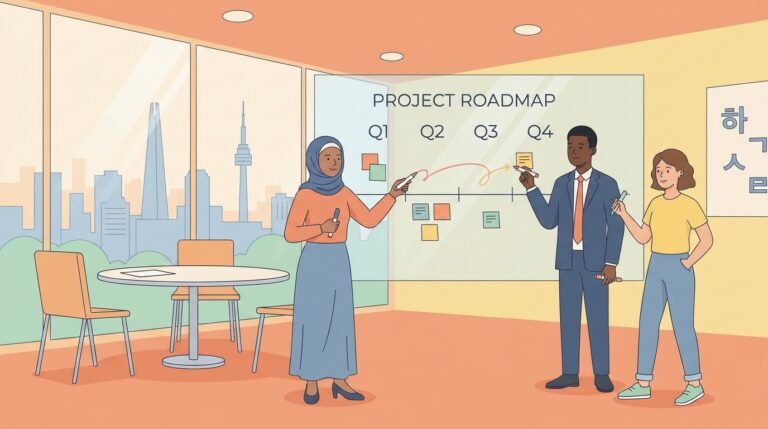
안녕하세요! 매일한글 에디터입니다. (Hello! This is your Daily Hangul editor.) Have you ever watched a scene in a K-drama like Misaeng (미생) or Start-Up (스타트업) where a newly appointed team leader stands before a glass whiteboard, holding a marker with a room full of sharp, quiet eyes watching their every move? The atmosphere is electric, polite, and yet somehow intense.
Leading a project kick-off meeting in a Korean corporate setting can feel like walking into that exact scene. You want to assign clear Roles and Responsibilities (R&R) without sounding dictatorial, and you want to inspire collective ownership without being vague. Many intermediate learners tell us: “I know how to say ‘Let’s do this,’ but how do I express that we need to start off on the right foot so everyone stays aligned until the finish line?”
In Korean work culture, the beginning of any initiative carries immense psychological weight. Today, we are breaking down the exact natural phrasing, cultural cues, and diplomatic nuances that will make your Korean colleagues think, “와, 이 사람 일 진짜 똑 부러지게 하네!” (Wow, this person really knows how to get things done right!). Based on real feedback from global project managers working at tech firms in Pangyo and Gangnam, this guide will give you the confidence to run a kick-off meeting smoothly from start to finish.
Phase 2: Deep Dive into 3 Key Expressions
1. 첫 단추를 잘 끼우다 (Cheot danchureul jal kkiuda)
- Pronunciation: [Cheot dan-chu-reul jal kki-u-da] (Think of ‘cheot’ like ‘ch-ut’, and ‘kki-u-da’ like snapping a Lego piece into place with a crisp double-k sound.)
- Meaning: Literal: “To button the first button correctly” | Actual Nuance: “To start off on the right foot” or “To establish the foundational step accurately so everything down the line runs smoothly.”
- K-Culture Moment: In office dramas, senior directors often use this idiom when greenlighting a high-stakes campaign: “첫 단추가 잘못 끼워지면 다 틀어집니다” (If the first button is fastened incorrectly, everything gets derailed).
- Editor’s Insight: Koreans view a project like a well-tailored dress shirt. If the very top button goes into the wrong hole, every single button beneath it looks crooked, regardless of how neatly you iron it later. Using this metaphor signals that you value systemic planning over rushed action.
- Situation Spectrum:
- Casual (Friends/Peers): ✅
- Semi-formal (Internal Team Slack/Meeting): ✅
- Formal (Boardroom Presentation/Client Kick-off): ✅
- 🤔 Think About It: In English, we often say “Hit the ground running,” which emphasizes speed. Why do you think Korean emphasizes “fastening the first button correctly,” which focuses on deliberate alignment and precision?
2. 역할과 책임을 명확히 나누다 (Yeokhwal-gwa chaegim-eul myeonghwak-hi nanuda)
- Pronunciation: [Yeok-hwal-gwa chae-gim-eul myeong-hwak-hi na-nu-da] (Pronounce ‘myeong-hwak’ crisply, like snapping your fingers: clear, precise, and unambiguous.)
- Meaning: Literal: “To clearly divide roles and responsibilities” | Actual Nuance: “To define unambiguous ownership and eliminate gray areas (R&R) across team members.”
- K-Culture Moment: Used constantly during sprint planning or cross-functional kickoff syncs to avoid the infamous “핑퐁” (ping-ponging blame between departments).
- Editor’s Insight: While Korean business culture emphasizes teamwork (“우리”, we/us), modern Korean offices deeply crave “업무 명확성” (work clarity). Using this expression shows both strategic leadership and empathy for team workload.
- Situation Spectrum:
- Casual: ⚠️ (A bit too formal for weekend plans with friends)
- Semi-formal: ✅
- Formal: ✅
- 🤔 Think About It: How does stating “responsibility” (책임) in Korean carry personal moral accountability compared to just assigning a “task” (업무)?
3. 한 방향을 보고 달리다 (Han banghyang-eul bogo dallida)
- Pronunciation: [Han bang-hyang-eul bo-go dal-li-da] (Flow smoothly from ‘bang-hyang’ to ‘dal-li-da’ like a rowing crew moving in unison.)
- Meaning: Literal: “To run looking toward one single direction” | Actual Nuance: “To stay completely aligned and united toward a shared vision without internal friction.”
- K-Culture Moment: A team leader at an agency cheering everyone on after an intense kickoff session: “우리 모두 한 방향을 보고 끝까지 완주해 봅시다!” (Let’s all look in the same direction and run until the finish line!).
- Editor’s Insight: Notice the verb is not just 걷다 (walk), but 달리다 (run). It captures the dynamic, fast-paced momentum (빨리빨리) characteristic of Korean corporate innovation.
- Situation Spectrum:
- Casual: ⚠️ (Slightly dramatic for mundane chores)
- Semi-formal: ✅
- Formal: ✅
- 🤔 Think About It: Why does Korean organizational rhetoric prefer spatial metaphors like “facing the same direction” over individualist metaphors like “playing your own part well”?
Phase 3: Textbook Korean vs. Real Korean
Situation 1: Setting up team roles during the kickoff
- 📖 교과서 한국어 (Textbook):
“지금부터 각자의 역할을 정하겠습니다. 맡은 일을 열심히 하세요.”
(Now we will decide each person’s role. Work hard on your assigned task.) - 🗣️ 진짜 한국어 (Real-World):
“프로젝트 초반에 R&R을 명확히 싱크 맞춰두어야 나중에 병목이 안 생깁니다. 각 파트별 오너십을 확실히 가져가 볼까요?”
(We need to clearly sync our R&R early on so we don’t encounter bottlenecks later. Shall we make sure each domain has clear ownership?) - 💡 왜 다를까?: The textbook phrase sounds cold, elementary, and top-down. Real Korean business meetings adopt loanwords like “R&R”, “싱크” (sync), and “병목” (bottleneck) combined with polite yet empowering prompts like “오너십을 가져가다” (take ownership).
Situation 2: Emphasizing alignment before starting the execution phase
- 📖 교과서 한국어 (Textbook):
“우리는 모두 같은 목표를 가지고 일해야 성공할 수 있습니다.”
(We must all work with the same goal in order to succeed.) - 🗣️ 진짜 한국어 (Real-World):
“첫 단추를 잘 끼운 만큼, 끝까지 흔들림 없이 한 방향으로 얼라인해서 달려봅시다.”
(Since we buttoned the first button so well, let’s stay aligned toward the same direction and push forward steadily until the end.) - 💡 왜 다를까?: The textbook version sounds like a slogan from a school poster. The real version uses the beloved “첫 단추” idiom and combines it with modern corporate phrasing (“얼라인하다”, to align), creating motivating, natural professional cadence.
Phase 4: K-Culture Deep Dive & Non-Verbal Manners
4-1. 눈치 (Nunchi) & Meeting Gestures
When leading a kickoff in Korea, balance authority with approachable collective humility:
* The Open-Palm Agenda Presentation: When referring to slides or whiteboards, never point with an index finger. Use an open palm facing upward (손바닥을 위로 향하기). It denotes respect and transparency.
* Active Eye-Contact & Nodding (고개 끄덕임): Korean team members may not immediately vocalize disagreement due to workplace hierarchy. When you introduce a slide about R&R, pause, make soft eye contact across the room, and ask: “혹시 이 부분에 대해 실무자 관점에서 보완할 점이 있을까요?” (From a practitioner’s perspective, is there anything we should adjust here?). This proactive Nunchi gives junior staff permission to speak safely.
* The Two-Handed Handover: If you hand over printouts or digital tablets, use both hands or support your right elbow with your left hand.
4-2. The Cultural Code: “우리 팀” and the Post-Meeting Coffee Sync
In Korea, a kick-off doesn’t end when the projector turns off. The real bonding begins right after with the sacred ritual of “팀 커피 타임” (Team Coffee Time). Walking side-by-side to a nearby café to grab Iced Americanos (아아) is where informal trust is built. If someone seemed quiet during the role assignment, this is where a great leader gently checks in: “아까 일정 괜찮으세요? 타이트하면 언제든 말씀해 주세요” (Is the timeline okay from earlier? If it feels too tight, please let me know anytime).
Phase 5: Real-Life Roleplay Scenario
Setting: Conference Room 4B at a tech startup in Seongnam. Ji-hoon (Senior PM) is leading a sprint kick-off with Sarah (Lead Product Designer).
- Ji-hoon: “자, 여러분. 이번 프로젝트는 첫 단추를 체계적으로 잘 끼우는 게 핵심입니다.”
(Ja, yeoreobun. Ibeon peurojekteuneun cheot danchureul chegyejeog-euro jal kkiuneun ge haeksim-imnida.)
“Alright, everyone. The key to this project is buttoning the very first button systematically.”
🎭 (화이트보드 마커를 쥐고 팀원들을 따뜻하면서도 단호하게 바라보며 / Holding the whiteboard marker, looking at the team with warm yet firm conviction) -
Sarah: “맞아요, 지훈 님. 기획 단계에서 R&R이 모호하면 나중에 개발팀과 디자인팀 사이에 혼선이 생기더라고요.”
(Maj-ayo, Ji-hun nim. Gihoek dangyeeseo R&R-i mohohamyeon najung-e gaebaltim-gwa dijaintim saie honseon-i saenggideoragoyo.)
“That’s right, Ji-hoon. If the R&R is vague during the planning stage, confusion inevitably crops up between Dev and Design later.”
🎭 (노트북에서 시선을 들어 고개를 끄덕이며 / Looking up from her laptop with an approving nod) -
Ji-hoon: “정확합니다. 그래서 오늘은 각 마일스톤별 오너와 데드라인을 명확히 정의하려고 합니다.”
(Jeonghwak-hamnida. Geuraeseo oneureun gak ma-ilseuton-byeol oneowa dedeurain-eul myeonghwak-hi jeong-uiharyeogo hamnida.)
“Exactly. That’s why today I want to explicitly define owners and deadlines for each milestone.”
🎭 (슬라이드를 넘기며 주요 타임라인을 손바닥으로 가리킨다 / Advancing the slide and gesturing toward the timeline with an open palm) -
Sarah: “디자인 시스템 확정은 제가 전적으로 책임지고 다음 주 수요일까지 마칠게요.”
(Dijain siseutem hwakjeong-eun jega jeonjeog-euro chaegimjigo da-eum ju suyoil-kkaji machilgeyo.)
“I will take full responsibility for finalizing the design system by next Wednesday.”
🎭 (자신감 있는 미소로 다이어리에 메모를 적으며 / Taking notes in her planner with a confident smile) -
Ji-hoon: “감사합니다, 사라 님. 이렇게 초반에 역할을 딱 정리해 두니 든든하네요.”
(Gamsahamnida, Sara nim. Ireoke choban-e yeokhwal-eul ttak jeongrihae duni deundeunhaneyo.)
“Thank you, Sarah. Having our roles neatly organized right at the outset makes me feel very reassured.”
🎭 (가볍게 고개를 숙여 감사를 표하며 / Nodding slightly in sincere appreciation) -
Sarah: “팀원들 모두가 한 방향을 바라보고 움직이니까 속도가 훨씬 날 것 같아요.”
(Tim-wondeul moduga han banghyang-eul barabogo umjig-inikka sokdoga hwolssin nal geot gat-ayo.)
“Because the whole team is moving while looking in the same direction, we’ll gain much more speed.”
🎭 (손을 모아 기대감을 드러내며 / Clasping hands together in anticipation) -
Ji-hoon: “좋습니다! 중간에 흔들리지 않도록 매주 화요일 15분 스탠드업 싱크도 유지하겠습니다.”
(Joeumnida! Junggan-e heundeulliji antorok maeju hwayoil sibobin seutaendeu-eop singkeudo yujihagessseumnida.)
“Great! To make sure we don’t waver mid-way, we’ll also maintain a 15-minute standup sync every Tuesday.”
🎭 (회의록에 최종 결정을 기록하며 / Typing the final decision into the shared meeting minutes) -
Sarah: “완벽해요. 이번 프로젝트, 첫 출발이 아주 깔끔하네요!”
(Wanbyeokhaeyo. Ibeon peurojekteu, cheot chulbal-i aju kkalkkeumhaneyo!)
“Perfect. This project is getting off to a remarkably clean start!”
🎭 (엄지를 살짝 들어 보이며 유쾌하게 웃는다 / Giving a subtle thumbs up with a cheerful grin)
🔀 인터랙티브 분기점 (Interactive Decision Point)
Imagine the frontend developer raises their hand and says, “제 업무 범위가 생각보다 너무 넓은 것 같습니다” (My scope of work feels wider than expected). How would you respond as the meeting lead?
- Option A: “원래 프로젝트 초반엔 다 그렇습니다. 일단 진행해 보시죠.” (That’s how kickoffs usually are. Let’s just carry on.)
- Feedback [Bad]: Dismissive and damages psychological safety. Team morale drops immediately.
- Option B: “어떤 태스크가 가장 부담되시나요? 지금 업무 분장을 다시 리뷰해서 병목을 덜어내 봅시다.” (Which tasks feel most burdensome? Let’s review the division of work right now and relieve bottlenecks.)
- Feedback [Best]: Demonstrates exemplary leadership! It aligns directly with “첫 단추를 잘 끼우다” by fixing mismatches early.
- Option C: “그럼 그 업무는 디자인팀 사라 님이 대신해 주실 수 있나요?” (Then could Sarah from Design handle that work instead?)
- Feedback [Risk]: Cross-functional friction danger! Dumping tasks onto another team without prior consultation breeds resentment.
Phase 6: 10초 감정 섀도잉 드릴 (10-Second Emotion Shadowing Drill)
Read aloud with pauses at each / mark, matching the indicated emotional posture:
[💼 진중하고 신뢰감 넘치게 / Poised, serious, and inspiring trust]
“첫 단추를 / 체계적으로 잘 끼워야 / 프로젝트 끝까지 / 흔들리지 않습니다.”
(Cheot danchureul / chegyejeog-euro jal kkiwoya / peurojekteu kkeutkkaji / heundeulliji anseumnida.)-
[🤝 명확하고 배려 깊게 / Clear, firm, and supportive]
“각 파트의 역할과 책임을 / 명확히 정리해서 / 서로의 부담을 / 덜어줍시다.”
(Gak pateu-ui yeokhwal-gwa chaegim-eul / myeonghwak-hi jeongrihaeseo / seoroui budam-eul / deoreojupssida.) -
[🔥 사기를 북돋우며 활기차게 / High energy, rallying the team]
“팀원 모두가 / 한 방향을 보고 달릴 수 있게 / 제가 앞에서 / 확실하게 서포트하겠습니다!”
(Tim-won moduga / han banghyang-eul bogo dallil su itge / jega ap-eseo / hwaksilhage seopoteuhagessseumnida!)
Phase 7: K-Culture Mini Dictionary (핵심 키워드 4개)
- 첫 단추 (Cheot danchu): Literal: “The first button.” Used figuratively across modern Korean corporate and political life to mean the critical initial stage that dictates overall success.
- R&R (알앤알 / Al-aen-al): “Roles and Responsibilities.” Pronounced simply as “알앤알” in Korean offices; essential when dividing scope without stepping on toes.
- 싱크를 맞추다 (Singkeureul matchuda): “To sync up.” A widely adopted Konglish term used when aligning expectations, calendars, or cross-departmental roadmaps.
- 오너십 (Oneosip): “Ownership.” Taking end-to-end accountability for an assigned feature or task rather than waiting passively for top-down orders.
Phase 8: Travel & Expat Survival Kit
If you find yourself visiting a Korean branch office or co-working hub in Teheran-ro, keep these handy:
- Top 3 Workplace Survival Expressions:
- “회의 아젠다 먼저 공유해 드리겠습니다.” (Hoe-ui ajenda meonjeo gong-yuhae deurigessseumnida. / I’ll share the meeting agenda first.) – Pro Tip: Say this right before screen-sharing.
- “이 부분 R&R을 다시 한번 명확히 짚고 넘어갈까요?” (I bubun R&R-eul dasi hanbeon myeonghwak-hi jipgo neomeogalkkayo? / Shall we clearly clarify the R&R on this part once more before moving forward?) – Pro Tip: A diplomatic way to stop confusion.
- “오늘 킥오프 미팅 생산적이었습니다. 다들 고생하셨습니다!” (Oneul kik-opeu miting saengsanjeog-ieossseumnida. Dadeul gosaenghasyeossseumnida! / Today’s kickoff was very productive. Great work everyone!) – Pro Tip: Use this exact wrap-up sentence to conclude on a high note.
- Editor’s Workplace Note:
To collaborate on site in Seoul effortlessly, ensure you install local communication and transit tools. Bookmark the 네이버 지도 앱 다운로드 (Naver Map application download) so you never arrive late to an offsite client meeting, and check the 구글 캘린더 연동 가이드 (Google Calendar integration guide) favored by most fast-paced Korean startups.
Phase 9: “한 발 더 깊이” (A Deeper Step)
In Western business discourse, leadership often highlights the autonomy of independent actors executing discrete contractual functions. In contrast, Korean corporate language leans heavily on spatial togetherness: “한 방향을 보다” (looking toward the same direction) and “발을 맞추다” (matching footsteps). The underlying philosophical belief is that even the most brilliant individual contributor cannot compensate for a fractured team spirit (화합, Hwahap). When you tell your Korean peers that you want to button the first button systematically so everyone runs together, you are not just managing project logistics—you are acknowledging emotional solidarity.
💬 Your Turn: In your home culture, what idiom is used to describe kicking off a project well? Does it emphasize speed, precision, or teamwork? Share your reflections below!
Phase 10: FAQ & Common Mistakes
Q: Can I use “첫 단추를 잘 끼우다” in personal settings, like dating or starting university?
A: Absolutely! It is widely used when entering college, starting a new hobby, or even introducing yourself on a blind date: “우리의 첫 단추가 잘 끼워진 것 같아요” (I feel like our start was very promising).
Q: What is the difference between “역할” (Yeokhwal) and “담당” (Damdang)?
A: “역할” refers to strategic functional roles (e.g., Lead Architect, Facilitator), whereas “담당” or “담당자” refers specifically to the designated person handling concrete tasks (e.g., “슬라이드 작성 담당”, person in charge of slide drafting).
Q: Is using English acronyms like “R&R” and “PM” seen as unprofessional in traditional Korean conglomerates?
A: Not at all. In fact, terms like R&R, PM, KPI, and TF (Task Force) are universal across both cutting-edge IT unicorns and traditional Chaebol environments like Samsung and Hyundai.
🚨 Common Mistakes Alert
- Mistake: Saying “제 말을 따르세요” (Follow my words) to lead a kickoff.
- Correct Action: Use “이 방향으로 함께 가보시죠” (Let’s move in this direction together). Leading in Korea requires inclusive plural phrasing.
- Mistake: Using 반말 (informal talk) with peers of the same rank during formal kickoff meetings.
- Correct Action: Always stick to 해요체 or 하십시오체 during official meetings, even if you are casual friends outside work.
- Mistake: Saying “내 책임이 아니다” (It’s not my responsibility) when a gray area emerges.
- Correct Action: Say “그 부분은 R&R 재조율이 필요해 보입니다” (That area looks like it requires a quick realignment of R&R).
Phase 11: Action Missions
- 🥉 Bronze Mission (Solo Shadowing): Record yourself saying: “첫 단추를 잘 끼운 덕분에 모두가 한 방향을 보고 달릴 수 있었습니다” three times with crisp diction.
- 🥈 Silver Mission (Social/Study Share): Post the idiom #첫단추를잘끼우다 on your Korean study journal or Instagram story, explaining its literal versus figurative meaning in English.
- 🥇 Gold Mission (Real-Life Application): In your next meeting or Korean lesson, use either “R&R을 명확히 하다” or “싱크를 맞추다” in a complete sentence.
- 🎮 K-Culture Mission: Watch an episode of an office K-drama (Misaeng, Agency, or Search: WWW) and listen for when someone mentions either “단추” or “방향”. Note down the scene context!
Phase 12: Interactive Quiz Challenge
1. Situational Judgment: You want to emphasize that clarifying roles early prevents later disputes. Which phrase is best?
* (A) 나중에 싸우지 마세요.
* (B) 초반에 R&R을 명확히 나누어 둡시다.
* (C) 각자 알아서 잘 합시다.
2. Fill-in-the-Blank: “프로젝트의 ( )를 잘 끼워야 끝까지 흔들림 없이 갈 수 있습니다.”
* (A) 둘째 단추
* (B) 첫 단추
* (C) 마지막 단추
3. True or False: In Korean meetings, pointing with an isolated index finger toward a colleague to assign a task is considered polite professional etiquette.
* (True / False)
정답 및 해설 확인하기 (Click to reveal answers)
Answers & Explanations:
1. Answer: (B) – “초반에 R&R을 명확히 나누어 둡시다” is professional, tactful, and constructive. (A) is rude, and (C) is irresponsible.
2. Answer: (B) 첫 단추 – The established idiom is “첫 단추를 잘 끼우다” (to button the first button well).
3. Answer: False – Pointing fingers is considered aggressive and disrespectful in Korean corporate culture. Always gesture with an open palm facing upward!
🎬 Watch Our Daily Videos! (Daily Hangul Official Instagram)
Review the expressions you learned in this article with our fun daily short videos! Check out native pronunciation and real-life nuances in action.
- Instagram @dailyhangul_en







