

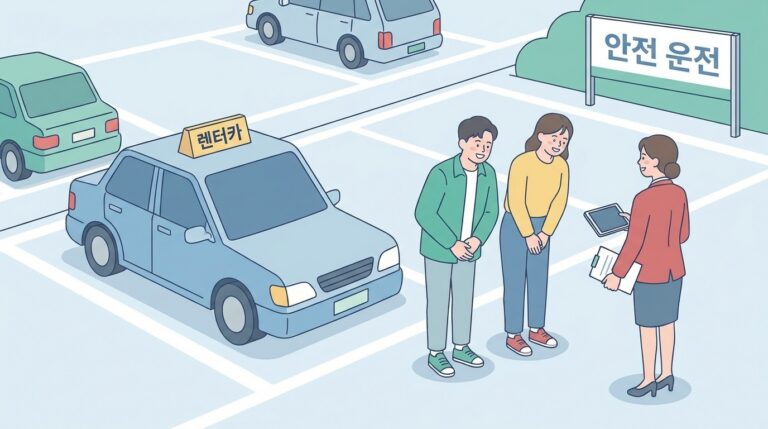
Don’t Panic After a Parking Lot Scrape: Your Friendly Korean Survival Guide
Phase 1: Empathy (Story-Driven Opening)
안녕하세요! 매일한글 에디터입니다. (Hello! This is your Daily Hangul editor.)
Picture this: You are having the absolute road trip of a lifetime. The salty breeze of Jeju Island or the pine trees of Gangneung are blowing through your car window, your playlist is bumping the latest hits, and you pull into a charming local cafe. You spot an open parking space between two parked sedans. You shift into reverse, inch backward slowly, and then—screeech. That heart-stopping, agonizing sound of plastic scraping against plastic. Your palms instantly turn sweaty. You check your side mirror and see a dull grey smudge on the pristine white bumper of the car next to you.
Your brain starts firing a million panic signals at once: Will the police arrest me? How do I explain this in Korean when I can barely order a latte? Am I going to get yelled at by an angry local?
Take a long, deep breath! Parking spaces in South Korea are notoriously narrow, and minor parking scrapes happen every single day even to veteran Seoul drivers. You do not need to flee or break down in tears. Based on real-life queries from our international learners who have braved the roads of Korea, this comprehensive guide will equip you with the exact words, etiquette, and steps to resolve a minor rental car fender-bender like a calm, respectful pro.
Phase 2: Core Expressions Deep Dive
1. 주차하다가 살짝 긁었어요. (Juchahadaga saljjak geulgeosseoyo.)
- Pronunciation: [Ju-cha-ha-da-ga sal-jjak geul-geo-sseo-yo] (Think “Joo-cha” like judo-tea, followed by a crisp “sal-chuck”, ending in “geul-geo-ssuh-yo”).
- Meaning: “While parking, I accidentally scraped it a little.” (Literal: “While doing parking, lightly scratched.”)
- K-Culture Moment: You will see this line in countless K-dramas whenever an anxious junior employee sheepishly calls their grumpy CEO after misjudging the parking garage pillar.
- Editor’s Insight: The magical word here is 살짝 (saljjak, “slightly/a tiny bit”). In Korean interpersonal communication, using cushions like 살짝 immediately conveys that the incident is minor and softens initial shock, preventing unnecessary conflict.
- Situation Spectrum: Casual ⚠️ | Semi-formal ✅ | Formal ✅
- 🤔 Think About It: In Western contexts, admitting you “slightly” damaged something might sound like minimizing fault. Why do you think Korean communication prefers softening the blow before discussing technical blame?
2. 보험사 현장 출동 좀 보내주세요. (Boheomsa hyeonjang chuldong jom bonaejuseyo.)
- Pronunciation: [Bo-heom-sa hyeon-jang chul-dong jom bo-nae-ju-se-yo] (Sounds like “Bo-hum-sa hyun-jahng chool-dong jom bo-neh-joo-seh-yo”).
- Meaning: “Please dispatch an insurance agent to my location.” (Literal: “Insurance company on-site dispatch, please send a bit.”)
- K-Culture Moment: Often heard on Korean reality road-trip shows when celebrities encounter unexpected tire punctures or scrapes in unfamiliar towns.
- Editor’s Insight: Notice the little word 좀 (jom, literally “a little”). Without 좀, the sentence sounds like an aggressive military command. Adding it transforms the statement into a polite, urgent customer request.
- Situation Spectrum: Casual 🚫 | Semi-formal ✅ | Formal ✅
- 🤔 Think About It: Notice how Korean customer service relies heavily on subtle honorific inflections (-주세요) combined with mitigating adverbs (좀). How does roadside emergency phrasing differ in your native tongue?
3. 차량 파손 사진 찍어두었습니다. (Charyang pason sajin jjigeodueotseumnida.)
- Pronunciation: [Cha-ryang pa-son sa-jin jji-geo-du-eot-seum-ni-da] (“Cha-ryang” like car-yang, “pa-son” rhyming with paw-sone, and “sajin” like saw-jean).
- Meaning: “I have already taken photos of the vehicle damage.” (Literal: “Vehicle damage photos have been taken and stored.”)
- K-Culture Moment: A staple phrase featured on Korean automotive legal programs and dashcam analysis broadcasts like Han Moon-chul TV.
- Editor’s Insight: The grammatical ending -어 두다 (-eo duda) signifies completing an action beforehand and preserving its state for future reference. Using this shows you are prepared, organized, and cooperative.
- Situation Spectrum: Casual 🚫 | Semi-formal ⚠️ | Formal ✅
- 🤔 Think About It: Why is proving that you documented the scene calmly viewed as an act of good citizenship rather than purely self-serving defense in Korea?
Phase 3: Textbook Korean vs. Real Korean
Situation 1: Calling the owner of the parked car
- 📖 교과서 한국어: “귀하의 자동차에 물리적 손상을 입혔습니다.” (Gwihaui jadongchae mullijeok sonsang-eul iphyeotseumnida. / “I have inflicted physical damage upon your automobile.”)
- 🗣️ 진짜 한국어: “안녕하세요, 차를 빼다가 범퍼를 살짝 긁어서 연락드렸어요. 정말 죄송합니다.” (Annyeonghaseyo, chareul ppaedaga beompeoreul saljjak geulgeoseo yeollakdeuryeosseoyo. Jeongmal joesonghamnida. / “Hello, I am calling because I scraped your bumper while pulling out. I am so sorry.”)
- 💡 왜 다를까?: Textbook Korean sounds like an official police inquest from the 1980s. Real Koreans speak in warm, courteous sentences combining the action (-다가) with an immediate, heartfelt apology.
Situation 2: Informing your rental car hotline
- 📖 교과서 한국어: “차량 간의 충돌 사고가 발생하였습니다.” (Charyang gan-ui chungdol sagoga balsaenghayeotseumnida. / “A collision accident between vehicles has taken place.”)
- 🗣️ 진짜 한국어: “주차장에서 후진하다가 옆 차랑 살짝 부딪혔어요.” (Juchajang-eseo hujinhadaga yeop charang saljjak budichyeosseoyo. / “While reversing in a parking lot, I lightly bumped into the car next to me.”)
- 💡 왜 다를까?: “충돌 사고” conjures images of high-speed highway pileups! Native speakers describe the physical movement plainly (후진하다가) and use softer everyday verbs like 부딪히다.
Phase 4: K-Culture Deep Dive & Non-Verbal Etiquette
4-1. Nunchi & Physical Body Language
- The Courteous Bow: When the owner of the other vehicle arrives at the scene, give a slight bow (around 30 to 45 degrees) with both hands gathered politely in front of your waist (공수 자세, gongsu jase). This non-verbal sign of humility diffuses 90% of initial annoyance before anyone even inspects the bumper.
- Gaze and Demeanor: Never cross your arms, roll your eyes, or maintain aggressive, wide-eyed stare-downs. Looking down slightly while listening demonstrates empathy and sincere regret.
- Speech Volume: Keep your pitch calm and grounded. Raising your voice in public parking lots is seen as losing self-control and will escalate tension instantly.
4-2. Cultural Code Analysis
- The Dashboard Phone Number (전화번호판): Have you noticed that almost every car in Korea has a small printed phone number or digital LED tag visible on the front dashboard? Due to congested parking situations, Koreans leave their personal mobile numbers out of communal courtesy. When an accident occurs, you are expected to look through the windshield, find that number, and contact them directly.
- The Black Box Ubiquity (블랙박스 문화): In South Korea, over 95% of cars are equipped with dual-channel dashcams that continuously record in parking mode (주차 녹화) triggered by motion and physical shock. Attempting to quietly drive away is futile; the car’s cameras—and adjacent vehicles—will capture your license plate clearly!
Phase 5: Real-World Roleplay Scenario
- Setting: A tight parking lot behind a popular ocean-view cafe in Gangneung.
- Characters: You (an international driver in a white rental Avante) and Mr. Park (the owner of the parked SUV, walking out holding an iced coffee).
-
Turn 1 (You): [🎭 bowing slightly with two hands holding phone] 안녕하세요, 혹시 12가 3456 차주분이신가요? (Annyeonghaseyo, hoksi sib-i-ga sam-sa-o-yuk chajubun-isingayo? / Hello, by any chance, are you the owner of vehicle 12Ga 3456?)
- Turn 2 (Mr. Park): [🎭 looking curious, checking his bumper] 네, 맞는데요. 무슨 일 있으신가요? (Ne, manneundeyo. Museun il isseusingayo? / Yes, that is me. Did something happen?)
- Turn 3 (You): [🎭 pointing gently with an open palm toward the scratch] 정말 죄송합니다. 후진하다가 범퍼 모서리를 살짝 긁었습니다. (Jeongmal joesonghamnida. Hujinhadaga beompeo moseorireul saljjak geulgeotseumnida. / I am truly sorry. While reversing, I scraped the corner of your bumper.)
- Turn 4 (Mr. Park): [🎭 bending down to inspect the mark, sighing gently] 아이고, 긁혔네요. 렌터카이신가 보네요? (Aigo, geulkhyeotenneyo. Renteokaisinga bone-yo? / Oh dear, it is scratched. Looks like you are driving a rental car?)
- Turn 5 (You): [🎭 nodding earnestly, displaying camera photos on screen] 네, 여행 중에 미숙해서 실수를 했습니다. 사진은 미리 찍어두었습니다. (Ne, yeohaeng jung-e misukhaeseo silsureul haetseumnida. Sajineun miri jjigeodueotseumnida. / Yes, my driving was clumsy while traveling. I have already taken photos of the scene.)
- Turn 6 (Mr. Park): [🎭 face visibly softening at your respectful demeanor] 다치신 데는 없죠? 사진 잘 찍으셨네요. 보험 접수 하셨어요? (Dachisin deneun eopjyo? Sajin jal jjigeosyeotneyo. Boheom jeopsu hasyeosseoyo? / Nobody got hurt, right? Good job taking photos. Have you filed with the insurance company?)
- Turn 7 (You): [🎭 showing rental insurance hotline screen] 지금 막 렌터카 보험사에 출동 요청을 드렸습니다. 금방 오실 거예요. (Jigeum mak renteoka boheomsa-e chuldong yocheong-eul deuryeotseumnida. Geumbang osil geoyeyo. / I just contacted the rental insurance for roadside dispatch. They should arrive very soon.)
- Turn 8 (Mr. Park): [🎭 smiling reassuringly] 네, 그럼 기사님 오실 때까지 카페 그늘에서 기다리시죠. (Ne, geureom gisanim osil ttaekkaji kape geuneureseo gidarisijo. / Alright, let us wait in the cafe shade until the technician arrives.)
🔀 Interactive Branching Decision
What should you do immediately after hearing the bumper scrape before the car owner appears?
* Choice A: Inspect the scratch, notice it is very faint, and drive off to avoid paying rental penalties.
* Choice B: Take wide-angle photos of both cars, capture wheel angles and license plates, check the dashboard phone number, and call both the owner and rental insurance.
* Choice C: Leave a 50,000 KRW bill under their windshield wiper with a note saying “Sorry” and walk away.
Feedback:
* Choice A [Bad / Illegal]: Extreme risk! The car’s black box shock sensor recorded your vehicle. Fleeing without leaving identity constitutes hit-and-run on parked property (물피도주), triggering criminal fines and rental blacklists.
* Choice B [Best]: Flawless! Documenting the context immediately, calling the owner, and notifying the rental company keeps you completely protected legally and financially.
* Choice C [Risk]: Leaving cash without mutual agreement (합의) does not fulfill your legal duty to provide contact information and can still be reported as an unlawful departure.
Phase 6: 10-Second Emotional Shadowing Drill
Practice these lines with pauses (marked by /) matching the indicated emotional delivery:
[🥺 당황스럽지만 정중하게 - Flustered yet courteous]
정말 죄송합니다 / 주차하다가 / 범퍼를 살짝 긁었어요. (Jeongmal joesonghamnida / juchahadaga / beompeoreul saljjak geulgeosseoyo. / I am truly sorry / while parking / I lightly scraped the bumper.)-
[📞 침착하고 명확하게 - Calm and clear over the phone]
렌터카 사고 접수 때문에 / 연락드렸습니다 / 현장 출동 부탁드립니다. (Renteoka sago jeopsu ttaemune / yeollakdeuryeotseumnida / hyeonjang chuldong butakdeurimnida. / Because of a rental car accident report / I am calling / roadside dispatch, please.) -
[🙏 차분하고 신뢰감 있게 - Composed and reassuring]
제 연락처와 / 보험 접수 번호를 / 남겨드리겠습니다. (Je yeollakcheowa / boheom jeopsu beonhoreul / namgyeodeurigetseumnida. / My contact details / and insurance claim number / I will leave with you.)
Phase 7: K-Culture Mini Dictionary
- 물피도주 (Mulpidoju) | Hit-and-run on parked/unattended property | A specific legal offense where a driver damages an unoccupied parked vehicle and departs without providing contact info.
- 과실비율 (Gwasilbiyul) | Fault/negligence percentage | The official liability ratio (such as 80:20 or 100:0) calculated by insurance companies based on dashcam video and traffic regulations.
- 블랙박스 (Beullaekbakseu) | Vehicle dashcam | The dual camera recording device installed in virtually every Korean vehicle, serving as prime evidence in road settlements.
- 현장출동 (Hyeonjangchuldong) | Emergency on-site dispatch | A rapid service where an insurance agent personally travels to the accident scene to inspect damage, take photos, and facilitate documentation.
Phase 8: Traveler’s Survival Kit
Survival Expressions TOP 3
- “한국어가 서툴러서 통역이 필요해요.” (Hangugeo-ga seotulleoseo tong-yeog-i piryohaeyo. / My Korean is not fluent, so I need an interpreter.)
* Pro Tip: Major Korean insurance dispatch lines offer three-way English interpretation. Say this sentence right away!
2. “보험 접수 번호 나왔나요?” (Boheom jeopsu beonho nawannayo? / Has the insurance claim number been issued?)
* Pro Tip: Once a claim number (접수 번호) is generated, both drivers can peacefully leave; the insurance companies handle repairs directly.
3. “블랙박스 영상 확인해 봐도 될까요?” (Beullaekbakseu yeongsang hwaginhae bwado doelkkayo? / May we check the dashcam footage?)
* Pro Tip: If there is any question about how the contact occurred, checking the recording immediately settles the facts.
Editor’s Travel Note
- Location Accuracy: When calling insurance dispatch, open the 네이버 지도 앱 다운로드 to copy the exact Korean street address (도로명 주소) or share your current GPS pin.
- CDW Insurance Check: When renting in Korea, always opt for Super CDW (완전자차, Wanjeon-jacha). It often reduces your deductible for minor parking scrapes to zero won!
Phase 9: “One Step Deeper” (Reflective Essay)
In many countries, leaving your personal mobile phone number taped to your car windshield would seem like an alarming privacy risk. In South Korea, however, it is considered the bedrock of everyday urban driving etiquette. Because Korea’s mountainous topography and rapid development created hyper-dense residential neighborhoods, double-parking and tight maneuvers are simply unavoidable realities of daily life.
This visible phone number represents an unspoken social contract: “I may have to park close to you, but I am reachable and accountable at any moment.” When a minor scratch happens, stepping forward immediately with a respectful bow and transparent communication honors this communal trust. Koreans are remarkably generous and forgiving when someone displays sincere manners.
💬 Your Turn: Have you ever experienced a parking scrape in another country? How does the Korean custom of dashboard phone numbers compare to parking habits in your hometown? Leave a comment below!
Phase 10: FAQ & Avoiding Misunderstandings
Q: Do I need to dial the police (112) for a minor parking scratch with no injuries?
A: Generally, no. In Korea, minor property-only fender-benders where both drivers are cooperative are resolved through private insurance dispatches. However, if the owner cannot be reached after repeated attempts, notifying 112 or visiting the nearest police substation (파출소) protects you from being accused of leaving the scene.
Q: What if the rental company claims my insurance does not cover parking scrapes?
A: Check your agreement terms. Most standard rental CDW policies cover collision, but some budget tiers exclude single-vehicle or parking negligence. Opting for full coverage (완전자차) at pickup is the safest path for foreign travelers.
Q: If I say “정말 죄송합니다” (I am so sorry), am I legally confessing 100% liability?
A: No! In Korean culture, an apology expresses empathy for the inconvenient situation, not a binding legal confession. Adjusters determine fault (과실비율) objectively through black box dashcam evidence and road markings, not polite courtesies.
🚨 Common Mistakes (흔한 실수 TOP 3)
- Mistake: Leaving a handwritten note with only an email address and hotel room number.
* Correct Action: Take multiple angle photos, call the dashboard phone number immediately, and alert the rental car insurance dispatch.
2. Mistake: Settling with cash under the table directly with the other driver.
* Correct Action: Rental cars are corporate property. Settling privately without notifying the rental agency breaches your rental contract and can void your coverage.
3. Mistake: Driving away because the scratch looks unnoticeable.
* Correct Action: Shock sensors trigger dashcams automatically. Driving away without notifying the owner counts as 물피도주, which carries legal fines.
Phase 11: Action Mission & Engagement
- 🥉 Bronze Mission (Solo): Practice saying “주차하다가 살짝 긁었어요. 정말 죄송합니다” out loud 5 times using a calm, apologetic tone.
- 🥈 Silver Mission (Social): Write down the word “현장 출동” on your study notebook and post your practice notes or audio snippet in your Korean study group.
- 🥇 Gold Mission (Real-world ready): The next time you rent a vehicle in Korea, locate the emergency road assistance number on your contract and store it in your phone contacts before driving away!
- 🎮 K-Culture Mission: Search YouTube for Han Moon-chul TV (한문철 TV) to watch how real Korean dashcam footage is analyzed by insurance experts!
Phase 12: Interactive Quiz Challenge
- [Situation Judgment] You accidentally scratched a parked car’s bumper while backing out. What is your first action?
A) Drive away and buff it out later.
B) Take wide-angle photos of both vehicles, wheels, and license plates before moving the car.
C) Go back inside the cafe to order another drink while waiting. -
[Fill in the Blank] Fill in the missing word for insurance on-site assistance:
“보험사 현장 ______ 좀 보내주세요.”
(Hint: The Korean word for emergency dispatch) -
[True or False] Leaving the scene of an unoccupied parked car after scratching it without leaving your contact information is classified as 물피도주 under Korean traffic law. (True / False)
Click here to reveal the answers and explanations!
- Answer: B! Taking comprehensive photographic evidence before touching or moving either vehicle is crucial for the insurance company to establish fault.
- Answer: 출동 (chuldong)! The full phrase is “보험사 현장 출동 좀 보내주세요” (Please send insurance on-site dispatch).
- Answer: True! Under Article 148-2 of the Korean Road Traffic Act, failure to provide your identity after damaging an unattended vehicle is considered 물피도주 and can result in fines and license penalty points.
🎬 Watch Our Daily Videos! (Daily Hangul Official Instagram)
Review the expressions you learned in this article with our fun daily short videos! Check out native pronunciation and real-life nuances in action.
- Instagram @dailyhangul_en







