

Master Korean Live Commerce: The Secret Cue Sheet Strategy for Viewer Surges
Phase 1: Empathy (Story-Driven Opening)
안녕하세요! 매일한글 에디터입니다. (Hello! This is your Daily Hangul editor.)
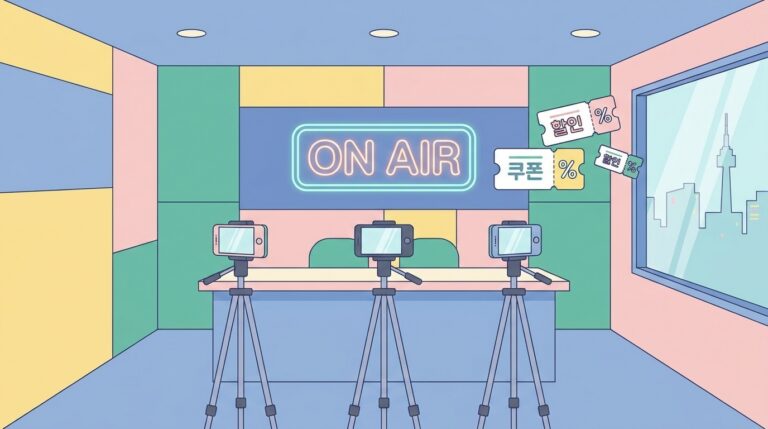
Picture this: You are sitting in a glass-walled conference room in Gangnam alongside a fast-talking live commerce producer (PD) and an energetic show host. The neon “ON AIR” sign glows in the studio next door. Your team has only 60 minutes to sell 5,000 sets of a premium skincare serum on Naver Shopping Live. The producer taps the cue sheet, looks at you, and asks: “초기 유입 어떻게 잡으실 거예요?” (How are you going to capture the initial traffic?). You freeze. You know the textbook word for ‘discount’ is hal-in (할인), but how do you professionally articulate that you set up a pre-notification push alert with stackable coupons to explode viewer numbers within the first two minutes?
In Korea, live commerce—affectionately known as 라방 (Rabang)—is an adrenaline-fueled arena where timing, psychological micro-incentives, and crystal-clear cues dictate millions of won in sales. When foreign professionals work with Korean retail or agency partners, stumbling over specialized terms like ‘stackable coupon’ (jungbok hal-in kupon) or ‘traffic influx’ (chogi yuip) can make you look hesitant. This guide draws directly on real studio floor feedback to give you the exact B2-level phrasing and cultural confidence needed to dominate your next Korean e-commerce strategy meeting.
Phase 2: Core Expressions In-Depth
1. 사전 알림 받기 (Sajeon allim batgi)
- Pronunciation: [Sa-jeon al-lim bat-gi] (Sounds like sah-jeon ahl-leem baht-ghee — rhythmically similar to saying ‘surgeon all-in bucket’ with soft endings)
- Meaning: Literal: Receiving prior notice / Actual Nuance: Signing up for pre-show push notifications or showtime alerts on e-commerce apps.
- K-Culture Moment: Seen constantly on Kakao Shopping Live or Naver Shopping Live banners where hosts beg viewers: “사전 알림 받기 누르고 쿠폰 챙기세요!” (Tap notification alert and grab your coupon!).
- Editor’s Insight: Sajeon (사전) means ‘in advance’ or ‘preliminary’. In digital marketing, this isn’t just an alert; it’s the primary KPI for predicting live broadcast rank placement.
- Situation Spectrum: Casual: ⚠️ (Say 알림 설정 instead) | Semi-formal: ✅ | Formal: ✅
- 🤔 Think About It: In Korean mobile commerce, getting permission for push alerts is fiercely competitive. Why do Korean apps emphasize “혜택 알림” (benefit alerts) over simple reminder notifications?
2. 중복 할인 쿠폰 (Jungbok hal-in kupon)
- Pronunciation: [Jung-bok hal-in ku-pon] (Sounds like joong-bohk hahl-een koo-pon — stress the crisp ‘bok’ like ‘book’ with an open ‘o’)
- Meaning: Literal: Overlapping discount coupon / Actual Nuance: A stackable coupon that can be applied on top of existing base brand discounts or platform-wide sales.
- K-Culture Moment: In K-Dramas featuring corporate retail battles, a marketer will announce a breakthrough: “중복 할인 쿠폰 풀면 바로 품절각입니다!” (If we release stackable coupons, it will sell out immediately!).
- Editor’s Insight: Jungbok (중복) means redundancy or duplication. While ‘redundant’ sounds negative in English, in Korean shopping, jungbok hal-in is the ultimate magic word that triggers spontaneous purchases.
- Situation Spectrum: Casual: ✅ | Semi-formal: ✅ | Formal: ✅
- 🤔 Think About It: How does your native language refer to ‘stackable’ offers? Notice how Korean frames it structurally as ‘overlapping layers’ of generosity.
3. 초기 시청자 유입을 극대화하다 (Chogi sicheongja yuibeul geukdaehwahada)
- Pronunciation: [Cho-gi si-cheong-ja yu-ib-eul geuk-dae-hwa-ha-da] (Sounds like cho-gee shee-chong-jah you-eep-eul gook-day-hwah-hah-dah)
- Meaning: Literal: Maximize early viewer influx / Actual Nuance: Driving massive concurrent viewers right at kickoff to manipulate the platform’s trending algorithm.
- K-Culture Moment: Standard jargon used in agency pitch decks and cue sheet reviews right before going live.
- Editor’s Insight: Geukdaehwahada (극대화하다) elevates your speech instantly to executive-level B2/C1 business Korean. Replacing the casual 늘리다 (neullida – to increase) with 극대화하다 signals deep strategic command.
- Situation Spectrum: Casual: 🚫 | Semi-formal: ⚠️ | Formal: ✅
- 🤔 Think About It: Korean business culture heavily rewards Sino-Korean compounds (한자어) for quarterly objectives. Why do you think 4-character Sino-Korean concepts dominate corporate slide decks?
Phase 3: Textbook Korean vs. Real Korean
Situation 1: Explaining your coupon promotion
- 📖 교과서 한국어 (Textbook Korean): 방송 전에 알림을 신청한 사람들에게 쿠폰을 더 주었습니다. (Bangsong jeone allimeul sincheonghan saramdeurege kuponeul deo jueosseumnida. / We gave more coupons to people who applied for notifications before the broadcast.)
- 🗣️ 진짜 한국어 (Real Korean): 사전 알림 신청 고객 대상으로 3,000원 중복 쿠폰을 지급해서 초반 화력을 확 끌어올렸어요. (Sajeon allim sincheong gogaek daesangeuro samcheonwon jungbok kuponeul jigeuphaeseo choban hwaryeogeul hwak kkeureoollyeosseoyo. / We issued 3,000-won stackable coupons to customers who pre-registered for alerts, dramatically revving up our opening momentum.)
- 💡 왜 다를까? (Why is it different?): Textbook phrasing relies on literal verbs like ‘give more’ (deo judea), whereas native commerce strategists use vivid metaphors like ‘firepower’ (hwaryeok) and punchy adverbs like hwak (drastically/rapidly).
Situation 2: Announcing viewer spikes during the show
- 📖 교과서 한국어 (Textbook Korean): 지금 시청자가 매우 많아지고 있습니다. (Jigeum sicheongjaga maeu manajigo osseumnida. / Viewers are becoming very numerous right now.)
- 🗣️ 진짜 한국어 (Real Korean): 시작과 동시에 동접자 터졌네요! 유입 속도 장난 아닙니다. (Sijakgwa dongsie dongjeopja teojyeotneyo! Yuip sokdo jangnan animnida. / Concurrent viewers blew up right at kickoff! The incoming traffic speed is no joke.)
- 💡 왜 다를까? (Why is it different?): Native tech and live commerce pros love compounding abbreviations like dongjeopja (동시 접속자 – concurrent viewers) and the expressive colloquial verb teojida (to burst/blow up).
Phase 4: K-Culture Deep Dive & Non-Verbal Manners
4-1. Nunchi & Studio Gestures
In a Korean live commerce control room or live studio booth, communication must be silent and ultra-expressive. When the floor PD points upward with both index fingers while making eye contact, they are signaling “초기 유입 상승 중” (Traffic is surging).
- The Cue Sheet Tap: When emphasizing coupon release timing, gently tap the specific row on the printout with a pen tip rather than pointing bluntly with a single finger.
- The Two-Handed Screen Show: When showing real-time mobile app analytics to a senior manager or client, hold the smartphone with both hands, slightly bowing your head: “현재 유입 추이 이렇습니다” (Here is the current inflow trend).
4-2. The Cultural Psychology of ‘알림 설정’ (Alert Settings) and Fired-up Crowds
Koreans have a high digital sensitivity known as Chotong (초고속 소통 – hyper-speed communication). The concept of 본방사수 (Bonbangsasu – watching the original live airing) moved from television dramas straight into live shopping. Korean consumers don’t browse passively; they enter digital waiting rooms 5 minutes before the show starts to snap up limited quantities (seonchaksoon). Pre-notification coupons act as an exclusive social badge—it implies: “I am an insider who gets an unfair advantage.” Understanding this helps you write cue sheets that treat alerts not as spam, but as an exclusive VIP entry ticket.
Phase 5: Real-World Roleplay Scenario
- Setting: 15 minutes before showtime in a Naver Shopping Live control room in Seongsu-dong.
- Characters:
- 팀장 민지 (Team Leader Minji): Sharp, analytical, hyper-focused on initial 5-minute metrics.
- 당신 (You / Alex): E-commerce Marketing Specialist presenting the opening boost tactic.
- 민지: 알렉스 씨, 오늘 라이브 시작 5분이 승부처인 거 알죠? 초반 트래픽 대책 어떻게 세웠어요?
(Alex-ssi, oneul raibu sijak obuni seungbucheoin geo aljyo? Choban teuraepik daechaek eotteoke sewoyeosseoyo?)
“Alex, you know the first 5 minutes are the make-or-break moment today, right? What’s your plan for opening traffic?”
🎭 민지가 태블릿 모니터를 응시하며 펜을 가볍게 돌린다. (Minji stares at her tablet monitor, lightly twirling her pen.) -
당신: 네, 팀장님. 방송 전 사전 알림 받기를 신청한 고객에게 3,000원 중복 할인 쿠폰을 지급해 방송 시작과 동시에 초기 시청자 유입을 극대화했어요.
(Ne, timjangnim. Bangsong jeon sajeon allim batgireul sincheonghan gogaekege samcheonwon jungbok hal-in kuponeul jigeuphaeseo bangsong sijakgwa dongsie chogi sicheongja yuibeul geukdaehwahaeosseoyo.)
“Yes, Team Leader. We issued 3,000-won stackable coupons to customers who signed up for pre-notifications, maximizing our initial traffic right at kickoff.”
🎭 출력된 큐시트의 오프닝 섹션을 두 손으로 짚으며 자신감 있게 보고한다. (Confidently points with both hands to the opening section of the printed cue sheet.) -
민지: 중복 쿠폰? 기존 15% 기본 할인에 추가로 들어가는 거죠? 마진율 방어는 계산된 건가요?
(Jungbok kupon? Gijon sip-o-peosenteu gibon hal-ine chugaro deureoganeun geojyo? Majinyul bangeoneun gyesandoen geongayo?)
“Stackable coupons? That stacks on top of our existing 15% base discount, right? Did you calculate profit margin defense?”
🎭 눈썹을 살짝 올리며 날카로운 눈빛으로 숫자를 점검한다. (Raises an eyebrow slightly, checking numbers with an incisive gaze.) -
당신: 네, 객단가 5만 원 이상 구매 시에만 적용되도록 허들을 걸어둬서 마진 방어와 객단가 상승을 동시에 잡았습니다.
(Ne, gaekdanga oman-won isang gumae si-eman jeokyongdoedorok heodeureul georeodwoseo majin bangeowa gaekdanga sangseungeul dongsie jabasseumnida.)
“Yes, we set a minimum cart threshold of 50,000 won to protect margins while simultaneously boosting average order value.”
🎭 준비한 엑셀 시뮬레이션 지표를 화면으로 띄워 보여준다. (Brings up the prepared Excel simulation metrics on screen.) -
민지: 오, 허들 장치 좋네요. 그럼 쇼호스트 멘트 큐시트에는 사전 알림 쿠폰 사용 마감 시간 박혀 있나요?
(Oh, heodeul jangchi jonneyo. Geureom syo-hoseuteu menteu kyusiteu-eneun sajeon allim kupon sayong magam sigan bakhyeo itnayo?)
“Oh, nice safety threshold. Now, is the expiration countdown for that pre-alert coupon etched into the host’s cue sheet?”
🎭 고개를 끄덕이며 큐시트 1페이지 타임테이블을 확인한다. (Nods in agreement, checking the timetable on page 1 of the cue sheet.) -
당신: 네, 방송 시작 후 10분 내 결제 시에만 적용된다고 호스트님이 3번 연속 강조하도록 굵은 글씨로 픽스해 두었습니다.
(Ne, bangsong sijak hu sibun nae gyeolje si-eman jeokyongdoendago hoseuteunimi sebeon yeonsok gangjohadorok gulkeun geulssiro pikseuhae dueosseumnida.)
“Yes, it is locked in bold text for the host to emphasize three times consecutively that it expires 10 minutes post-kickoff.”
🎭 호스트 리딩용 모니터의 하이라이트 표시를 가리킨다. (Points to the highlighted text on the host reading monitor.) -
민지: 완벽하네요. 초기 트래픽 몰리면 랭킹 알고리즘 타고 메인 탭에 바로 걸리겠어요. 스탠바이 합시다!
(Wanbyeokhaniyo. Chogi teuraepik mollimyeon raengking algo-rijeum tago mein taebe baro geolligesseoyo. Seutaenbai hapsida!)
“Flawless. If initial traffic crowds in, we’ll hit the ranking algorithm and get featured on the main tab right away. Let’s stand by!”
🎭 만족스러운 미소를 띠며 스튜디오 부스 마이크를 켠다. (Smiles with satisfaction, turning on the studio booth intercom.) -
당신: 네, 큐 사인 주시면 즉시 알림 푸시 상태 모니터링 들어가겠습니다!
(Ne, kyu sain jusimyeon jeuksi allim pusi sangtae moniteoring deureogagesseumnida!)
“Understood, as soon as you give the cue, I’ll immediately monitor push notification delivery rates!”
🎭 노트북 콘솔 앞에 착석해 양손을 키보드 위에 대기한다. (Sits in front of the laptop console with hands ready over the keyboard.)
🔀 Interactive Decision Point
After the first 3 minutes of the stream, concurrent viewers hit 10,000 people, but coupon redemptions are moving slower than anticipated. What do you say to the PD?
- Option A: “팀장님, 쇼호스트님께 쿠폰 만료 3분 남았다고 채팅창 보면서 긴급 멘트 요청할게요!” (Team Leader, let’s ask the host to urgently call out the 3-minute remaining deadline while engaging the live chat!)
- Option B: “사람들이 쿠폰을 안 쓰네요. 그냥 라이브 끝날 때까지 쿠폰 기한을 연장할까요?” (People aren’t using the coupon. Should we just extend the coupon validity until the broadcast ends?)
- Option C: “할인율이 너무 적은 것 같습니다. 지금 바로 5,000원 쿠폰으로 다시 발행하죠.” (I think the discount rate is too low. Let’s immediately re-issue a 5,000-won coupon right now.)
Decision Feedback:
- Selection A (Best): 🏆 Brilliant! You recognize the live commerce golden rule: FOMO (Fear Of Missing Out) drives conversions. Pushing a dynamic deadline creates urgency without sacrificing your margin plan.
- Selection B (Risk): ⚠️ Extending coupon deadlines ruins brand trust for future streams. If viewers discover “deadlines don’t mean anything,” they won’t rush in at kickoff during your next Rabang.
- Selection C (Bad): 🚫 Changing coupon denominations live without executive sign-off disrupts the entire checkout cart API and ruins preset budget ROI calculations. Dangerous move!
Phase 6: 10-Second Emotion Shadowing Drill
Practice reading these lines using the slash marks / as breathing/pacing pauses.
[🔥 프로답고 자신감 넘치게 - Confident & Strategic]
방송 전 사전 알림 받기를 / 신청한 고객에게 / 3,000원 중복 할인 쿠폰을 지급해 / 초기 시청자 유입을 / 극대화했어요.
(Bangsong jeon sajeon allim batgireul / sincheonghan gogaekege / samcheonwon jungbok hal-in kuponeul jigeuphaeseo / chogi sicheongja yuibeul / geukdaehwahaeosseoyo.)-
[⚡ 긴장감 있고 다급하게 - Urgent Live Pace]
시작과 동시에 / 동접자 1만 명 터졌습니다! / 지금 바로 / 중복 쿠폰 마감 멘트 / 들어가야 합니다!
(Sijakgwa dongsie / dongjeopja ilman myeong teojyeotseumnida! / Jigeum baro / jungbok kupon magam menteu / deureogaya hamnida!) -
[🤝 정중하면서도 명쾌하게 - Professional & Reassuring]
객단가 허들을 설정해 두었기 때문에 / 중복 할인이 적용되어도 / 마진율 방어에는 / 전혀 문제없습니다.
(Gaekdanga heodeureul seoljeonghae dueotgi ttaemune / jungbok hal-ini jeokyongdoe-eodo / majinyul bangeo-eneun / jeonhyeo munjeeopseumnida.)
Phase 7: K-Culture Mini Dictionary
- 라방 (Rabang)
Short for 라이브 방송 (Live Broadcasting). Refers to mobile-first interactive live commerce platforms like Naver Shopping Live, Grip, and Kakao Shopping. - 큐시트 (Kyusiteu – Cue Sheet)
The sacred master timeline of any broadcast. In e-commerce, it maps camera angles, product demos, price drops, and comment-reading periods down to the second. - 혜택존 (Hwetaek-jon – Benefit Zone)
The designated segment during a live stream where exclusive, stacking benefits (coupons, free gifts, 1+1 offers) are unveiled to spur instant buying. - 본방사수 (Bonbangsasu – Original Broadcast Defense)
Originally meaning tuning in live to watch a TV episode rather than catching reruns. In live commerce, it means tuning in live to capture exclusive limited-quantity promotions.
Phase 8: Survival Kit for Travelers & E-Commerce Professionals
Top 3 Real-World Survival Expressions:
- 알림 받기 쿠폰 어떻게 적용해요?
(Allim batgi kupon eotteoke jeokyonghaeyo?)
“How do I apply the pre-notification coupon?”
Pro Tip: Use this in customer service chats or when testing checkout flows on Korean shopping platforms. - 중복 적용 가능한가요?
(Jungbok jeokyong ganeunghangayo?)
“Can this be stacked / combined with other discounts?”
Pro Tip: Essential when shopping at duty-free malls or participating in department store flash sales in Korea. - 오픈런 혜택 마감됐나요?
(Opeun-reon hyetaek magam-dwaennayo?)
“Are the early-bird rush benefits already closed?”
Pro Tip: Perfect for checking if limited-capacity live gifts or pop-up store perks are still redeemable.
Editor’s Travel & Business Tech Note:
If you want to understand how modern Koreans shop, you must study Korean mobile platforms on your phone. Start by searching for the 네이버 지도 앱 다운로드 to easily locate pop-up live studios in trendy hubs like Seongsu-dong or Gangnam. Next, observe push marketing directly by accessing the 카카오톡 쇼핑하기 알림 설정 inside KakaoTalk, where hundreds of brands send tailored pre-show coupons every morning.
Phase 9: “A Step Deeper” (Reflective Question)
In Korean digital commerce, traffic isn’t gathered lazily; it is ignited like a coordinated sprint. This phenomenon mirrors Korea’s broader cultural ethos of 빨리빨리 (Ppalli-ppalli – Fast and Swift) combined with 공동체적 열기 (Communal Enthusiasm). When thousands of people hit a stream within the first 120 seconds because of an alert, they feel part of an exclusive happening. Notice how business communication around this strategy combines hard numerical metrics with collective emotional energy (hwaryeok – firepower).
💬 Your Turn: In your country, do consumers respond to live shopping push alerts, or are mobile notifications considered intrusive? Share your thoughts in the comments below!
Phase 10: FAQ & Avoiding Misunderstandings
Q: Can I use the word ‘더블 할인’ (Double Hal-in) instead of ‘중복 할인’ (Jungbok Hal-in)?
A: Yes, but with a nuance shift! 더블 할인 (Double discount) is frequently used as consumer-facing advertising copy because it sounds exciting and catchy. However, inside internal business meetings, cue sheet planning, and POS/cart development, 중복 할인 (Stackable/Overlapping discount) is the standard industry terminology.
Q: Is ‘사전 알림’ only used for online shopping?
A: Not at all! You will encounter 사전 알림 when reserving pop-up store tickets in Hongdae or Seongsu, signing up for new mobile game launches, and registering for webinar events.
Q: What is the difference between ‘시청자 유입’ and ‘접속자 수’?
A: 시청자 유입 (Viewer Influx) refers to the dynamic flow of people entering the stream over a period. 접속자 수 (Connected Users/Concurrent Viewers) is the static count of active screens watching at any single point in time.
🚨 Common Mistakes Warning Board
- Mistake: Saying 동시 쿠폰 (Dongsi kupon) to mean stackable coupons.
Correct Action: Always use 중복 할인 쿠폰 (Jungbok hal-in kupon). Dongsi means simultaneous in time, not structural stacking in a checkout cart. - Mistake: Translating ‘drive traffic’ literally as 교통을 운전하다 (Gyotongeul unjeonhada).
Correct Action: Use 유입을 이끌어내다 (Bring in traffic) or 트래픽을 유입시키다 (Induce traffic influx). - Mistake: Calling the cue sheet a 타임라인 (Timeline) during studio operations.
Correct Action: Stick to 큐시트 (Kyusiteu). Production staff universally refer to broadcast schedules as cue sheets.
Phase 11: Action Missions & Engagement
- 🥉 Bronze Mission (Solo Practice): Read the Phase 6 Shadowing lines aloud 3 times, paying close attention to pausing at the
/marks and projecting an upbeat business tone. - 🥈 Silver Mission (Social Connection): Open any Korean live shopping app (such as Naver Shopping Live or Kakao Shopping Live). Find a show banner and screenshot where it says “알림 받기”. Post it to your study log or Instagram Story tagging
#DailyHangul! - 🥇 Gold Mission (Real Application): Write a 2-sentence proposal in Korean explaining a flash promotion for your company or study project using both 사전 알림 and 중복 할인 쿠폰.
- 🎮 K-Culture Mission: Watch a replay of a Korean beauty brand’s Rabang. Listen carefully to the first 2 minutes: how many times does the host say 알림 (Notification) or 쿠폰 (Coupon)?
Phase 12: Interactive Quiz Challenge
Question 1: Situational Judgment
You are presenting a live commerce plan to a Korean partner brand. You want to say that offering a stackable coupon will dramatically maximize early viewer traffic. Which sentence is the most natural and professional?
* A) 라이브 때 쿠폰 주면 사람들이 많이 올 수 있습니다.
* B) 방송 전 사전 알림 신청자에게 중복 할인 쿠폰을 지급하여 초기 시청자 유입을 극대화하겠습니다.
* C) 먼저 알람을 받은 사람한테 더블 세일을 시켜서 손님을 엄청 늘리겠습니다.
👉 Click to view Answer & Explanation
Correct Answer: B
Explanation: Sentence B utilizes sophisticated B2-level business Korean (사전 알림 신청자, 중복 할인 쿠폰, 초기 시청자 유입 극대화). Option A is too simplistic, and Option C uses awkward and unprofessional vocabulary (알람, 더블 세일을 시키다).
Question 2: Fill-in-the-Blank
Fill in the blank with the appropriate corporate marketing term:
이번 라방은 시작과 동시에 초기 시청자 ( ______ )을 극대화하는 전략이 핵심입니다.
(This Rabang’s core strategy is maximizing early viewer influx right at kickoff.)
👉 Click to view Answer & Explanation
Correct Answer: 유입 (Yuip – Influx/Inflow)
Explanation: 시청자 유입 is the set phrase for incoming audience traffic in digital broadcasts.
Question 3: True or False (K-Culture True/False)
In Korean live commerce platforms, applying a “중복 할인 쿠폰” cancels out the base discount already active on the stream.
* True
* False
👉 Click to view Answer & Explanation
Correct Answer: False
Explanation: 중복 할인 specifically means a stackable discount that applies in addition to existing product or storewide discounts!
🎬 Watch Our Daily Videos! (Daily Hangul Official Instagram)
Review the expressions you learned in this article with our fun daily short videos! Check out native pronunciation and real-life nuances in action.
- Instagram @dailyhangul_en







