

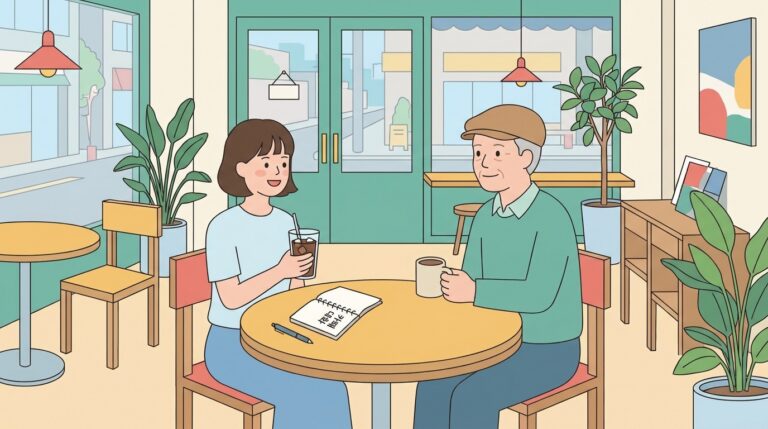
Don’t Make It Awkward: The Beginner Guide to Using Oppa in Korea
Phase 1: Empathy (Real-Life Opening)
안녕하세요! 매일한글 에디터입니다. (Hello! I’m your Daily Hangul editor.)
Picture this: You have just landed in Seoul after binge-watching your favorite romance K-dramas for months. You step inside a sunlit cafe near Hongik University. The young male barista hands you your drink with a polite nod. Remembering how effortlessly your favorite drama leads speak, you flash a friendly smile and say: “오빠 (Oppa), 감사해요 (gamsahaeyo)!”
Instantly, the barista freezes. His eyes dart nervously around the room, the cashier stifles a giggle, and a thick, awkward silence settles across the counter. You wonder: Did I mispronounce it? Was my tone wrong?
Don’t worry—almost every Korean learner has faced this exact moment of cultural confusion! In international pop culture, the word 오빠 (Oppa) has become a trendy meme or a romantic label for handsome actors and K-pop idols. But in real Korean society, Oppa is a nuanced relationship title woven into Korea’s traditional age hierarchy and social distance. Using it with a stranger can feel overwhelmingly flirtatious or simply out of place, while using it correctly with close friends builds instant warmth and emotional trust.
In this lesson, crafted from hundreds of real classroom experiences with beginner learners just like you, we will untangle the mystery of Oppa. By the end of this guide, you will know exactly who to call Oppa, how to introduce it naturally into conversation, and when to avoid it so you never experience that cafe cringe again!
Phase 2: Top 3 Core Expressions
1. 오빠 (Oppa)
- Pronunciation: [Oppa] (Think of saying “oh” followed by “paw” with a firm, sharp ‘p’ sound: OH-pah)
- Meaning: Literal: “Older brother” | Real Nuance: An affectionate title used exclusively by a female speaker toward an older male sibling, close older male friend, or older boyfriend.
- K-Culture Moment: In youth dramas like Weightlifting Fairy Kim Bok-joo, the female lead addresses her trusted older childhood male friend as Oppa when bantering or asking for advice.
- Editor’s Insight: Oppa implies mutual familiarity. You don’t call someone Oppa on the very first day you meet unless he explicitly invites you to: “편하게 오빠라고 불러 (Pyeonhage opparago bulleo – Feel free to call me Oppa).”
- Situation Spectrum: Casual: ✅ | Semi-formal: ⚠️ | Formal: 🚫
- 🤔 Think About It: In English, you call friends, coworkers, and brothers simply by their first name. Why do you think Korean uses specific family titles even for people who aren’t blood relatives?
2. [Name] 오빠 ([Name] Oppa)
- Pronunciation: [Name + Oppa] (e.g., 민수 오빠 / Minsu Oppa)
- Meaning: Literal: “Older brother Minsu” | Real Nuance: The safest, most natural way to address an older male friend in a group setting.
- K-Culture Moment: When multiple older guys are in a college club or group trip, female characters add the person’s first name before Oppa (“지훈 오빠, 여기예요! / Jihun oppa, yeogiyeyo!”) to clarify who they are speaking to without sounding flirtatious.
- Editor’s Insight: Adding the name cools down the intimacy slightly, making it clear you are addressing him out of polite friendship rather than romantic affection.
- Situation Spectrum: Casual: ✅ | Semi-formal: ⚠️ | Formal: 🚫
- 🤔 Think About It: Does adding someone’s name in your language make a nickname feel more personal or more respectful?
3. 오빠, 밥 먹었어요? (Oppa, bap meogeosseoyo?)
- Pronunciation: [Oppa, bap meo-geo-sseo-yo?] (Sound analogy: bap rhymes with cup, meo rhymes with the mu in mud)
- Meaning: Literal: “Oppa, did you eat rice?” | Real Nuance: “Oppa, have you eaten yet? / How are you doing?”
- K-Culture Moment: A classic daily check-in line in Korean youth dramas showing genuine care for an older friend’s wellbeing.
- Editor’s Insight: In Korean culture, asking if someone ate is the supreme expression of everyday warmth. Pairing Oppa with this polite question is the gold standard for friendly, respectful communication.
- Situation Spectrum: Casual: ✅ | Semi-formal: ✅ | Formal: 🚫
- 🤔 Think About It: Why do you think asking about a meal is a standard greeting in Korea, compared to asking “How’s the weather?” in Western cultures?
Phase 3: Textbook Korean vs. Real Korean
Situation 1: Asking an older male acquaintance what he likes
- 📖 교과서 한국어 (Textbook Korean):
당신은 무엇을 좋아합니까? (Dangsineun mueoseul joahamnikka?) – “What do you like?” - 🗣️ 진짜 한국어 (Real Korean):
오빠는 뭐 좋아해요? (Oppaneun mwo joahaeyo?) – “What do you like, Oppa?” - 💡 왜 다를까? (Why is it different?):
Textbooks often teach the word 당신 (dangsin) for “you,” but in real spoken Korean, using 당신 with someone face-to-face sounds confrontational or like an argument! Koreans almost always replace the word “you” with titles like Oppa or the person’s name.
Situation 2: Talking about an older male friend to someone else
- 📖 교과서 한국어 (Textbook Korean):
그 사람은 저의 남자 사람 친구입니다. (Geu sarameun jeoeui namja saram chingu-imnida.) – “That person is my male human friend.” - 🗣️ 진짜 한국어 (Real Korean):
아, 아는 오빠예요. (A, aneun oppayeyo.) – “Oh, he’s an older guy friend I know.” - 💡 왜 다를까? (Why is it different?):
The phrase 남자 사람 친구 (namja saram chingu – male friend) is a mouthful. In daily conversation, women naturally refer to older male friends as 아는 오빠 (aneun oppa – an oppa I know).
Phase 4: K-Culture Deep Dive & Non-Verbal Manners
4-1. 눈치 (Nunchi) & Non-Verbal Manners
When calling someone Oppa, body language matters just as much as your tone:
* Eye Contact & Tilt: Make soft, friendly eye contact. A slight head tilt paired with a relaxed smile conveys natural friendliness. Avoid yelling “OPPA!” at the top of your lungs across a quiet room.
* Toning Down Aegyo: In dramas, actresses often stretch out the vowels (“오~빠~ / O-ppa~”) with a baby voice. In real life, doing this with a casual friend or colleague can make people uncomfortable. Keep your tone level, bright, and sincere.
* Handing Items: When handing a coffee or menu to your older friend while saying Oppa, lightly support your right forearm with your left hand. This subtle gesture signals genuine cultural respect.
4-2. Cultural Code: The Fiction of Family Kinship
Why do Koreans use family titles like Oppa (older brother for females), Hyung (older brother for males), Nuna (older sister for males), and Unni (older sister for females) for people outside their family?
Korea’s linguistic foundation is built on fictive kinship. In traditional Korean community culture, social harmony is maintained by viewing the entire community as an extended family network. Calling an older male friend Oppa establishes a warm, protective bond: it signals that you respect his seniority, and in return, he takes on the cultural responsibility of looking out for you (and often picking up the dinner bill!).
However, this rule applies only once a social connection exists. Staff at restaurants, taxi drivers, and random strangers are never your Oppa—calling a stranger Oppa blurs personal boundaries and creates instant awkwardness.
Phase 5: Real-World Roleplay Scenario
Setting: A trendy dessert cafe in Sinchon, Seoul. You are meeting your language exchange partner, Minsu (민수), who is 2 years older than you. You have been studying together for three weeks and he previously told you to speak comfortably.
- Turn 1 (Minsu):
여기 와플 진짜 맛있어요. (Yeogi wapeul jinjja masisseoyo.)
“The waffles here are really delicious.”
🎭 행동 지문: 메뉴판을 가리키며 활짝 웃는다. (Points to the menu with a bright smile.) -
Turn 2 (You):
와, 맛있겠다! 민수 오빠는 뭐 마실래요? (Wa, masikgetda! Minsu oppaneun mwo masillaeyo?)
“Wow, looks yummy! Minsu oppa, what do you want to drink?”
🎭 행동 지문: 눈을 반짝이며 메뉴판을 함께 본다. (Looks at the menu together with sparkling eyes.) -
Turn 3 (Minsu):
저는 아이스 아메리카노요. 단 거 먹을 땐 커피가 최고죠. (Jeoneun aiseu amerikkanoyo. Dan geo meogeul ttaen keopiga choegojo.)
“I’ll have an iced Americano. When eating sweet things, coffee is the best.”
🎭 행동 지문: 지갑을 꺼내며 카드를 든다. (Pulls out his wallet and holds his card.) -
Turn 4 (You):
오빠, 지난번에 커피 사주셨잖아요. 오늘은 제가 살게요! (Oppa, jinanbeone keopi sajusyeotjanayo. Oneureun jega salgeyo!)
“Oppa, you bought coffee last time. Today, I’ll pay!”
🎭 행동 지문: 자신의 카드를 서둘러 꺼내며 손을 흔든다. (Quickly pulls out your own card and waves your hand politely.) -
Turn 5 (Minsu):
아니에요, 괜찮아요! 제가 오빠니까 오늘은 제가 사야죠. (Anieyo, gwaenchanayo! Jega oppanikka oneureun jega sayajo.)
“No, it’s totally fine! Since I’m the oppa, I should buy it today.”
🎭 행동 지문: 손사래를 치며 웃는다. (Waves his hands dismissively with a laugh.) -
Turn 6 (You):
그럼 와플은 오빠가 사고, 음료는 제가 살게요! (Geureom wapeureun oppaga sago, eumryoneun jega salgeyo!)
“Then oppa can buy the waffles, and I will buy the drinks!”
🎭 행동 지문: 밝게 웃으며 절충안을 제안한다. (Smiles warmly and offers a friendly compromise.) -
Turn 7 (Minsu):
오, 좋은 생각이에요! 역시 센스쟁이네요. (O, joeun saenggagieyo! Yeoksi senseujaeng-ineyoyo.)
“Oh, that’s a great idea! You really have great sense.”
🎭 행동 지문: 고개를 끄덕이며 주문대로 향한다. (Nods and heads to the counter.) -
Turn 8 (You):
네! 오빠, 같이 가요! (Ne! Oppa, gachi gayo!)
“Yes! Oppa, let’s go together!”
🎭 행동 지문: 가벼운 발걸음으로 뒤따라간다. (Follows behind with light, cheerful steps.)
🔀 Interactive Branching Choice
At Turn 4, instead of offering to split the bill, Minsu is heading to the counter. What do you do?
- Option A: Shout “오빠 대박! 오빠 짱! (Oppa daebak! Oppa jjang!)” while clapping loudly inside the quiet cafe.
- Option B: Say “오빠, 진짜 잘 먹을게요! 다음엔 꼭 제가 살게요. (Oppa, jinjja jal meogeulgeyo! Daeumen kkok jega salgeyo.)” with a gracious smile.
- Option C: Say “야, 돈 많아? (Ya, don mana? – Hey, you got lots of money?)” playfully.
Detailed Feedback:
- Option A [Risk]: While enthusiastic, dramatic gestures and exaggerated slang inside a cozy Korean cafe attract unwanted attention and might embarrass your companion.
- Option B [Best!]: Perfect! Expressing gratitude with 잘 먹을게요 (I will eat well) and promising to pay next time matches natural Korean dining etiquette flawlessly.
- Option C [Bad]: Using 야 (Ya – Hey) drops all honorifics immediately. Unless you are close childhood friends who agreed to drop respect completely, this sounds rude and abrasive.
Phase 6: 10-Second Emotion Shadowing Drill
Practice these core lines out loud! Pay attention to the pause markers (/) and adopt the suggested emotion:
[😊 Cheerful and Friendly]
민수 오빠! / 오늘 / 시간 있어요?
(Minsu oppa! / Oneul / sigan isseoyo?)
“Minsu oppa! / Do you have time / today?”-
[☕ Gentle and Considerate]
오빠, / 커피 / 잘 마실게요.
(Oppa, / keopi / jal masilgeyo.)
“Oppa, / thank you / for the coffee.” -
[🥺 Polite Curiosity]
오빠, / 이거 / 어떻게 해요?
(Oppa, / igeo / eotteoke haeyo?)
“Oppa, / how / do you do this?”
Phase 7: K-Culture Mini Dictionary
- 호칭 (Hoching): Terms of address. In Korea, choosing the correct hoching (such as Oppa, Unni, Nim, or Ssi) is the cornerstone of social respect.
- 애교 (Aegyo): Cute, charming behavior or tone. While common in media, real-life relationships prioritize natural sincerity over exaggerated aegyo.
- 썸남 (Sseomnam): The guy you have mutual romantic chemistry with before officially dating (from the English word “something”). Girls frequently use Oppa when addressing their sseomnam.
- 동생 (Dongsaeng): A younger sibling or younger friend. Anyone younger than you—regardless of gender—is culturally your dongsaeng.
Phase 8: Traveler’s Survival Kit
Top 3 Survival Phrases When You Need Someone’s Attention
If the person is not your personal friend, never use Oppa. Use these instead:
- 저기요! (Jeogiyo!)
- Pronunciation: [Jeo-gi-yo!]
- Meaning: “Excuse me!”
- Pro Tip: The universal magic phrase to call waitstaff at restaurants or get attention on the street.
- 사장님! (Sajangnim!)
- Pronunciation: [Sa-jang-nim!]
- Meaning: “Boss / Store owner!”
- Pro Tip: Safe, highly respectful, and universally loved by shopkeepers, cafe owners, and market vendors of all ages.
- [Name] 씨 ([Name] ssi)
- Pronunciation: [Name + ssi] (e.g., 지훈 씨 / Jihun ssi)
- Meaning: “Mr./Ms. [Name]”
- Pro Tip: Ideal for male colleagues, university classmates, or acquaintances you aren’t close with yet.
Editor’s Travel Note
When navigating modern Seoul, you don’t need to guess who owns a shop or how to call for service. Simply download Naver Map app for verified transit routes, and use table bell buttons inside restaurants. If you need assistance, a warm “저기요 (Jeogiyo)” will always save the day!
Phase 9: “One Step Deeper” (Critical Thinking)
In Western languages, the pronoun “you” is egalitarian and universal. Whether speaking to a president, a sibling, or a clerk, “you” stays identical. In contrast, Korean social architecture rarely uses direct second-person pronouns. Instead, the language asks: Where do we stand in relation to one another? By calling an older friend Oppa, you consciously step into a mutually supportive social web where age defines caring responsibilities rather than mere hierarchy.
💬 Your Turn: How does your mother tongue address older friends or mentors? Do you call everyone by their first name, or do you have special terms of respect? Share your thoughts in the comments below!
Phase 10: FAQ & Common Mistakes
Q: Can a male speaker call an older guy “Oppa”?
A: No! If you are male, calling an older guy Oppa is grammatically and socially incorrect. Male speakers must call an older brother or older male friend 형 (Hyung). Oppa is strictly used by female speakers.
Q: Can I call a male celebrity or K-pop idol “Oppa”?
A: Yes, but context matters! In fan letters, fan signs, or on social media comments, fans often call older idols Oppa (“지민 오빠 생일 축하해요! / Jimin oppa, happy birthday!”). However, if you run into an idol unexpectedly in a private setting, keep it polite and respectful.
Q: What if an older guy asks me to call him “Oppa” on a first meeting?
A: If someone you barely know insists, “오빠라고 불러 (Call me Oppa),” trust your instincts. While it can be friendly, some people use it to force intimacy too quickly. You can politely stick to their name with 씨 (ssi) (“아직 어색해서 민수 씨라고 부를게요 / I’m still a bit shy, so I’ll call you Minsu-ssi for now”).
🚨 Common Mistakes Warning Board
- Mistake 1: Calling restaurant waiters or baristas “Oppa”
- Why it’s wrong: It creates awkward romantic confusion.
- Correct Action: Say “저기요 (Jeogiyo)” or “사장님 (Sajangnim)”.
- Mistake 2: Using “Oppa” with male bosses or seniors at work
- Why it’s wrong: It undermines professional office boundaries.
- Correct Action: Use their job title + 님 (과장님 / Gwajangnim or 대리님 / Daerinim).
- Mistake 3: Pronouncing it as “Oh-bah” or “Oh-ba”
- Why it’s wrong: Pronouncing with a soft ‘b’ sounds like 오바 (oba), which means “overreacting” in Korean slang!
- Correct Action: Double the ‘pp’ sound firmly with your lips: Oppa.
Phase 11: Action Missions & Engagement
- 🥉 Bronze Mission (Solo Practice): Stand in front of a mirror and practice saying: “오빠, 밥 먹었어요? (Oppa, bap meogeosseoyo?)” three times with a relaxed, friendly smile.
- 🥈 Silver Mission (Social Connection): If you have a trusted Korean male language exchange partner who is older than you, ask him in your next chat: “오빠라고 불러도 돼요? (Can I call you Oppa?)”.
- 🥇 Gold Mission (Real-World Mastery): When watching a K-drama this week, spot the exact moment a female character switches from [Name] 씨 to Oppa. What changed in their relationship?
🎮 K-Culture Mission: Watch an episode of a slice-of-life drama (like Hospital Playlist or Reply 1988). Count how many times female characters say Oppa to real brothers versus close friends versus boyfriends!
Phase 12: Interactive Quiz Challenge
Test your understanding of Korean titles with these quick questions!
1. Situation Challenge: You are 22 years old and female. You are having lunch with Minho, a 24-year-old friend from your university club. How should you naturally ask him what he wants to eat?
* A) 민호야, 뭐 먹을래? (Minhoya, mwo meogeullae?)
* B) 민호 오빠, 뭐 먹을래요? (Minho oppa, mwo meogeullaeyo?)
* C) 저기요, 뭐 먹을래요? (Jeogiyo, mwo meogeullaeyo?)
👉 Click to see the answer and explanation
Answer: B
Explanation: Since Minho is older than you and in your club, combining his name with 오빠 (Oppa) and using the polite ending -요 (-yo) strikes the perfect balance of warmth and respect! Option A drops honorifics too abruptly, while Option C is used for strangers.
2. Fill-in-the-Blank: Complete the sentence with the correct polite title:
“선생님, ( ) 커피 주문할게요!” (Calling the cafe owner to order coffee)
* Choice: [ 오빠 / 사장님 ]
👉 Click to see the answer and explanation
Answer: 사장님 (Sajangnim)
Explanation: Never call a cafe worker or store owner Oppa! The universal, respectful business title is 사장님 (Sajangnim).
3. True or False: Male speakers can call older male close friends “Oppa” if they are very close.
* [ True / False ]
👉 Click to see the answer and explanation
Answer: False
Explanation: Oppa is strictly reserved for female speakers. Male speakers must use 형 (Hyung) when addressing older brothers or older male friends.
🎬 Watch Our Daily Videos! (Daily Hangul Official Instagram)
Review the expressions you learned in this article with our fun daily short videos! Check out native pronunciation and real-life nuances in action.
- Instagram @dailyhangul_en







