

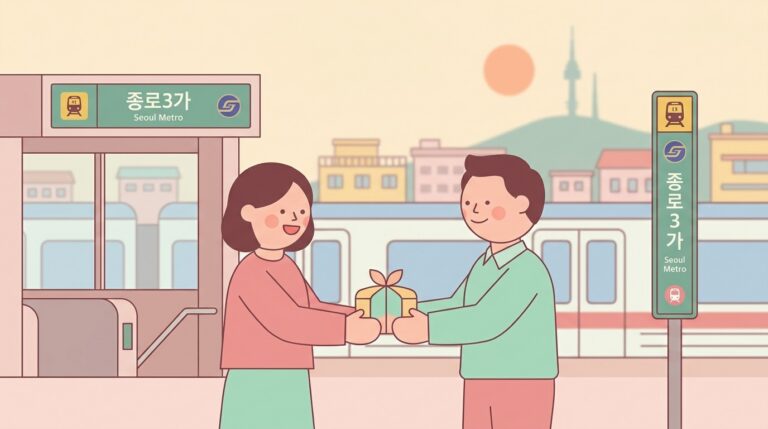
Phase 1: Empathy & Story Opening
안녕하세요! 매일한글 에디터입니다.
Imagine this: You are standing under the vibrant yellow canopy outside Exit 3 of Mangwon Station on a breezy Friday evening. Your smartphone is in your hand, glowing with the cute orange rabbit logo of Korea’s favorite neighborhood secondhand app, Karrot (당근마켓). You just agreed to meet a friendly neighbor who listed a pristine, aesthetic ceramic mug—something you’ve been hunting for weeks—for a jaw-dropping price of just 2,000 KRW, practically a giveaway (나눔)!
Suddenly, someone carrying a neat little paper bag looks around and catches your eye. Your heart starts pounding. In your head, you rehearse what textbook Korean taught you: “대단히 감사합니다…” Wait, does that sound too robotic? Like you’re signing an international diplomatic treaty? Should you just say “Gamsahamnida” and dash away awkwardly like a startled squirrel?
If you have ever felt nervous about making direct deals (직거래) or chatting with Korean locals on marketplace apps, take a deep breath. You are not alone! Many of our learners tell us: “I know how to say hello, but how do I express genuine, warm gratitude without sounding stiff or overly casual?”
Today, you will learn the exact phrases real Seoulites use to warm up any Karrot deal. By the end of this guide, your seller will not only smile from ear to ear, but they will also award you glowing feedback, boosting your “Manner Temperature” straight toward 99°C!
Phase 2: Core Expressions Deep Dive
1. 좋은 물건 저렴하게 주셔서 감사해요! (Joeun mulgeon jeoryeomhage jusyeoseo gamsahaeyo!)
- Pronunciation: Joh-eun mool-geon jeo-ryeom-ha-ge joo-shyeo-seo gahm-sa-hae-yo! (Tip: “Joeun” rhymes with “sewn”, and “mulgeon” sounds like a soft “mool-gun”).
- Meaning: Literal: “Because you gave a good item cheaply, I am grateful!” | Real Nuance: “Thank you so much for letting me have such a great item at such a generous price!”
- K-Culture Moment: You will hear this warm exchange in neighborhood K-dramas like Crash Landing on You or Once Again, where neighbors bond over everyday domestic treasures.
- Editor’s Insight: In English, we often say “Thanks for the deal!” which focuses on the transaction. In Korean, adding “주셔서” (because you gave it to me) frames the seller’s low price as a personal favor and act of kindness toward you.
- Situation Spectrum: Casual ⚠️ | Semi-formal ✅ (Ideal for Karrot chat & face-to-face) | Formal ✅
- 🤔 Think About It: How does thanking someone for giving rather than just selling transform a cold transaction into a warm community interaction?
2. 무료 나눔 정말 감사드려요, 잘 쓸게요! (Muryo nanum jeongmal gamsadeuryeoyo, jal sseulgeyo!)
- Pronunciation: Moo-ryo nah-noom jeong-mahl gahm-sa-deu-ryeo-yo, jal sseul-ge-yo! (Tip: “Nanum” rhymes with “calm room” without the ‘c’).
- Meaning: Literal: “I give thanks for the free sharing, I will use it well!” | Real Nuance: “Thank you so much for the free giveaway, I promise to put it to wonderful use!”
- K-Culture Moment: Karrot has a dedicated “나눔” (sharing/giveaway) culture. When moving out or decluttering, locals give things away for free to ensure items find a loving second home.
- Editor’s Insight: Never forget the phrase “잘 쓸게요” (I will use it well)! To Koreans, knowing their cherished item won’t be discarded or resold is the ultimate reward.
- Situation Spectrum: Casual ⚠️ | Semi-formal ✅ | Formal ✅
- 🤔 Think About It: In your culture, is it common to promise the giver that you will take good care of their gift? Why is this so reassuring to hear?
3. 덕분에 꼭 필요했던 건데 잘 구했어요! (Deokbune kkok piryohaetdeon geonde jal guhaesseoyo!)
- Pronunciation: Deok-boo-neh kkok pee-ryo-haet-deon geon-deh jal goo-haet-sseo-yo! (Tip: Pronounce “Deokbune” like “Duck-boo-neh”).
- Meaning: Literal: “Thanks to you, it was something I really needed and I obtained it well!” | Real Nuance: “Thanks to you, I finally found what I was looking for! You really made my day!”
- K-Culture Moment: When a K-pop fan finally scores a rare photo card or lightstick on a secondhand market, this is the exact text they send in relief!
- Editor’s Insight: “덕분에” is a magical grammar point. Unlike “때문에” (which can mean fault or cause), “덕분에” is solely reserved for attributing a positive, happy outcome to someone’s benevolence.
- Situation Spectrum: Casual ⚠️ | Semi-formal ✅ | Formal ✅
- 🤔 Think About It: Notice how “덕분에” credits the other person for your good fortune. It instantly dissolves tension between strangers.
Phase 3: Textbook Korean vs. Real Korean
Situation 1: Meeting at the subway station to receive the item
- 📖 교과서 한국어 (Textbook): 대단히 감사합니다. 물건을 잘 받았습니다. (Daedanhi gamsahamnida. Mulgeoneul jal badatseumnida. / “Thank you very much. I have received the article.”)
- 🗣️ 진짜 한국어 (Real Local): 와, 상태 진짜 좋네요! 저렴하게 주셔서 감사해요! (Wa, sangtae jinjja jonneyo! Jeoryeomhage jusyeoseo gamsahaeyo! / “Wow, it is in amazing condition! Thank you so much for the great deal!”)
- 💡 왜 다를까? Textbook Korean sounds like an official receipt issued by an international cargo carrier. Real Koreans praise the item’s condition (“상태 진짜 좋네요”) right away to validate the seller’s care for their belongings.
Situation 2: Concluding a free giveaway (나눔) transaction
- 📖 교과서 한국어 (Textbook): 무료 증정에 대하여 깊이 감사드립니다. (Muryo jeungjeonge daehayeo gipi gamsadeurimnida. / “I express deep gratitude regarding the complimentary presentation.”)
- 🗣️ 진짜 한국어 (Real Local): 따뜻한 나눔 감사해요, 소중히 잘 쓸게요! (Ttatteutan nanum gamsahaeyo, sojunghi jal sseulgeyo! / “Thank you for this warm giveaway, I will cherish it and use it well!”)
- 💡 왜 다를까? “증정” is marketing jargon printed on department store posters. “나눔” (sharing) carries an emotional undertone of neighborly warmth and solidarity.
Phase 4: K-Culture Deep Dive & Non-verbal Manners
4-1. Nunchi & Physical Manners (눈치와 바디랭귀지)
When meeting for a direct deal (직거래) in Korea, your body language speaks louder than your words:
* The Two-Handed Handover (두 손 매너): When receiving the item or handing over cash, always hold the item with both hands, or support your right forearm lightly with your left hand. It signals immediate respect.
* The 15-Degree Nod-Bow: You don’t need a deep 90-degree bow! A polite 15-degree nod accompanied by a smile and “감사합니다” hits the sweet spot between respectful and friendly.
* Fast Inspection, No Lingering Doubts: Quickly verify the item with a bright nod. Staring at an item under a magnifying glass for five minutes during a 2,000 KRW trade breaks the communal trust.
4-2. The Soul of Karrot: “Manner Temperature” & Return Treats
In Korea, Karrot isn’t merely an e-commerce platform; it’s a neighborhood hub. Everyone starts with a Manner Temperature (매너온도) of 36.5°C—the standard human body temperature. As you receive compliments and positive badges, your temperature rises. Reaching 50°C or higher makes you a neighborhood celebrity!
Here is an insider secret: When collecting a 100% free giveaway (나눔), locals rarely show up empty-handed. They will often hand the giver a chilled can of coffee, a small bottle of juice, or a couple of tangerines with a smile: “작지만 드세요!” (It’s small, but please enjoy!). This warm practice embodies 정 (Jeong)—the unspoken glue of Korean human affection.
Phase 5: Real-world Roleplay Scenario
Setting: Outside Exit 2 of Mangwon Station. It is 6:30 PM. Commuters are heading home. You are waiting near the convenience store for Min-ji, a local seller who listed a chic vintage study lamp.
- Turn 1 (Min-ji): 혹시… 당근마켓 ‘초코’ 님이세요? (Hoksi… Danggeunmaket ‘Choko’ nimiseyo?) 🎭 She approaches cautiously, holding a neat paper bag, tilting her head with a friendly smile.
- Turn 2 (You): 네, 맞아요! 민지 님이시죠? 안녕하세요! (Ne, majayo! Minji nimisijyo? Annyeonghaseyo!) 🎭 Brightly waving your hand and giving a quick 15-degree polite bow.
- Turn 3 (Min-ji): 네, 반가워요! 스탠드 조명 가져왔어요. 불 잘 들어오는지 집에서 방금 확인했어요. (Ne, bangaweoyo! Seutaendeu jomyeong gajyeowasseoyo. Bul jal deureooneunji jibeseo banggeum hwaginhaesseoyo.) 🎭 She opens the top of the paper bag slightly to show you the bulb and neat cord.
- Turn 4 (You): 와, 사진보다 실물이 훨씬 깨끗하네요! (Wa, sajinboda silmuri hwolssin kkaekkeuthaneyo!) 🎭 Looking inside with genuine delight, eyes widening with appreciation.
- Turn 5 (Min-ji): 마음에 드신다니 다행이에요. 원래 2만 원에 올리려다가 이사 때문에 급하게 나눔 수준으로 올렸어요. (Maeume deusindani dahaengieyo. Wonrae iman wone olliryeodaga isa ttaemune geubhage nanum sujuneuro ollyeosseoyo.) 🎭 Chuckling softly while handing the bag over using both hands.
- Turn 6 (You): 이렇게 좋은 물건 저렴하게 주셔서 정말 감사해요! 잘 쓸게요! (Ireoke joeun mulgeon jeoryeomhage jusyeoseo jeongmal gamsahaeyo! Jal sseulgeyo!) 🎭 Accepting the paper bag firmly with both hands and bowing your head politely.
- Turn 7 (Min-ji): 별말씀을요! 조심히 들고 가시고, 예쁘게 쓰세요! (Byeolmalsseumeullyo! Josimhi deulgo gasigo, yeppeuge sseuseyo!) 🎭 Beaming with a 50°C-manner smile and stepping back to let you pass.
- Turn 8 (You): 네! 조심히 들어가세요. 매너 평가 예쁘게 남길게요! (Ne! Josimhi deureogaseyo. Maeneopyeongga yeppeuge namgilgeyo!) 🎭 Waving warmly as she turns toward the crosswalk.
🔀 Interactive Decision Point
Suppose Min-ji suddenly says: “아, 그리고 가방 안에 제가 안 쓰는 예쁜 북마크도 같이 넣었어요!” (Oh, and I also slipped a pretty bookmark inside that I don’t use!). How do you respond?
- Option A (Best): 두 손으로 쇼핑백을 살짝 모아 쥐며: “어머, 덤까지 챙겨주시다니 정말 감동이에요! 소중히 잘 쓸게요!” (Eomeo, deomkkaji chaenggyeojusidani jeongmal gamdongieyo! Sojunghi jal sseulgeyo!)
- Outcome: Manner Temperature +5°C! Acknowledging an unexpected bonus gift (덤) with sincere delight melts any Korean seller’s heart.
- Option B (Bad): 손을 휘저으며: “저 책 안 읽어서 필요 없어요. 도로 가져가세요.” (Jeo chaek an ilgeoseo piryo eopseoyo. Doro gajyeogaseyo.)
- Outcome: Major Faux Pas! Even if you don’t read books, bluntly rejecting a good-faith gift creates intense embarrassment (민망함).
- Option C (Risk): 덤덤하게 받으며: “네, 땡큐요.” (Ne, ttaengkyuyo.)
- Outcome: Awkward Silence. Sounds indifferent, making the seller regret offering extra kindness.
Phase 6: 10-Second Shadowing Drill
Practice reading these 3 key lines out loud. Pay close attention to the pause markers (/) and the emotional guidance tags!
[😊 기쁘고 활기차게 - Cheerful & Energetic]
안녕하세요! / 혹시 당근마켓 / 민지 님이세요? / 만나서 반가워요!
(Annyeonghaseyo! / Hoksi Danggeunmaket / Minji nimiseyo? / Mannaseo bangaweoyo!)-
[🥰 진심 어린 감사 - Heartfelt & Warm Gratitude]
좋은 물건 / 저렴하게 나눔해 주셔서 / 정말 감사해요! / 소중하게 / 잘 쓸게요!
(Joeun mulgeon / jeoryeomhage nanumhae jusyeoseo / jeongmal gamsahaeyo! / Sojunghage / jal sseulgeyo!) -
[👋 훈훈하고 정답게 - Friendly & Gentle Farewell]
날씨 추운데 / 조심히 들어가세요! / 매너 평가 / 꼭 남겨드릴게요!
(Nalssi chuunde / josimhi deureogaseyo! / Maeneopyeongga / kkok namgyeodeurilgeyo!)
Phase 7: K-Culture Mini Dictionary
- 나눔 (Nanum) | Free Giveaway / Sharing
- Real-world usage: When an item price is listed as 0 KRW on Karrot, it is labeled as “나눔”. Locals say “무료 나눔 받았다” (I received a free giveaway).
- 매너온도 (Maeneoon-do) | Manner Temperature
- Real-world usage: Karrot’s peer-review metric. Starting at 36.5°C, users with high temperatures are deemed trustworthy, punctual, and generous.
- 직거래 (Jikgeorae) | Direct In-Person Deal
- Real-world usage: Meeting face-to-face near a subway station or apartment security office instead of shipping by courier (택배거래).
- 쿨거래 (Kulgurae) | Quick, Haggle-Free Transaction
- Real-world usage: Derived from “Cool deal”. Refers to a smooth transaction where neither party complains, haggles, or arrives late.
Phase 8: Traveler’s Survival Kit
Top 3 Survival Phrases for Street Pickups
- 혹시 당근이세요? (Hoksi danggeuniseyo?)
- Meaning: Excuse me, are you from Karrot?
- Pro Tip: When meeting someone in a busy crowd, this simple sentence saves you from wandering around awkwardly checking everyone’s shoes!
- 잔돈 여기 딱 맞춰 준비했어요! (Jandon yeogi ttak matchwo junbihaesseoyo!)
- Meaning: I prepared the exact change right here!
- Pro Tip: Cash trades for small amounts (1,000 ~ 5,000 KRW) run smoothest when you don’t ask the seller to break a 50,000 KRW note.
- 좋은 거래 감사해요! (Joeun georae gamsahaeyo!)
- Meaning: Thank you for the pleasant deal!
- Pro Tip: Use this as your exit line while stepping back to leave.
Editor’s Travel Note: Spotting Meetup Landmarks
- Navigate Like a Local: Forget Google Maps in South Korea—it lacks walking route details. Instead, install the 네이버 지도 앱 (Naver Map app) to pinpoint apartment complex gates (아파트 정문) or exact subway station exits.
- Designated Safe Spots: When in doubt, suggest meeting in front of a 24-hour convenience store (편의점 앞) or right beside the station ticketing gates. They are bright, crowded, and safe!
Phase 9: Think Deeper (“한 발 더 깊이”)
In many Western cultures, secondhand buying is driven largely by thriftiness or environmental minimalism. In South Korea, while those factors matter, platforms like Karrot have revived something ancient: the spirit of 품앗이 (Pumasi) and 정 (Jeong)—traditional practices where villagers shared labor, seasonal food, and domestic equipment without expecting immediate financial returns.
When a Korean seller lists an almost-new toaster or coat for just a couple of dollars, their primary motive is often the joy of seeing someone in their immediate neighborhood benefit from it. That is why saying “잘 쓸게요” (I will use it well) touches the seller so deeply; it affirms that their act of community goodwill was successful.
💬 Your Turn: Have you ever received a free or discounted item from a stranger in your hometown? What did you say in your native language, and how does it compare to the Korean emphasis on “promising good use”?
Phase 10: FAQ & Common Mistakes
Q: Can I negotiate the price (네고) when meeting the seller face-to-face?
A: No, absolutely avoid this! In Korean secondhand etiquette, all price negotiations (called “네고” / Nego) must happen via chat before agreeing to meet. Haggling at the meetup spot is considered very rude and will tank your Manner Temperature immediately.
Q: Is it mandatory to bring a drink or return gift for a free giveaway (나눔)?
A: Not mandatory at all, but highly appreciated! Even a 1,000 KRW warm soy milk or barley tea from the convenience store demonstrates wonderful cultural awareness.
Q: Should I use formal honorifics (-ㅂ니다/-습니다) or polite informal (-요)?
A: Polite informal (-아/어요) is the gold standard! Sentences like “저렴하게 주셔서 감사해요!” sound warm, respectful, and natural. Full formal (“감사합니다”) is always acceptable, but dropping to casual talk (반말) without permission is strictly forbidden.
🚨 흔한 실수 (Common Mistakes) Warning Box
- Mistake: Arriving 10 minutes late without sending a chat message.
- Correct Action: Send a quick note: “5분 정도 늦을 것 같아요, 죄송해요!” (I think I’ll be about 5 minutes late, I’m sorry!). Korean sellers value punctuality above all.
- Mistake: Forgetting to hit “거래 완료” (Deal Complete) and skipping the review.
- Correct Action: Open the app immediately after walking away, mark the transaction complete, and tap “매너 칭찬” (Compliment Manners) to give them 5 stars!
- Mistake: Asking the seller to deliver the item straight to your door for a cheap deal.
- Correct Action: The buyer usually travels to the seller’s preferred location (often outside the seller’s apartment complex or nearest station).
Phase 11: Action Mission & Engagement
Ready to put your skills into action? Climb the Daily Hangul ladder!
- 🥉 Bronze Mission (Solo Practice): Stand in front of your mirror, hold a coffee mug with both hands, bow 15 degrees, and say out loud three times: “좋은 물건 저렴하게 주셔서 감사해요! 잘 쓸게요!”
- 🥈 Silver Mission (Community Share): Write down your favorite item that you own in Korean (e.g., 책, 머그컵, 조명) in our comments section and form a sentence thanking the seller!
- 🥇 Gold Mission (Real-world Challenge): If you are in Korea, open Karrot, locate a free or cheap listing, and send a polite opening chat message using today’s phrases!
- 🎮 K-Culture Mission: Watch an episode of a neighborhood vlog or reality show (like I Live Alone). Watch closely for when someone receives a gift or buys a secondhand item. Did you catch them saying “잘 쓸게요”?
Phase 12: Interactive Quiz Challenge
Test your knowledge before hitting the streets of Seoul!
1. Situational Judgment
You just met an elderly neighbor who gave you a beautiful study desk for free (무료 나눔). What is the most natural and polite thing to say as you receive it?
* A) “고마워, 잘 쓸게!”
* B) “따뜻한 나눔 정말 감사드려요, 예쁘게 잘 쓸게요!”
* C) “이거 새것 아니네요? 깎아주세요.”
2. Fill-in-the-Blank
Complete the sentence to show gratitude for a great bargain:
* “좋은 물건 ______ 주셔서 감사해요! 잘 쓸게요!”
* Hint: The adverb form of 저렴하다 (cheap/affordable).
3. Cultural True or False
- True or False: On the Karrot app, if your Manner Temperature drops below 36.5°C, it means your neighbors consider your trading manners below average.
👉 Click here to reveal the answers and explanations!
Quiz Explanations
- Answer: B
- Explanation: Choice A uses casual talk (반말) which is rude to elders and strangers. Choice C demands a discount on a free item! Choice B combines warm appreciation (따뜻한 나눔) with the magic promise (잘 쓸게요).
- Answer: 저렴하게 (jeoryeomhage)
- Explanation: Combining 저렴하다 (to be affordable) with -게 creates the adverb “affordably/cheaply”.
- Answer: True
- Explanation: Everyone begins at normal body temperature (36.5°C). Below that indicates late arrivals, cancellations, or unfriendliness, while temperatures above 40°C indicate a stellar neighbor!
did you get all 3 right? Let us know your score below!
🎬 Watch Our Daily Videos! (Daily Hangul Official Instagram)
Review the expressions you learned in this article with our fun daily short videos! Check out native pronunciation and real-life nuances in action.
- Instagram @dailyhangul_en







