

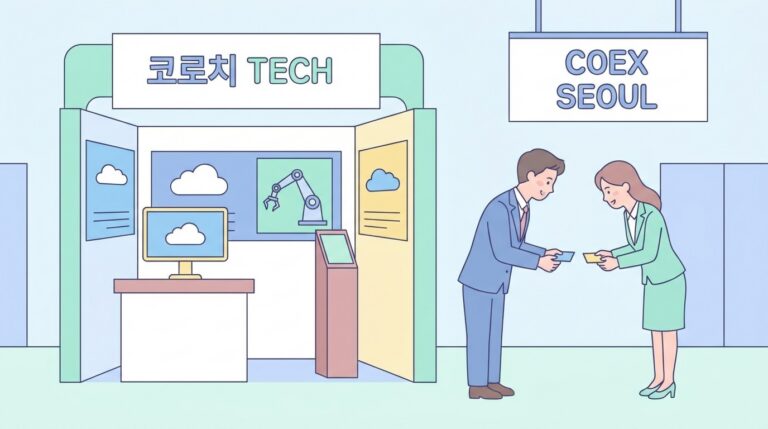
Phase 1: Empathy (Welcome to the Hustle of COEX!)
안녕하세요! 매일한글 에디터입니다. (Hello! It’s your Daily Hangul editor.)
Picture this: You are standing under the gleaming LED spotlights of Hall C inside Seoul’s massive COEX Convention & Exhibition Center. The air is thick with the scent of fresh glossy brochures, the hum of hundreds of tech pitches, and the intermittent beep-beep of QR badge scanners. You’re clutching an iced Americano like a lifeline, representing your company’s cutting-edge B2B SaaS solution. Suddenly, a sharply dressed Korean operations manager with a lanyard from a major conglomerate stops right in front of your booth. He squints at your banner, his eyes scanning your dashboard demo.
Your heart races. You spent weeks rehearsing textbook Korean, but suddenly questions flash through your mind: Do I say ‘어서오세요’ (Welcome) like a convenience store clerk? How do I politely ask for his business card without sounding aggressive? How do I sound like a competent tech partner instead of an awkward tourist?
If you’ve watched corporate K-dramas like Misaeng (Incomplete Life) or Start-Up, you know that business interactions in Korea are an intricate dance of respect, precision, and rapid value delivery. Stepping onto an exhibition floor can feel terrifying, but it is also the ultimate shortcut to building high-value business relationships. This guide is crafted directly from real-life field feedback from foreign founders and global sales reps who have manned booths at COEX and KINTEX. By mastering these expressions and behavioral codes, you won’t just survive the three-day expo—you will turn wandering visitors into solid enterprise leads.
Phase 2: Core Expressions Deep Dive
Here are three B2-level power expressions designed to hook buyers, secure demonstrations, and lock in seamless follow-ups.
1. 바쁘신 와중에 부스에 들러주셔서 감사드립니다.
- Pronunciation: [Babbusin wajunge buseu-e deulleojusyeoseo gamsadeurimnida.] (Sound tip: Pronounce ‘wajunge’ like ‘wah-joong-eh’, smoothly gliding through the syllables like thanking a guest entering your home.)
- Meaning: “Thank you for taking the time out of your busy schedule to stop by our booth.”
- Literal vs. Nuanced: Literally “In the midst of being busy, thank you for dropping by.” In nuance, it immediately acknowledges the visitor’s seniority and hectic schedule, setting a deeply professional and humble tone.
- K-Culture Moment: You will hear this exact cadence in dramas whenever two executives meet at an industry symposium or corporate gala. It establishes mutual respect before pitching a single feature.
- Editor’s Insight: Never open with a blunt “우리 제품 보세요” (Look at our product). In Korean B2B culture, acknowledging the buyer’s effort to pause and step into your space creates instant rapport.
- Situation Spectrum: Casual: 🚫 | Semi-formal: ⚠️ | Formal: ✅
- 🤔 Think About It: Why does Korean business communication prioritize acknowledging the other person’s busy status before introducing oneself? How does this compare to elevator pitches in your country?
2. 저희 솔루션이 담당자님의 업무 효율을 어떻게 개선할 수 있는지 간단히 시연해 드려도 괜찮을까요?
- Pronunciation: [Jeohui sollusyeoni damdangjanim-ui eommu hyoyureul eotteoke gae-seonhal su inneunji gandani si-yeonhae deuryeodo gwaenchanheulkkayo?]
- Meaning: “Would it be alright if I gave you a quick demonstration of how our solution can improve your team’s operational efficiency?”
- Literal vs. Nuanced: Literally “May I simply demonstrate how our solution improves your manager-level work efficiency?” Nuance-wise, using the honorific title 담당자님 (Damdangjanim – Person in charge) flatters their authority while keeping the demo low-pressure (“간단히 – briefly/simply”).
- K-Culture Moment: Think of Start-Up when Dal-mi pitches her AI engine to corporate directors—confident yet asking permission to present value, never forcing a long presentation.
- Editor’s Insight: B2B decision-makers in Korea care immensely about 업무 효율 (operational efficiency) and ROI. Framing your demo as a problem-solver rather than a sales pitch disarms their guard.
- Situation Spectrum: Casual: 🚫 | Semi-formal: ⚠️ | Formal: ✅
- 🤔 Think About It: Notice the soft ending -도 괜찮을까요? (Would it be okay if…?). How does indirect permission-seeking in Korean business soften aggressive cold pitches?
3. 명함 주시면 박람회 종료 후 도입 사례 자료와 함께 메일로 팔로업 드리겠습니다.
- Pronunciation: [Myeongham jusimyeon bangramhoe jongryo hu doip sarye jaryowa hamkke meillo palro-eop deurigesseumnida.]
- Meaning: “If you could share your business card, I’ll follow up by email with case studies right after the expo concludes.”
- Literal vs. Nuanced: Literally “If you give a name card, after exhibition end, together with adoption case materials, via mail I will give a follow-up.” The real nuance is a frictionless trade: their contact details in exchange for high-value proof (도입 사례 – implementation case studies).
- K-Culture Moment: The climactic exchange of business cards with both hands at the end of a pivotal negotiation scene in Misaeng.
- Editor’s Insight: Notice the Koreanized tech-industry term 팔로업 드리겠습니다 (I will follow up). Combining English business jargon with the ultra-polite auxiliary verb 드리다 (to give/offer humbly) sounds hyper-natural in Korean IT corridors like Pangyo and Teheran-ro.
- Situation Spectrum: Casual: 🚫 | Semi-formal: ⚠️ | Formal: ✅
- 🤔 Think About It: Why is offering tangible materials like “도입 사례” (case studies) far more effective when requesting contact info in Korea than just asking to “keep in touch”?
Phase 3: Textbook Korean vs. Real Korean
| Situation | 📖 Textbook Korean | 🗣️ Real B2B Korean (Natural & Effective) |
|---|---|---|
| Inviting Booth Visitors | 저희 회사의 제품을 구경해 보시겠습니까? (Would you like to observe our company’s product?) |
편하게 둘러보세요! 커피 쿠폰과 카탈로그 준비되어 있습니다. (Feel free to look around! We have coffee coupons and catalogs ready.) |
| Promising a Follow-up | 제가 나중에 당신에게 연락을 취하겠습니다. (I will make contact with you later.) |
명함 주시면 이번 주 내로 상세 자료 정리해서 메일 보내드리겠습니다. (If you could share your card, I’ll organize the detailed docs and email you within this week.) |
- 💡 왜 다를까? (Why the difference?)
Textbook Korean often sounds like robotic translation software (“구경해 보시겠습니까?”, “당신에게 연락을 취하겠습니다”). In real exhibitions at COEX, top sales specialists lower the visitor’s psychological barrier by saying 편하게 둘러보세요 (Feel free to take a look), often leveraging promotional swag or coffee coupons, and state clear, actionable timelines (이번 주 내로 – within this week).
Phase 4: K-Culture Deep-Dive & Non-Verbal Manners
4-1. 눈치 (Nunchi) & The Sacred Business Card Ritual
At Korean B2B expos, your body language speaks before your words do:
* The Two-Handed Rule (양손 원칙): When receiving a business card (명함 – Myeongham), never grab it with one hand like a playing card. Receive it with both hands, slightly bow your head (15 degrees), and read their company name and title out loud: “아, OO물산 김민우 팀장님, 반갑습니다.” (Ah, Team Lead Kim Min-woo of OO Corporation, great to meet you.)
* The Desk Placement: During your demo, do NOT slip their card directly into your back pocket or wallet! Place it respectfully on the high cocktail table next to your laptop screen so you can glance at their title while speaking.
* Reading the Eye-Line (눈치 – Nunchi): If an expo visitor pauses at your booth for more than three seconds while looking at a monitor, make eye contact, offer a warm micro-nod, and step forward. If they avoid eye contact and keep walking, do not physically step into their path.
4-2. Cultural Code: The ‘Ppallli-Ppalli’ Tech Ecosystem
Korean corporate managers value speed and clarity. They visit trade shows under strict KPIs to discover solutions that can be implemented swiftly. When pitching SaaS at COEX, keep your initial pitch under two minutes. Use buzzwords like 업무 자동화 (work automation), 비용 절감 (cost reduction), and 보안 안정성 (security stability). Show that your product respects their time.
Phase 5: Real-World Roleplay Scenario
Setting: Day 2 at COEX Hall C, Booth B-104. The convention floor is buzzing. Kim Min-woo (김민우), an IT Infrastructure Team Lead at a nationwide logistics enterprise, pauses by your interactive dashboard screen.
- Turn 1 (You): 🎭 (Approaching gently with a soft smile and open posture)
바쁘신 와중에 부스에 들러주셔서 감사드립니다. 편하게 둘러보세요.
(Babbusin wajunge buseu-e deulleojusyeoseo gamsadeurimnida. Pyeonhage deulleoboseyo.)
“Thank you for stopping by our booth in your busy schedule. Please feel free to look around.” - Turn 2 (Min-woo): 🎭 (Pointing his lanyard pen toward your dashboard)
아, 네. 실시간 물류 추적 SaaS인 것 같은데, 기존 ERP 시스템과도 연동이 되나요?
(A, ne. Silsigan mulryu chujeok SaaS-in geot gateunde, gijon ERP siseutemgwado yeondongi doenayo?)
“Ah, yes. Looks like a real-time logistics tracking SaaS. Does it integrate with existing ERP systems?” - Turn 3 (You): 🎭 (Nodding enthusiastically, maintaining polite eye contact)
네, 맞습니다! 표준 API를 지원해서 기존 시스템과 3일 이내로 완벽히 연동됩니다.
(Ne, matseumnida! Pyojun API-reul jiwonhaeseo gijon siseutemgwa sam-il inaero wanbyeokhi yeondongdoemnida.)
“Yes, that’s correct! We support standard APIs, so it integrates seamlessly with existing systems within three days.” - Turn 4 (Min-woo): 🎭 (Looking impressed, crossing his arms thoughtfully)
오, 3일이요? 생각보다 빠르네요. 실제 국내 도입 레퍼런스가 좀 있습니까?
(O, sam-iriyo? Saenggakboda ppareuneyo. Silje guknae doip repeoreonseuga jom itseumnikka?)
“Oh, three days? That’s faster than I expected. Do you have local Korean enterprise references?” - Turn 5 (You): 🎭 (Inviting him closer to the tablet terminal with a gentle hand gesture)
저희 솔루션이 담당자님의 업무 효율을 어떻게 개선할 수 있는지 간단히 시연해 드려도 괜찮을까요? 국내 유통사 사례도 함께 보여드리겠습니다.
(Jeohui sollusyeoni damdangjanim-ui eommu hyoyureul eotteoke gae-seonhal su inneunji gandani si-yeonhae deuryeodo gwaenchanheulkkayo? Guknae yutongsa saryedo hamkke boyeodeurigesseumnida.)
“Would it be alright if I gave you a quick demonstration of how our solution can improve operational efficiency? I can also show you case studies from domestic retail companies.” - Turn 6 (Min-woo): 🎭 (Uncrossing arms and stepping toward the monitor)
좋습니다. 다음 미팅 전까지 5분 정도 시간이 있으니 간단히 부탁드립니다.
(Chosseumnida. Daeum miting jeonkaji obun jeongdo sigani isseuni gandani butakdeurimnida.)
“Sounds good. I have about 5 minutes before my next meeting, so please give me a brief overview.” - Turn 7 (You): 🎭 (Finishing a crisp 3-minute demo, gesturing towards business card case)
설명 들어주셔서 감사합니다. 명함 주시면 박람회 종료 후 도입 사례 자료와 함께 메일로 팔로업 드리겠습니다.
(Seolmyeong deureojusyeoseo gamsahamnida. Myeongham jusimyeon bangramhoe jongryo hu doip sarye jaryowa hamkke meillo palro-eop deurigesseumnida.)
“Thank you for listening to our presentation. If you could share your business card, I’ll follow up by email with case studies right after the expo concludes.” - Turn 8 (Min-woo): 🎭 (Reaching into his suit jacket and pulling out a card with both hands)
여기 제 명함입니다. 물류 자동화 관련 상세 자료 꼭 부탁드립니다.
(Yeogi je myeongham-imnida. Mulryu jadonghwa gwanryeon sangse jaryo kkok butakdeurimnida.)
“Here is my card. Please be sure to send the detailed documentation regarding logistics automation.”
🔀 Interactive Branching Moment
When Min-woo asks about ERP integration in Turn 2, how would you respond?
* Option A: “당연하죠! 저희 기술이 세계 최고라서 안 되는 게 없습니다. 지금 계약하시면 할인해 드려요!” (Of course! Our tech is the world’s best, everything works. If you sign right now, we give you a discount!)
* Option B: “네, 맞습니다! 표준 API를 지원해서 기존 시스템과 3일 이내로 완벽히 연동됩니다.” (Yes, that’s correct! We support standard APIs, so it integrates seamlessly within three days.)
* Option C: “글쎄요… 개발팀에 물어봐야 해서 나중에 메일로 답변드려도 될까요?” (Well… I have to ask our dev team, can I email you later?)
Feedback:
* Option A (Risk / Bad): Overselling and pushing instant contracts at an initial expo booth sounds untrustworthy and desperate in Korean B2B contexts.
* Option B (Best): Confident, specific (3 days), and highlights standardized interoperability (표준 API).
* Option C (Risk): Shows lack of preparation on basic technical specs. While honesty is good, delaying a core question loses immediate buyer interest.
Phase 6: 10-Second Emotional Shadowing Drill
Practice these lines with rhythm, breath control, and targeted business emotion. (Pause at /):
[💼 프로페셔널하고 정중하게 - Crisp & Welcoming]
바쁘신 와중에 / 부스에 들러주셔서 / 감사드립니다.
(Babbusin wajunge / buseu-e deulleojusyeoseo / gamsadeurimnida.)-
[🤝 확신에 차고 부드러운 제안 - Confident & Gentle Value Proposition]
저희 솔루션이 / 담당자님의 업무 효율을 / 어떻게 개선할 수 있는지 / 간단히 시연해 드려도 괜찮을까요?
(Jeohui sollusyeoni / damdangjanim-ui eommu hyoyureul / eotteoke gae-seonhal su inneunji / gandani si-yeonhae deuryeodo gwaenchanheulkkayo?) -
[📩 신뢰감을 주는 약속 - Trustworthy Closing]
명함 주시면 / 박람회 종료 후 / 도입 사례 자료와 함께 / 메일로 팔로업 드리겠습니다.
(Myeongham jusimyeon / bangramhoe jongryo hu / doip sarye jaryowa hamkke / meillo palro-eop deurigesseumnida.)
Phase 7: K-Culture Mini Dictionary
- 명함 교환 (Myeongham Gyohwan) | Business Card Exchange
- The sacred handshake of Korean professional life. Always handed and received with two hands, turned so the recipient can read it immediately.
- 리드 발굴 (Rideu Balgul) | Lead Generation
- In Korean tech sales, turning a booth visitor into a genuine prospective client through targeted questions rather than passive flyer distribution.
- 도입 사례 (Doip Sarye) | Implementation Case Study / Client Reference
- Korean corporate clients heavily mitigate risk by checking who else in their industry has adopted your software. Having domestic or recognizable global “도입 사례” is your golden ticket.
- 부스 철수 (Buseu Cheolsu) | Booth Teardown / Dismantling
- The chaotic, celebratory period on the final afternoon of an expo when teams pack up banners, collect badges, and head out for celebratory Korean BBQ (회식 – Hoesik).
Phase 8: Survival Kit for Business Travelers
Top 3 Survival Expressions
- “브로슈어 한 권 챙겨드릴까요?” (Beurosyueo han gwon chaenggyeodeurilkkayo?)
- Meaning: “May I offer you a brochure?”
- Pro Tip: Hand it with both hands while stepping slightly to the side to showcase your screen.
- “잠시 명함 한 장 부탁드려도 될까요?” (Jamsi myeongham han jang butakdeuryeodo doelkkayo?)
- Meaning: “May I politely request one of your business cards?”
- Pro Tip: Use this when someone spent several minutes observing your booth but hasn’t initiated contact.
- “혹시 어떤 부서에서 담당하고 계신가요?” (Hoksi eotteon buseoe-seo damdanghago gyesingayo?)
- Meaning: “May I ask which department you are in charge of?”
- Pro Tip: Pinpoint whether the visitor is an end-user, an engineer, or a budget decision-maker.
Editor’s Travel Note: Conquering COEX
- Navigating the Underground Maze: COEX is infamous for being an underground labyrinth. If you arrange coffee meetings with buyers, don’t just say “Meet at COEX.” Pick an unmistakable landmark like the giant bookshelf at the center of the Starfield Library or the café directly outside Hall C. Make sure to download the Naver Map app navigation before arriving; international GPS apps often fail to pinpoint exhibition hall gates indoors.
- The Recharge Strategy: Need high-speed Wi-Fi, a quiet desk, or emergency printing? Visit the COEX Business Center located near Hall A. And remember: keeping an extra stash of branded USB drives or quality mints at your booth desk will make wandering buyers linger twice as long.
Phase 9: “One Step Deeper” (Cultural Philosophy)
In Western sales philosophy, speed and directness often dominate: What is your pain point? Here is our price. Let’s sign. However, Korean B2B transactions are built on 정 (Jeong – relational warmth) and 신뢰 (Sinroe – organizational trust). When a Korean manager stops at your booth, they aren’t just evaluating a SaaS platform; they are evaluating whether your company will be a reliable, long-term partner who will answer the phone when a server issues an alert at 10 PM. Demonstrating humility, respecting the hierarchy of titles (팀장님, 부장님), and promising structured follow-up data reflects your team’s internal competence.
💬 Your Turn: Have you ever attended a business expo in Korea or abroad? What was the hardest part about pitching in another language? Share your stories in the comments below!
Phase 10: FAQ & Common Mistakes
Q: What should I do if a buyer brings up their CEO or senior director without giving a direct answer?
A: This is a classic Korean corporate consensus process (품의/결재 – Pumi/Gyeoljae). Reply warmly: “내부 검토용 자료를 메일로 전달해 드리겠습니다. 언제든 편하게 문의해 주십시오.” (I will send over internal review documents by email. Please feel free to reach out anytime.)
Q: Can I call a visitor by their first name if their English business card has it?
A: In Korean business settings, calling someone by just their first name (e.g., “Min-woo-ssi”) can feel overly familiar or disrespectful in a B2B context. Always combine their surname and corporate title, such as 김 팀장님 (Team Lead Kim) or use 담당자님 (Manager in charge) if you aren’t sure of their rank.
Q: How soon should I send the follow-up email after the expo ends?
A: Within 24 to 48 hours! Mention the exact booth location and topic discussed: “코엑스 산업 박람회 부스에서 인사드렸던 [회사명]의 [이름]입니다.” (This is [Name] from [Company] who greeted you at the COEX Industry Expo booth.)
🚨 Common Mistakes Warning Board
| Foreign Booth Operator Mistake | Why It Hurts Your Deals | Correct Professional Action |
|---|---|---|
| Stuffing a received business card straight into a pocket | Looks careless and signals that you don’t value the person’s rank | Hold with both hands, read it, and place it on your demonstration stand |
| Saying “안녕!” or casual speech to young attendees | Young engineers and associates in Korea still expect professional respect at work | Use formal 존댓말 (Honorifics): “안녕하세요, 반갑습니다!” |
| Pushing for a contract on the spot | Korean enterprise SaaS procurement requires multi-tiered internal approvals | Focus on securing an intro meeting or demo follow-up email instead |
Phase 11: Action Mission & Engagement
- 🥉 Bronze Mission (Solo Practice): Read the Phase 6 Shadowing Drill out loud 3 times. Focus on smooth transitions between honorific suffixes (-님, -드리겠습니다).
- 🥈 Silver Mission (Social Challenge): Take a photo of your business card or lanyard, post it to your Instagram or LinkedIn, and caption it using our keyword: “명함 주시면 메일로 팔로업 드리겠습니다!”
- 🥇 Gold Mission (Real-World Application): Attend a networking event or convention, exchange business cards using both hands, and deliver the greeting: “바쁘신 와중에 시간 내주셔서 감사드립니다.”
🎮 K-Culture Media Mission: Watch Episode 1 or 2 of the K-drama Misaeng (미생) or Start-Up (스타트업). Spot the exact moment characters hand over their business cards. Notice their hands, eye contact, and head tilt!
Phase 12: Interactive Quiz Challenge
Question 1: Situational Judgment
A buyer visits your COEX SaaS booth, checks your software, and hands you their business card. What is the most appropriate response?
* A) Take it with one hand, slide it into your jeans pocket, and say “고마워!”
* B) Receive it with both hands, read their title out loud, and place it beside your laptop.
* C) Hand them a 50-page paper manual immediately and ask them to sign an NDA.
Question 2: Fill in the Blanks
Complete the professional lead generation sentence:
“명함 주시면 박람회 종료 후 도입 사례 자료와 함께 메일로 __________ 드리겠습니다.”
* A) 놀아 (nora)
* B) 팔로업 (palro-eop)
* C) 식사 (siksa)
Question 3: True or False (Culture Check)
True or False: In a Korean exhibition hall, immediately telling a wandering buyer to buy your software on the spot with a steep discount is the best way to earn trust with corporate managers.
👉 Click to Reveal Answers & Detailed Explanations
Answer 1: B
Explanation: Receiving with both hands and keeping the card visible honors the person’s identity and organizational rank.
Answer 2: B (팔로업)
Explanation: “팔로업 드리겠습니다” (I will follow up) is the industry standard expression for post-conference outreach.
Answer 3: False
Explanation: High-pressure sales discount pitches signal instability in Korean B2B environments. Korean enterprises value verified references (도입 사례) and thoughtful follow-up documentation far more than quick on-site discounts.
🎬 Watch Our Daily Videos! (Daily Hangul Official Instagram)
Review the expressions you learned in this article with our fun daily short videos! Check out native pronunciation and real-life nuances in action.
- Instagram @dailyhangul_en







