Phase 1: 공감 (Story Opening)
안녕하세요! 매일한글 에디터입니다.
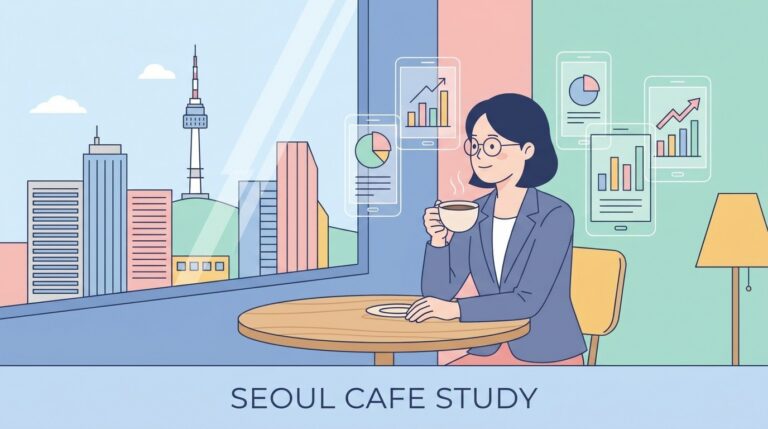
Picture this: You are sitting in a sunlit café in Yeouido, Seoul’s bustling financial hub. At the table next to you, two young professionals in sharp business-casual attire are frantically tapping their smartphones. Instead of gossiping or discussing weekend plans, they are showing each other glowing red charts—in Korea, red means stock gains, while blue signals a drop. One whispers in exasperation, “나 빼고 다 돈 벌었어… 진짜 포모 온다.” (Na ppaego da don beoreosseo… jinjja pomo onda. / Everyone got rich except me… I’m really getting FOMO.)
Sound familiar? Whether you are browsing Korean online communities, watching YouTube financial channels, or having casual lunch chats with Korean coworkers, conversations about money, investments, and side hustles move at lightning speed. Buzzwords like N잡러 (multi-jobber), 영끌 (leveraging soul and bone), and 벼락거지 (sudden relative pauper) dominate everyday discourse.
When everyone around you seems to be hitting jackpots or scrambling into the latest asset bubble, a distinct wave of anxiety hits. You wonder: Should I jump in too? Am I falling behind?
As someone navigating Korean language and society at an upper-intermediate (B2) level, mastering these economic buzzwords isn’t just about expanding vocabulary—it is your cultural armor. Today, we will unpack how to decipher these trendy phrases, understand the deep societal pressures behind them, and use graceful, natural Korean expressions to say: “I’m sticking to my own lane and investing at my own pace.”
Phase 2: 핵심 표현 3선 심층 분석 (Top 3 Core Expressions)
1. 포모가 오다 (Pomo-ga oda)
- Pronunciation: [Pomo-ga oda] (Sounds like: Poh-moh-gah oh-dah; rhymes with ‘sofa soda’)
- Meaning: Literal: “FOMO arrives” | Nuance: Getting hit with a sudden, overwhelming wave of Fear Of Missing Out when watching others profit.
- K-Culture Moment: Seen frequently on YouTube investment channels like Shuka World or retail investor forums when a meme stock surges overnight and casual observers panic-buy.
- Editor’s Insight: In English, you “have” FOMO. But in Korean emotional syntax, feelings frequently “arrive” (오다) to you as an external wave—just like 현타가 오다 (a reality check hits) or 멘붕이 오다 (mental collapse arrives).
- Situation Spectrum: Casual: ✅ | Semi-formal: ✅ | Formal: ⚠️
- 🤔 Think About It: In English, stating “I have FOMO” sounds like an active state of mind. In Korean, saying it comes to you frames it as an external emotional tide you must endure. Does this make it easier to talk about feeling insecure without sounding weak?
2. 뇌동매매 (Noedong-maemae)
- Pronunciation: [Noedong-maemae] (Sounds like: Nay-dong-meh-meh; rhymes with ‘play-song-may-may’)
- Meaning: Literal: “Thunder-following transaction” | Nuance: Herd trading, impulse buying, or blindly copying other people’s trades without doing any personal due diligence.
- K-Culture Moment: In the K-Drama Stock Struck (개미가 타고 있어요), rookie investors jump on a hyped tech stock simply because their friends bought it, later confessing: “또 뇌동매매했어…” (Tto noedongmaemaehaesseo… / I did herd trading again…).
- Editor’s Insight: Although it derives from formal Sino-Korean roots (雷同買賣), this word is used constantly by Gen Z and Millennials on internet forums and Blind (블라인드) as a self-deprecating confession when an impulsive trade goes wrong.
- Situation Spectrum: Casual: ✅ | Semi-formal: ✅ | Formal: ✅
- 🤔 Think About It: Is impulsive investing treated as an embarrassing personal blunder in your culture, or is it recognized as a widespread social phenomenon like 뇌동매매 in Korea?
3. 멘탈을 잡다 (Mental-eul japda)
- Pronunciation: [Mental-eul japda] (Sounds like: Men-tahl-eul jahp-dah; ‘mental’ pronounced with crisp Korean phonetic cadence)
- Meaning: Literal: “To grab/hold one’s mentality” | Nuance: To regain your composure, pull yourself together, and avoid getting swayed by external chaos or peer pressure.
- K-Culture Moment: Often heard when office colleagues comfort a teammate whose crypto holding plummeted, or when someone refuses to buy at the peak: “남들 수익률 보지 말고 멘탈 잡아!” (Namdeul suikryul boji malgo mental jaba! / Don’t look at other people’s yields; keep your head on straight!).
- Editor’s Insight: 멘탈 (mental) is arguably Korea’s favorite Konglish noun for resilience. When you are shaken, your 멘탈이 털리다 (mentality gets plundered). To withstand the investing frenzy, you consciously 잡다 (seize) it.
- Situation Spectrum: Casual: ✅ | Semi-formal: ✅ | Formal: ⚠️
- 🤔 Think About It: Why has mental resilience become such a central buzzword among young Koreans navigating competitive job and financial markets?
Phase 3: 교과서 한국어 vs 진짜 한국어 (Textbook vs. Real Korean)
Situation 1: Declining an acquaintance’s risky “hot stock tip”
- 📖 교과서 한국어: “저는 그 위험한 금융 상품에 투자하고 싶지 않습니다.”
(Jeoneun geu wieomhan geumyung sangpume tujahago sipji anseumnida. / I do not wish to invest in that dangerous financial product.) - 🗣️ 진짜 한국어: “전 제 페이스대로 갈게요. 제 투자 성향이랑 안 맞아서요.”
(Jeon je peiseudaero galgeyo. Je tuja seonghyang-irang an majaseoyo. / I’ll stick to my own pace. It just doesn’t fit my risk tolerance style.) - 💡 왜 다를까? Directly labeling someone’s enthusiastic tip as “dangerous” (위험하다) implies poor judgment on their part. Natural B2 speakers soften boundaries by framing the refusal around personal tolerance (내 성향) and individual pace (내 페이스).
Situation 2: Reacting to a friend’s viral profit screenshot
- 📖 교과서 한국어: “당신의 높은 수익률을 축하합니다. 부럽습니다.”
(Dangsinui nopeun suikryureul chukhahamnida. Bureopseumnida. / I congratulate your high profit return. I am envious.) - 🗣️ 진짜 한국어: “우와, 대박이네요! 전 쫄보라서 그렇게 베팅 못 해요. 축하해요!”
(Uwa, daebagineyo! Jeon jjolboraseo geureoke beting mot haeyo. Chukhahaeyo! / Whoa, incredible! I’m way too cautious to bet like that. Congrats!) - 💡 왜 다를까? In Korean peer interactions, playful self-deprecation like 쫄보 (scaredy-cat / ultra-cautious person) eases potential envy and deflects any subsequent pressure for you to copy their risky trades.
Phase 4: K-Culture 딥다이브 & 비언어적 매너 (Culture Deep Dive & Non-verbal Manners)
4-1. 눈치 (Nunchi) & Body Language Around Money
- The Phone Angle Etiquette: If a colleague turns their phone toward you to show a +120% green/red return, react with wide eyes and an affirmative nod: “우와, 진짜요? 축하해요!” However, never lean forward to squint at the principal amount or ask, “원금이 얼마예요?” (How much principal was that?). In Korea, discussing return percentages is casual banter; interrogating total monetary volume violates personal boundaries.
- The Deflecting Hand Gesture: When someone asks why you haven’t bought into a trending stock or cryptocurrency, give a gentle half-smile and wave one hand horizontally near your chest while slightly tilting your head. This physical cue signals: “I’m happy for you, but I know my limits!”
4-2. Cultural Code: The ‘벼락거지’ (Sudden Pauper) Anxiety
Between 2020 and 2022, Seoul’s real estate and asset prices surged at historic rates. People who prudently saved cash in bank deposits discovered that while their absolute savings remained untouched, their relative purchasing power had cratered. This birthed the dark sociological buzzword 벼락거지 (Byeolak-geoji—someone who became poor overnight without losing a single won, purely due to asset inflation).
Understanding this reveals why Korean FOMO is not superficial greed; it is rooted in existential anxiety about social mobility. Keeping this context in mind allows you to empathize with your Korean peers’ financial restlessness without feeling compelled to participate in high-risk maneuvers.
Phase 5: 실전 롤플레이 시나리오 (Interactive Roleplay Scenario)
Setting: A quiet third-wave coffee roastery in Jongno during Friday lunchtime.
Characters:
* 민우 (Min-woo): Your ambitious, trend-sensitive Korean colleague who checks crypto candles on his smartwatch.
* You: A sensible foreign professional working in Seoul who values financial balance.
[Turn 1] 민우: (흥분된 표정으로 휴대폰 화면을 보여주며) “이것 봐! 이번에 들어간 코인, 벌써 50% 넘게 뛰었어. 너도 지금이라도 타야 하는 거 아니야?”
(Igeot bwa! Ibeone deureogan koin, beolsseo osip peosenteu neomge ttwieosseo. Neodo jigeumirado taya haneun geo aniya? / Look at this! The coin I entered just jumped over 50%. Shouldn’t you jump on board right now before it’s too late?)
[Turn 2] You: (차분한 미소를 지으며 고개를 가볍게 젓는다) “와, 수익률 대박이네요! 하지만 전 제 페이스대로 가려고요.”
(Wa, suikryul daebagineyo! Hajiman jeon je peiseudaero garyeogoyo. / Wow, that return is incredible! But I think I’ll stick to my own pace.)
[Turn 3] 민우: (답답하다는 듯 가슴을 치며) “에이, 요즘 같은 시대에 예적금만 들면 벼락거지 된다니까? 뇌동매매하라는 게 아니라, 확실한 자리라 그래!”
(Ei, yojeum gateun sidaee yejeokgeumman deulmyeon byeolak-geoji doendanikka? Noedongmaemaeharaneun ge anira, hwaksilhan jarira geurae! / Come on, in times like these, relying only on savings accounts turns you into a sudden pauper! I’m not telling you to herd trade, it’s just such a guaranteed spot!)
[Turn 4] You: (공감하듯 고개를 끄덕이며) “솔직히 남들 수익 보면 순간 포모가 확 오긴 해요. 그래도 빚투나 무리한 투자는 제 성향에 안 맞아요.”
(Soljikhi namdeul suik bomyeon sungan pomoga hwak ogin haeyo. Geuraedo bittu-na murihan tujaneun je seonghyange an majayo. / Honestly, when I see other people’s gains, a sudden wave of FOMO definitely hits. Still, debt-leveraging or overextending doesn’t fit my risk style.)
[Turn 5] 민우: (한숨을 내쉬며 뒷머리를 긁적인다) “하긴… 네 말이 맞아. 나도 지난달에 영끌했다가 물려서 밤마다 잠도 못 잤거든.”
(Hagin… ne mari maja. Nado jinandare yeongkkeulhaetdaga mullyeoseo bammada jamdo mot jatgeodeun. / Well… you’re right. Last month I leveraged everything, got trapped at the peak, and couldn’t sleep a wink at night.)
[Turn 6] You: (따뜻한 눈빛으로) “맞아요. 남들 인증에 흔들리기 시작하면 끝이 없잖아요. 멘탈을 잡는 게 제일 중요하죠.”
(Majayo. Namdeul injeunge heundeulligi sijakhamyeon kkeuchi eopjanayo. Mentareul jamneun ge jeil jungyohajyo. / Exactly. Once you start getting shaken by everyone’s screenshots, there’s no end to it. Keeping your mindset steady is what matters most.)
[Turn 7] 민우: (안도한 듯 커피를 마시며) “네 말이 백번 맞아. 건전한 재테크가 오래 가지. 나도 무리하지 말고 분할 매수나 해야겠다.”
(Ne mari baekbeon maja. Geonjeonhan jaetekeu-ga orae gaji. Nado murihaji malgo bunhal maesuna haeyagetda. / You’re a hundred percent right. Sound investing lasts longest. I should stop overleveraging and just dollar-cost average.)
[Turn 8] You: (미소 지으며 잔을 들어 올린다) “좋은 생각이에요! 우리 각자 번 돈 소중하게 지킵시다.”
(Joeun saenggagieyo! Uri gakja beon don sojunghage jikipsida. / Great idea! Let’s protect our hard-earned money safely.)
🔀 인터랙티브 분기점 (Your Next Move at Turn 2!)
If Min-woo shoved his phone in your face and pressured you, how would you respond?
* Choice A: “솔직히 포모가 좀 오긴 하지만, 제 기준대로 안전하게 갈게요.”
👉 [Best Choice!] Acknowledges the human feeling of FOMO without being defensive, while asserting healthy boundaries.
* Choice B: “코인은 다 사기잖아요. 그런 거 왜 해요?”
👉 [Bad Choice!] Direct attack on his lifestyle choice. Ruins lunch ambiance and destroys rapport.
* Choice C: “우와! 저도 퇴직금 전부 영끌해서 지금 바로 매수할게요!”
👉 [High Risk!] Classic 뇌동매매 (herd panic-buying) induced by FOMO. High risk of financial regret!
Phase 6: 10초 감정 섀도잉 드릴 (Emotional Shadowing Drill)
Practice these natural rhythm pauses (/) and inhabit the emotional tone cues:
[😌 차분하고 단호하게 - Calm and grounded]
“남들 수익률에 / 흔들리지 말고, / 제 페이스대로 갈래요.”
(Namdeul suikryure / heundeulliji malgo, / je peiseudaero gallaeyo. / Rather than being shaken by other people’s yields, I’ll go at my own pace.)-
[😅 솔직하고 유쾌하게 - Honest and lighthearted]
“순간 포모가 확 왔는데, / 멘탈 잡고 / 뇌동매매 참았어요!”
(Sungan pomoga hwak wanneunde, / mental japgo / noedongmaemae chamasseoyo! / A sudden wave of FOMO hit me hard, but I held onto my mindset and resisted panic buying!) -
[🤝 다정하게 위로하듯 - Warm and reassuring]
“벼락거지라는 말에 / 너무 불안해하지 마세요. / 건전한 재테크가 답이에요.”
(Byeolak-geojiraneun mare / neomu buranhaehaji maseyo. / Geonjeonhan jaetekeu-ga dabieyo. / Don’t be too anxious about the term ‘sudden pauper’. Sound personal investing is the real answer.)
Phase 7: K-Culture 미니 사전 (Mini Dictionary: 4 Buzzwords)
-
벼락거지 (Byeolak-geoji)
Literal: Sudden pauper.
Usage: Describes individuals who felt relatively poor almost overnight when property or crypto prices spiked, leaving pure bank savers feeling left behind. -
영끌 (Yeong-kkeul)
Literal: Gathering even one’s soul (영혼까지 끌어모으다).
Usage: Liquidating every deposit, borrowing maximum loans, and tapping family members to scrape together enough capital to buy an apartment or stocks. -
빚투 (Bit-too)
Literal: Debt-fueled investing (빚내서 투자).
Usage: Taking high-interest personal credit loans or margin debt to gamble on volatile assets; often cited in Korean economic news as a macroeconomic warning sign. -
N잡러 (N-japler)
Literal: Multi-jobber (The mathematical variable ‘N’ + job + person suffix ‘-er’).
Usage: Young Korean salaried workers who juggle side businesses, Coupang delivery shifts, blogging, or e-commerce after office hours to secure multiple income streams.
Phase 8: 여행자를 위한 생존 키트 (Traveler’s Financial Kit)
서바이벌 표현 TOP 3
- “이 카드 해외 결제 되나요?”
(I kadeu haeoe gyeolje doenayo? / Does this card work for international payments?)
Pro Tip: While Korea is virtually cashless, certain small independent stalls or transit kiosks occasionally reject specific foreign credit cards. - “더치페이 할까요, 아니면 엔분의 일 할까요?”
(Deochipei halkkayo, animyeon enbune il halkkayo? / Shall we pay separately, or split it evenly N-ways?)
Pro Tip: Young Koreans frequently calculate and request exact splits via mobile apps like KakaoPay right at the table. - “가성비 좋은 메뉴로 추천해 주세요.”
(Gaseongbi joeun menyuro chucheonhae juseyo. / Please recommend a menu item with great price-to-performance ratio.)
Pro Tip: 가성비 (Gaseongbi) is Korea’s beloved consumer compass for finding maximum value on a budget.
Editor’s Travel Note
When traveling across Korea, leave Google Maps behind for street exploration. Download the Naver Map application for real-time transit and restaurant verification, and install the Kakao T transportation app for hassle-free taxi dispatching. If you dislike carrying cash or paying ATM conversion fees, consider picking up a pre-funded card like the WOWPASS card service, which combines debit spending with T-money subway access in one slick chip.
Phase 9: 한 발 더 깊이 (A Step Deeper)
Korea transformed from a war-torn nation into an economic powerhouse in less than two generations. The engine behind this miraculous ascent was the famous 빨리빨리 (hurry, hurry) mindset and an intense collective synchronization. In Korean society, life milestones—university entrance, landing a major corporation job, marriage, buying a home—have historically been viewed through a shared societal timeline.
When asset price surges occur in our hyper-connected digital age, this collective synchronization triggers acute social comparison. Watching an anonymous user post a screenshot showing a +300% return on an online forum does not just evoke envy; it triggers an innate cultural anxiety that one is falling behind the collective pack.
Learning to say “제 페이스대로 갈게요” (I will go at my own pace) is more than just language acquisition; it is an act of healthy self-determination inside a fast-paced society. True fluency in Korean means understanding the community’s collective heartbeat while retaining the calm confidence to walk your own path.
💬 Your Turn: Have you ever experienced intense FOMO after seeing friends or social media influencers post their financial wins? What Korean phrase from this lesson would you use to keep your cool? Share your story in the comments below!
Phase 10: FAQ & 오해 방지 (FAQ Schema)
Q: Can I use buzzwords like ‘영끌’ or ‘빚투’ in a formal job interview or corporate meeting?
A: No. These are colloquial neologisms suited for casual watercooler chats, lifestyle columns, and peer conversations. In formal business Korean, use standard economic terminology such as 무리한 대출 (excessive loan borrowing), 차입 투자 (debt-financed investment), or 레버리지 활용 (utilization of leverage).
Q: Is it considered offensive to call someone a ‘벼락거지’ as a joke?
A: Yes, it can be quite offensive if used carelessly. While people freely refer to themselves as 벼락거지 in self-deprecating humor, labeling an acquaintance or colleague as one implies that their financial situation has fallen behind. Only use it in abstract social commentary or when playfully referring to your own wallet.
Q: What is the grammatical difference between ‘FOMO를 느끼다’ and ‘포모가 오다’?
A: Both are understood, but 포모가 오다 (FOMO arrives/hits) is far more natural in everyday spoken Korean. Koreans conceptualize sudden mental or psychological shifts as unexpected visitors that “arrive” (오다), similar to 감기가 오다 (catching a cold) or 잠이 오다 (sleepiness arriving).
🚨 흔한 실수 (Common Mistakes) Warning Board
- Mistake: Telling a superior or elder, “부장님, 뇌동매매 하지 마세요.” (Manager, don’t do herd trading.)
Why: It sounds patronizing and insults their judgment.
Correct Action: Say softly, “부장님, 워낙 변동성이 크니까 신중하게 보시는 게 좋을 것 같아요.” (Manager, since volatility is high, it might be wise to review it cautiously.) - Mistake: Assuming N잡러 means someone is unemployed or struggling to find full-time work.
Why: In modern Korea, N잡러 often carries a connotation of high energy, agility, and proactive self-development (갓생 – diligent life), rather than involuntary hardship. - Mistake: Equating 단타 (day trading / scalping) with 뇌동매매 (herd impulse trading).
Why: 단타 is a deliberate, short-term timing strategy; 뇌동매매 specifically denotes uncalculated, panic-driven emotional copying.
Phase 11: 액션 미션 & 참여 유도 (Action Missions)
- 🥉 Bronze Mission (Solo Practice): Stand in front of your mirror and practice the 3 Emotional Shadowing Drill sentences aloud until you can deliver “남들 수익률에 흔들리지 말고, 제 페이스대로 갈래요” in under 5 seconds with a calm smile.
- 🥈 Silver Mission (Community Share): Write a sentence in the comments below stating your current savings or investing philosophy using either 제 페이스대로 (at my own pace) or 멘탈 잡고 (keeping my head straight).
- 🥇 Gold Mission (Real-life Practice): Next time you meet a Korean friend or language exchange partner, ask them this conversation starter: “요즘 한국에선 N잡러나 재테크에 관심 있는 사람들이 진짜 많죠?” (Are there really a lot of people interested in side hustles and investing in Korea these days?) and observe their reaction.
- 🎮 K-Culture Mission: Search for a sketch from SNL Korea MZ Office (MZ 오피스) on YouTube and spot the moments when junior employees secretly check cryptocurrency tickers or talk about side hustles under their desks!
Phase 12: 인터랙티브 퀴즈 챌린지 (Interactive Quiz)
Test your mastery of Korean economic slang and conversational nuances!
- [Situational Judgment] Your coworker frantically shows you a coin that soared 80% this morning and urges you to invest your entire emergency fund right now. Which response is the most natural, polite, and culturally appropriate B2 Korean reply?
- (a) “코인 하는 사람들은 다 제정신이 아니에요.”
- (b) “와, 대박이네요! 하지만 전 쫄보라서 제 기준대로 안전하게 갈게요.”
- (c) “선생님의 말씀대로 즉시 전 재산을 뇌동매매하겠습니다.”
- [Fill-in-the-Blank] Complete the sentence with the correct slang:
“남들이 다 산다고 무작정 따라 사는 [ ________ ]를 피하려면, 평소에 자신만의 투자 원칙을 세워야 해요.”
(To avoid blind herd trading where you recklessly copy what everyone buys, you must establish your own investment principles.) -
[True / False Cultural Quiz]
In Korea, addressing your company director as “완전 벼락거지시네요!” during an official performance review is considered a respectful compliment on their modest lifestyle.- (True / False)
🔍 Click here to reveal Answers & Explanations
- Answer: (b)
Explanation: Option (b) acknowledges the colleague’s win enthusiastically (대박이네요!), uses playful self-deprecation (전 쫄보라서), and sets clear boundaries (제 기준대로 안전하게 갈게요). Option (a) is an offensive insult, and option (c) is reckless. -
Answer: 뇌동매매 (Noedong-maemae)
Explanation: 뇌동매매 refers specifically to impulsive, unresearched herd copying. -
Answer: False
Explanation: 벼락거지 means someone who felt relatively impoverished due to asset inflation. Calling your boss a 벼락거지 would be deeply disrespectful and inappropriate in any professional setting!
🎬 Watch Our Daily Videos! (Daily Hangul Official Instagram)
Review the expressions you learned in this article with our fun daily short videos! Check out native pronunciation and real-life nuances in action.
- Instagram @dailyhangul_en