

Say Goodbye to Blocked Noses: How to Talk to an ENT Doctor in Korea Without Panicking
Phase 1: 공감 (Story-Immersive Opening)
안녕하세요! 매일한글 에디터입니다. (Hello! I’m your Daily Hangul editor.)
Imagine this: It’s a gorgeous spring morning in Seoul. Cherry blossom petals are dancing outside your window, or maybe autumn has painted the trees of Namsan in fiery crimson. You open your eyes, expecting to feel refreshed, but instead, your skull feels like a bowling ball. Both of your nostrils are completely, unforgivingly shut. Not even a single molecule of oxygen is getting through. Because you were forced to breathe entirely through your mouth all night, your throat feels like sandpaper and your tongue feels like dry toast. You swallow, and it actually stings.
“Right,” you think. “Time to find an 이비인후과 (I-bi-in-hu-gwa — Ear, Nose, and Throat clinic).”
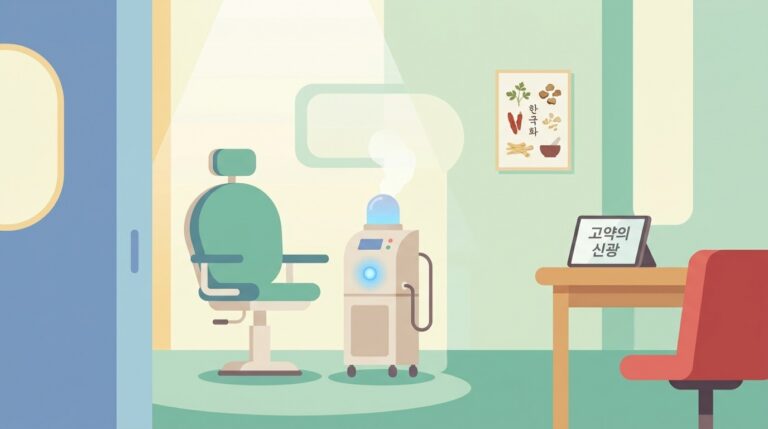
You walk into a sparkling clean clinic in Hongdae or Gangnam, take a number, and sit in the futuristic examination chair under bright surgical lights. The doctor turns toward you with a friendly smile and asks: “어디가 불편하세요?” (What seems to be the trouble?) You open your mouth to explain your misery, but your mind goes blank. In textbook Korean, you only learned “감기에 걸렸어요” (I caught a cold) or “머리가 아파요” (My head hurts). But this isn’t just a regular cold—your nose is like a sealed vault, and mouth-breathing has left your oral cavity completely parched!
You end up pointing at your nose and whispering, “코… 아파요…” (Nose… hurts…), while the doctor tilts their head, trying to decipher your exact symptoms.
Don’t worry! Every foreign resident and traveler in Korea has faced this exact hurdle. South Korea’s seasonal shifts (환절기) and yellow dust (황사) make allergic rhinitis a national shared experience. The good news? Korean ENT clinics are fast, affordable, and world-class. Today, I’m going to equip you with the exact natural phrases native speakers use to describe blocked sinuses and a bone-dry mouth so you can get the right spray, medication, and steam treatment within minutes.
Phase 2: 핵심 표현 3선 심층 분석 (Top 3 Key Expressions)
1. 코가 꽉 막혔어요 (Ko-ga kkwak ma-khyeo-sseo-yo)
- Pronunciation: [Ko-ga kkwak ma-kyeo-sseo-yo] (Sound tip: ‘kkwak’ starts with a sharp, tight ‘kk’ like the snap in ‘quick’, followed by a punchy duck-quack sound)
- Meaning: Literally: “My nose is tightly blocked.” vs. Real Nuance: “Both of my nostrils are completely stuffed up / I cannot breathe through my nose at all.”
- K-Culture Moment: You’ll see this constantly in reality shows like I Live Alone (나 혼자 산다) whenever a celebrity wakes up during seasonal transitions, sniffling into a box of tissues.
- Editor’s Insight: The magic word here is 꽉 (kkwak). It is a mimetic word describing something packed to maximum capacity with zero wiggle room—like a packed subway train at Sindorim station. Adding 꽉 turns a generic symptom into an unmistakable cry for decongestant relief!
- Situation Spectrum:
- Casual (Friends): 코 꽉 막혔어 (⚠️ Only close peers)
- Semi-formal (Polite standard): 코가 꽉 막혔어요 (✅ Perfect for the clinic desk and doctor)
- Formal (Official setting): 코가 꽉 막혔습니다 (✅ Highly polite)
- 🤔 Think About It: English uses the passive adjective “congested” or “stuffed,” whereas Korean treats the nose as the subject undergoing a blockage (막히다). Does phrasing your body parts as active subjects make it easier to pinpoint sensations?
2. 입으로 숨 쉬니까 입안이 바짝 말라요 (Ib-eu-ro sum swi-ni-kka ib-an-i ba-jjak mal-la-yo)
- Pronunciation: [Ib-eu-ro soom-swi-ni-kka ib-an-i ba-jjak mal-la-yo] (Sound tip: ‘ba-jjak’ sounds like a crisp, dry twig snapping: ‘bah-jjak’)
- Meaning: Literally: “Because I breathe with mouth, inside mouth is crackling dry.” vs. Real Nuance: “Breathing through my mouth has made my mouth bone dry.”
- K-Culture Moment: Often heard in historical K-dramas (사극) when a weary traveler walks across a sun-scorched desert, begging for a sip of water.
- Editor’s Insight: Notice 바짝 (ba-jjak). Just like 꽉, 바짝 is a vivid sensory adverb representing extreme dehydration—like leaves curling up in autumn or laundry drying under the sweltering summer sun. It immediately tells the physician that your mucous membranes are suffering.
- Situation Spectrum:
- Casual: 입으로 숨 쉬니까 입안이 바짝 말라 (⚠️ Close friends only)
- Semi-formal: 입으로 숨 쉬니까 입안이 바짝 말라요 (✅ Recommended for doctors)
- Formal: 입으로 숨을 쉬어 구강이 바짝 마릅니다 (✅ Medical report style)
- 🤔 Think About It: English speakers describe this sensation as “parched” or “cotton-mouthed.” How does Korean’s reliance on sound-symbolic adverbs (의태어) convey physical agony more colorfully?
3. 알레르기 비염인 것 같아요 (Al-le-reu-gi bi-yeom-in geot ga-ta-yo)
- Pronunciation: [Al-le-reu-gi bi-yeom-in geot gah-tah-yo] (Sound tip: Pronounce ‘알레르기’ as ‘Ahl-leh-reu-gee’, similar to the German pronunciation ‘Allergie’)
- Meaning: Literally: “It seems to be allergy rhinitis.” vs. Real Nuance: “I suspect I have an allergic rhinitis flare-up.”
- K-Culture Moment: Every April on YouTube daily vlogs, Korean creators hold up packs of saline flushes and antihistamines, saying this exact line to their subscribers.
- Editor’s Insight: Notice the ending ~인 것 같아요 (~in geot gat-a-yo / it seems like). In Korean medical etiquette, stating a diagnosis bluntly as a patient (“알레르기 비염이에요!” – It is allergic rhinitis!) can sound presumptuous. Softening it with “I think it might be…” demonstrates modesty and invites the doctor to validate your hunch.
- Situation Spectrum:
- Casual: 알레르기 비염인 것 같아 (⚠️ Friends)
- Semi-formal: 알레르기 비염인 것 같아요 (✅ Ideal consultation phrase)
- Formal: 알레르기 비염으로 사료됩니다 (🚫 Overly archaic for conversation)
- 🤔 Think About It: Why does Korean conversation favor hedging expressions (~것 같아요) even when people are completely certain about what they feel?
Phase 3: 교과서 한국어 vs 진짜 한국어 (Textbook vs. Real Korean)
Situation 1: Telling the doctor your nose is completely obstructed
- 📖 교과서 한국어 (Textbook Korean): 비강이 완전히 폐쇄되었습니다. (Bi-gang-i wan-jeon-hi pye-swae-doe-eot-seum-ni-da. / “The nasal cavity is completely occluded.”)
- 🗣️ 진짜 한국어 (Real Korean): 코가 양쪽 다 꽉 막혔어요. (Ko-ga yang-jjok da kkwak ma-khyeo-sseo-yo. / “Both sides of my nose are completely stuffed up.”)
- 💡 왜 다를까? (Why is it different?): Textbook phrases often translate medical jargon literally. Real Koreans focus on subjective, everyday functional discomfort (양쪽 다 = both sides, 꽉 = totally).
Situation 2: Asking for a nasal spray prescription
- 📖 교과서 한국어 (Textbook Korean): 비강 분무용 스테로이드제를 처방해 주십시오. (Bi-gang bun-mu-yong seu-te-ro-i-deu-je-reul cheo-bang-hae ju-sip-si-o. / “Please prescribe a nasal spray steroid agent.”)
- 🗣️ 진짜 한국어 (Real Korean): 코에 뿌리는 스프레이도 처방해 주실 수 있나요? (Ko-e ppu-ri-neun seu-peu-re-i-do cheo-bang-hae ju-sil su in-na-yo? / “Could you also prescribe a spray I can use in my nose?”)
- 💡 왜 다를까? (Why is it different?): Native speakers use descriptive action verbs (코에 뿌리는 = spraying into the nose) rather than technical terminology when talking to healthcare providers.
Phase 4: K-Culture 딥다이브 & 비언어적 매너 (K-Culture Deep Dive & Non-Verbal Manners)
4-1. 눈치 (Nunchi) & Clinic Etiquette
- The Examination Chair Dance: When summoned to the doctor’s futuristic swivel chair, sit all the way back. Do not lean forward toward the doctor. Wait until the doctor says “고개 살짝만 들어보세요” (Please lift your head slightly) before tilting your chin up.
- Suction Courtesy: The doctor will likely insert an aspirator (석션 – suction tool) to clear out the mucus. It makes a loud whirring sound and feels ticklish or mildly shocking. Never jerk your head away! If it stings, gently raise your right hand slightly off your lap—this is the universal Korean clinic signal for discomfort.
- Post-Treatment Bow: Always give a 15-degree seated bow and say “감사합니다” (Thank you) before stepping down from the examination platform.
4-2. The Inhalation Therapy Phenomenon
In Korean ENT clinics, walking out of the consultation room isn’t the end of your visit! You will almost always be directed to the 호흡기 치료실 (Nebulizer / Inhalation Therapy Station). You sit in front of a tabletop machine, press a button, and breathe in soothing, medicated warm steam through a plastic nosepiece for three minutes. It is a signature ritual of Korean clinical efficiency that helps open up your sinuses before you even reach the pharmacy downstairs!
Phase 5: 실전 롤플레이 시나리오 (Real-World Roleplay Scenario)
Setting: A bustling ENT clinic near Sinchon Station. Dr. Park (박 원장님), a calm and experienced specialist, examines you.
- Turn 1 (Dr. Park): 어디가 불편해서 오셨어요?
(Eo-di-ga bul-pyeon-hae-seo o-syeo-sseo-yo? / What brought you in today?) - Turn 2 (You):
🎭 Sniffling while pointing lightly to your nose
코가 양쪽 다 막혀서 숨쉬기가 너무 힘들어요.
(Ko-ga yang-jjok da ma-khyeo-seo sum-swi-gi-ga neo-mu him-deul-eo-yo. / Both nostrils are blocked, so it is really hard to breathe.) - Turn 3 (Dr. Park): 언제부터 그러셨어요? 재채기나 콧물도 나나요?
(Eon-je-bu-teo geu-reo-syeo-sseo-yo? Jae-chae-gi-na kot-mul-do na-na-yo? / Since when? Are you also sneezing or having a runny nose?) - Turn 4 (You):
🎭 Swallowing dryly and gesturing towards throat
며칠 됐어요. 입으로 숨을 쉬니까 입안이 바짝 말라요.
(Myeo-chil dwaet-seo-yo. Ib-eu-ro sum-eul swi-ni-kka ib-an-i ba-jjak mal-la-yo. / It’s been a few days. Breathing through my mouth makes my mouth bone dry.) - Turn 5 (Dr. Park): 코안을 한번 볼게요. 고개 살짝만 들어보세요.
(Ko-an-eul han-beon bol-ge-yo. Go-gae sal-jjak-man deul-eo-bo-se-yo. / Let me take a look inside your nose. Tilt your head up slightly, please.) - Turn 6 (You):
🎭 Tilting head slightly upward and relaxing shoulders
네, 원장님.
(Ne, won-jang-nim. / Yes, doctor.) - Turn 7 (Dr. Park): 점막이 많이 부었네요. 알레르기 비염이에요. 코 치료하고 약 처방해 드릴게요.
(Jeom-mag-i man-i bu-eot-ne-yo. Al-le-reu-gi bi-yeom-i-e-yo. Ko chi-ryo-ha-go yak cheo-bang-hae deu-ril-ge-yo. / The mucous lining is quite swollen. It’s allergic rhinitis. We’ll do a local nose treatment and prescribe medicine.) - Turn 8 (You):
🎭 Nodding gratefully
감사합니다. 졸리지 않은 약으로 부탁드려요!
(Gam-sa-ham-ni-da. Jol-li-ji an-eun yag-eu-ro bu-tak-deu-ryeo-yo! / Thank you. Could you please make sure the medicine is non-drowsy!)
🔀 인터랙티브 분기점 (Interactive Decision Point)
At Turn 8, the doctor asks if you have work or classes today. How do you respond?
* Option A: “졸리지 않은 약으로 처방해 주실 수 있나요?” (Could you prescribe non-drowsy medicine?)
👉 [BEST] Doctors love this specific request! Allergy pills (antihistamines) are notorious for causing drowsiness in Korea. Asking for 졸리지 않은 약 ensures you stay alert.
* Option B: “항생제 제일 센 걸로 바로 주세요!” (Give me the strongest antibiotics right away!)
👉 [RISK] Allergic rhinitis is an allergic inflammation, not a bacterial infection. Demanding strong antibiotics makes you look demanding and medically uninformed.
* Option C: “그냥 참아볼 테니 약은 안 주셔도 돼요.” (I’ll just endure it, so no medicine needed.)
👉 [BAD] If you walk away without treatment, your nasal membranes will remain swollen, making mouth-breathing worse and causing secondary throat infections!
Phase 6: 10초 감정 섀도잉 드릴 (10-Second Emotion Shadowing Drill)
Practice reading these out loud with rhythm pauses (/) and matching facial expressions!
[🥺 Exhausted & completely stuffed up tone]
코가 / 양쪽 다 막혀서 / 숨을 못 쉬겠어요.
(Ko-ga / yang-jjok da ma-khyeo-seo / sum-eul mot swi-get-seo-yo. / Both nostrils / are blocked, / so I cannot breathe.)-
[😮💨 Desperately dry & weary tone]
입으로 숨을 쉬니까 / 입안이 / 바짝 말라요.
(Ib-eu-ro sum-eul swi-ni-kka / ib-an-i / ba-jjak mal-la-yo. / Because I breathe through my mouth, / the inside of my mouth / gets bone dry.) -
[🙏 Polite & hopeful request tone]
코에 뿌리는 스프레이도 / 같이 처방해 주세요.
(Ko-e ppu-ri-neun seu-peu-re-i-do / ga-chi cheo-bang-hae ju-se-yo. / The nasal spray too, / please prescribe it together.)
Phase 7: K-Culture 미니 사전 (Mini Dictionary)
- 비염 (Bi-yeom) | Allergic Rhinitis
Usage: The most common diagnosis in Korea between March and May. If your nose runs or blocks up seasonally, you have 비염. - 환절기 (Hwan-jeol-gi) | Seasonal Transition Period
Usage: Refers to the weeks between seasons (winter-spring, summer-autumn) when massive day-and-night temperature swings wreck immune systems. - 코세척 (Ko-se-cheok) | Nasal Saline Irrigation
Usage: You will see plastic nasal wash bottles sold at every Korean pharmacy. Doctors frequently recommend 코세척 twice a day for rhinitis. - 처방전 (Cheo-bang-jeon) | Prescription Slip
Usage: The paper handed to you at the clinic reception counter. You must carry this to the pharmacy (약국) located on the first floor of the same building.
Phase 8: 여행자를 위한 생존 키트 (Traveler’s Survival Kit)
Survival Expressions TOP 3
- 비염약 주세요. (Bi-yeom-yak ju-se-yo.)
Meaning: “Please give me rhinitis/allergy medicine.”
Pro Tip: Use this at any pharmacy if you don’t have time to see a doctor. - 목도 칼칼해요. (Mok-do kal-kal-hae-yo.)
Meaning: “My throat feels scratchy and irritated too.”
Pro Tip: Excellent addition when mouth-breathing has irritated your pharynx. - 하루에 몇 번 먹어요? (Ha-ru-e myeot beon meog-eo-yo?)
Meaning: “How many times a day do I take this?”
Pro Tip: Ask the pharmacist when collecting your pill packets.
Editor’s Travel Note
- Finding an English-Friendly Clinic: Download the 네이버 지도 앱 (Naver Map App) and search for “이비인후과” (ENT). Clinics inside major hubs like Hongdae, Itaewon, or Gangnam almost always have doctors who speak conversational English.
- No Appointment Needed: Unlike Western medical systems where you wait weeks for a specialist, 90% of Korean ENT clinics accept walk-ins (당일 접수). Arrive, show your passport or Alien Registration Card (ARC), and you will usually see a doctor within 15–30 minutes!
Phase 9: “한 발 더 깊이” (Cultural Insight)
In Korea, visiting a clinic is not reserved for emergencies; it is an act of routine self-maintenance. This is partly driven by the ultra-efficient National Health Insurance system and the fast-paced 빨리빨리 (hurry-hurry) culture, which prioritizes immediate symptom alleviation so individuals can return to work or study without downtime. Calling your doctor 원장님 (Won-jang-nim — Director/Head Doctor) rather than simply 의사 선생님 (Doctor) acknowledges their role as both medical healer and manager of their private clinic practice. Embracing this communal care style allows you to tackle health issues before they escalate.
💬 Your Turn: Have you ever experienced a sudden allergy attack in a foreign country? How do you describe nasal congestion in your native tongue? Share your story in the comments below!
Phase 10: FAQ & 오해 방지 (FAQ Schema)
Q: Do I need private medical insurance or Korean national insurance to go to an ENT clinic?
A: No! Even without Korean National Health Insurance (NHIS), foreign tourists can walk in. An uninsured consultation plus local nasal treatment typically costs only 25,000 to 40,000 KRW (approx. $20–$30 USD)—astonishingly affordable compared to many Western countries.
Q: What should I do with the paper prescription after seeing the doctor?
A: Do not leave the building! In Korea, medical clinics and pharmacies are legally separated. Take your prescription paper (처방전) to the pharmacy (약국), which is almost always situated right on the 1st floor or basement of the same building.
Q: What is the warm mist machine I was told to sit in front of after my checkup?
A: That is a nebulizer/inhalation treatment (네블라이저). It delivers fine saline mist and mild anti-inflammatory agents directly into your respiratory passages to soothe dried-out tissues. It takes 2 to 3 minutes and is completely painless!
🚨 흔한 실수 (Common Mistakes) Warning
- Mistake: Telling the doctor “코가 아파요” (My nose hurts).
Correction: If it’s blocked, say “코가 막혀요”. 아파요 implies physical trauma or a wound on your nose. - Mistake: Translating “dry mouth” literally into “입이 건조해요”.
Correction: While understandable, native speakers virtually always say “입안이 바짝 말라요”. - Mistake: Leaving the clinic without saying anything when allergy pills make you sleepy.
Correction: Always ask: “졸리지 않은 약으로 주세요” (Please give me non-drowsy pills).
Phase 11: 액션 미션 & 참여 유도 (Action Missions)
- 🥉 Bronze Mission (Solo Practice): Stand in front of your bathroom mirror and repeat “코가 꽉 막혔어요” 5 times with exaggerated facial relief at the end.
- 🥈 Silver Mission (Social Engagement): Snap a photo of your mug of warm water or humidifier and post it on your Instagram Story with the caption: “입안이 바짝 말라요 💧 #DailyHangul #KoreanStudy”.
- 🥇 Gold Mission (Real Life Action): Next time you step into a Korean pharmacy or clinic, use the phrase “코가 막혀서 그러는데 스프레이 하나 주세요” to purchase a saline nasal spray directly!
🎮 K-Culture Mission: Watch an episode of a Korean travel variety show like 2 Days & 1 Night (1박 2일). Spot how cast members speak with a nasal voice (비음) when camping outdoors in the cold, and listen for the word 코막힘 (stuffy nose)!
Phase 12: 인터랙티브 퀴즈 챌린지 (Interactive Quiz Challenge)
Test your knowledge before your next clinic visit!
1. Situation Judgment: You wake up with completely shut nostrils and need to describe the blockage vividly. Which word belongs in the blank?
“코가 [ ] 막혔어요.”
(A) 활짝 (Hwal-jjak)
(B) 꽉 (Kkwak)
(C) 번쩍 (Beon-jjeok)
2. Fill in the Blank: Which word vividly describes an intensely parched, dried-out mouth?
“입으로 숨을 쉬니까 입안이 [ ] 말라요.”
3. True or False: In Korea, you must always make an advance hospital reservation at least one week ahead to visit an ENT specialist.
👉 Click to Reveal Answers and Explanations!
- Answer: (B) 꽉 (Kkwak)
Explanation: 꽉 describes something crammed tight with no space. (A) 활짝 means wide open (like a flower or window), and (C) 번쩍 means flashing or lifting abruptly. -
Answer: 바짝 (Ba-jjak)
Explanation: 바짝 describes crisp, extreme dryness. Combined with 말라요 (dries up), it perfectly expresses a bone-dry mouth. -
Answer: False (X)
Explanation: Almost all neighborhood ENT clinics (이비인후과) in Korea welcome walk-ins on the same day without any prior reservation!
🎬 Watch Our Daily Videos! (Daily Hangul Official Instagram)
Review the expressions you learned in this article with our fun daily short videos! Check out native pronunciation and real-life nuances in action.
- Instagram @dailyhangul_en







