

Phase 1: Empathy (Story-Immersive Opening)
안녕하세요! 매일한글 에디터입니다.
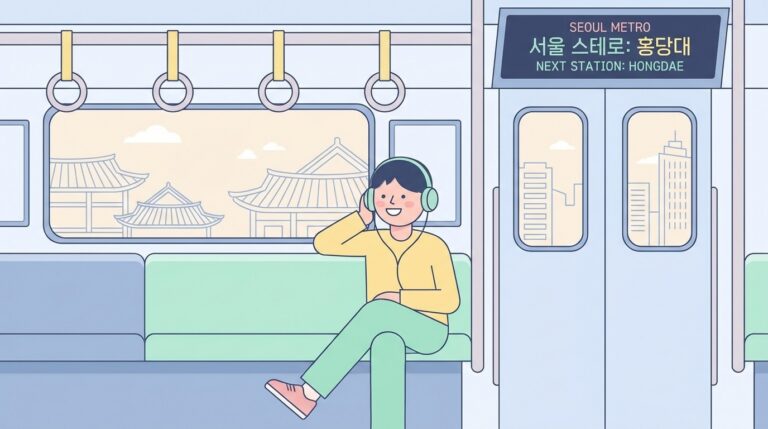
Picture this: You are on Seoul Subway Line 2 during evening rush hour. You’ve had an amazing day exploring Hongdae, eating street tteokbokki, and soaking in the neon vibes. You pull out your phone to watch the latest episode of your favorite K-drama while standing in a packed train car. You press play, but horror strikes—your wireless earbuds did not connect. Suddenly, dramatic romance background music and an impassioned actor’s voice blast through the dead-silent car.
Instantly, ten heads turn. You feel the laser-focused gazes of tired commuters, university students, and an ajumma (middle-aged lady) peering over her glasses right at you. Your cheeks flush hot, your fingers fumble across your phone screen, and you don’t even know what to whisper to break the awkward silence. Did you just commit the ultimate cultural crime?
Take a deep breath! As someone who has commuted on Seoul transit for over a decade, I can tell you that almost every foreign resident and traveler has experienced this exact panic. Korean public transit is world-class, clean, and amazingly efficient, but it also has an unspoken golden rule: shared silence. When you learn how to handle transit etiquette and the right phrases, you won’t just avoid awkward stares—you’ll travel with genuine confidence, earning warm smiles and respect from locals along the way.
Phase 2: Top 3 Core Expressions Deep-Dive
1. 이어폰을 착용해 주세요 (I-eoponeul chagyonghae juseyo)
- Pronunciation: [ee-uh-pon-eul cha-gyong-hae joo-seh-yo] (Think of ‘earphone’ with a soft Korean bounce: ee-uh-pon, followed by ‘cha-gyong-hae’, which rhymes with ‘cha-cha’ and ‘song’, ending in the polite ‘joo-seh-yo’)
- Meaning: Literal: “Please wear earphones” | Real nuance: A polite, official request often heard in transit announcements or politely nudged when personal audio is leaking.
- K-Culture Moment: You’ll hear this gentle chime-backed automated announcement right after boarding KTX bullet trains or on digital screens inside Seoul Metro trains.
- Editor’s Insight: The verb 착용하다 (chagyonghada) specifically means “to wear/put on gear or accessories” like earphones, seatbelts, or masks. In daily spoken Korean, locals often swap it with 꽂아주세요 (kkoja-juseyo – “please plug it in”).
- Situation Spectrum: Casual 🚫 | Semi-formal ✅ | Formal ✅
- 🤔 Think About It: In many Western countries, playing music at a moderate volume is considered an individual choice. Why do you think Korean public signs treat wearing earphones as a communal duty rather than a personal preference?
2. 조용히 해 주세요 (Joyonghi hae juseyo)
- Pronunciation: [jo-yong-hee hae joo-seh-yo] (Sounds like ‘Joe’ + ‘young-he’ + ‘hae joo-seh-yo’)
- Meaning: Literal: “Please do quietly” | Real nuance: “Please lower your voice / Please keep it down.”
- K-Culture Moment: Seen frequently in K-dramas where characters study late at night inside quiet study cafes (dokseosil) or when passengers speak too loudly on late-night transit buses.
- Editor’s Insight: This phrase is very direct. Even though it ends in the polite ~해 주세요 (~hae juseyo), hearing a stranger say this indicates that people around you are actively disturbed. If someone says this to you, a quick nod and lowering your volume immediately resolves the situation.
- Situation Spectrum: Casual ⚠️ | Semi-formal ✅ | Formal ⚠️
- 🤔 Think About It: Notice how the sentence asks you to act quietly rather than saying “stop talking.” How does framing requests around calm behavior soften the blow in Korean communication?
3. 죄송합니다 (Joesonghamnida)
- Pronunciation: [jweh-song-ham-nee-da] (Sounds like ‘Jweh-song’ + ‘hum-knee-da’)
- Meaning: Literal: “I am sorry” | Real nuance: The ultimate, most respectful social eraser for public slip-ups.
- K-Culture Moment: Every time a character bumps shoulders in a crowded metro scene in Seoul, this is the instant, bowed-head reflex phrase.
- Editor’s Insight: For A1 learners, never hesitate with this word. If your phone accidentally blares audio, saying “죄송합니다!” with a small 15-degree head bow instantly shows you understand the etiquette and didn’t mean to be disruptive.
- Situation Spectrum: Casual ⚠️ (too stiff for close friends) | Semi-formal ✅ | Formal ✅
- 🤔 Think About It: Why does Korean have distinct apology levels (미안해 vs 죄송합니다) while English uses “I’m sorry” for everything from spilling coffee to tragic news?
Phase 3: Textbook Korean vs Real Korean
Situation 1: Asking someone to plug in earphones
- 📖 교과서 한국어 (Textbook): 대중교통 내에서는 이어폰을 필히 착용하십시오. (Daejung-gyotong nae-eseoneun i-eoponeul pilhi chagyonghasipsio.) – “You must certainly wear earphones inside public transit.”
- 🗣️ 진짜 한국어 (Real-life): 이어폰 끼고 들어주세요. (I-eopon kkigo deureojuseyo.) / 소리 조금만 줄여주세요. (Sori jogeumman juryeojuseyo.) – “Please listen with earphones.” / “Could you lower the sound just a bit?”
- 💡 왜 다를까? (Why the difference?): Official written signs use stiff imperative grammar (~하십시오). Real people soften requests using soft requests (~주세요) and polite diminishers like 조금만 (just a little) to prevent confrontation.
Situation 2: When your phone audio goes off by mistake
- 📖 교과서 한국어 (Textbook): 소음을 일으켜 대단히 실례했습니다. (Soeumeul ireukyeo daedanhi sillye-haessseumnida.) – “I have caused a great discourtesy by making noise.”
- 🗣️ 진짜 한국어 (Real-life): 어머, 죄송합니다! (Eomeo, joesonghamnida!) – “Oh my, I’m so sorry!”
- 💡 왜 다를까? (Why the difference?): Nobody speaks like a 19th-century diplomat in daily life. An involuntary reaction like Eomeo (Oh gosh!) combined with a sincere Joesonghamnida signals genuine human error.
Phase 4: K-Culture Deep-Dive & Non-Verbal Manners
4-1. 눈치 (Nunchi) & Body Language on Korean Transit
In Korea, transit vehicles (subways, city buses, intercity coaches) are treated as collective quiet zones. People sleep, read webtoons, or decompress after intense work shifts.
* The Screen Tilt: If you watch videos, tilt your phone toward your chest so bright flickering screens don’t blind the person sitting opposite you.
* The Double-Check Gesture: Before tapping play on a video, visibly check that the Bluetooth icon is paired. If you accidentally leak sound, immediately clasp your hand over the phone’s bottom speaker while bowing your head slightly. This non-verbal gesture shows instant accountability.
4-2. Cultural Code: The Sanctuary of “퇴근길” (The Commute Home)
In hit dramas like My Liberation Notes, subway cars are depicted as quiet spaces where exhausted souls carry the weight of their daily grind. Korean public transit isn’t just transport; it is a mental buffer between demanding corporate workspaces and home. Disrupting that quiet with TikTok audio or loud speakerphone calls isn’t seen as minor background noise—it’s felt as an intrusion into people’s rare moments of personal peace.
Phase 5: Real-Life Roleplay Scenario
- Setting: Inside Seoul Subway Line 9 during peak evening hours. The train is humming quietly.
- Characters: You (an eager traveler) and Min-jun (a kind 20-something local commuter standing beside you).
- You: 🎭 Tapping your phone screen to start a travel vlog video, unaware your Bluetooth disconnected.
영상 봐야지! (Yeongsang bwayaji! / “Time to watch my video!”) - Sound from phone: 🔊 [Blares high-tempo K-Pop intro music throughout the silent train car]
- Min-jun: 🎭 Gently widens his eyes, leans slightly in, and points politely at your phone.
저기요, 소리 나요! (Jeogiyo, sori nayo! / “Excuse me, the sound is coming out!”) - You: 🎭 Panicking, quickly pressing the volume-down button.
어머! 안 돼요! (Eomeo! An dwaeyo! / “Oh no! It shouldn’t be!”) - Min-jun: 🎭 Gives a friendly, understanding smile and whispers.
이어폰 연결 안 된 것 같아요. (I-eopon yeongyeol an doen geot gat-ayo. / “I think your earphones aren’t connected.”) - You: 🎭 Instantly plugging in your wired earphones and bowing head lightly.
아, 정말 죄송합니다! 몰랐어요. (A, jeongmal joesonghamnida! Mollasseoyo. / “Ah, I’m truly sorry! I didn’t know.”) - Min-jun: 🎭 Waves his hand gently downward in a calming gesture.
괜찮아요. 대중교통에선 소리가 잘 울려요. (Gwaenchanayo. Daejung-gyotong-eseon soriga jal ullyeoyo. / “It’s okay. Sound echoes easily on public transit.”) - You: 🎭 Smiling gratefully in relief.
알려주셔서 감사합니다! (Sallyeojusyeoseo gamsahamnida! / “Thank you for letting me know!”)
🔀 Interactive Choice Point
What should you do right after your phone accidentally makes loud noise on the train?
* Option A: Pretend it wasn’t you and stare intently at the subway route map.
* Option B: Turn down the volume immediately, make brief eye contact, bow your head slightly, and say: “죄송합니다!” (Joesonghamnida!)
* Option C: Laugh out loud and show the funny video to the commuter next to you to lighten the mood.
- Feedback:
- Option A (Risk): People already know where the sound came from. Silence without an apology feels dismissive in collective Korean culture.
- Option B (Best): 🌟 Perfect! It demonstrates quick Nunchi (social awareness), immediate action, and cultural politeness.
- Option C (Bad): 🚫 Invading personal boundaries when strangers just want quiet will only multiply the awkwardness.
Phase 6: 10-Second Emotional Shadowing Drill
Follow the rhythm marks (/) and embody the emotion tags as you read aloud:
[🥺 당황하며 깜짝 놀란 목소리로]
어머! / 소리가 왜 나오지? (Eomeo! / soriga wae na-oji? / “Oh gosh! / Why is the sound playing?”)-
[🙏 진심으로 미안함을 담아 정중하게]
죄송합니다, / 바로 끌게요! (Joesonghamnida, / baro kkeulgeyo! / “I am sorry, / I will turn it off right away!”) -
[😊 안도하며 감사를 전하듯 상냥하게]
이어폰 꼈어요, / 감사합니다! (I-eopon kkkyeosseoyo, / gamsahamnida! / “I put my earphones on, / thank you!”)
Phase 7: K-Culture Mini Dictionary
- 이어폰 (I-eopon) | Noun: Earphones / Earbuds
The essential transit accessory. In Korea, wireless earbuds like Galaxy Buds or AirPods are universally expected during your commute. - 대중교통 (Daejung-gyotong) | Noun: Public Transportation
Refers collectively to subways, buses, and trains. Korea’s transit system is celebrated for cleanliness and strict public etiquette norms. - 매너모드 (Maeneomodeu) | Noun: Manner Mode (Vibrate/Silent)
Konglish at its finest! It means setting your smartphone to vibrate or silent. Transit signs always remind passengers: “휴대폰은 매너모드로” (Keep phones in Manner Mode). - 눈치 (Nunchi) | Noun: Situational quick-wittedness / Social antenna
The intuitive ability to read the room. On the metro, good nunchi means observing how quiet the car is and matching that energy.
Phase 8: Survival Kit for Travelers
Top 3 Survival Phrases
- 1. 소리 줄여주세요 (Sori juryeojuseyo) – “Please lower the sound.”
Pro Tip: If someone next to you has sound leaking heavily from their tablet, you can say this gently with a polite smile. - 2. 몰랐어요, 죄송합니다 (Mollasseoyo, joesonghamnida) – “I didn’t know, I’m sorry.”
Pro Tip: Your golden ticket whenever you accidentally make an etiquette blunder. - 3. 블루투스 연결됐어요? (Beullutuseu yeongyeoldwaesseoyo?) – “Is Bluetooth connected?”
Pro Tip: Great for asking your travel buddy before you both press play on a movie.
Editor’s Travel Note
- Essential Navigation Apps: Never get lost on Seoul’s complex underground labyrinth. Download the 네이버 지도 앱 다운로드 (Naver Map App) or install 카카오지하철 앱 설치 for precise, real-time car arrival updates and quiet-car indicators.
- Transit Courtesy Habit: Before boarding, toggle your phone to 매너모드 (Manner Mode). If you receive an urgent phone call, keep your hand cupped around your mouth and whisper: “지금 지하철이라서 이따 전화할게요” (I’m on the subway now, so I’ll call you later).
Phase 9: “One Step Deeper” (Cultural Reflection)
In Korean society, shared physical space is guided by the philosophy of 배려 (Baeryeo – Consideration) and the dread of being labeled 민폐 (Minpye – A public nuisance). Because Seoul is a hyper-dense metropolis where millions live and commute in close quarters, shared quiet is considered an essential public good. Silence is not coldness; rather, it is the community’s way of granting each other invisible personal space amidst the crowd.
💬 Your Turn: Have you ever had your phone accidentally go off in a quiet public place back home? How do people in your country react compared to Korea? Share your story in the comments below!
Phase 10: FAQ & Avoiding Misunderstandings
Q: Can I take phone calls on the Korean subway?
A: Quick, whispered calls (under 30 seconds) are acceptable if you cup your microphone. However, prolonged conversations—especially on speakerphone—are strictly considered bad etiquette. Most locals whisper that they will call back soon.
Q: Does the sign “휴대폰은 매너모드로” mean I cannot listen to music at all?
A: Not at all! You are free to enjoy music, podcasts, and K-dramas. It simply means your phone’s ringer should be muted and you must wear earphones without significant audio leakage.
Q: What if an elderly person speaks loudly on the subway? Why doesn’t anyone stop them?
A: In Korean Confucian-rooted culture, younger generations show deep deference to elders. Even when seniors occasionally break transit etiquette, commuters generally exercise patience rather than creating direct public confrontation.
🚨 Common Mistakes Warning Board
- Mistake: Taking a speakerphone call because your hands are full of shopping bags.
Correct Action: Send a quick text or wait until you step onto the station platform. - Mistake: Hanging earphones around your neck with music still blasting.
Correct Action: Turn the music off or keep the earbuds securely inside your ears. - Mistake: Loudly practicing Korean pronunciation drills on the subway.
Correct Action: Practice silently using your inner voice, and save your vocal drills for your room!
Phase 11: Action Missions & Community Engagement
- 🥉 Bronze Mission (Solo Practice): Say “죄송합니다, 몰랐어요!” out loud three times in front of your mirror with a polite 15-degree bow.
- 🥈 Silver Mission (Social Share): Check your phone settings today and learn how to quickly switch to “Manner Mode” with one swipe. Share a screenshot of your transit playlist in our Daily Hangul study group!
- 🥇 Gold Mission (Real-Life Application): Next time you step onto public transit, take note of the quietness. Put on your earphones before you even step through the train doors, just like a true local Seoulite.
🎮 K-Culture Mission: Watch any scene from a modern K-drama set on the Seoul metro (like Extraordinary Attorney Woo). Spot whether the protagonist uses noise-canceling headphones and observe how other commuters behave in the background!
Phase 12: Interactive Quiz Challenge
1. Situational Judgment:
You are on a quiet bus in Busan. You want to watch a YouTube vlog, but you left your earphones at the hotel. What should you do?
(A) Play it on the lowest possible speaker volume.
(B) Turn on English subtitles and watch the video on mute.
(C) Ask the passenger next to you if they mind listening too.
2. Fill-in-the-Blank:
대중교통 안에서는 ________을(를) 착용해 주세요.
(In public transit, please wear ________.)
Hint: The Korean word for earphones!
3. True or False:
“매너모드 (Manner Mode)” in Korea refers to setting your phone to silent/vibrate. (T / F)
👉 Click here to reveal the answers and explanations!
- Answer: (B) – Watching on mute with subtitles is the ultimate pro-traveler move! Even low speaker audio carries easily in quiet Korean buses.
- Answer: 이어폰 (I-eopon) – Full sentence: 대중교통 안에서는 이어폰을 착용해 주세요. (Please wear earphones on public transit.)
- Answer: True (T) – “매너모드” is widely recognized across Korea as silent or vibrate mode to respect communal spaces.
🎬 Watch Our Daily Videos! (Daily Hangul Official Instagram)
Review the expressions you learned in this article with our fun daily short videos! Check out native pronunciation and real-life nuances in action.
- Instagram @dailyhangul_en







