

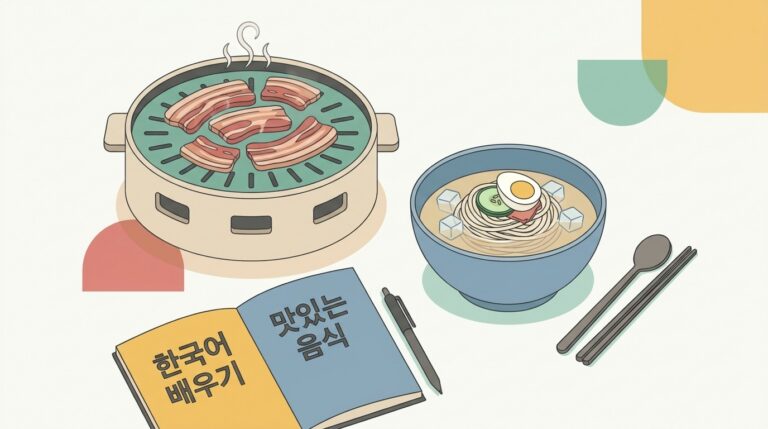
Never Eat Cold Noodles Alone: The Secret K-BBQ Phrase Every Local Uses
Phase 1: Empathy & Story-driven Opening
안녕하세요! I am your Daily Hangul editor and local culture navigator! Imagine this scene: you are sitting inside a bustling, neon-lit Korean BBQ restaurant in Mapo, Seoul. The air is thick with the irresistible aroma of sizzling pork belly (samgyeopsal). You flip through the menu and spot “후식 냉면” (husik naengmyeon—after-meal cold noodles). You excitedly order it, thinking you will wrap that hot, caramelized meat around chilled, tangy noodles—the holy grail pairing celebrated in every K-drama feast.
Twenty minutes later, your grill is empty, the heat is turned off, and only then does the server bring your cold noodles to the table. Disappointment hits! In Korea, husik literally translates to “dessert,” so servers customarily bring it at the very end of your meal unless you explicitly specify otherwise. Many of our beginner students tell us, “I tried ordering both, but they came separately!” Don’t worry. Today, you will master the exact magic sentence that bridges hot meat and ice-cold noodles at the perfect moment, elevating your K-BBQ game from tourist level to seasoned local foodie!
Phase 2: In-Depth Analysis of 3 Key Expressions
1. 후식 냉면은 고기랑 같이 지금 가져다주세요 (Husik naengmyeoneun gogirang gachi jigeum gajyeoda-juseyo)
- Pronunciation: [Hu-sik naeng-myeon-eun go-gi-rang ga-chi ji-geum ga-jyeo-da-ju-se-yo] (Sounds like: Who-seek neng-myun-oon go-ghee-rahng gah-chee jee-geum gah-jyor-dah-joo-say-yo)
- Meaning: “Please bring the side cold noodles right now along with the meat.”
- K-Culture Moment: Seen frequently on variety shows like Tasty Guys where hosts insist on immediate noodle delivery so no bite of meat goes unwrapped.
- Editor’s Insight: Husik (후식) denotes a smaller, discounted portion meant to finish the meal. By adding gogirang gachi jigeum (with meat, right now), you overturn the standard course timing politely.
- Situation Spectrum: Casual ✅ | Semi-formal ✅ | Formal ⚠️
- 🤔 Think About It: In many Western dining cultures, courses arrive strictly in sequence (appetizer, entrée, dessert). Why do you think Korean food culture embraces combining dishes across courses simultaneously?
2. 삼겹살 2인분 먼저 주세요 (Samgyeopsal i-inbun meonjeo juseyo)
- Pronunciation: [Sam-gyeop-sal i-in-bun meon-jeo ju-se-yo] (Sounds like: Sahm-gyup-sahl ee-een-boon mun-jyor joo-say-yo)
- Meaning: “Two servings of pork belly first, please.”
- K-Culture Moment: The iconic opening line in every K-drama gathering when characters sit down after a long workday.
- Editor’s Insight: Using meonjeo (먼저 / first) signals to the busy staff that more orders (like stew, noodles, or extra meat) are coming shortly.
- Situation Spectrum: Casual ✅ | Semi-formal ✅ | Formal ✅
- 🤔 Think About It: Notice the counter word inbun (인분 / portion per person). How does ordering by person-count reflect group-oriented dining?
3. 이 고기 지금 먹어도 돼요? (I gogi jigeum meogeodo dwaeyo?)
- Pronunciation: [I go-gi ji-geum meo-geo-do dwae-yo?] (Sounds like: Ee go-ghee jee-geum muh-guh-doh dway-yo?)
- Meaning: “Can I eat this meat now? / Is this meat ready?”
- K-Culture Moment: That suspenseful pause around a grill table when everyone clutches their chopsticks waiting for the server’s green light.
- Editor’s Insight: Rather than asking complex questions about cooking stages, Korean diners simply ask if it’s safe and ready to eat using the permission pattern -do dwaeyo? (Can I…?).
- Situation Spectrum: Casual ✅ | Semi-formal ✅ | Formal ⚠️
- 🤔 Think About It: Pork must be fully cooked, whereas beef can be enjoyed rare. Checking before digging in shows respect for the grill master’s effort!
Phase 3: Textbook Korean vs. Real Korean
Situation 1: Asking for cold noodles during the barbecue
- 📖 교과서 한국어 (Textbook): 냉면을 고기와 함께 제공해 주시겠습니까? (Naengmyeoneul gogiwa hamkke jegonghae jusigesseumnikka? / Would you please provide the cold noodles together with the meat?)
- 🗣️ 진짜 한국어 (Real-life): 냉면 고기랑 같이 바로 주세요! (Naengmyeon gogirang gachi baro juseyo! / Please give us the noodles right away with the meat!)
- 💡 왜 다를까? (Why the difference?): Real BBQ halls are loud and bustling. Overly formal vocabulary like jegonghada (to provide) sounds robotic and gets lost in the sizzle. Short, crisp words like baro (right away) and -rang (with) communicate your appetite instantly!
Situation 2: Inquiring about meat doneness
- 📖 교과서 한국어 (Textbook): 고기가 알맞게 익었는지 확인해 주십시오. (Gogiga almatge igeonneunji hwaginhae jusipsio. / Please verify whether the meat is cooked properly.)
- 🗣️ 진짜 한국어 (Real-life): 다 익었나요? 먹어도 돼요? (Da igeonnayo? Meogeodo dwaeyo? / Is it fully done? Can we eat?)
- 💡 왜 다를까? (Why the difference?): Real Koreans ask directly about readiness using the root ikda (to be cooked/ripe). It creates an upbeat, communal dining atmosphere.
Phase 4: K-Culture Deep Dive & Non-Verbal Manners
4-1. Nunchi & Table Etiquette
When dining at a Korean BBQ venue, never shout loudly across the room. Look around for the discreet call button (haendlleobeol / 벨) attached to the edge of your table. Press it once, wait for the chime, and make brief, pleasant eye contact with your server. If there is no bell, raise your right hand slightly, palm facing slightly inward, and call out a cheerful: 저기요! (Jeogiyo! / Excuse me!).
When scissors (gawi) and tongs (jipge) are in someone else’s hands, do not grab food off the grill until they place a cooked piece on your personal side plate or say it is ready. It is a sign of nunchi (social intuition) to let the designated griller manage the fire.
4-2. The “Yukssam” Phenomenon & Carb Finale
Koreans have elevated meat consumption into an art form known as 육쌈 (Yukssam = meat wrapped around cold noodles). The contrast between steaming, fatty pork belly and freezing, vinegar-infused naengmyeon broth cleanses the palate instantly. In Korea, noodles or fried rice (bokkeumbap) aren’t side items—they are the grand finale carb celebration that signifies a complete, satisfying night out.
Phase 5: Real-World Roleplay Scenario
Setting: A vibrant neighborhood BBQ restaurant in Yeonnam-dong. Smoke rising from golden exhaust pipes.
Characters:
* Alex: A hungry international traveler craving the ultimate pork belly and noodle combo.
* Imo-nim (이모님): The warm, speedy auntie running the grill section.
Turn 1
이모님: 몇 분이세요? 이쪽에 앉으세요!
(Myeot bun-iseyo? I-jjoge anjeuseyo!)
“How many people? Please take a seat right here!”
🎭 Wiping the round metallic table with lightning speed.
Turn 2
Alex: 두 명이에요. 삼겹살 2인분 먼저 주세요!
(Du myeong-ieyo. Samgyeopsal i-inbun meonjeo juseyo!)
“Two of us. Two servings of pork belly first, please!”
🎭 Holding up two fingers with a polite nod.
Turn 3
이모님: 네, 삼겹 2인분 바로 나와요!
(Ne, samgyeop i-inbun baro nawayo!)
“Yes! Two pork bellies coming right out!”
🎭 Placing banchan (side dishes) and fresh lettuce baskets down.
Turn 4
Alex: 저기 이모님, 후식 비빔냉면 하나 고기랑 같이 지금 가져다주세요!
(Jeogi imo-nim, husik bibim-naengmyeon hana gogirang gachi jigeum gajyeoda-juseyo!)
“Excuse me Imo-nim, could you bring one side spicy cold noodle right now along with the meat?”
🎭 Smiling warmly with hands lightly resting at the table edge.
Turn 5
이모님: 어머, 먹을 줄 아네! 고기랑 싸 먹게 바로 갖다줄게!
(Eomeo, meogeul jul ane! Gogirang ssa meokge baro gatdajulge!)
“Oh my, you know how to eat! I’ll bring it right away so you can wrap it with meat!”
🎭 Laughing approvingly and giving a hearty thumbs up.
Turn 6
Alex: 감사합니다! …이모님, 이 고기 지금 먹어도 돼요?
(Gamsahamnida! …Imo-nim, i gogi jigeum meogeodo dwaeyo?)
“Thank you! …Imo-nim, can we eat this meat now?”
🎭 Looking eagerly at the golden, sizzling meat slices.
Turn 7
이모님: 노릇노릇하네. 지금 먹어야 제일 맛있어. 어서 먹어!
(Noreut-noreuthane. Jigeum meogeoya jeil masisseo. Eoseo meogeo!)
“It’s nice and golden brown. It’s best right now. Dig in!”
🎭 Shifting the cooked meat pieces toward the cooler edge of the grill grill plate.
Turn 8
Alex: 잘 먹겠습니다!
(Jal meokgetseumnida!)
“We will eat well!”
🎭 Wrapping a slice of pork belly around the cold spicy noodles.
🔀 Interactive Decision Branch
What if the grill starts smoking heavily while waiting for the noodles?
* Choice A: You shout across the room: “야! 불 꺼!” (Ya! Bul kkeo! / Hey! Put the fire out!)
* Choice B: You press the call bell and say: “불판 좀 갈아주세요.” (Bulpan jom gara-juseyo. / Please change the grill plate.)
* Choice C: You pour your cold water directly onto the coals under the grill grate.
- Choice A Feedback (Bad): Calling an older restaurant owner Ya is deeply disrespectful and will shock the entire restaurant.
- Choice B Feedback (Best!): Professional and polite! Staff will swap the burnt grill plate seamlessly.
- Choice C Feedback (Risk!): Danger! Pouring water creates ash clouds and severe burns. Never pour water on BBQ coals.
Phase 6: 10-Second Emotional Shadowing Drill
Practice matching these rhythm breaks (/) and emotional moods out loud:
[🥢 Hungry and Eager]
후식 냉면은 / 고기랑 같이 / 지금 가져다주세요!
(Husik naengmyeoneun / gogirang gachi / jigeum gajyeoda-juseyo!)-
[😊 Bright and Polite]
삼겹살 2인분 / 먼저 주세요!
(Samgyeopsal i-inbun / meonjeo juseyo!) -
[👀 Curious and Anticipatory]
이 고기 / 지금 먹어도 돼요?
(I gogi / jigeum meogeodo dwaeyo?)
Phase 7: K-Culture Mini Dictionary
- 후식 (Husik / Hoo-seek): Literally “post-meal / dessert.” In K-BBQ contexts, this denotes smaller, budget-friendly servings of cold noodles, soybean paste stew (doenjang-jjigae), or porridge meant to round off your meal.
- 겉바속촉 (Geot-ba-sok-chok / Guht-bah-sok-chok): A beloved culinary portmanteau meaning “Crispy on the outside, juicy on the inside.” The gold standard for grilled Korean pork belly.
- 1인분 (Il-in-bun / Eel-een-boon): One serving/portion. Most traditional BBQ restaurants require an initial minimum order of 2 portions (i-inbun) even if dining solo.
- 쌈싸먹기 (Ssam-ssa-meokgi / Sahm-ssah-muhk-ghee): The act of making an all-in-one wrap with lettuce or perilla leaf, enclosing meat, grilled garlic, ssamjang sauce, and cold noodles.
Phase 8: Survival Kit for Travelers
🧰 Top 3 Survival Expressions at BBQ Joints
- 불판 갈아주세요 (Bulpan gara-juseyo)
Pronunciation: [Bool-pahn gah-rah-joo-say-yo]
Pro Tip: Use this when your grill plate turns black from burnt marinade or pork fat. - 마늘 참기름장에 넣어주세요 (Maneul chamgireum-jange neoeojuseyo)
Pronunciation: [Mah-neul chahm-ghee-reum-jahng-eh nuh-uh-joo-say-yo]
Pro Tip: Ask for garlic submerged in small foil cups with sesame oil so you can simmer it sweet without burning. - 가위랑 집게 하나 더 주세요 (Gawirang jipge hana deo juseyo)
Pronunciation: [Gah-wee-rahng jeep-geh hah-nah duh joo-say-yo]
Pro Tip: Great for sharing grilling duties with your travel buddy.
🗺️ Editor’s Travel Note
Always check customer photos on the Naver Map app before choosing a BBQ venue. Look for listings tagged with 참숯구이 (chamsut-gui / natural oak charcoal grill), which yields far better flavor than plain gas burners. Keep your credit card ready at the checkout counter by the front door—Korean BBQ tables do not process payments at the dining table.
Phase 9: One Step Deeper (Cultural Reflection)
Korean BBQ is far more than protein consumption; it is the ultimate expression of jeong (affectionate bonding) and communal harmony. Unlike individual plated dinners, everyone looks into the same glowing flame, shares side dishes, and monitors the meat for one another. Grilling a slice to perfection and handing it over to a companion’s plate is an unspoken Korean love language. Language is your invitation into this circle: speaking with warmth and local flair transforms you from an observer into an active participant.
💬 Your Turn:
Have you ever combined hot meat with icy noodles before? What unexpected food combinations from your home culture mirror this delicious harmony? Tell us in the comments below!
Phase 10: FAQ & Common Mistakes
Q: Can I order just one serving of naengmyeon if we haven’t finished ordering meat?
A: Yes! You can order husik naengmyeon whenever you want during your meal. Just be sure to say “지금 주세요” (jigeum juseyo / please give it now) so they don’t hold the ticket for dessert time.
Q: What is the difference between 물냉면 (Mul-naengmyeon) and 비빔냉면 (Bibim-naengmyeon)?
A: Mul-naengmyeon is served in a freezing, savory beef-and-radish broth with ice chips. Bibim-naengmyeon is served without broth, coated in a sweet, spicy, and tangy gochujang-based sauce. Both pair wonderfully with meat!
Q: What does 1인분 (il-inbun) mean if I go to a BBQ restaurant alone?
A: Many K-BBQ establishments require a minimum order of 2 portions (i-inbun) to light the charcoal grill, even for solo diners. You can order two portions of meat for yourself—it is completely acceptable!
🚨 Common Mistakes Alert Board
- Mistake: Waiting until you finish your meat to order noodles, hoping to pair them.
Correct Action: Order noodles as soon as the raw meat hits the table using: “후식 냉면은 고기랑 같이 지금 가져다주세요.” - Mistake: Cutting the noodles dozens of times with scissors.
Correct Action: Snip cold noodles only once or twice in a cross pattern (+). Over-cutting ruins the springy texture. - Mistake: Blowing on naengmyeon out of habit.
Correct Action: Remember it is an icy cold soup dish! Add a dash of mustard (gyeoja) and vinegar (sikcho) instead.
Phase 11: Action Mission & Engagement
- 🥉 Bronze Level: Stand in front of your mirror and practice saying: 후식 냉면은 고기랑 같이 지금 가져다주세요! three times in under 5 seconds.
- 🥈 Silver Level: Share this phrase on your Instagram or TikTok story while tagging your favorite K-food creator with the caption: #DailyHangul #KBBQGoals.
- 🥇 Gold Level: Visit a local Korean BBQ restaurant this weekend, press the call button, and order your cold noodles right along with your meat in fluent Korean!
- 🎮 K-Culture Mission: Watch an episode of a Korean food variety show (like The Backpacker Chef or Street Food Fighter) and count how many times diners say gachi (together) around food!
Phase 12: Interactive Quiz Challenge
Quiz 1: Situation Judgment
You are at a K-BBQ spot in Gangnam. Your grill is heating up, and you want your cold noodles right now so you can wrap the meat around them. Which sentence should you say to the server?
a) 후식 냉면은 다 먹고 나중에 천천히 주세요.
b) 후식 냉면은 고기랑 같이 지금 가져다주세요.
c) 냉면은 취소하고 밥만 주세요.
👉 Click to view Answer & Explanation
Correct Answer: b) 후식 냉면은 고기랑 같이 지금 가져다주세요.
Explanation: Option (a) asks for noodles slowly later after finishing, which ruins your meat-wrapping plan! Option (c) cancels the noodles completely. Option (b) gets your noodles served immediately alongside the sizzling meat.
Quiz 2: Fill in the Blank
Complete the sentence to say: “Two servings of pork belly first, please!”
삼겹살 2인분 ( ________ ) 주세요!
👉 Click to view Answer & Explanation
Correct Answer: 먼저 (meonjeo)
Explanation: Meonjeo means “first / in advance.” It informs the restaurant that you plan to order more delicious dishes during your feast.
Quiz 3: True or False (Culture Check)
True or False: In Korean BBQ culture, husik (후식) cold noodles will always automatically arrive at the exact same moment as raw meat, without you having to ask.
👉 Click to view Answer & Explanation
Correct Answer: False!
Explanation: Because husik means “dessert / meal-ender,” restaurant staff routinely wait until your meat is consumed before cooking noodles unless you specifically ask for them jigeum (now) together with the meat!
🎬 Watch Our Daily Videos! (Daily Hangul Official Instagram)
Review the expressions you learned in this article with our fun daily short videos! Check out native pronunciation and real-life nuances in action.
- Instagram @dailyhangul_en






