

Master Korean Delivery: How to Ask “How Much Is the Delivery Fee?”
Phase 1: Empathy (Story-Driven Opening)
안녕하세요! (Annyeonghaseyo!) Daily Hangul editor here!
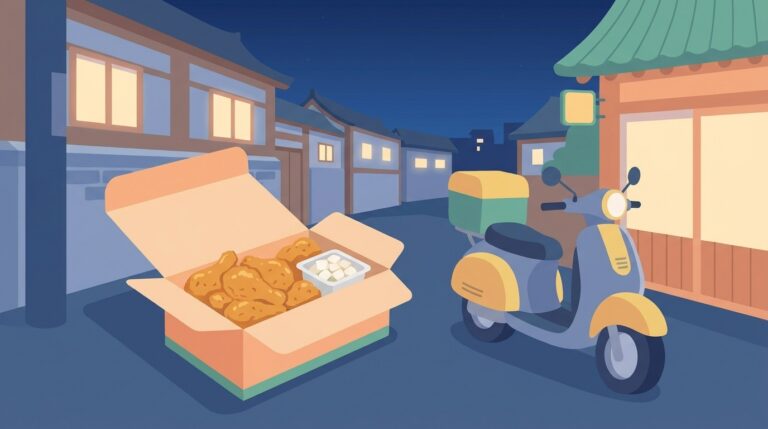
Picture this: It is 11:30 PM in your cozy Seoul Airbnb. Your feet are sore from walking around Hongdae, and your stomach lets out an unmistakable rumble. In K-dramas, this is the exact moment the characters open a crisp box of golden, crackling fried chicken accompanied by pickled radish and a cold beverage. You decide it is time to live the dream. You open a delivery app or dial the local chicken shop down the street.
You know the word for chicken: 치킨 (chikin). But suddenly, panic sets in when you look at the total bill. There is an extra charge you didn’t expect, or the person on the phone asks for an extra fee at the door! How do you ask about the delivery fee without sounding awkward or rude? Many of our beginner learners tell us: “I wanted to order fried chicken so badly, but I was terrified of hidden costs and didn’t know how to ask about the delivery fee!”
Don’t worry! Ordering food in Korea is an art form, and asking about fees is completely normal. In this friendly guide, you will master the essential A1 phrases you need to order your late-night chicken feast with total confidence.
Phase 2: Top 3 Core Expressions In-Depth
1. 배달비가 얼마예요? (Baedalbiga eolmayeyo?)
- Pronunciation: bae-dal-bi-ga eol-ma-ye-yo? (Sounds like “Bae-dahl-bee-gah uhl-mah-yeh-yo?” – think of bae like “babe” and eol like the “ea” in “early”).
- Meaning: Literal: “Delivery fee how much is it?” | Nuance: “How much is the delivery charge?”
- K-Culture Moment: You hear this constantly in sitcoms when roommates split the bill for late-night tteokbokki or fried chicken!
- Editor’s Insight: The word 배달비 (baedalbi) combines 배달 (baedal, delivery) and 비 (bi, fee/expense). Adding -가 (ga) marks it as the subject, and 얼마예요? (eolmayeyo?) is your golden phrase for “How much is it?”
- Situation Spectrum:
- Casual (Friends): ⚠️ 배달비 얼마야? (Baedalbi eolmaya?)
- Semi-formal (Polite everyday, standard): ✅ 배달비가 얼마예요? (Baedalbiga eolmayeyo?)
- Formal (Official business): 🚫 배달료가 얼마입니까? (Baedallyoga eolmaimnikka? – too stiff for food delivery)
- 🤔 Think About It: In many Western countries, delivery tips and service fees are calculated separately. In Korea, there is no tipping culture! The 배달비 is the all-inclusive delivery charge. How does this transparent pricing change how you view ordering out?
2. 치킨 한 마리 배달해 주세요 (Chikin han mari baedalhae juseyo)
- Pronunciation: chi-kin han ma-ri bae-dal-hae ju-se-yo (Sounds like “Chee-keen hahn mah-ree bae-dahl-hae joo-seh-yo”).
- Meaning: Literal: “Chicken one animal deliver please.” | Nuance: “Please deliver one whole chicken.”
- K-Culture Moment: In the hit drama Crash Landing on You, characters gather together over fried chicken boxes delivered right to the living room table.
- Editor’s Insight: In Korean, whole animals (including cooked chicken) use the counter 마리 (mari). Saying “치킨 하나 (chikin hana)” is understood, but “한 마리 (han mari)” shows authentic Korean flair!
- Situation Spectrum:
- Casual: ⚠️ 치킨 한 마리 배달해 줘 (Chikin han mari baedalhae jwo)
- Semi-formal (Everyday order): ✅ 치킨 한 마리 배달해 주세요 (Chikin han mari baedalhae juseyo)
- Formal: ⚠️ 치킨 한 마리 배달 부탁드립니다 (Chikin han mari baedal butakdeurimnida)
- 🤔 Think About It: Notice the polite request ending -해 주세요 (-hae juseyo), meaning “please do for me.” Why do you think Korean uses “give/do for me” instead of a standalone word like “please”?
3. 카드 결제 돼요? (Kadeu gyeolje dwaeyo?)
- Pronunciation: ka-deu gyeol-je dwae-yo? (Sounds like “Kah-deu gyuhl-jeh dway-yo?”).
- Meaning: Literal: “Card settlement is possible?” | Nuance: “Can I pay by card?”
- K-Culture Moment: The courier arrives at your apartment door carrying a portable wireless card terminal, ready for a tap payment in two seconds flat.
- Editor’s Insight: 결제 (gyeolje) means payment or settlement. If you are paying the delivery rider at the door, asking this ensures they bring the card machine.
- Situation Spectrum:
- Casual: ⚠️ 카드 돼? (Kadeu dwae?)
- Semi-formal (Polite standard): ✅ 카드 결제 돼요? (Kadeu gyeolje dwaeyo?)
- Formal: ⚠️ 카드 결제 가능합니까? (Kadeu gyeolje ganeunghamnikka?)
- 🤔 Think About It: Korea is nearly a 100% cashless society. Even street food and doorstep deliveries prioritize cards and mobile pay over paper money!
Phase 3: Textbook Korean vs Real Korean
Situation 1: Inquiring about the delivery fee
- 📖 교과서 한국어 (Textbook Korean): 배송료는 얼마입니까? (Baesongryoneun eolmaimnikka? – “What is the shipping fee?”)
- 🗣️ 진짜 한국어 (Real Korean): 배달비 얼마예요? (Baedalbi eolmayeyo? – “How much is the delivery fee?”)
- 💡 왜 다를까? (Why is it different?): “배송료 (Baesongryo)” is used for parcel shipping or e-commerce packages (like online shopping). For freshly cooked food brought on a scooter, native Koreans almost exclusively use 배달비 (baedalbi).
Situation 2: Asking for payment method at the door
- 📖 교과서 한국어 (Textbook Korean): 신용카드로 지불할 수 있습니까? (Sinyongkadeuro jibulhal su osseumnikka? – “May I pay with a credit card?”)
- 🗣️ 진짜 한국어 (Real Korean): 만나서 카드 결제할게요. (Mannaseo kadeu gyeoljehalgeyo. – “I’ll pay by card when we meet.”)
- 💡 왜 다를까? (Why is it different?): Koreans value speed and simplicity (Palli-palli culture). Long grammatical sentences like “~할 수 있습니까?” sound like an official interview. “만나서 카드 결제할게요” is the standard option used across all Korean food apps!
Phase 4: K-Culture Deep Dive & Non-Verbal Manners
4-1. Nunchi (눈치) & Delivery Etiquette
When your delivery rider rings the doorbell:
* The Quick Bow: Greet with a short, polite head nod and say “감사합니다! (Gamsahamnida!)”
* Two-Handed Rule: Always receive the delivery bag with both hands, especially if the rider is handing it directly to you.
* Contactless Delivery (문 앞): If you are staying at an apartment or studio, the modern standard is contactless delivery. Riders will text you a photo of the bag sitting outside your door. You don’t even have to open the door until they step into the elevator!
4-2. The “Chimaek” (치맥) Phenomenon
In Korea, chicken isn’t just fast food; it is a cultural ritual called 치맥 (Chimaek)—a portmanteau of 치킨 (chikin) and 맥주 (maekju, beer). From picnics along the Han River to late-night study sessions, delivery couriers will find you anywhere—even at a specific park bench! The delivery fee (배달비) usually ranges from 2,000 KRW to 4,000 KRW ($1.50 – $3.00 USD), making it remarkably affordable to enjoy piping-hot food at 2 AM.
Phase 5: Real-Life Roleplay Scenario
Setting: 10:30 PM. You are in your Seoul guesthouse calling the famous neighborhood chicken shop, Golden Crispy Chicken.
Characters: You (Hungry Traveler) & Owner Ajumma (Energetic Chicken Shop Master)
- Turn 1 (Owner): 네, 황금치킨입니다! (Ne, hwanggeumchikinimnida! – “Yes, Golden Chicken!”)
🎭 (Speaking quickly with a welcoming, upbeat phone voice) - Turn 2 (You): 저기요, 배달 돼요? (Jeogiyo, baedal dwaeyo? – “Excuse me, do you deliver?”)
🎭 (Speaking politely while checking your address note) - Turn 3 (Owner): 네, 어디세요? (Ne, eodiseyo? – “Yes, where are you located?”)
🎭 (Clicking a pen ready to write) - Turn 4 (You): 마포 게스트하우스예요. 배달비가 얼마예요? (Mapo geseuteuhauseuyeyo. Baedalbiga eolmayeyo? – “Mapo Guesthouse. How much is the delivery fee?”)
🎭 (Inquiring clearly with a rising intonation) - Turn 5 (Owner): 배달비 삼천 원이에요! 뭐 드릴까요? (Baedalbi samcheon wonieyo! Mwo deurilkkayo? – “The delivery fee is 3,000 won! What can I get you?”)
🎭 (Cheerfully shouting over the sound of frying chicken) - Turn 6 (You): 후라이드 반, 양념 반 한 마리 주세요. (Huraideu ban, yangnyeom ban han mari juseyo. – “Half fried, half seasoned chicken, one whole chicken please.”)
🎭 (Smiling in anticipation) - Turn 7 (Owner): 네! 카드 결제 하실 거예요? (Ne! Kadeu gyeolje hasil geoyeyo? – “Okay! Will you pay by card?”)
🎭 (Confirming the payment method) - Turn 8 (You): 네, 카드 결제 돼요? (Ne, kadeu gyeolje dwaeyo? – “Yes, can I pay by card?”)
🎭 (Nodding into the phone with relief)
🔀 Interactive Choice Point
The owner asks: “문 앞에 둘까요? (Mun ape dulkkayo? – Shall I leave it in front of the door?)”
* Option A: “네, 문 앞에 두고 가세요! (Ne, mun ape dugo gaseyo! – Yes, please leave it in front of the door!)”
* Option B: “아니요, 먹고 갈게요! (Aniyo, meokgo galgeyo! – No, I will eat here and go!)”
* Option C: “몰라요. (Mollayo. – I don’t know.)”
Feedback:
* Option A (Best): Perfect! This is the most common, effortless response for contactless delivery.
* Option B (Bad): Oops! You called for home delivery; saying “eat here and go” makes no sense because you are already in your room!
* Option C (Risk): Awkward! The owner will be confused about whether to knock or leave the bag, leading to endless phone calls.
Phase 6: 10-Second Emotional Shadowing Drill
Practice these lines out loud! Follow the slashes / for brief pauses:
[🤔 궁금하고 조심스럽게 / Curiously & politely]
저기요, / 배달비가 / 얼마예요?
(Jeogiyo, / baedalbiga / eolmayeyo?)-
[😊 밝고 명확하게 / Brightly & clearly]
후라이드 치킨 / 한 마리 / 배달해 주세요!
(Huraideu chikin / han mari / baedalhae juseyo!) -
[💳 시원시원하고 깔끔하게 / Crisp & confident]
도착하시면 / 카드 결제 / 돼요?
(Doochakasimyeon / kadeu gyeolje / dwaeyo?)
Phase 7: K-Culture Mini Dictionary
- 배달비 (Baedalbi) | Delivery fee
- Everyday usage: The surcharge added to your order for rider transport. Commonly 2,000 to 4,000 KRW.
- 반반 (Banban) | Half-and-half
- Everyday usage: Used when you can’t decide between crispy fried (Huraideu) and sweet-spicy garlic sauce (Yangnyeom). Just say “반반 주세요 (Banban juseyo)”!
- 치맥 (Chimaek) | Chicken + Beer
- Everyday usage: The quintessential social food pairing in modern Korea. Often enjoyed after work with colleagues or friends.
- 문 앞 (Mun ap) | Front of the door
- Everyday usage: The magic delivery drop-off spot. You will frequently hear or text “문 앞에 놔주세요 (Mun ape nwajuseyo – Please put it in front of the door)”.
Phase 8: Survival Kit for Travelers
Top 3 Survival Phrases
- 배달비 포함이에요? (Baedalbi pohamieyo?)
Translation: Is the delivery fee included?
Pro Tip: Use this if you are confused whether the total price includes the rider’s charge. - 얼마나 걸려요? (Eolmana geollyeoyo?)
Translation: How long does it take?
Pro Tip: Perfect for checking delivery wait times during peak Friday night rushes. - 문 앞에 두고 벨 눌러 주세요 (Mun ape dugo bel nulleo juseyo)
Translation: Please leave it in front of the door and ring the bell.
Pro Tip: Copy and paste this directly into delivery app memo boxes!
Editor’s Travel Note
- Apps to Know: Most local apps like Yogiyo or Baemin require a Korean phone number. If you are a traveler without a domestic phone plan, use foreign-friendly delivery platforms or services like the Shuttle Delivery App 다운로드 which accept international credit cards.
- Hotel Lobbies: Many hotels in Korea do not allow couriers to ride elevators to guest rooms. In that case, the rider will wait in the 1st floor lobby. Keep an eye on your phone!
Phase 9: “One Step Deeper” (Reflective Essay)
Did you know that until the mid-2010s, delivery in Korea was almost entirely free? Restaurants hired their own riders, and delivering food was seen as an automatic courtesy of neighborhood hospitality. With the rise of app platforms and independent logistics networks, the 배달비 (delivery fee) became standard. While some locals initially resisted, it sparked a broader conversation about fair compensation for couriers who navigate dense traffic in freezing winters and humid summers. When you pay that modest 3,000 won fee, you are directly supporting the hard-working riders who keep Korea running 24/7.
💬 Your Turn: In your home country, how are delivery fees and driver tips handled? Do you prefer a flat delivery fee or tipping based on service? Share your thoughts below!
Phase 10: FAQ & Mistake Prevention
Q: Can I tip the delivery rider in cash when they arrive?
A: Tipping is not customary in Korea and can cause polite confusion. The delivery fee (배달비) already covers the driver’s service, so you do not need to leave any extra tip.
Q: What if I don’t have a Korean bank card or app?
A: You can often call small local restaurants directly and request “만나서 카드 결제 (pay by card upon arrival)”. When the driver arrives, you can swipe your foreign Visa or Mastercard on their mobile terminal.
Q: How do I say “extra pickled radish” for my chicken?
A: Say “치킨무 많이 주세요 (Chikinmu mani juseyo – Please give me lots of chicken radish)”. Chicken radish (chikinmu) is an absolute must-have side dish that cleanses the palate between bites!
🚨 Common Mistakes Alert
- Mistake: Using “배송비 (baesongbi)” instead of “배달비 (baedalbi)” for restaurant food.
Correct Action: Use 배달비 for hot food and 배송비 for online retail packages. - Mistake: Forgetting to mention the payment method when ordering by phone.
Correct Action: Always specify “카드 결제예요 (Card payment)” so the driver brings the handheld card machine. - Mistake: Waiting inside without watching your phone.
Correct Action: Delivery couriers in Korea move rapidly. If they can’t access your building entrance code, they will call your phone immediately. Always keep your phone close by!
Phase 11: Action Mission & Engagement
- 🥉 Bronze Mission (Solo): Say “배달비가 얼마예요? (Baedalbiga eolmayeyo?)” out loud 5 times using our shadow drill audio cues.
- 🥈 Silver Mission (Community): Leave a comment with your dream Korean delivery order: Fried (Huraideu), Seasoned (Yangnyeom), or Half-and-Half (Banban)?
- 🥇 Gold Mission (Real World): Visit a local Korean restaurant or order through a food app and spot the word 배달 (delivery) or 배달비 (delivery fee) on the menu or receipt!
🎮 K-Culture Mission: Watch any modern K-drama episode (like Weightlifting Fairy Kim Bok-joo or Hospital Playlist). Spot the exact moment a character unwraps a food delivery bag. Notice how they interact with the delivery person!
Phase 12: Interactive Quiz Challenge
Question 1: Situational Judgment
You are calling a chicken place and want to know the delivery fee. Which sentence is the most natural and polite for a beginner?
A) 배송료가 얼마입니까?
B) 배달비가 얼마예요?
C) 치킨 얼마예요?
Question 2: Fill in the Blank
Complete the sentence for ordering half-and-half chicken:
“후라이드 반, 양념 반 한 _______ 배달해 주세요.”
(Hint: Counter for whole chickens)
Question 3: True or False
In Korea, you are expected to give a 15-20% cash tip to the delivery rider at the door. (True / False)
👉 Click here to reveal the answers and explanations!
- Answer 1: B) 배달비가 얼마예요?
Explanation: A is too stiff and uses shipping terminology for packages. C asks for the price of the chicken itself, not the delivery fee! - Answer 2: 마리 (mari)
Explanation: 마리 is the counter for whole chickens. “한 마리 (han mari)” means “one whole chicken”. - Answer 3: False
Explanation: Korea has no tipping culture! The delivery fee (배달비) covers the driver’s compensation completely.
🎬 Watch Our Daily Videos! (Daily Hangul Official Instagram)
Review the expressions you learned in this article with our fun daily short videos! Check out native pronunciation and real-life nuances in action.
- Instagram @dailyhangul_en







