

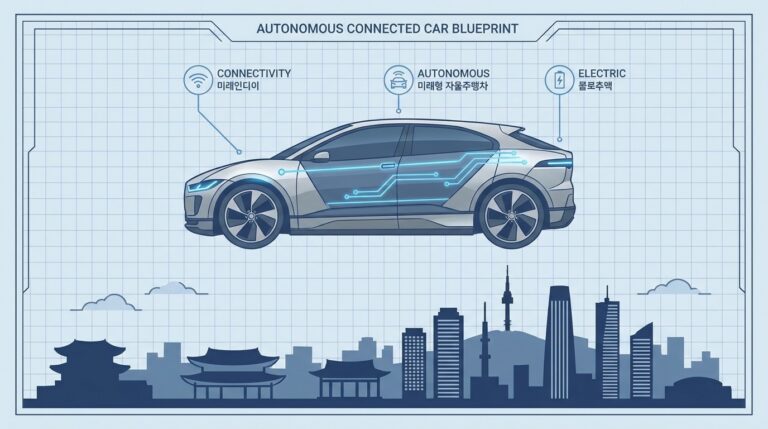
Master SDV & E/E Architecture Korean: From Distributed ECUs to High-Performance Centralized Computing
Phase 1: Empathy (Narrative Immersion Opening)
안녕하세요! 매일한글 에디터입니다. (Annyeonghaseyo! Maeil Hangul editeo-imnida. – “Hello! This is your Daily Hangul editor.”)
Picture this: You are sitting in a glass-walled conference room overlooking the bustling high-tech corridor of Pangyo Techno Valley—South Korea’s very own Silicon Valley. Across the sleek mahogany table sits Director Park, a veteran automotive engineer who cut his teeth on mechanical powertrains at Hyundai in the 1990s, and Min-ji, a razor-sharp software architect recruited straight from a leading mobility platform. The slide projected on the screen shows a tangled spiderweb of over eighty distributed Electronic Control Units (ECUs), each operating in its own siloed hardware cage.
Min-ji leans forward and asserts that keeping this legacy setup is a death sentence for autonomous driving. She pitches a radical overhaul: consolidating those dozens of legacy controllers into four zonal controllers anchored by a centralized high-performance computing (HPC) unit running a proprietary vehicle OS. Director Park frowns, taps his pen, and challenges the room: “사고 발생 시 책임 소재를 어떻게 증명할 겁니까?” (Sago balsaeng si chaegim sojae-reul eotteoke jeungmyeong-hal geomnikka? – “When an accident occurs, how will you prove where liability lies?”)
You want to jump into the technical fray. You want to articulate that an end-to-end (E2E) AI model coupled with a software-defined vehicle (SDV) architecture is not just a software update, but the very structural backbone needed to isolate software bugs from sensor failures. Yet, your tongue ties up. How do top-tier Korean engineers express radical architectural consolidation without sounding dismissive of legacy hardware engineering? How do you debate legal culpability (baesang chaegim) and electronic architecture (E/E akitekcheo) with the elegance of a C2-level professional?
Whether you are negotiating joint ventures with Korean mobility giants or consulting on autonomous mobility liability in Seoul, this guide provides real-world battle-tested expressions from actual Pangyo engineering war rooms. Let us elevate your Korean to the highest strategic level.
Phase 2: In-Depth Breakdown of 3 Core Expressions
1. 뼈대를 세우다 (Ppyeodae-reul seuda)
- Pronunciation: [Ppyeo-dae-reul seu-da] (Think of the sharp, double-p sound like the pop in “spot,” followed by “duh-reul seh-oo-da”)
- Meaning:
- Literal: To erect the skeletal frame of a building or organism.
- Nuance: To establish the foundational, non-negotiable core architecture of a complex initiative or technological system.
- K-Culture Moment: You will hear this in high-stakes corporate dramas like Agency (대행사) or Start-Up (스타트업), where visionary project leads silence boardroom squabbles by emphasizing the absolute structural framework over cosmetic adjustments.
- Editor’s Insight: While 초석을 다지다 (choseog-eul dajida – “to lay the cornerstone”) focuses on early preparatory ground work, 뼈대를 세우다 emphasizes structural scaffolding that supports weight and enables future expansion. In SDV architecture, moving to centralized zonal computing is the quintessential “뼈대” (skeleton) upon which all subsequent over-the-air (OTA) feature rollouts rely.
- Situation Spectrum: Casual: ⚠️ | Semi-formal: ✅ | Formal: ✅
- 🤔 Think About It: In English, we often say “building the backbone” or “laying the foundation.” Notice how Korean automotive engineers favor somatic metaphors (bones, joints, nerves) when speaking of mechanical-to-software transformations. How does conceptualizing vehicle networks as a biological skeletal system alter the way we perceive software updates?
2. 일원화하다 (Ilweonhwahada)
- Pronunciation: [Il-weon-hwa-ha-da] (Smoothly liaison the ‘l’ sound: “Eel-won-hwa-ha-da”)
- Meaning:
- Literal: To make into one single source or origin.
- Nuance: To systematically integrate, centralize, or streamline fragmented processes, hardware nodes, or governance pipelines into a cohesive single point of control.
- K-Culture Moment: Classic Korean tech-news reporting and boardroom briefings use this phrase incessantly. When tech conglomerates merge overlapping R&D teams or when vehicle OS platforms absorb splintered Tier-1 supplier software, the anchor announces: “소프트웨어 컨트롤 타워를 일원화하기로 결정했습니다.” (They decided to unify the software control tower).
- Editor’s Insight: Contrast this with 통합하다 (tonghap-hada – “to combine/integrate”). 통합하다 simply means putting things together in one bucket. 일원화하다 implies structural rationalization—eliminating redundancy and establishing a single, authoritative hierarchy or pipeline.
- Situation Spectrum: Casual: 🚫 | Semi-formal: ✅ | Formal: ✅
- 🤔 Think About It: Why does Korean corporate and engineering culture place such a profound premium on “일원화” (unification)? Consider how unified command structures streamline consensus (geumtto) in traditional corporate hierarchies.
3. 발목을 잡다 (Balmog-eul japda)
- Pronunciation: [Bal-mog-eul jap-da] (Pronounced with an unreleased ‘k’ at the bottom of mog: “Bahl-mohk-eul jahp-dah”)
- Meaning:
- Literal: To grab someone by the ankle.
- Nuance: To act as a severe bottleneck, drag down progress, or serve as an inescapable liability that hinders systemic evolution.
- K-Culture Moment: From tense Korean political thrillers to corporate sports dramas like Hot Stove League (스토브리그), when an obsolete contract, legacy code, or unresolved liability claim prevents a forward leap, the protagonist mutters: “결국 과거의 잔재가 우리 발목을 잡네요.” (In the end, the remnants of the past are catching our ankles).
- Editor’s Insight: At a C2 level, you avoid simplistic negative adjectives like “나쁘다” (bad) or “비효율적이다” (inefficient). Stating that fragmented CAN bus protocols and eighty disparate ECUs are “발목을 잡고 있다” creates a vivid, visceral picture of a vehicle paralyzed by its own legacy complexity.
- Situation Spectrum: Casual: ✅ | Semi-formal: ✅ | Formal: ⚠️ (Acceptable in formal executive debates if used objectively)
- 🤔 Think About It: Contrast “발목을 잡다” (holding the ankle) with English “holding our feet to the fire” or “anchoring us down.” In Korean, holding the ankle implies tripping someone mid-stride while they attempt to sprint toward the future.
Phase 3: Textbook Korean vs. Real Korean
Scenario 1: Proposing Zonal Architecture Over Distributed Systems
- 📖 교과서 한국어 (Textbook Korean):
“우리는 분산된 제어기를 하나의 컴퓨터로 통합해야 합니다.”
(Uri-neun bunsan-doen jeeo-gi-reul hana-ui keompyuteo-ro tonghap-haeya hamnida. – “We must integrate distributed controllers into one single computer.”) - 🗣️ 진짜 한국어 (Real Pangyo Tech Korean):
“산재된 수십 개의 ECU를 존(Zonal) 아키텍처로 싹 묶어내야 진정한 SDV로의 전환이 가능해집니다.”
(Sanjae-doen susip gae-ui ECU-reul jon akitekcheo-ro ssak mukkeonaeya jinjeonghan SDV-ro-ui jeonhwan-i ganeung-haejimnida. – “We must bundle all those scattered dozens of ECUs into a zonal architecture in one sweep to make a genuine transition to SDV possible.”) - 💡 왜 다를까? (Why is it different?):
Engineers in Korea do not just say “통합하다”; they use expressive verb compounds like “묶어내다” (to round up and bind together) combined with adverbs like “싹” (completely/cleanly in one sweep) paired with loan words like “존(Zonal) 아키텍처” to indicate both speed and architectural decisiveness.
Scenario 2: Addressing Legal Exposure in AI Autonomous Failures
- 📖 교과서 한국어 (Textbook Korean):
“사고가 나면 법적인 책임 소재를 밝히는 것이 매우 어렵습니다.”
(Sago-ga namyeon beopjeok-in chaegim sojae-reul balkhineun geos-i maeu eoryeopseumnida. – “If an accident occurs, clarifying the legal attribution of responsibility is very difficult.”) - 🗣️ 진짜 한국어 (Real Pangyo Tech Korean):
“End-to-End AI 특유의 블랙박스 문제 때문에, 사고 터졌을 때 제조물 배상 책임에서 법리적으로 취약해질 수밖에 없습니다.”
(End-to-End AI teugyu-ui beullaekbakseu munje ttaemune, sago teojyeosseul ttae jejomul baesang chaegim-eseo beomni-jeog-euro chwiyak-hae-jil subakke eopseumnida. – “Due to the black-box nature intrinsic to End-to-End AI, when an accident breaks out, we are inevitably left legally vulnerable under product liability doctrines.”) - 💡 왜 다를까? (Why is it different?):
High-level practitioners blend legal jurisprudence terminology such as “법리적으로” (jurisprudentially / legally reasoned) and statutory terms like “제조물 배상 책임” (product liability) with natural colloquial verbal triggers like “사고 터졌을 때” (when an accident explodes/erupts) rather than sterile textbook formulas.
Phase 4: K-Culture Deep Dive & Non-Verbal Manners
4-1. Nunchi (눈치) & Meeting Etiquette in Korean Tech Boardrooms
When proposing disruptive architectural overhauls (such as replacing hardware supplier contracts with a unified in-house OS) in a Korean OEM environment, non-verbal cues (nunchi) dictate the outcome just as much as your benchmark metrics.
* The Head Tilt and Slow Nod: When an executive (상무 or 전무) folds their hands, rests their chin, and nods slowly while looking downward at your architecture diagram, do not interrupt with more slides. This is not disinterest; it is the physical manifestation of weighing supply-chain friction against innovation. Wait for their question.
* The Two-Handed Pointer: When gesturing toward an architecture slide or handing over an engineering spec sheet, never use a single index finger or toss the document across the table. Use an open palm facing upward supported lightly by your other hand at the wrist or forearm. It conveys high respect while simultaneously presenting cutting-edge expertise.
4-2. Cultural Phenomenon: “Pangyo Saturi” (판교 사투리)
In South Korea’s premier tech clusters—Pangyo, Teheran-ro in Gangnam, and Gasan Digital Complex—a distinct linguistic sociolect has emerged known affectionately as “판교 사투리” (Pangyo Dialect). It blends high-level Silicon Valley Siliconisms directly into polite Korean honorific grammar.
Instead of translating technical terms into pure Korean hanja words, engineers use phrases like:
* “이 아키텍처는 얼라인(Align)이 선행되어야 온보딩(Onboarding)이 가능합니다.” (This architecture requires alignment prior to onboarding.)
* “레거시 ECU 디펜던시(Dependency)를 먼저 덜어내시죠.” (Let us decouple the legacy ECU dependencies first.)
Understanding this dynamic prevents foreigners from sounding either too antiquated (using obscure Chinese character translations) or too informal (speaking only English without Korean contextual casing).
Phase 5: Real-World Roleplay Scenario
Setting: A conference room at Namyang Mobility R&D Campus in Hwaseong.
Characters:
* Dr. Alex Vance: Principal Software Architect from a global autonomous compute partner.
* Executive Director Park (박 전무): Head of Vehicle Platform Integration at a major Korean automotive OEM.
- 박 전무 (Director Park): “SDV로 가야 한다는 대의에는 공감합니다. 하지만 기존 80여 개의 ECU를 중앙 집중형 HPC 소수로 통합하는 건 하드웨어 결함 시 리스크가 너무 큽니다.”
(SDV-ro gaya handaneun daeuie-neun gonggamhamnida. Hajiman gijon palsip-yeogae-ui ECU-reul jungang jipjunghyeong HPC sosuro tonghaphaneun geon hadeuweeo gyeolham si riseukeuga neomu keumnida.)
🎭 Closing the binder slightly and adjusting his glasses with a skeptical gaze
“I agree with the overarching goal of moving to SDV. However, consolidating 80+ legacy ECUs into just a few centralized HPCs carries too much risk if hardware fails.” - Dr. Alex Vance: “충분히 우려하실 수 있는 대목입니다. 다만 기능 안전을 위해 Zonal 아키텍처 기반의 이중화 설계를 병행한다면 단일 장애 리스크를 상쇄할 수 있습니다.”
(Chungbunhi uryeohasil su inneun daemogimnida. Daman gineung anjeoneul wihae Zonal akitekcheo giban-ui ijunghwa seolgyereul byeonghaenghandamyeon danil jang-ae riseukeureul sangswaehal su itseumnida.)
🎭 Presenting the redundancy block diagram calmly with an open palm
“That is an entirely valid concern. However, if we pair zonal architecture with functional safety redundancy, we can offset single-point-of-failure risks.” - 박 전무: “기존 레거시 배선과 파편화된 제어기들이 결국 OTA 업데이트의 발목을 잡고 있긴 하죠. 그런데 End-to-End AI 오작동 시 책임 소재는 어떻게 증명할 겁니까?”
(Gijon regeosi baeseongwa papyeonhwadoen jeeogideuri gyeolguk OTA eopdeiteu-ui balmeogeul japgo itgin hajyo. Geureonde End-to-End AI ojakdong si chaegim sojaeneun eotteoke jeungmyeonghal geomnikka?)
🎭 Leaning forward, resting his pen on the legal-liability slide
“True, legacy wiring and fragmented controllers are indeed holding back our OTA updates. Still, if End-to-End AI malfunctions, how do you prove where liability lies?” - Dr. Alex Vance: “차량용 OS 레벨로 로깅 체계를 일원화하면, 센서 오류와 AI 판단 결함을 밀리초 단위로 분리 입증할 수 있어 법리적 방어권이 오히려 강화됩니다.”
(Charyang-yong OS rebeullo roging chegyereul ilweonhwahamyeon, senseo oryuwa AI pandan gyeolhameul millicho danwiro bulli ipjeunghal su isseo beomnijeok bangeogwoni ohiryeo ganghwadoemnida.)
🎭 Speaking steadily with measured executive poise
“By unifying the logging pipeline at the vehicle OS level, we can isolate sensor faults from AI decision errors down to the millisecond—actually strengthening our legal defense.” - 박 전무: “단순한 하드웨어 통폐합이 아니라 차세대 플랫폼의 뼈대를 세우고 법적 안전망까지 확보하자는 말씀이군요. 꽤 설득력 있습니다.”
(Dansunhan hadeuweeo tongpyehabi anira chasedae peullaetpom-ui ppyeodaereul seugo beopjeok anjeonmangkkaji hwakbohajaneun malsseumigunyo. Kkwae seoldeungnyeok itseumnida.)
🎭 Uncrossing his arms and nodding slowly in approval
“So you’re proposing not just hardware consolidation, but building the structural backbone of our next-gen platform with a legal safety net. Quite persuasive.” - Dr. Alex Vance: “감사합니다, 전무님. 다음 주 실무진 미팅에서 구체적인 마이그레이션 로드맵을 보고드리겠습니다.”
(Gamsahamnida, jeonmunim. Daeum ju silmujin miting-eseo guchejeogin maigeureisyeon rodeumaebeul bogodeurigetseumnida.)
🎭 Offering a crisp, respectful bow
“Thank you, Director. We will present the concrete migration roadmap at next week’s working-level meeting.”
🔀 Interactive Branching Point
Director Park asks: “How should we handle our long-time Tier-1 hardware suppliers who fear losing individual ECU contracts?” What is your sharpest C2 response?
* A: “트렌드에 못 맞추는 협력사는 과감히 정리해야 합니다.” (“We must boldly cut suppliers who can’t keep up with trends.”)
* B: “기존 부품사들이 스마트 액추에이터와 센서 모듈 고도화로 역할을 피봇할 수 있도록 공동 개발 생태계를 제안하겠습니다.” (“We will propose a co-development ecosystem so legacy suppliers can pivot toward smart actuators and advanced sensor modules.”)
* C: “그건 구매팀이 단가 협상으로 풀 문제이지, 아키텍트 소관이 아닙니다.” (“That’s for procurement to solve via price negotiations, not an architect’s job.”)
💡 Feedback:
* Choice B (Best!): Masterful C2 diplomacy—acknowledging Korean OEMs’ deep supply-chain relationships while steering toward zonal consolidation.
* Choice A (Risk): Sounds tone-deaf to Tier-1 ecosystem politics in Korea.
* Choice C (Bad): Passing the buck (소관이 아니다) undermines executive trust.
Phase 6: 10-Second Emotion Shadowing Drill
Read aloud with crisp pauses at / and executive cadence:
[💼 Strategic and authoritative]
차세대 SDV의 뼈대를 세우기 위해 / 제어기 아키텍처를 / 존 단위로 일원화해야 합니다.
(Chasedae SDV-ui ppyeodaereul seugi wihae / jeeogi akitekcheoreul / jon danwiro ilweonhwahaeya hamnida.)-
[⚖️ Analytical and precise]
파편화된 레거시 시스템이 / 결국 OTA 전환의 / 발목을 잡고 있습니다.
(Papyeonhwadoen regeosi siseutemi / gyeolguk OTA jeonhwan-ui / balmogeul japgo itseumnida.) -
[🤝 Reassuring under pressure]
OS 레벨의 데이터 통합이 선행되면 / 법리적 책임 소재를 / 명확히 입증할 수 있습니다.
(OS rebeul-ui deiteo tonghabi seonhaengdoemyeon / beomnijeok chaegim sojaereul / myeonghwakhi ipjeunghal su itseumnida.)
Phase 7: K-Culture Mini Dictionary
- 뼈대를 세우다 (Ppyeodae-reul seuda) | To establish the structural backbone | Used in C-suite strategy briefings for foundational, load-bearing architecture.
- 일원화 (Ilweonhwa) | Unification / Single-source integration | Streamlining fragmented pipelines or control towers into one authoritative system.
- 판교 사투리 (Pangyo Saturi) | Pangyo Tech Dialect | Korea’s Silicon Valley sociolect blending English tech terms (얼라인, 디펜던시) into formal Korean grammar.
- 책임 소재 (Chaegim sojae) | Where liability lies | A high-stakes legal and executive phrase in autonomous driving, fintech, and AI governance debates.
Phase 8: Survival Kit for Tech Executives in Korea
Top 3 Boardroom Survival Phrases
- 실무진 간 얼라인(Align)부터 맞추시죠. (Silmujin gan eollain-buteo matchusijyo. / Let’s align at the working-level first.)
- Pro Tip: Use this to bridge executive vision and engineering execution smoothly.
- 단일 장애점(SPOF)을 원천 차단했습니다. (Danil jang-aejeom-eul woncheon chadanhaetseumnida. / We eliminated single points of failure at the root.)
- Pro Tip: 원천 차단 (“root-level blockage”) carries immense technical credibility.
- 양산 일정에 차질 없도록 조율하겠습니다. (Yangsan iljeong-e chajil eopdorok joyulhagetseumnida. / We will coordinate so mass production faces zero disruption.)
- Pro Tip: In Korean automotive OEMs, 양산 (mass production) schedules are sacred.
Editor’s Logistics Note
- Getting to Pangyo & Namyang: Take the Shinbundang Line (신분당선) directly from Gangnam to Pangyo Station in just 14 minutes—keep Naver Map installed for real-time bus transfers to R&D campuses in Suwon or Hwaseong, and use a T-money or WOWPASS card for seamless transit and campus café payments.
Phase 9: “One Step Deeper” — Architecture as Legal Trust
In Korean mobility boardrooms, consolidating 80 ECUs into a centralized HPC isn’t merely an engineering optimization—it is an exercise in institutional accountability. In a society where rapid ppalli-ppalli innovation coexists with strict regulatory and corporate liability scrutiny, unifying the vehicle OS creates the transparent audit trail needed for executives to sign off with confidence.
💬 Your Turn: In your industry, what technical bottleneck is currently “grabbing everyone by the ankle” (발목을 잡다)? Share your thoughts below!
Phase 10: FAQ & Myth-Busting
Q: When should I use “일원화하다” instead of “통합하다”?
A: Use 통합하다 for general merging, and 일원화하다 when emphasizing unified governance, single-source data pipelines, or eliminating conflicting control towers.
Q: Is “Pangyo Saturi” acceptable in formal executive presentations?
A: Moderate use of industry-standard English terms (아키텍처, 로드맵, 얼라인) is completely normal and expected in Korean tech—just anchor them with formal 합쇼체 (-ㅂ니다/습니다) endings.
Q: Why do Korean engineers bring up legal liability so early in architecture reviews?
A: Because autonomous systems shift risk from individual drivers to OEM software platforms, 제조물 배상 책임 (product liability) is treated as a core design constraint from day one.
🚨 Common Mistakes TOP 3
- Using casual “단순히 합치자” (let’s just combine them) in an executive review -> Say 아키텍처를 일원화하자 to convey structural rigor.
- Interrupting a senior executive’s silent nod during diagram review -> Pause and let them formulate their question (nunchi).
- Handing over spec sheets with one hand -> Always present technical documents or tablets with both hands.
Phase 11: Action Mission & Engagement
- 🥉 Bronze Mission (Solo Practice): Record yourself delivering the three Phase 6 shadowing lines using formal -습니다 endings with zero hesitation.
- 🥈 Silver Mission (Social Share): Pick one C2 expression (뼈대를 세우다, 일원화하다, or 발목을 잡다) and write a one-sentence tech summary using it.
- 🥇 Gold Mission (Real-Life Use): In your next bilingual tech or strategy call, frame a bottleneck using 발목을 잡고 있다 or 일원화!
- 🎮 K-Culture Mission: Watch a Korean tech keynote (e.g., Hyundai or Naver DAN) on YouTube and count how many times speakers use 뼈대, 일원화, or 생태계!
Phase 12: Interactive Quiz Challenge
- Situational Judgment: You want to tell an OEM executive that consolidating fragmented control pipelines into one unified vehicle OS is essential. Which verb sounds sharpest at C2 level?
- A) 일원화하다 (ilweonhwahada)
- B) 모으다 (moeuda)
- C) 섞다 (seokda)
- Fill-in-the-Blank: Complete the idiom meaning “Legacy wiring is holding back our OTA updates”:
레거시 배선이 OTA 업데이트의 ( )을 잡고 있습니다. -
True or False (Cultural Quiz): In Korean tech boardrooms, using established English terms like 아키텍처 or 얼라인 inside formal -습니다 sentences is considered unprofessional slang. (True / False)
Click to Reveal Quiz Answers & Detailed Explanations
- Answer: A (일원화하다).
- Explanation: 일원화하다 specifically conveys structural rationalization into a single authoritative control pipeline—far sharper than 모으다 (“gather”) or 섞다 (“mix”).
- Answer: 발목 (balmok / ankle).
- Explanation: 발목을 잡다 (“to grab the ankle”) is the quintessential C2 metaphor for a legacy bottleneck dragging down progress.
- Answer: False.
- Explanation: Known affectionately as 판교 사투리 (Pangyo Dialect), blending global engineering terminology into formal Korean grammar is standard across Korean mobility and tech leadership!
🎬 Watch Our Daily Videos! (Daily Hangul Official Instagram)
Review the expressions you learned in this article with our fun daily short videos! Check out native pronunciation and real-life nuances in action.
- Instagram @dailyhangul_en






