

안녕하세요! 매일한글 에디터입니다.
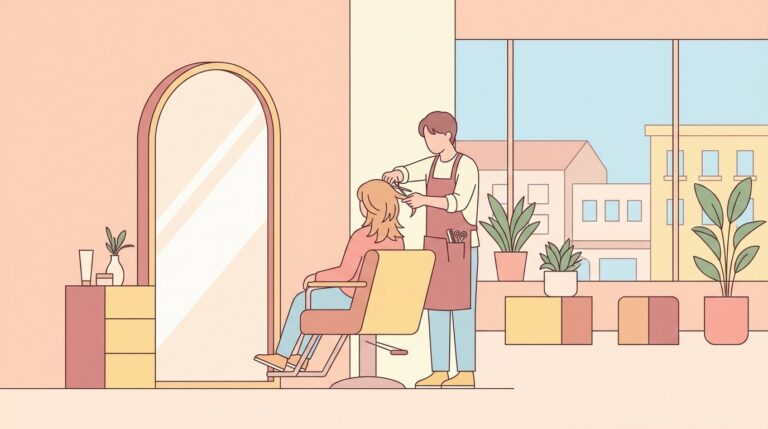
Have you ever walked into a chic, minimalist hair salon in Hongdae, Seongsu, or Gangnam, holding a picture of your favorite K-pop star or K-drama actor, only to freeze when the stylist greets you? Many of our international students tell us the exact same story: “I wanted a trendy, airy Korean layered cut, but I panicked, mumbled something about a trim, and walked out looking like a mushroom!”
If you have thick hair, you know the struggle all too well. Korean stylists are world-renowned masters of the airy, textured look—often creating effortless movement that feels featherlight. But to get that magical result, you need to know how to express hair density and layering naturally. Relying on automated translation apps can lead to awkward moments because machine tools often translate “thinning out” into strange medical or technical jargon. This guide is crafted directly from real salon coaching sessions with A2-level Korean learners. By the end of this guide, you will sit in that salon chair with complete confidence, knowing exactly what to say to get the stylish, lightweight cut you want!
Phase 2: Top 3 Core Expressions in Depth
1. 머리숱이 많아서 가볍게 층 내 주세요 (Meorisusi manaseo gabyeopge cheung nae juseyo)
- Pronunciation: meh-ree-soo-shee mah-nah-seo gah-byeop-geh cheung neh joo-seh-yo (Think of cheung like the English word “chung” with an upward, bright tone).
- Meaning: Literal: “Because my hair volume is plentiful, please make light layers.” | Real Nuance: “My hair is really thick and heavy, so please add some light layers to take off the weight.”
- K-Culture Moment: This is the exact phrase spoken during makeover scenes in K-dramas when the main lead transitions from an overwhelmed office worker into a chic professional.
- Editor’s Insight: The word 머리숱 (meorisut) refers specifically to the density or quantity of hair strands on your scalp, not the hair length. Combining it with 가볍게 (gabyeopge – lightly/airily) tells the hairdresser you want movement without losing your overall silhouette.
- Situation Spectrum: Casual: ⚠️ | Semi-formal (Polite): ✅ | Formal: ✅
- 🤔 Think About It: In English, we often say “thin it out.” In Korean, asking to “make layers lightly” focuses on the aesthetic balance of weight and movement. Notice how Korean beauty phrasing prioritizes overall harmony (jo-hwa).
2. 숱 좀 쳐 주세요 (Sut jom chyeo juseyo)
- Pronunciation: soot jom chyeo joo-seh-yo (Sounds like “suit” + gentle “chaw”).
- Meaning: Literal: “Please strike/cut the hair density a bit.” | Real Nuance: “Please thin out my hair / reduce the bulk.”
- K-Culture Moment: You will hear teenagers and young adults say this casually right before the stylist whips out the thinning shears (called 틴닝 가위 in Korean salons).
- Editor’s Insight: The verb 치다 (chida) means to hit or strike, but in hair terminology, 숱을 치다 (suteul chida) specifically means removing bulk using texturizing shears. Adding 좀 (jom – a little/please) softens the request instantly.
- Situation Spectrum: Casual: ✅ | Semi-formal: ✅ | Formal: ⚠️
- 🤔 Think About It: Why does Korean use the dynamic action verb “to strike” (chida) for hair thinning? It mimics the rapid snipping motion of professional texturizing shears!
3. 길이는 유지하고 다듬어만 주세요 (Girineun yujihago dadeumeoman juseyo)
- Pronunciation: ghee-ree-neun yoo-jee-hah-goh dah-deu-meo-mahn joo-seh-yo (Focus on a smooth, rhythmic flow on dadeumeoman).
- Meaning: Literal: “Maintain the length and please only tidy it up.” | Real Nuance: “Please keep the current length and just clean up the split ends.”
- K-Culture Moment: The holy grail phrase used by idols who must maintain their signature hair length for album promotions while keeping their hair healthy.
- Editor’s Insight: Adding the particle -만 (man – only) to 다듬다 (dadeumda – to trim/tidy) creates an essential boundary. It prevents the stylist from cutting off more length than you agreed upon.
- Situation Spectrum: Casual: ⚠️ | Semi-formal: ✅ | Formal: ✅
- 🤔 Think About It: Setting gentle boundaries politely is an art in Korean service interactions. By pairing 유지하다 (yujihada – to maintain) with -만 (only), you protect your hair length without sounding demanding.
Phase 3: Textbook Korean vs. Real Korean
Situation 1: Asking the stylist to remove hair bulk
- 📖 교과서 한국어 (Textbook): 제 모발의 밀도를 감소시켜 주십시오. (Je mobal-ui mildoreul gamsosikyeo jusipsio. / “Please decrease the density of my hair strands.”)
- 🗣️ 진짜 한국어 (Real Life): 머리숱이 많아서 숱 좀 많이 쳐 주세요. (Meorisusi manaseo sut jom mani chyeo juseyo. / “My hair is really thick, so please thin it out a lot.”)
- 💡 왜 다를까? (Why the difference?): Nobody uses the scientific term 모발 (mobal – biological hair) in everyday salon chats. Real Koreans use 머리 (meori) or 머리숱 (meorisut) with everyday verbs like 치다 (chida).
Situation 2: Asking for modern layers
- 📖 교과서 한국어 (Textbook): 머리카락에 단차를 두어 가위질해 주세요. (Meorikarage danchareul dueo gawijilhae juseyo. / “Please cut stairs into my hair with scissors.”)
- 🗣️ 진짜 한국어 (Real Life): 가볍게 레이어드 컷으로 해 주세요. (Gabyeopge re-i-eo-deu keos-euro hae juseyo. / “Please give me a light layered cut.”)
- 💡 왜 다를까? (Why the difference?): Salon culture in Korea adopts Konglish terms seamlessly. 레이어드 컷 (layered cut) or 허쉬컷 (hush cut) are universally understood terms used by every Korean hair designer.
Phase 4: K-Culture Deep Dive & Non-Verbal Manners
4-1. 눈치 (Nunchi) & Salon Body Language
- The Visual Reference: Never describe a haircut with words alone! Stylists in Korea love visual clarity. Prepare 2–3 photos saved on your phone. When showing your screen, hold the phone with two hands slightly tilted toward the stylist while nodding gently.
- The Volume Gesture: When saying 머리숱이 많아요 (My hair is thick), gently cup the sides of your hair and puff it outward with your fingers. This universal visual reinforces your spoken Korean and gives the designer instant context.
- Mirror Eye Contact: In Korean salons, avoid staring intensely at the stylist through the mirror while they work. Stylists appreciate relaxed posture. A gentle smile when they ask questions shows good salon etiquette.
4-2. The Korean Salon Phenomenon: The “Airy Cut”
Korean hair culture is obsessed with volume at the crown and weightless ends (often referred to as kong-gi-gam, or “airy feeling”). From the legendary “Wendy Cut” to effortless K-drama curtain bangs, Korean hairdressers specialize in making thick Asian and global hair look flowy rather than blunt and heavy. When you ask for 가볍게 층 내 주세요, you are tapping straight into the core philosophy of Korean salon artistry.
Phase 5: Real-Life Roleplay Scenario
Setting: A bright, stylish salon near Hongdae Station. Stylist Minji approaches with a warm smile and a cup of iced corn silk tea.
Characters:
* 디자이너 민지 (Designer Minji): Trendy, perceptive Korean hair stylist.
* 알렉스 (Alex): Eager traveler with thick, overgrown hair.
- 턴 1 (Minji): 안녕하세요! 오늘 어떤 스타일 원하세요?
(Annyeonghaseyo! Oneul eotteon seutail wonhaseyo?)
“Hello! What style are you looking for today?”
🎭 Bows politely and places a fresh salon cape around Alex. -
턴 2 (Alex): 안녕하세요! 머리가 너무 무거워서요.
(Annyeonghaseyo! Meoriga neomu mugeowoseoyo.)
“Hello! My hair feels way too heavy.”
🎭 Gently runs hands along the thick ends of hair. -
턴 3 (Minji): 아, 머리숱이 정말 많으시네요! 숱을 좀 쳐 드릴까요?
(A, meorisusi jeongmal maneusineyo! Suteul jom chyeo deurilkkayo?)
“Ah, you really have thick hair! Shall I thin it out for you?”
🎭 Runs a comb through Alex’s hair to check the density. -
턴 4 (Alex): 네! 머리숱이 많아서 가볍게 층 내 주세요.
(Ne! Meorisusi manaseo gabyeopge cheung nae juseyo.)
“Yes! My hair is thick, so please add light layers to make it light.”
🎭 Nods with a friendly smile, showing reference photo on phone. -
턴 5 (Minji): 사진 보니까 예쁘네요. 길이는 어떻게 할까요?
(Sajin bonikka yeppeuneyo. Girineun eotteoke halkkayo?)
“Looking at your photo, this is pretty. What about the overall length?”
🎭 Tilts head, measuring Alex’s collarbone line. -
턴 6 (Alex): 길이는 유지하고 끝만 다듬어 주세요.
(Girineun yujihago kkeutman dadeumeo juseyo.)
“Please keep the length and just trim the ends.”
🎭 Pinches half an inch with index finger and thumb to indicate length. -
턴 7 (Minji): 알겠습니다! 숱 꼼꼼히 쳐서 시원하게 해 드릴게요.
(Algesseumnida! Sut kkomkkomhi chyeoseo siwonhage hae deurilgeyo.)
“Got it! I will thoroughly thin it out so it feels nice and breezy.”
🎭 Picks up the scissors with a reassuring nod. -
턴 8 (Alex): 감사합니다! 잘 부탁드려요.
(Gamsahamnida! Jal butakdeuryeoyo.)
“Thank you so much! I look forward to it.”
🎭 Relaxes back comfortably into the salon chair.
🔀 Interactive Choice Point
Minji suddenly asks: “앞머리도 같이 자를까요?” (Shall we cut bangs too?)
- Choice A: “네, 눈썹 가리게 시스루 뱅으로 해 주세요.” (Ne, nunsseop garige siseuru baeng-euro hae juseyo.)
Feedback: [BEST] Clear, trendy, and specific! You get iconic airy see-through bangs that graze the eyebrows. - Choice B: “그냥 알아서 다 잘라 주세요.” (Geunyang araseo da jalla juseyo.)
Feedback: [RISK] Saying “just cut whatever you like” gives total creative control to the stylist. You might walk out with short micro-bangs! - Choice C: “머리 안 잘라요.” (Meori an jallayo.)
Feedback: [BAD] Means “I don’t cut hair.” Grammatically unnatural and abrupt. Say “앞머리는 괜찮아요” (Bangs are fine as is) instead.
Phase 6: 10-Second Emotion Shadowing Drill
Follow the pause marks (/) and embody the emotion tag:
[😊 Polite & Hopeful]
저기요, / 머리숱이 많아서 / 가볍게 층 내 주세요.
(Jeogiyo, / meorisusi manaseo / gabyeopge cheung nae juseyo.)
“Excuse me, / my hair is quite thick, / so please layer it lightly.”-
[✂️ Precise & Confident]
길이는 유지하고 / 숱만 많이 쳐 주세요.
(Girineun yujihago / sutman mani chyeo juseyo.)
“Please keep the length / and just thin out the bulk a lot.” -
[✨ Cheerful & Grateful]
와, / 머리가 진짜 가벼워졌어요! / 감사합니다!
(Wa, / meoriga jinjja gabyeowojyeosseoyo! / Gamsahamnida!)
“Wow, / my hair feels so much lighter! / Thank you!”
Phase 7: K-Culture Mini Dictionary
- 머리숱 (Meorisut) | Hair density or hair thickness. Essential when describing whether your hair feels heavy or thin.
- 레이어드 컷 (Re-i-eo-deu keot) | Layered cut. The standard Korean beauty term for cuts featuring varied lengths for fluid movement.
- 다듬다 (Dadeumda) | To tidy up or trim. Use this verb when you want split ends removed without losing noticeable length.
- 시스루 뱅 (Si-seu-ru baeng) | See-through bangs. The classic Korean wispy forehead fringe that looks natural and soft.
Phase 8: Survival Kit for Travelers
Top 3 Survival Phrases
- 사진처럼 해 주세요. (Sajin-cheoreom hae juseyo.)
Pronunciation: sah-jin-cheo-reom hae joo-seh-yo
Pro Tip: The ultimate lifesaver. Hand over your smartphone picture and say this phrase! - 너무 짧지 않게 해 주세요. (Neomu jjalji anke hae juseyo.)
Pronunciation: neo-moo jjal-jee ahn-keh hae joo-seh-yo
Pro Tip: Prevents salon tears. Reminds the stylist not to cut too short. - 샴푸 시원해요. (Syampu siwonhaeyo.)
Pronunciation: syahm-poo shee-won-hae-yo
Pro Tip: Korean stylists often ask, “물 온도 어떠세요?” (How is the water temperature?) or “더 헹구고 싶은 곳 있으세요?” (Any spot you want rinsed more?). Answering with this shows high satisfaction.
Editor’s Travel Note
- Booking: Skip international phone calls! Search and reserve via the Naver Map app reservation tab. Many salons offer a 10% to 20% discount for first-time Naver Bookings (Naver Yeyak).
- Tipping Culture: Tipping is not practiced in South Korea. The price listed on the menu or app screen is the exact total you pay with card or cash.
Phase 9: A Step Deeper
In Korean culture, visiting a hair salon (mi-yong-sil) is viewed as an act of self-care and hospitality rather than just a quick chore. Korean stylists speak in gentle, elevated honorifics (haeyo-che or hasipsio-che) to show genuine respect to each guest. When you make an effort to use polite phrases like -해 주세요 (-hae juseyo / please do this for me), Korean hairdressers appreciate your consideration and will often pamper you with extended scalp massages, premium treatment samples, and warm beverages.
💬 Your Turn: What hairstyle are you eager to try in Korea? Have you ever had a funny or unexpected haircut adventure abroad? Tell us in the comments below!
Phase 10: FAQ & Avoiding Misunderstandings
Q: Can I just say “Thin my hair” in English at Seoul salons?
A: In trendy districts like Hongdae or Gangnam, many designers know basic English words like “layer” or “thinning.” However, subtle preferences like “keep the length but remove bulk” often get misunderstood. Using 머리숱이 많아서 숱 쳐 주세요 removes all confusion.
Q: What is the difference between 허쉬컷 (Hush cut) and 레이어드 컷 (Layered cut)?
A: A 레이어드 컷 is a classic layered cut with smooth transitions. A 허쉬컷 is a trendier, feathered Korean shaggy cut with much sharper separation between upper and lower sections.
Q: Do Korean salons charge extra for styling after a haircut?
A: Usually, basic blow-drying and lovely curling iron styling (deu-ra-i) are included in the haircut price! If you have plans after your appointment, your stylist will happily style your hair with gorgeous waves.
🚨 Common Mistakes Alert
- Mistake: Saying “머리 깎아 주세요” (Meori kkakka juseyo).
Why it’s wrong: 깎다 is used for buzzing military crew cuts or peeling fruit!
Correct Action: Say 머리 잘라 주세요 (Please cut my hair) or 다듬어 주세요 (Please trim my hair). - Mistake: Forgetting to specify length before thinning bulk.
Why it’s wrong: The stylist might assume you want both a shorter length and layers.
Correct Action: Always state 길이는 유지해 주세요 (Please keep the length) first. - Mistake: Translating “feathered cut” literally.
Why it’s wrong: Asking for 깃털 컷 (git-teol keot) will earn you a puzzled look.
Correct Action: Use 가볍게 층 내 주세요 (Add light layers).
Phase 11: Action Mission & Engagement
- 🥉 Bronze Mission (Solo Shadowing): Stand in front of your mirror, hold a hairbrush, and say: “머리숱이 많아서 가볍게 층 내 주세요!” 3 times smoothly.
- 🥈 Silver Mission (Social Sharing): Screenshot your favorite Korean celebrity hairstyle and caption it with: #매일한글 #길이는유지하고다듬어주세요.
- 🥇 Gold Mission (Real Life Execution): Next time you visit a hair salon or practice with a Korean speaking buddy, state your desired haircut using at least two expressions learned today.
- 🎮 K-Culture Mission: Watch a salon vlog or K-drama makeover scene. Listen for the words 머리 (hair), 길이 (length), or 가볍게 (lightly)!
Phase 12: Interactive Quiz Challenge
1. Situation Judgment: You want to keep your long hair, but your thick hair feels too heavy for summer. What is the most natural sentence to say?
(A) 머리 다 밀어 주세요.
(B) 머리숱이 많아서 가볍게 층 내 주세요.
(C) 머리카락을 버려 주세요.
2. Fill-in-the-Blank: Complete the sentence meaning “Please keep the length and just trim it.”
“길이는 ________하고 다듬어만 주세요.”
(A) 유지 (yuji)
(B) 출발 (chulbal)
(C) 주문 (jumun)
3. True or False: In South Korea, it is standard practice to leave a 15–20% tip on top of your haircut bill. (True / False)
👉 Click to reveal answers & explanations!
- Answer: (B) 머리숱이 많아서 가볍게 층 내 주세요.
Explanation: (A) means “please shave all my hair off,” and (C) means “please throw away my hair strands”! -
Answer: (A) 유지 (yuji – maintain/keep)
Explanation: 길이를 유지하다 is the standard phrase for keeping your existing hair length. -
Answer: False
Explanation: South Korea is a strictly non-tipping country. The price shown is the final price!
🎬 Watch Our Daily Videos! (Daily Hangul Official Instagram)
Review the expressions you learned in this article with our fun daily short videos! Check out native pronunciation and real-life nuances in action.
- Instagram @dailyhangul_en







