

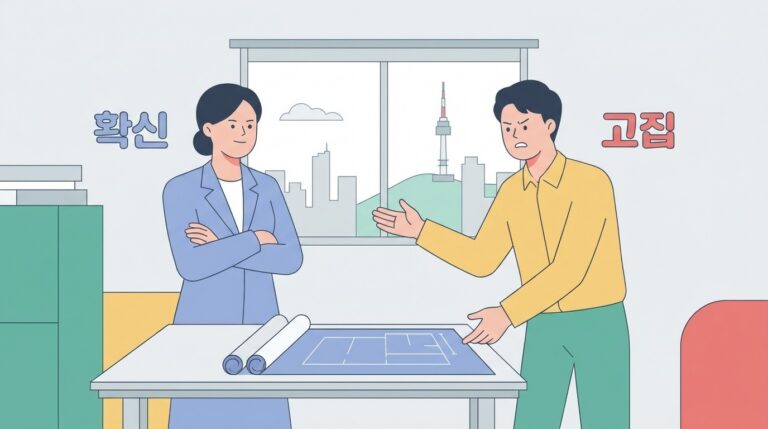
안녕하세요! 매일한글 에디터입니다.
Have you ever watched an intense K-drama boardroom showdown—think Queen of Tears or Itaewon Class—where two characters clash over an unyielding opinion? One is portrayed as a noble hero who never betrays his principles, while the other is painted as an insufferable tyrant refusing to compromise. In English, we might juggle words like “resolute,” “principled,” “stubborn,” or “dogmatic.” But in the nuanced emotional landscape of advanced Korean, using the wrong word here can either turn a respectful compliment into an unforgivable corporate insult—or flatter someone who actually deserves a wake-up call.
Just last month, one of our advanced learners, David, tried to compliment his Korean team lead during a high-stakes performance review. He wanted to praise his boss for sticking to his vision against the executive board. Intending to say “You are so principled and decisive,” he confidently said: “팀장님은 정말 독선적이세요! (Timjangnimeun jeongmal dokseonjeogiseyo!).” The entire meeting room froze in petrified silence. Why? While David thought dokseonjeogida meant “independent and firm,” he actually said: “Team Leader, you are a despotic, self-righteous dictator!” His boss cleared his throat, laughed awkwardly, and asked if David meant “소신이 있다 (sosin-i itda).”
This guide is born out of moments exactly like that. As a C1-level learner, you are moving beyond simple grammar into the territory of delicate social calibration. Today, we decode the fine line between holding true conviction and being insufferably rigid in Korean society.
Phase 2: Core Nuances Deep Dive (핵심 표현 3선)
1. 소신(이) 있다 (Sosin-i itda)
- Pronunciation: [so-sin-i it-da] (Think of ‘so’ as in ‘soul’, ‘sin’ as in ‘seen’, followed by a punchy ‘it-da’)
- Meaning: Literally “to possess one’s small belief” (소신/所信). In real usage, it means having an unwavering moral compass or holding steadfast convictions in the face of immense pressure or popular opposition.
- K-Culture Moment: Park Saeroyi in Itaewon Class choosing prison over kneeling before the Jangga Group patriarch. The public whispers: “그는 끝까지 자기 소신을 지켰어 (He defended his convictions until the bitter end).”
- Editor’s Insight: Sosin is profoundly respected in Korea precisely because collective harmony (눈치, nunchi) usually demands compromise. Having sosin means you are not being selfish; you are being morally courageous. It is almost always a high compliment.
- Situation Spectrum: Casual ✅ | Semi-formal ✅ | Formal ✅
- 🤔 Think About It: In your culture, is sticking to your personal creed valued over group cohesion, or is it seen as risky individualism?
2. 강단(이) 있다 (Gangdan itda)
- Pronunciation: [gang-dan it-da] (Sounds like ‘gahng’ like the river ‘Han’ with a hard G, and ‘dahn’ like dawn)
- Meaning: Having backbone, inner grit, and resolute tenacity. While sosin focuses on philosophical conviction, gangdan emphasizes physical and mental resolve under duress.
- K-Culture Moment: A calm, soft-spoken female CEO who politely listens to aggressive corporate rivals, then coolly signs an ultimatum without flinching. Her secretary whispers with awe: “우리 대표님, 체구는 작으셔도 강단이 보통 아니셔 (Our CEO may be small in stature, but her grit is no joke).”
- Editor’s Insight: Gangdan carries the feeling of internal steel beneath a gentle exterior (외유내강, oeyunaegang). It is one of the highest praises you can give someone who handles a crisis without breaking down.
- Situation Spectrum: Casual ✅ | Semi-formal ✅ | Formal ✅
- 🤔 Think About It: Does your native language distinguish between moral principle (sosin) and pure behavioral backbone (gangdan)?
3. 완고하다 (Wan-gohada) & 독선적이다 (Dokseonjeogida)
- Pronunciation: [wan-go-ha-da] / [dok-seon-jeo-gi-da] (Wan-go: rhymes with ‘tango’ with a ‘w’; Dok-seon: ‘dock’ + ‘sun’ + ‘jeo-gi-da’)
- Meaning:
- 완고하다: Stubborn, archaic, and stubbornly entrenched in old ways.
- 독선적이다: Self-righteous, autocratic, and believing “only I am correct” while ignoring everyone else.
- K-Culture Moment: The grumpy traditional patriarch who refuses to taste modern fusion food and bans his adult children from dating outside their hometown (wan-gohada), versus the ruthless chaebol villain who shouts over his board of directors and fires anyone who questions his strategy (dokseonjeogida).
- Editor’s Insight: Never use these words toward an elder or a superior in their presence unless you want to declare emotional or professional war. While wan-gohada focuses on stubborn resistance to change, dokseonjeogida highlights an aggressive disregard for others’ rights.
- Situation Spectrum: Casual (About others) ✅ | Semi-formal ⚠️ | Direct to Superiors 🚫
- 🤔 Think About It: Why does a community-oriented culture have such a rich, biting vocabulary for individuals who refuse to heed collective advice?
Phase 3: Textbook Korean vs. Real Korean
Scenario 1: Praising someone who won’t budge under executive pressure
- 📖 교과서 한국어 (Textbook): “김 부장님은 본인의 주장이 매우 강하십니다.” (Department Head Kim’s personal argument is very strong.)
- 🗣️ 진짜 한국어 (Real-life): “김 부장님, 위에서 아무리 흔들어도 끄떡없으시네. 진짜 뚝심 있고 강단 있으셔.” (Department Head Kim doesn’t flinch no matter how much upper management shakes him up. He has real grit and backbone.)
- 💡 왜 다를까? “주장이 강하다” can sound borderline defensive or contentious. Real Koreans admire emotional endurance (ttuksim) and quiet steel (gangdan).
Scenario 2: Venting about a colleague who refuses to listen
- 📖 교과서 한국어 (Textbook): “이 대리는 다른 사람의 의견을 수용하지 않습니다.” (Assistant Manager Lee does not accommodate others’ opinions.)
- 🗣️ 진짜 한국어 (Real-life): “이 대리랑은 진짜 말이 안 통해. 완전 벽창호에 독선적이라니까.” (You literally can’t communicate with Assistant Manager Lee. He’s a complete brick wall and entirely dogmatic.)
- 💡 왜 다를까? In venting contexts (뒷담화), advanced speakers employ idioms like 벽창호 (byeokchangho – stubborn donkey from Byeokdong) and socio-critical descriptors like 독선적이다 to emphasize the emotional futility of collaboration.
Phase 4: K-Culture Deep Dive & Non-Verbal Manners
4-1. 눈치 (Nunchi) & Body Language
When expressing sosin (firm conviction) respectfully in a Korean corporate setting, your posture must remain non-confrontational:
* The Sosin Tilt: Lower your chin slightly, maintain gentle but unblinking eye contact (approx. 70% of the time), and keep your hands loosely clasped on the table.
* The Apologetic Disagreement: Before stating your conviction, soften the blow with a physical nod and a soft hedge: “말씀의 취지는 충분히 이해합니다만… (I fully understand the intent of your words, however…)”
* What looks like 독선 (Dogmatism): Crossing your arms, scoffing, rolling your eyes toward the ceiling, or interrupting senior members mid-sentence instantly flips your perception from “passionate employee with sosin” to “insolent, dogmatic nuisance.”
4-2. Cultural Code: The Drama of Principles
Korean storytelling thrives on the friction between collective pressure and individual conviction. Think of legal dramas like Extraordinary Attorney Woo or Vincenzo. The hero’s moral virtue is consistently proven when they endure financial ruin or career demotion to honor their sosin. Conversely, the tragic downfall of senior villains usually stems from their prideful descent from being “respected leaders with authority” to becoming “완고하고 독선적인 꼰대 (stubborn and self-righteous relics).” In Korean philosophy, power without humility inevitably rots into dokseon.
Phase 5: Real-World Roleplay Scenario
Setting: A tense marketing strategy meeting at an agency in Gangnam. Team Leader Kang (강 팀장), known for his perfectionism, has proposed a risky, out-of-touch campaign.
Characters:
* 강 팀장 (Team Leader Kang): Veteran marketer, authoritative.
* 민호 (Minho): Mid-level designer, looking nervously at David.
* 데이비드 (David – You): Senior Strategist (C1 Korean learner).
Turn 1
강 팀장: “이번 런칭 캠페인은 기존 레트로 콘셉트 그대로 밀고 나갑니다. 내 직관을 믿으세요.”
(Ibeon reonching kaempeineun gijon reteuro konsepteu geudaero milgo nagamnida. Nae jikgwaneul mideuseyo.)
“We are pushing forward with the retro concept for this launch. Trust my intuition.”
🎭 [턱을 치켜들며 단호하게 서류를 탁자에 내려놓는다]
Turn 2
민호: “하지만 팀장님… 2030 타깃층 데이터는 전혀 다른 반응을 가리키고 있는데요…”
(Hajiman timjangnim… Isamsip tagitcheung deiteoneun jeonhyeo dareun baneungeul garikigo inneundeyo…)
“But Team Leader… the 2030 demographic data indicates a completely different response…”
🎭 [시선을 피하며 목소리가 기어들어간다]
Turn 3
강 팀장: “데이터가 다가 아니야. 내가 이 바닥에서만 15년이야!”
(Deiteoga daga aniya. Naega i badageseoman sibonyeon-iya!)
“Data isn’t everything. I’ve been in this industry for fifteen years!”
🎭 [미간을 찌푸리며 민호를 노려본다]
Turn 4
데이비드 (David): “팀장님, 팀장님의 오랜 경험과 직관은 저희 팀의 소중한 자산입니다.”
(Timjangnim, timjangnim-ui oraen gyeongheomgwa jikgwaneun jeohui tim-ui sojunghan jasan-imnida.)
“Team Leader, your long experience and intuition are invaluable assets to our team.”
🎭 [차분하게 눈을 맞추며 가볍게 목례를 한다]
Turn 5
강 팀장: “그렇지? 데이비드도 내 생각에 동의하지?”
(Geureochi? Deibideudo nae saenggage dong-uihaji?)
“Right? David, you agree with me, don’t you?”
🎭 [기대감에 찬 눈빛으로 팔짱을 낀다]
Turn 6
데이비드 (David): “그렇지만 이번 프로젝트의 성패를 위해서는 시장의 흐름도 무시할 수 없다는 것이 제 소신입니다.”
(Geureochiman ibeon peurojekteu-ui seongpaereul wihaeseoneun sijang-ui heureumdo musihal su eopdaneun geosi je sosin-imnida.)
“However, it is my firm conviction that for the success of this project, we cannot afford to ignore current market dynamics.”
🎭 [정중한 미소를 머금은 채 허리를 곧게 편다]
Turn 7
강 팀장: “허… 소신이라. 데이비드 씨, 오늘따라 제법 강단 있게 나오는데?”
(Heo… sosin-ira. Deibideu ssi, oneulttara jebeop gangdan itge naoneunde?)
“Ha… conviction, is it? David, you’re showing quite a spine of steel today, aren’t you?”
🎭 [안경을 고쳐 쓰며 헛기침을 한다]
Turn 8
데이비드 (David): “프로젝트의 성공을 바라는 마음만큼은 팀장님과 똑같습니다.”
(Peurojekteu-ui seonggongeul baraneun ma-eummankeumeun timjangnimgwa ttokgatseumnida.)
“My desire for this project’s success is identical to yours, sir.”
🎭 [양손을 단정히 모으고 부드럽게 대답한다]
🔀 Interactive Decision Point
How should David handle Team Leader Kang if Kang refuses to budge further?
- Option A: “팀장님은 왜 이렇게 완고하고 독선적이십니까? 팀원들 말 좀 들으세요!”
- Feedback: 🚫 Worst (Catastrophic). Calling a Korean supervisor wan-gohada and dokseonjeogida to his face is organizational suicide. You will be branded as insubordinate and disrespectful.
- Option B: “팀장님의 뚝심도 존경스럽지만, 이번만큼은 실무진의 강단 있는 결단도 한 번 믿어주십시오.”
- Feedback: 🏆 Best. You reframe Kang’s stubbornness positively as ttuksim (steadfast grit) while pitching the team’s counter-proposal as gangdan (courageous resolve). Maximum respect, maximum impact.
- Option C: “네, 알겠습니다. 팀장님 소신대로 하시죠.”
- Feedback: ⚠️ Risk (Passive-Aggressive). Using sosin here can sound slightly sarcastic, implying you are washing your hands of the impending disaster.
Phase 6: 10-Second Emotional Shadowing Drill
Practice these lines out loud with exact rhythmic pauses (/) and emotional tone markers:
[😤 차분하지만 절대 꺾이지 않는 소신을 담아]
비난을 받더라도 / 제 소신대로 / 밀고 나가겠습니다.
(Binaneul batdeorado / je sosindaero / milgo nagagetseumnida.)
“Even if I face criticism / according to my convictions / I will forge ahead.”-
[😮 감탄과 존경을 가득 담아]
그 압박 속에서도 타협하지 않다니 / 정말 강단 있는 분이에요.
(Geu appak sogeseodo tahyeophaji antani / jeongmal gangdan inneun bun-ieyo.)
“To not compromise under that pressure / they truly are someone with a spine of steel.” -
[😒 답답하고 피로감이 섞인 어조로]
자기 생각만 맞다고 우기니까 / 도무지 대화가 안 통해요.
(Jagi saenggangman matdago uginikka / domuji daehwaga an tonghaeyo.)
“Since they insist only their opinion is right / it’s simply impossible to communicate.”
Phase 7: K-Culture Mini Dictionary
-
뚝심 (Ttuksim) | Unshakeable grit / Staying power
Describes someone who silently perseveres through hardship or criticism without swaying, often seen in seasoned craftspeople, athletes, or steady business founders. -
줏대 (Juttae) | Self-determination / Backbone of opinion
The internal anchor of one’s mind. Frequently used in the negative idiom “줏대가 없다 (juttaega eopda),” meaning someone is wishy-washy and easily swayed by crowd sentiment. -
벽창호 (Byeokchangho) | Hopelessly stubborn person / A human brick wall
Historically originating from the sturdy, stubborn donkeys bred in Byeokdong and Changseong. Used colloquially when venting about someone who simply will not listen to logic. -
꼰대 (Kkondae) | Condescending elder / Dogmatic boomer
Slang for someone—regardless of biological age—who relies on past authority and rigid social hierarchy to impose their outdated worldviews onto others.
Phase 8: Traveler & Professional Survival Kit
Survival Expressions TOP 3
- “제 소신껏 결정하겠습니다.” (Je sosinkeot gyeoljeonghagetseumnida.)
Pro Tip: Use this in negotiations or shop settings when salespeople try to aggressively push you into upgrades: “I will decide according to my own judgment.” - “조금만 융통성을 발휘해 주실 수 있을까요?” (Jogeumman yungtongseong-eul balhwihae jusil su isseulkkayo?)
Pro Tip: When an official or clerk is being unyieldingly bureaucratic (wan-gohada), ask for yungtongseong (flexibility) instead of calling them stubborn. - “다양한 의견에 귀 기울여 주셔서 감사합니다.” (Dayanghan uigyeone gwi giuryeo jusyeoseo gamsahamnida.)
Pro Tip: The ultimate preemptive strike against a superior’s dogmatism (dokseon). Flatter their open-mindedness before they turn rigid!
Editor’s Travel Note
When navigating Korea’s public offices or negotiating travel reservations, you may run into staff who stick rigidly to manual protocols. In these moments, do not raise your voice or argue dogmatically. Instead, equip yourself with accurate data before you walk in! We strongly recommend using the Naver Map app download for real-time transit and venue hours to confirm local policies ahead of time. If you run into payment roadblocks where stores unyieldingly refuse foreign cards, having a backup digital payment handy—such as checking the official Toss Card registration and mobile payment guide—will save you from hours of frustrating debate!
Phase 9: A Step Deeper (한 발 더 깊이)
Historically, traditional Korean society placed supreme value on collectivism, filial piety, and communal harmony (hwarang spirit, pumasi, and Confucian hierarchy). In such a cultural ecosystem, sticking out from the crowd (모난 돌이 정 맞는다 — “the stone that sticks out gets hit with the chisel”) was often branded as selfish or dokseonjeogida. However, in modern, fast-evolving Korea, true moral spine—sosin—has evolved into one of the most celebrated personal virtues, especially among the millennial and Gen Z workforce who yearn for authentic, uncorrupted leadership.
💬 Your Turn: Have you ever encountered a situation where your principled stance was misunderstood as stubbornness? How would you describe your attitude using today’s Korean words: 소신 (sosin), 강단 (gangdan), or 뚝심 (ttuksim)? Share your experience in the comments below!
Phase 10: FAQ & Common Mistakes
Q: Can I compliment my Korean boss by saying “정말 고집이 세시네요” (You have such strong stubbornness)?
A: Absolutely not! 고집 (gojip) carries an inherently negative connotation of stubborn pig-headedness. Even if you mean “perseverant,” calling your senior gojibi seda will come off as rude. Instead, praise them with “소신이 뚜렷하십니다” (Your convictions are so clear) or “뚝심이 대단하십니다” (Your staying power and grit are incredible).
Q: What is the exact difference between ‘소신’ (sosin) and ‘신념’ (sinnyeom)?
A: While both mean conviction, 신념 (sinnyeom) represents a grand, often philosophical or religious ideology (e.g., “자유라는 신념” – the belief in freedom). 소신 (sosin) is one’s personal, practical guiding principle applied in day-to-day decisions, work ethics, and moral standpoints.
Q: Is ‘강단 있다’ only used for women or small-statured people?
A: Not exclusively, but it is most vividly used when someone’s outer appearance or quiet demeanour contrasts with their fierce internal resolve. When an imposing bodybuilder refuses to back down, people often say 기백이 있다 (spirited); when a calm, gentle-looking individual stands their ground, Koreans love to say 강단 있다.
🚨 흔한 실수 (Common Mistakes) 경고판
- ❌ Mistake 1: Calling someone’s dedication 독선 (dokseon) thinking it means “independent leadership.”
- Correct Action: Replace with 소신 (sosin) or 추진력 (chujinryeok – driving force).
- ❌ Mistake 2: Using 완고하다 (wan-gohada) directly to an elder: “할머니는 완고하세요.”
- Correct Action: Soften into “할머니는 옛 방식을 소중히 여기세요” (Grandmother deeply cherishes the old traditions).
- ❌ Mistake 3: Saying “저는 독선적인 성격입니다” in a job interview.
- Correct Action: Say “저는 주관이 뚜렷하고 강단 있는 편입니다” (I have clear personal convictions and a firm backbone).
Phase 11: Action Missions (액션 미션)
- 🥉 Bronze Mission (Self Practice): Look in the mirror and shadow the Phase 6 drill lines 3 times each, paying sharp attention to the tone shift between proud conviction and weary frustration.
- 🥈 Silver Mission (Social Connection): Choose your favorite K-drama protagonist and write a one-sentence character description on your Instagram or Threads using either 소신 있다 or 강단 있다. Tag us at
@DailyHangul! - 🥇 Gold Mission (Real-World Application): In your next Korean language exchange or conversation with a native speaker, praise someone who showed grit by saying: “그 어려운 상황에서도 강단 있게 대처하셨네요!”
- 🎮 K-Culture Mission: Watch an episode of a Korean workplace or courtroom drama. Listen closely for whether opposing characters accuse the hero of having 고집 (gojip) while their allies praise them for having 소신 (sosin).
Phase 12: Interactive Quiz Challenge
Quiz 1: Nuance Distinction
Which word best fits the blank?
“그 정치인은 거센 당내 반발에도 불구하고, 평소 자신의 ( )대로 법안을 발의했다.”
* A) 독선 (Dokseon)
* B) 완고 (Wan-go)
* C) 소신 (Sosin)
* D) 줏대 없음 (Juttae eopseum)
정답과 해설 보기 (Click for Answer & Explanation)
정답: C) 소신 (Sosin)
해설: In the context of standing up to political or institutional pressure to do what one believes is right, 소신 (principled conviction) is the ideal word. 독선 and 완고 carry negative connotations of arrogant pig-headedness that do not fit a constructive legislative initiative.
Quiz 2: Dialogue Fill-in-the-Blank
Complete the sentence with the word that represents gritty tenacity:
“우리 팀 막내는 겉으로는 얌전해 보이지만, 위기 상황이 오면 흔들림 없이 수습하는 ( )이/가 있는 친구예요.”
정답과 해설 보기 (Click for Answer & Explanation)
정답: 강단 (Gangdan)
해설: The contrast between an unassuming, polite exterior and courageous crisis management is the textbook usage of 강단 있다 (having backbone/grit).
Quiz 3: True or False (Culture Check)
True or False: Calling your Korean department head “완고한 분” directly to his face during a dinner banquet (회식) is understood as a playful compliment honoring his steadfast wisdom.
정답과 해설 보기 (Click for Answer & Explanation)
정답: False!
해설: 완고하다 explicitly faults someone for being rigid, old-fashioned, and impervious to sound reasoning. Calling your boss 완고한 분 to his face will freeze the atmosphere faster than an iced Americano in mid-winter! Instead, use 뚝심 있는 분 or 소신이 뚜렷하신 분.
🎬 Watch Our Daily Videos! (Daily Hangul Official Instagram)
Review the expressions you learned in this article with our fun daily short videos! Check out native pronunciation and real-life nuances in action.
- Instagram @dailyhangul_en







