

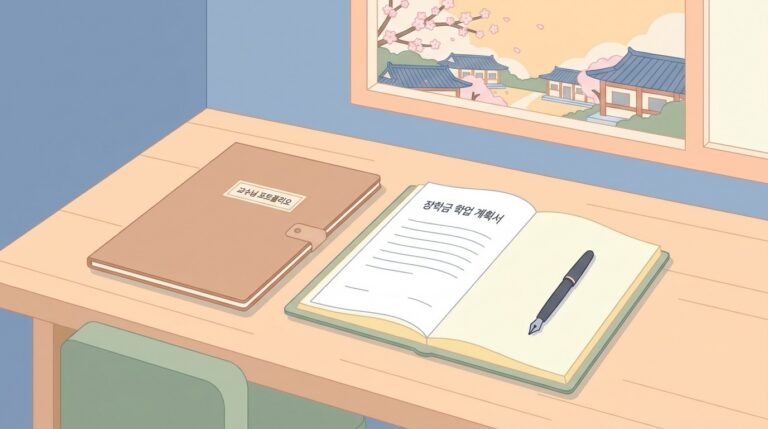
Master the Art of Requesting a Recommendation Letter in Korea: How to Prepare the Ultimate Reference Packet
Phase 1: Empathy (Story-Driven Opening)
안녕하세요! 매일한글 에디터입니다. (Hello! It’s your Daily Hangul editor.)
Imagine this scenario: You are sitting at your desk late at night, staring at the Global Korea Scholarship (GKS) or foundation application portal. The deadline is looming in four weeks, and you need two critical letters of recommendation (추천서 – chucheonseo). You open your email client, type “Dear Professor…” and instantly freeze. Your mind races: Is asking a busy Korean professor too burdensome? What if they forgot who I was among 150 students? Will I sound entitled or pushy if I ask them to write 500 words about my academic virtues?
If you have ever watched the college drama Cheese in the Trap or the high-stakes academic battles in Crash Course in Romance, you know that relationships between Korean university professors and their students are defined by deep mutual respect, unspoken boundaries, and a hyper-sensitive social barometer known as 눈치 (nunchi). In Korean academia, professors are genuinely thrilled to see their international students succeed. However, writing a detailed, persuasive scholarship recommendation takes hours of cognitive labor.
Here is the golden rule of Korean academic etiquette: Never ask for a favor without doing 80% of the groundwork yourself. By delivering a complete, impeccably organized packet—containing your academic transcript, CV, draft study plan, and standout assignments completed in their course—you transform a stressful burden into an effortless endorsement. In this guide, tailored specifically for B2 intermediate learners, we will unpack the exact Korean expressions, psychological cues, and cultural strategies you need to approach your professors with polished humility and sharp competence.
Phase 2: Core Expressions Deep Dive
1. 교수님의 부담을 덜어 드리고자 관련 서류를 미리 정리해 보았습니다. (한글)
- Pronunciation: Gyosunim-ui budam-eul deol-eo deurigoja gwanlyeon seolyureul miri jeongrihae boasseumnida. (Sounds like: Gyo-soo-neem-wee boo-dahm-eul dull-uh doo-ree-goh-jah gwahn-ryun suh-ryoo-reul mee-ree jung-nee-hae boh-aht-seum-nee-dah)
- Meaning: Literal: “Wishing to lessen the professor’s burden, I arranged the relevant documents in advance.” | Real Nuance: “I know how busy you are, so I’ve already done the legwork to make writing this recommendation as fast and painless for you as possible.”
- K-Culture Moment: Think of an ambitious graduate student in Law School handing a neat leather folder to their senior mentor with both hands before the professor even needs to ask for context.
- Editor’s Insight: The connective ending -고자 (-goja) is an elegant, formal B2-level grammar pattern expressing intent. Pairing it with the humble auxiliary verb 드리다 (deurida – to give/offer to an elder) showcases top-tier Korean politeness.
- Situation Spectrum: Casual 🚫 | Semi-formal ⚠️ | Formal ✅
- 🤔 Think About It: In many Western universities, students expect professors to look up their records. Why does Korean culture place the responsibility of “lightening the burden” (부담을 덜다) squarely on the person making the request?
2. 부족하지만 지난 학기 교수님 강의에서 제출했던 과제물도 함께 첨부하였습니다. (한글)
- Pronunciation: Bujokhajiman jinan hakgi gyosunim gang-uieseo jechulhaetdeon gwajemuldo hamkke cheombuhayeosseumnida. (Sounds like: Boo-johk-hah-jee-mahn jee-nahn hahk-gee gyo-soo-neem gahng-wee-eh-suh jeh-chool-haet-duhn gwah-jeh-mool-doh hahm-kkeh chuhm-boo-hah-yuh-sseum-nee-dah)
- Meaning: Literal: “Though lacking, I also attached the assignment submitted in your lecture last semester.” | Real Nuance: “Here is a tangible sample of the top-grade work I did in your course to jog your memory and provide specific evidence for the recommendation.”
- K-Culture Moment: In Korean business and academic life, acknowledging that your work is 부족하다 (bujokhada – deficient/humble) is not self-deprecation; it is an essential ritual of modesty (겸양의 미덕) before displaying excellence.
- Editor’s Insight: By attaching the exact graded assignment with the professor’s original comments, you instantly remind them: “Ah! This is the student who scored an A+ on the policy analysis paper.”
- Situation Spectrum: Casual 🚫 | Semi-formal ⚠️ | Formal ✅
- 🤔 Think About It: How does starting a sentence with a modest disclaimer change the power balance in hierarchical communication?
3. 혹시 추가로 보완할 내용이나 필요한 서류가 있으시면 언제든 편히 말씀해 주십시오. (한글)
- Pronunciation: Hoksi chugaro bowanhal naeyong-ina pil-yohan seolyuga isseusimyeon eonjedeun pyeonhi malsseumhae jusipsio. (Sounds like: Hohk-shee choo-gah-roh boh-wahn-hahl nae-yong-ee-nah peel-yo-hahn suh-ryoo-gah eess-eu-shee-myun uhn-jeh-deun pyuhn-hee mahl-sseum-hae joo-sheep-shee-oh)
- Meaning: Literal: “If by chance there is content to supplement or necessary documents, please comfortably tell me at any time.” | Real Nuance: “I am entirely at your service to provide more data if anything is missing.”
- K-Culture Moment: The polite softening adverb 혹시 (hoksi – by any chance) acts as an linguistic shock absorber, ensuring your follow-up request does not sound like a rigid command.
- Editor’s Insight: Using 말씀해 주십시오 (malsseumhae jusipsio) instead of 말해주세요 elevates the entire closing paragraph to professional academic standard.
- Situation Spectrum: Casual 🚫 | Semi-formal ⚠️ | Formal ✅
- 🤔 Think About It: Contrast the direct English statement “Let me know if you need anything else” with the Korean indirect, layered honorific formulation.
Phase 3: Textbook Korean vs. Real Korean
Situation 1: Asking the Professor to Check Your Attached Portfolio
- 📖 교과서 한국어 (Textbook): 제가 보낸 첨부파일을 확인하세요. (Jega bonaen cheombupaileul hwaginhaseyo. – Please check the attached files I sent.)
- 🗣️ 진짜 한국어 (Real-World): 서류를 첨부파일로 묶어 송부해 드렸으니 너른 마음으로 검토 부탁드립니다. (Seolyureul cheombupaillo mukkeo songbuhae deulyeosseuni neoreun ma-eumeuro geomto butakdeurimnida. – I have compiled and sent the documents as an attachment, so I kindly ask for your generous review.)
- 💡 왜 다를까? (Why the Difference?): Using
~하세요with a professor sounds like a workplace manager issuing a task checklist. Real Korean academic correspondence utilizes humble verbs like송부해 드리다(to deliver/send upward) and polite request forms like검토 부탁드립니다(I request your inspection).
Situation 2: Emphasizing That You Prepared Materials to Save Their Time
- 📖 교과서 한국어 (Textbook): 교수님이 바쁘니까 제가 자료를 다 찾아서 보냅니다. (Gyosunimi bappeunikka jega jaryoreul da chajaseo bonaemnida. – Because the professor is busy, I found all the materials and am sending them.)
- 🗣️ 진짜 한국어 (Real-World): 일정에 조금이나마 무리가 없으시도록 참고 자료를 일목요연하게 정리해 두었습니다. (Iljeong-e jogeuminama muriga eopseusidorok chamgo jaryoreul ilmogyoyeonhage jeongrihae dueosseumnida. – To minimize any disruption to your demanding schedule, I have synthesized the reference materials clearly at a glance.)
- 💡 왜 다를까? (Why the Difference?): Never tell a Korean superior directly that they are “busy” (바쁘다) as a justification for your action. Instead, phrase your assistance as an effort to avoid burdening their routine (
무리 없으시도록), showing exceptional organizational polish (센스 – sense).
Phase 4: K-Culture Deep Dive & Non-verbal Etiquette
4-1. 눈치 (Nunchi) & Digital Manners
When communicating with Korean university faculty, digital etiquette carries the same weight as physical bows:
1. The Digital Presentation Standard: Never send raw, haphazard file attachments named document(1).pdf or draft_final_v2.docx. Name your files systematically: [GKS지원_추천서참고자료]_학번_이름.pdf. Compress all supplemental items into one neatly categorized PDF or a single master ZIP archive.
2. The 9-to-5 Golden Window: Sending an academic email at 11:30 PM on Sunday creates the impression of uncoordinated urgency. Schedule your email to land in your professor’s inbox between 9:15 AM and 10:30 AM on Tuesday through Thursday.
3. In-Person Portfolio Etiquette: If you visit the professor’s laboratory (연구실 – yeongusil), present printed physical copies in a clear transparent folder. Use both hands (두 손으로) to present the folder with the document facing the professor so they can read it immediately without rotating it.
4-2. Cultural Code: The Sacred Mentor-Disciple Bond (사제지간 – Sajejigan)
In traditional Korean society, there is an enduring proverb: “스승의 그림자는 밟지도 않는다” (One does not even step on the shadow of one’s teacher). While modern Korean campuses are vibrant and democratic, the cultural core of the 사제지간 (sajejigan – teacher-student relationship) still emphasizes that guidance is a moral investment, not a transactional administrative service. When you proactively prepare your portfolio packet, the professor doesn’t see a self-centered applicant; they see a student who honors their time and demonstrates the maturity required to represent the university abroad.
Phase 5: Real-World Roleplay Scenario
- Background: Office 408, Department of International Relations, Seoul National University. Alex (a B2 intermediate exchange student) has knocked on the door of Professor Park (박 교수님), an internationally renowned policy advisor.
Turn 1: Alex (알렉스)
🎭 Standing upright by the door, bowing at a 30-degree angle.
교수님, 실례지만 잠시 이야기 나눌 시간 있으십니까?
Gyosunim, sillyejiman jamsi iyagi nanul sigan isseusipnikka?
“Professor, excuse me, but might you have a brief moment to speak?”
Turn 2: Professor Park (박 교수님)
🎭 Looking up from a research monograph, taking off reading glasses with a mild smile.
어, 알렉스 학생. 마침 논문 교정 끝났으니 들어와요. 무슨 일이에요?
Eo, Allekseu haksaeng. Machim nonmun gyojeong kkeutnasseuni deureowayo. Museun il-ieyo?
“Oh, Alex. I just finished proofreading a paper, so please come in. What brings you by?”
Turn 3: Alex (알렉스)
🎭 Stepping forward, holding a neatly bound clear folder with both hands.
다름이 아니라, 이번에 정부초청장학생(GKS) 프로그램에 지원하게 되었습니다. 혹시 교수님께 추천서를 부탁드려도 될지 여쭙고자 찾아뵈었습니다.
Dareumi anira, ibeone jeongbuchocheongjanghaksaeng(GKS) peurogeuraeme jiwonhage doe-eosseumnida. Hoksi gyosunimkke chucheonseoreul butakdeulyeodo doelji yeojjupgoja chajaboe-eosseumnida.
“To get straight to the point, I am applying for the Global Korea Scholarship (GKS). I came to respectfully ask if I might trouble you for a recommendation letter.”
Turn 4: Professor Park (박 교수님)
🎭 Leaning back thoughtfully, clasping hands.
GKS 장학금? 경쟁률이 꽤 높을 텐데 도전하는 모습이 보기 좋네요. 그런데 내가 요즘 학기말 심사 기간이라 일정이 많이 촉박한데… 마감이 언제인가요?
GKS janghakgeum? Gyeongjaengryuli kkwae nopeul tende dojeonhaneun moseubi bogi jochneyo. Geurende naega yojeum hakgimal simsa gigilira iljeongi mani chokbakan-de… Magami eonjeingayo?
“The GKS scholarship? The competition is fierce, so it’s commendable to see you take this on. However, with end-of-semester reviews right now, my schedule is quite tight… When is the deadline?”
Turn 5: Alex (알렉스)
🎭 Placing the reference packet gently on the coffee table with both hands, open toward the professor.
마감은 3주 뒤입니다. 교수님의 부담을 덜어 드리고자 성적증명서, 이력서, 학업계획서 초안, 그리고 지난 학기 수업 때 칭찬해 주셨던 과제물을 파일로 묶어 정리해 왔습니다.
Magameun sam-ju dwi-imnida. Gyosunim-ui budam-eul deol-eo deurigoja seongjeokjeungmyeongseo, iryeokseo, hageopgyohoekseo cho-an, geurigo jinan hakgi sueop ttae chingchanhae jusyeotdeon gwajemureul paillo mukkeo jeongrihae wasseumnida.
“The deadline is three weeks away. To ease your burden, professor, I compiled my transcript, CV, draft study plan, and the project paper you commended in class last semester into this organized portfolio.”
Turn 6: Professor Park (박 교수님)
🎭 Flipping through the organized tabs with a pleased, impressed expression.
허허, 알렉스 학생이 아주 야무지게 준비해 왔네. 지난 학기에 쓴 동아시아 안보 분석 리포트도 들어있군요. 구체적인 사례를 적기 아주 수월하겠어요.
Heoheo, Allekseu haksaeng-i aju yamujige junbihae watne. Jinan hakgi-e sseun dong-asia anbo bunseok ripoteudo deul-eo-itgunyo. Guchejeogin saryereul jeokgi aju suweolhagess-eoyo.
“Haha, you have prepared this exceptionally thoroughly, Alex! Even your East Asian security analysis report from last semester is here. This will make it very easy to cite specific examples.”
Turn 7: Alex (알렉스)
🎭 Nodding respectfully with shoulders lowered in humility.
바쁘신 와중에 신경 써 주셔서 진심으로 감사드립니다. 혹시 추가로 필요한 서류가 있으시면 언제든 편히 말씀해 주십시오.
Bappeusin wajung-e singyeong sseo jusyeoseo jinsimeuro gamsadeurimnida. Hoksi chugaro pil-yohan seolyuga isseusimyeon eonjedeun pyeonhi malsseumhae jusipsio.
“Thank you sincerely for your consideration amidst your busy schedule. If there are any additional documents you need, please let me know at any time.”
Turn 8: Professor Park (박 교수님)
🎭 Nodding and setting the file onto his priority tray.
좋아요. 주말 동안 꼼꼼하게 읽어보고 다음 주 화요일까지 멋지게 써 줄게요. 메일로도 이 파일들 그대로 한 번 쏴 줘요.
Joh-ayo. Jumal dong-an kkomkkomhage ilgeo-bogo da-eum ju hwayo-ilkkaji meotjige sseo julgeyo. Meillo-do i pildeul geudaero han beon sswa jwoyo.
“Great. I’ll read through it thoroughly over the weekend and write a stellar letter by next Tuesday. Send these exact files to my email as well.”
🔀 Interactive Decision Point
How would you reply to the professor’s request to send the files via email?
- Option A: “네, 지금 바로 메일 보낼 테니까 꼭 다음 주 화요일까지 써 주세요.” (Ne, jigeum baro meil bonael tenikka kkok daeum ju hwayo-ilkkaji sseo juseyo. – Yes, I’ll email it right now, so make sure you write it by next Tuesday.)
- Option B: “네, 교수님 연구실을 나가는 즉시 PDF 파일로 일목요연하게 정리하여 메일로 송부해 올리겠습니다. 귀한 시간 내주셔서 다시 한번 감사드립니다.” (Ne, gyosunim yeongusireul naganeun jeuksi PDF paillo ilmogyoyeonhage jeongrihayeo meillo songbuhae olligess-eumnida. Gwihan sigan naejusyeoseo dasi hanbeon gamsadeurimnida. – Yes, as soon as I leave your office, I will synthesize everything neatly in a PDF and submit it by email. Thank you once again for sparing your precious time.)
- Option C: “메일 주소 알려주세요. 확인하시면 바로 답장 부탁드립니다.” (Meil juso allyeojuseyo. Hwaginhasimyeon baro dapjang butakdeurimnida. – Give me your email address. Reply immediately once you check it.)
Analysis:
* Option A is [RISK ⚠️]: Saying 꼭 써 주세요 (make sure you write it) borders on issuing an order to a faculty member. It ruins the excellent rapport built.
* Option B is [BEST ✅]: Shows lightning speed, proper deference (송부해 올리겠습니다), and expresses sincere gratitude for the professor’s precious time.
* Option C is [BAD 🚫]: Asking a professor for their email address (which is public on the faculty directory) reveals a lack of basic preparation, and demanding an immediate reply (바로 답장) is an etiquette catastrophe.
Phase 6: 10-Second Emotion Shadowing Drill
Practice these lines out loud. Focus on the pitch accents, the humble tonal descent, and pause cleanly at each slash (/).
- [😊 정중하고 조심스럽게 – Respectful & Tentative]
교수님의 부담을 / 조금이나마 덜어 드리고자 / 서류를 미리 정리해 보았습니다.
Gyosunim-ui budam-eul / jogeuminama deol-eo deurigoja / seolyureul miri jeongrihae boasseumnida.
(To lighten the professor’s burden even slightly / I compiled the documents in advance.) -
[✨ 자신감과 겸손을 담아 – Confident Yet Modest]
부족하지만 / 지난 학기 강의에서 수행했던 과제물도 / 함께 동봉하였습니다.
Bujokhajiman / jinan hakgi gang-uieseo suhaenghaetdeon gwajemuldo / hamkke dongbonghayeosseumnida.
(Though deficient / the project report carried out in your lecture last semester / is enclosed together.) -
[🙏 진심 어린 감사를 담아 – Sincere & Deeply Grateful]
바쁘신 연구 일정 중에도 / 귀한 시간 내어 주셔서 / 진심으로 머리 숙여 감사드립니다.
Bappeusin yeongu iljeong jung-edo / gwihan sigan nae-eo jusyeoseo / jinsimeuro meori sugyeo gamsadeurimnida.
(Even amidst your busy research agenda / granting me your precious time / I bow my head in sincere gratitude.)
Phase 7: K-Culture Mini Dictionary
-
추천서 (Chucheonseo) [Recommendation Letter]
In Korea, a chucheonseo is rarely an open-ended generic template. It is expected to testify to specific academic achievements, ethics, and character. Faculty seal it in stamped university envelopes or upload directly via protected institutional portals. -
학업계획서 (Hageopgyohoekseo) [Study Plan / Statement of Purpose]
Unlike personal statements focusing on life memoirs, a Korean hageopgyohoekseo requires structured sections: Motivation (지원동기), Academic Milestones (학업목표), and Post-Graduation Career Pathway (졸업 후 진로계획). -
부담을 덜다 (Budam-eul deolda) [To Lighten the Burden]
A critical interpersonal idiom in Korean collectivism. Whether bringing coffee to a coworker or pre-filling a form for an elder, demonstrating that you are actively reducing another person’s cognitive burden is the highest form of social etiquette. -
첨부서류 (Cheombuseoryu) [Attached Documents / Enclosures]
The formal administrative standard term used in emails and academic portals for attached portfolios, transcripts, and certificates.
Phase 8: Expat & Student Survival Kit
Top 3 Academic Survival Expressions
- 면담 일정을 잡고 싶습니다. (Myeondam iljeong-eul japgo sipsumnida.)
Pro Tip: Use this when emailing a professor for an office appointment. Never write “Can I see you tomorrow?”; offer 2-3 specific time slots. - 공식 서식에 맞춰 작성해 주시면 됩니다. (Gongsik seosig-e matchwo jakseonghae jusimyeon doemnida.)
Pro Tip: “You can simply fill out the official template.” Reassures the professor that they don’t have to draft formatting from scratch. - 마감일은 이번 달 말일까지입니다. (Magam-ireun ibeon dal mar-ilkkaji-imnida.)
Pro Tip: Clearly states the deadline with ample margin. In Korean universities, always state the deadline as at least 5 business days earlier than the true institutional portal closeout.
Editor’s Academic Survival Note
When communicating with Korean university administrative portals, you must download the official .hwp or .hwpx viewer (Hangul Word Processor). Check your university’s intranet via 대한민국 대학 포털 서식 다운로드 센터 to verify whether scholarship letters must be submitted via university letterhead or an encrypted institutional email address.
Phase 9: “한 발 더 깊이” (Going Deeper: Cultural Essay)
In many Western education systems, independence is shown by maintaining direct boundaries: you make your request, the professor fulfills their duty, and the transaction is closed. However, Korean society operates on the bedrock of 상호 배려 (mutual anticipation and consideration). When you ask someone of higher social standing for help, you incur a delicate psychological debt. Providing a spotless reference packet—containing your transcripts, CV, and exemplary course papers—is not merely an organizational trick; it is an act of 예의 (ye-ui – etiquette). It signals: “I value your time as much as my own future.” When you honor the professor’s effort through your preparation, they don’t just write a recommendation—they become your genuine advocate.
- 💬 Your Turn: How does requesting an academic recommendation in your home country differ from this Korean practice? Have you ever felt hesitant to reach out to a mentor? Share your experiences in the comments below!
Phase 10: FAQ & Avoiding Misunderstandings
Q: How far in advance should I ask a Korean professor for a recommendation letter?
A: The golden window is 3 to 4 weeks prior to the application deadline. Anything less than two weeks in Korea is considered impolite (결례 – gyeollye), as professors sit on national research committees, conduct final grade adjudications, and travel to academic conferences. If you must ask on short notice, open with profound apologies for the sudden schedule interruption.
Q: Should I offer to write a full draft of the recommendation letter for the professor to sign?
A: In Korean academia, you should provide a detailed draft summary of bullet points and key achievements, but never say “Here is the letter, please just sign it.” That implies the professor’s personal assessment is irrelevant. Frame it as: “To assist you, I have summarized my key project highlights and research interests for your reference.”
Q: What should I give the professor as a thank-you gift after they submit the letter?
A: Under the strict South Korean anti-corruption legislation known as the Kim Young-ran Act (김영란법), students cannot give gifts of monetary value, gift cards, or lavish items to professors with whom they currently have grade evaluations. Instead, write a sincere, handwritten thank-you letter (손편지) and perhaps a modest cup of coffee or tea during working hours once the final decision has been submitted.
🚨 Common Mistakes Warning Board
- Mistake 1: Sending an email with unorganized, separate files.
Correct Action: Combine all relevant materials into a single bookmarked PDF named[GKS추천서자료]_지원자이름_전공.pdf. - Mistake 2: Failing to specify the scholarship agency and submission method.
Correct Action: State explicitly in the first paragraph whether the letter must be sealed in an envelope, emailed directly, or uploaded to an online portal. - Mistake 3: Disappearing after the recommendation is sent.
Correct Action: Send an immediate thank-you note when they submit, and always report the final scholarship result back to the professor—even if you did not get accepted.
Phase 11: Action Mission & Community Challenge
- 🥉 Bronze Level: Write down the 3 core expressions from Phase 2 in your notebook, highlighting the formal connective
-고자and the modest adjective부족하지만. - 🥈 Silver Level: Draft your own mock email to a professor requesting a recommendation letter using at least two real-world phrases from Phase 3. Review the file naming format!
- 🥇 Gold Level: Share a 15-second audio recording in the Daily Hangul community practicing the Shadowing Drill from Phase 6, focusing on genuine warmth and humble respect.
- 🎮 K-Culture Mission: Watch an episode of a campus-based K-Drama (Weightlifting Fairy Kim Bok-joo, Law School, or Twenty-Five Twenty-One). Observe how students address their academic advisors (교수님) and spot the exact physical bows they use when entering and exiting an office.
Phase 12: Interactive Quiz Challenge
Test your mastery of Korean academic etiquette with this 3-question challenge!
- Situational Judgment: Which of the following is the most culturally appropriate way to introduce your past class assignments in an email requesting a recommendation letter?
- (A) 제가 제출했던 과제 중 제일 잘한 걸 보냈으니 참고하세요.
- (B) 부족하지만 지난 학기 교수님 강의에서 제출했던 과제물도 함께 첨부하였습니다.
- (C) 과제물 확인하시고 제 실력을 칭찬해 주세요.
- Fill-in-the-Blank: Complete the sentence with the appropriate formal B2-level grammar:
- “교수님의 부담을 조금이나마 덜어 _______(드리다 + -고자) 관련 서류를 미리 정리해 보았습니다.”
- True / False Cultural Nuance: Under Korean academic culture and current public regulations, it is customary to buy an expensive department store gift set for your professor before they write your scholarship recommendation.
- True or False?
Click to reveal answers & explanations!
- Answer: (B)
Explanation: Option (B) demonstrates the golden balance of modesty (부족하지만) and high academic formality (첨부하였습니다). Option (A) uses an overly casual imperative (참고하세요), and Option (C) is wildly presumptuous and rude. -
Answer: 드리고자 (deuligoja)
Explanation: Combining the humble auxiliary verb드리다with the B2 intention connective-고자produces the polished phrase:덜어 드리고자(wishing to lighten [your burden]). -
Answer: False
Explanation: Strict anti-graft laws (김영란법) prohibit giving valuable gifts to university professors with whom direct academic evaluations occur. The most prized and culturally appropriate response is a polite handwritten letter of gratitude (손편지) followed by an update on your scholarship admission outcome!
🎬 Watch Our Daily Videos! (Daily Hangul Official Instagram)
Review the expressions you learned in this article with our fun daily short videos! Check out native pronunciation and real-life nuances in action.
- Instagram @dailyhangul_en







