

Speed vs. Direction: Rethinking Compressed Modernity in Fluent Korean
Phase 1: 공감 (Story Opening)
안녕하세요! 매일한글 에디터입니다. (Hello! This is your Daily Hangul editor.)
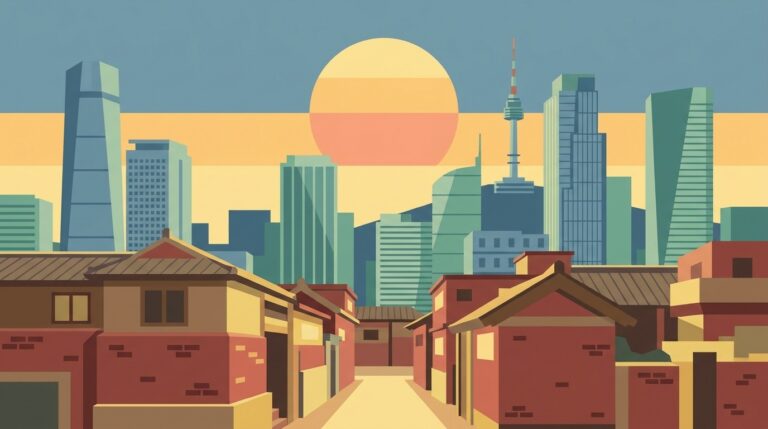
Picture this: You are sitting at a late-night pojangmacha in Euljiro, surrounded by neon signs, glass skyscrapers, and weathered alleyways. You are watching a scene straight out of a critically acclaimed drama like My Mister (나의 아저씨) or Misaeng (미생). Your Korean friend sighs after another grueling 70-hour work week and murmurs, “We ran so fast, but where are we actually running to?”
You understand the historical gravity behind this sentiment. You know how South Korea transformed from post-war ashes into an economic powerhouse within a single generation—a sociological miracle known as 압축 성장 (Compressed Modernity). But when you want to join this deep conversation, you freeze. Standard textbook Korean only gave you words like “경제 발전이 빨라요” (Economic development is fast) or “힘내세요” (Cheer up). You want to articulate the profound dilemma between economic efficiency and human dignity, yet your vocabulary feels trapped in elementary school.
Many advanced Korean learners reach this exact wall at the C1 level. You can read newspaper editorials, but participating in heartfelt, philosophically grounded socio-cultural discussions requires nuance, cultural empathy, and sharp phrasing. Today, we will unpack the exact expressions native Koreans use when reflecting on growth, speed, and the restoration of human solidarity.
Phase 2: 핵심 표현 3선 심층 분석 (Key Expressions Analysis)
1. 속도보다 방향이 중요해요 (Sogdoboda banghyang-i jung-yohaeyo)
- Pronunciation: [Sok-tto-bo-da bang-hyang-i jung-yo-hae-yo] (Sounds like: Sohk-ttoh-boh-dah bahng-hyahng-ee joong-yoh-heh-yoh)
- Meaning: Literal: “Direction is more important than speed.” / Actual Nuance: A philosophical plea to pause relentless productivity and question whether our goals honor human well-being.
- K-Culture Moment: Often heard in introspective documentary narrations or uttered by weary, principled mentors in K-dramas when junior colleagues face severe burnout.
- Editor’s Insight: In a society dominated by the “빨리빨리” (hurry, hurry) mindset, saying this isn’t just an observation; it is an act of gentle resistance against unchecked hyper-efficiency.
- Situation Spectrum: Casual: ✅ | Semi-formal: ✅ | Formal: ✅
- 🤔 Think About It: Does your native culture prioritize speed or destination? How does the linguistic weight of “방향” (direction) shift your perspective on productivity?
2. 사람답게 살 권리와 사회적 연대를 고민해야죠 (Saramdapge sal gwonriwa sahoejeok yeondaereul gominhaeyajyo)
- Pronunciation: [Sa-ram-dap-kke sal gwon-ni-wa sa-hoe-jeok yeon-dae-reul go-min-hae-ya-jyo]
- Meaning: Literal: “We must ponder the right to live like a human and social solidarity.” / Actual Nuance: A mature appeal to restore collective empathy over cutthroat competition.
- K-Culture Moment: Frequently featured in panel discussions on public broadcast programs like KBS Special or university student union debates.
- Editor’s Insight: The phrase “사람답게 살다” (to live with human decency) has deep roots in modern Korean labor history, particularly commemorating Jeon Tae-il’s sacrifice during Korea’s industrial push in the 1970s.
- Situation Spectrum: Casual: ⚠️ (sounds academic) | Semi-formal: ✅ | Formal: ✅
- 🤔 Think About It: How does your language express “human dignity”? In Korean, attaching “-답게” implies living up to the profound responsibility of being human.
3. 각자도생의 시대를 넘어 함께 가야 해요 (Gakjadosaeng-ui sidaereul neomeo hamkke gaya haeyo)
- Pronunciation: [Gak-jja-do-saeng-ui si-dae-reul neo-meo ham-kke ga-ya hae-yo]
- Meaning: Literal: “Beyond the era where everyone fends for themselves, we must go together.” / Actual Nuance: Overcoming extreme individualism to re-establish community trust.
- K-Culture Moment: Commonly referenced in social critique podcasts, literary essays, and indie films spotlighting urban isolation.
- Editor’s Insight: “각자도생” (individual survival) became a buzzword in modern Korea to critique the breakdown of the welfare net and mutual trust. Rejecting it signals an enlightened social consciousness.
- Situation Spectrum: Casual: ⚠️ | Semi-formal: ✅ | Formal: ✅
- 🤔 Think About It: Why does modern hyper-growth often isolate people into individual survival units, and how can shared language dismantle that isolation?
Phase 3: 교과서 한국어 vs 진짜 한국어 (Textbook vs. Real Korean)
Situation 1: Discussing work burnout in hyper-competitive Seoul
- 📖 교과서 한국어: 한국 사람들은 너무 열심히 일해서 스트레스가 많습니다. (Hanguk saramdeureun neomu yeolsimhi ilhaeseo seuteureseuga manseumnida. / Korean people work too hard, so they have a lot of stress.)
- 🗣️ 진짜 한국어: 효율성만 좇다 보니 인간 소외 현상이 심화된 것 같아요. (Hyoyulseongman jota boni ingan soeoe hyeonsang-i simhwadoen geot gatayo. / In chasing nothing but efficiency, human alienation seems to have deepened.)
- 💡 왜 다를까? C1 level discourse replaces generic words like “스트레스” (stress) with structural sociological insights like “효율성” (efficiency) and “인간 소외” (alienation).
Situation 2: Emphasizing community solidarity over competition
- 📖 교과서 한국어: 우리는 서로 도와야 하고 착하게 살아야 합니다. (Urineun seoro dowaya hago chakage saraya hamnida. / We must help each other and live kindly.)
- 🗣️ 진짜 한국어: 무한 경쟁보다는 상생과 연대의 가치를 복원할 때예요. (Muhan gyeongjaengbodaneun sangsaeng-gwa yeondae-ui gachireul bogwonhal ttaeyeyo. / It is time to restore the values of coexistence and solidarity rather than infinite competition.)
- 💡 왜 다를까? Adults discussing policy, ethics, or modern history employ terms like “상생” (mutual flourishing) and “복원” (restoration) rather than childlike imperatives.
Phase 4: K-Culture 딥다이브 & 비언어적 매너 (Deep Dive & Non-Verbal Manners)
4-1. 눈치 (Nunchi) & Somber Resonance
When discussing topics as grave as compressed modernization, rapid industrialization, and human alienation, your physical delivery matters as much as your grammar:
* The Reflective Nod (고개 끄덕임): Do not nod vigorously as you would during light café banter. Instead, tilt your head slightly downward, pause for 1–2 seconds, and nod slowly with a lowered voice pitch.
* Softened Eye Contact: Direct staring can feel aggressive during philosophical critique. Soften your gaze toward the middle of the table or tea cup before looking up to deliver your concluding thought.
* The Sigh of Shared Empathy (가벼운 한숨): A subtle, gentle exhale before saying “그렇죠…” (Indeed…) signals that you share the historical weight of the Korean experience.
4-2. Cultural Code Analysis: Modernization on Screen
Consider the cinematic contrast between Bong Joon-ho’s Parasite (기생충) and slice-of-life dramas like Our Blues (우리들의 블루스). While modern Korean cinema brilliantly exposes the harsh polarization born of rapid development, contemporary storytelling increasingly emphasizes 연대 (solidarity) as the ultimate salvation. By understanding how the Miracle on the Han River created unprecedented convenience alongside intense comparative anxiety, you can empathize deeply with why modern Koreans treasure restorative communal spaces.
Phase 5: 실전 롤플레이 시나리오 (Real-Life Roleplay Scenario)
Setting: A quiet vintage café in Mullae-dong, an industrial steel district transformed into an artists’ quarter. You are talking with Min-jun (민준), a 35-year-old documentary producer.
- 민준: 옛날 철공소 골목에 이런 세련된 카페들이 들어선 걸 보면 참 묘한 기분이 들어요. (Yennal cheolgongso golmoge ireon seryeondoen kapedeuri deureoseon geol bomyeon cham myohan gibuni deureoyo.)
🎭 Looks out the window at an elderly metalworker walking past hipster art studios.
Seeing these trendy cafés pop up in old factory alleys gives me such a bittersweet feeling. -
Learner: 맞아요. 한국의 압축 성장이 남긴 명암이 한눈에 보이는 공간 같아요. (Majayo. Hanguk-ui apchuk seongjang-i namgin myeong-am-i hannune boineun gonggan gatayo.)
🎭 Nods slowly, tracing the rim of the coffee cup.
I agree. It feels like a space where the light and shadow of Korea’s compressed modernity are visible at a glance. -
민준: 정말 그래요. 짧은 시간에 눈부신 성장을 이뤘지만, 우리가 너무 많은 걸 놓치고 달려온 건 아닐까요? (Jeongmal geuraeyo. Jjalkeun sigane nunbusin seongjang-eul irwotjiman, uriga neomu maneun geol notchigo dallyeoon geon anilkkayo?)
🎭 Sighs softly, looking conflicted.
Indeed. We achieved dazzling growth in such a short time, but haven’t we sprinted ahead missing far too much? -
Learner: 성장의 속도에 취해 인간의 존엄이나 사회적 연대를 소홀히 했던 대가겠죠. (Seongjang-ui sokdoe chwihae ingan-ui jon-eomina sahoejeok yeondaereul soholhi haetdeon daegagettjyo.)
🎭 Maintains a calm, respectful tone.
It is likely the cost of being intoxicated by the speed of growth while neglecting human dignity and social solidarity. -
민준: 맞아요. 요즘은 다들 각자도생하느라 주변을 돌아볼 여유조차 없잖아요. (Majayo. Yojeumeun dadeul gakjadosaenghaneura jubyeon-eul dorabol yeoyujocha eopjanayo.)
🎭 Frowns slightly with genuine concern.
Exactly. Nowadays everyone is so consumed by individual survival that they lack the bandwidth to even look around. -
Learner: 그래서 이제는 속도보다 방향을 다시 짚어봐야 할 시점 같아요. (Geuraeseo ijeneun sokdoboda banghyang-eul dasi jipeobwaya hal sijeom gatayo.)
🎭 Makes gentle, earnest eye contact.
That is why it feels like the very moment to reassess our direction rather than our speed. -
민준: 동감합니다. 경제적 풍요만큼이나 서로를 지켜주는 연대가 회복되어야 진짜 선진국이겠죠. (Donggamhamnida. Gyeongjeeok pung-yomankeumina seororeul jikyeojuneun yeondaega hoebokdoeeoya jinjja seonjin-gugigetjyo.)
🎭 Smiles faintly, feeling understood.
I completely agree. True maturity as a developed nation comes when mutual solidarity is restored alongside economic prosperity. -
Learner: 함께 고민하며 한 걸음씩 나아가면 좋겠어요. (Hamkke gominhamyeo han georeumssik na-agamyeon jokgesseoyo.)
🎭 Offers a supportive and warm nod.
I hope we can move forward step by step, contemplating this together.
🔀 인터랙티브 분기점 (Interactive Fork)
After turn 3, how should you steer the philosophical discussion?
- Option A: “그래도 빨리 발전해서 지금 부자가 됐으니 좋은 거 아닌가요?” (Still, didn’t developing quickly make Korea rich, so isn’t it great?)
Result: [Bad] Dismisses historical sacrifice and ignores the human trauma of rapid industrialization. - Option B: “성장의 속도에 취해 인간의 존엄이나 사회적 연대를 소홀히 했던 대가겠죠.” (It is likely the cost of neglecting dignity and solidarity in the rush for speed.)
Result: [Best] Shows deep historical empathy, advanced vocabulary, and an introspective worldview. - Option C: “옛날 노동자들은 힘들었겠지만 지금은 다 끝난 역사잖아요.” (It must have been tough for past laborers, but that history is completely over now.)
Result: [Risk] Sounds detached and oblivious to lingering generational trauma and structural issues.
Phase 6: 10초 감정 섀도잉 드릴 (Emotion Shadowing Drill)
Practice breathing through these pauses (/) while channeling the specified emotion:
[😔 안타깝고 차분하게 / With solemn poignancy]
눈부신 경제 성장 뒤에는 / 이름 없는 이들의 희생과 / 인간 소외가 / 공존하고 있었어요.
(Nunbusin gyeongje seongjang dwieneun / ireum eomneun ideurui huisaeng-gwa / ingan soeoega / gongjonhago isseosseoyo.)
Behind the dazzling economic growth / the sacrifices of nameless souls / and human alienation / coexisted.-
[😌 단호하고 통찰력 있게 / With calm, resolute insight]
이제는 / 성장의 속도보다 / 삶의 올바른 방향과 / 사회적 연대를 / 복원해야 할 때입니다.
(Ijeneun / seongjang-ui sokdoboda / salmui olbareun banghyang-gwa / sahoejeok yeondaereul / bogwonhaeya hal ttaeimnida.)
Now is the time / over the speed of growth / to restore the rightful direction of life / and social solidarity.
Phase 7: K-Culture 미니 사전 (Mini Dictionary)
- 압축 성장 (Apchuk seongjang) | Compressed Modernity
Refers to the condensed industrial and social transformation achieved in decades rather than centuries. Used in academic, media, and socio-political evaluations. - 각자도생 (Gakjadosaeng) | Each Seeking Their Own Survival
A four-character idiom (사자성어) describing a hyper-individualistic society where public support fails and citizens must protect themselves individually. - 인간 소외 (Ingan soeoe) | Human Alienation
A philosophical term describing individuals being reduced to mere functional gears or economic tools in high-efficiency systems. - 사회적 연대 (Sahoejeok yeondae) | Social Solidarity
The civic bond and collective responsibility that binds diverse members of a society to support the vulnerable and pursue common well-being.
Phase 8: 여행자를 위한 생존 키트 (Traveler’s Survival Kit)
서바이벌 표현 TOP 3 for Conscious Explorers
- 이곳의 역사적 배경을 조금 더 알고 싶어요. (Igot-ui yeoksajeok baegyeong-eul jogeum deo algo sipeoyo.)
Pro Tip: Use this at cultural heritage centers or walking tours in historic industrial neighborhoods. - 단순한 관광지가 아니라 삶의 터전이었군요. (Dansunhan gwan-gwangjiga anira salmui teojeonieotgunyo.)
Pro Tip: Perfect when visiting regenerated urban zones like Mullae-dong or Changsin-dong sewing alleys. - 옛 모습과 현대가 공존하는 모습이 인상 깊습니다. (Yet moseupgwa hyeondaega gongjonhaneun moseubi insang gipseumnida.)
Pro Tip: A sophisticated, polite compliment to pay museum docents and local shopkeepers.
Editor’s Travel Note: Beyond the Glamour of Seoul
When exploring Seoul, take an afternoon away from commercial districts like Gangnam. Head to the Jeon Tae-il Memorial Hall (전태일기념관) near Cheonggyecheon or wander through the historic manufacturing alleys of Euljiro. To navigate these intricate cultural spots seamlessly, search for localized transit routes via the 네이버 지도 앱 다운로드 rather than foreign mapping services, which lack pedestrian detail in historic alleys.
Phase 9: “한 발 더 깊이” (Going Deeper)
Korea’s compressed modernity was an undeniable triumph of human resilience, lifting millions out of absolute poverty. Yet, this intense acceleration crystallized an obsession with measurable output, creating the hyper-competitive climate experienced today. Asking about direction rather than speed is not an admission of defeat; it is the ultimate maturation of Korean democracy and civic solidarity. When you speak these words, you honor both the sacrifice of past generations and the human dignity of those living today.
💬 Your Turn: What has your home country gained—or lost—in the pursuit of economic speed? Share your thoughts below in Korean!
Phase 10: FAQ & 흔한 실수 (FAQ & Common Mistakes)
Q: Can I use “속도보다 방향” in a business or workplace setting?
A: Absolutely! It is frequently used by progressive team leads and executives during project retrospectives to remind teams that burnout and rushing lead to strategic mistakes.
Q: Is “각자도생” considered impolite or taboo?
A: No, it is not taboo. It is an intellectual critique often heard on news analyses. However, using it in casual chitchat can sound overly solemn, so save it for deeper discussions.
Q: What is the difference between “인간의 존엄” and “인권”?
A: “인권” (human rights) refers primarily to legal, political, and institutional entitlements, while “인간의 존엄” (human dignity) encompasses the existential and moral worth inherent to every human being.
🚨 흔한 실수 (Common Mistakes) TOP 3
- Translating “Slow down” literally as “느려지세요”:
Wrong Action: Telling a stressed Korean friend “조금 느려지세요” sounds unnatural or even condescending.
Correct Action: Use “속도를 늦추고 주변을 돌아보세요” (Slow down the pace and look around you) or “잠시 숨을 고르세요” (Catch your breath for a moment). - Confusing “연대” (Solidarity) with “연대” (Yonsei University abbreviation or Chronology):
Mistake: Context clarifies this immediately, but learners often hesitate. In socio-economic debates, “연대” overwhelmingly refers to civic solidarity. - Overusing dry textbook terms like “자본주의의 폐해”:
Mistake: Sounding like an ideological textbook rather than an empathetic peer.
Correct Action: Ground your speech in human-centered phrases like “사람다운 삶” (a decent human life) and “따뜻한 연대” (warm solidarity).
Phase 11: 액션 미션 & 참여 유도 (Action Missions)
- Bronze Mission (Solo Mastery): Read the 10-second shadowing drills in Phase 6 out loud three times, matching the emotional tone markings.
- Silver Mission (Social Sharing): Write a 2-sentence journal entry on Instagram or Threads reflecting on your personal work-life balance using the phrase “속도보다 방향이 중요해요.”
- Gold Mission (Real Connection): During your next Korean language exchange or coffee chat, ask your partner: “한국의 빠른 발전 속에서 가장 소중하게 지켜야 할 가치는 무엇일까요?” (In Korea’s rapid development, what is the most precious value we must protect?)
- 🎮 K-Culture Mission: Watch Episode 11 of the drama My Mister (나의 아저씨) or browse an editorial on Kyunghyang Shinmun to spot the words “연대” and “존엄” in context.
Phase 12: 인터랙티브 퀴즈 챌린지 (Quiz Challenge)
Q1. Situational Judgment: Your Korean colleague is suffering from severe burnout, lamenting that everyone only cares about quarterly sales metrics. Which response expresses empathetic social solidarity?
* A) “빨리빨리 끝내고 집에 가서 주무세요.”
* B) “효율성도 좋지만, 속도보다 방향과 사람의 존엄이 더 소중하잖아요.”
* C) “어쩔 수 없죠. 각자도생의 시대니까 혼자 버티세요.”
Q2. Fill in the Blank:
우리는 무한 경쟁의 시대를 넘어 서로를 보듬는 사회적 ( )를 복원해야 합니다.
(Hint: Civic bond and mutual support)
Q3. True or False:
In modern Korean history, the phrase “사람답게 살다” emerged purely as a modern marketing slogan for well-being and organic food.
🔍 Check Answer & Explanation (정답 및 해설 보기)
- Q1 Answer: B (Option B directly validates their emotional pain with philosophical maturity, whereas A is dismissive and C is cynical).
- Q2 Answer: 연대 (Yeondae / Solidarity). (사회적 연대 = Social solidarity).
- Q3 Answer: False. “사람답게 살다” has deep historical roots in the 1970s labor rights movement, symbolizing the hard-fought struggle for humane working conditions and fundamental dignity.
🎬 Watch Our Daily Videos! (Daily Hangul Official Instagram)
Review the expressions you learned in this article with our fun daily short videos! Check out native pronunciation and real-life nuances in action.
- Instagram @dailyhangul_en







