

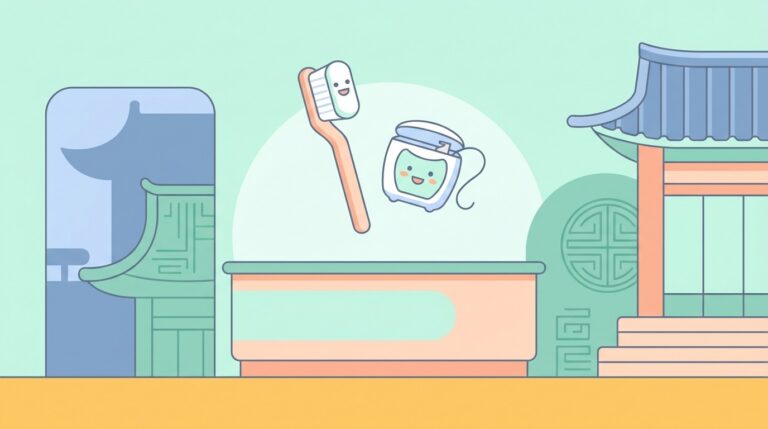
Phase 1: 공감 (Story-Driven Opening)
안녕하세요! 매일한글 에디터입니다. (Hello! This is your Daily Hangul editor.)
Have you ever watched a Korean office drama or an idol’s vlog and noticed something interesting right after lunch? Like clockwork, everyone grabs a cute little pouch and heads straight to the restroom to brush their teeth! In Korea, after-meal brushing isn’t just a habit—it’s practically an art form. But what happens when you are living or traveling in Korea, and you suddenly wake up with throbbing gums or a suspicious toothache? The thought of navigating a Korean dental clinic (치과 – chigwa) and explaining specialized items like “치간칫솔” (interdental brush) or “치실” (dental floss) can feel completely overwhelming for beginner Korean learners.
Don’t worry! You don’t need a medical degree in Korean to get great dental care. Based on real-world experiences and pain points shared by our global learners, this guide is designed specifically for A2 elementary speakers. By the end of this lesson, you will master the exact conversational phrases needed to talk about your oral health, ask how to use proper dental tools, and walk out of any Korean dental clinic with sparkling teeth and total confidence!
Phase 2: 핵심 표현 3선 심층 분석 (Top 3 Key Expressions)
1. 양치질할 때 치실도 같이 쓰세요. (Yangchijilhal ttae chisil-do gachi sseuseyo.)
- Pronunciation: [Yang-chi-jil-hal ttae chi-sil-do ga-chi sseu-se-yo] (Sounds like: “Yang-chee-jeel-hal tay chee-sheel-doh gah-chee ssuh-say-yo”)
- Meaning: Literal: “When doing tooth-brushing, please use dental floss together too.” / Actual Nuance: “Make sure to floss as well whenever you brush your teeth.”
- K-Culture Moment: A kind dental hygienist demonstrating proper brushing techniques on an oversized plastic tooth model during your routine checkup.
- Editor’s Insight: The pattern
-ㄹ 때 (-l ttae)means “when/during an action.” Adding-도 같이 쓰세요 (-do gachi sseuseyo)turns this into a warm, polite recommendation that Korean health professionals frequently offer to patients.- Situation Spectrum: Casual ⚠️ | Semi-formal ✅ | Formal ✅
- 🤔 Think About It: Notice how Korean advice often highlights “doing things together” (같이)? How does your home culture view oral hygiene advice—is it direct or suggestive?
2. 잇몸이 좀 부었어요. (Inmomi jom bueosseoyo.)
- Pronunciation: [In-mom-i jom bu-eot-seo-yo] (Sounds like: “Een-mohm-ee johm boo-uht-suh-yo”)
- Meaning: Literal: “The gum has swollen a bit.” / Actual Nuance: “My gums feel swollen and tender.”
- K-Culture Moment: A character in a variety show biting into hot, spicy tteokbokki and cupping their cheek in surprise because of sudden gum sensitivity.
- Editor’s Insight: The magic word here is 좀 (jom), meaning “a bit.” In Korean social etiquette, using “좀” softens negative statements or physical complaints, making you sound polite rather than dramatic or demanding.
- Situation Spectrum: Casual ⚠️ | Semi-formal ✅ | Formal ✅
- 🤔 Think About It: Why do Koreans instinctively soften descriptions of pain? Compare this to how you report symptoms in your native language!
3. 치간칫솔은 어떻게 써요? (Chigan-chitsol-eun eotteoke sseoyo?)
- Pronunciation: [Chi-gan-chit-sol-eun eo-tteo-ke sseo-yo?] (Sounds like: “Chee-gahn-cheet-sohl-eun uh-ttuh-kay ssuh-yoh?”)
- Meaning: Literal: “Interdental brush, how to use?” / Actual Nuance: “How do I use an interdental brush properly?”
- K-Culture Moment: Browsing the vibrant dental care aisle at an Olive Young store or a neighborhood pharmacy (약국) and asking the clerk for advice on the right brush size.
- Editor’s Insight: The grammar formula
[Noun] + 은/는 어떻게 써요?is an essential survival pattern for A2 learners. You can substitute any tool or product into this sentence.- Situation Spectrum: Casual ⚠️ | Semi-formal ✅ | Formal ✅
- 🤔 Think About It: How straightforward it is to ask for help using
어떻게 써요?! Language does not always need complicated grammar to be deeply respectful.
Phase 3: 교과서 한국어 vs 진짜 한국어 (Textbook vs. Real-Life Korean)
Situation 1: Explaining your dental discomfort at the reception desk
- 📖 교과서 한국어: 제 치아와 잇몸에 통증이 있습니다. (Je chia-wa inmome tongjeungi itseumnida.) — “I possess pain in my dentition and gingiva.”
- 🗣️ 진짜 한국어: 이랑 잇몸이 좀 아파요. (I-rang inmomi jom apayo.) — “My teeth and gums hurt a bit.”
- 💡 왜 다를까?: Native Koreans rarely use heavy Sino-Korean words like 치아 (dentition) or 통증 (pain symptom) in daily speech. Instead, they use simple native Korean words like 이 (teeth) and 아파요 (it hurts).
Situation 2: Asking if daily flossing is genuinely mandatory
- 📖 교과서 한국어: 매일 치실을 사용하는 것이 의무적입니까? (Maeil chisireul sayonghaneun geosi uimujeogimnikka?) — “Is utilizing dental floss daily obligatory?”
- 🗣️ 진짜 한국어: 치실 매일 꼭 써야 돼요? (Chisil maeil kkok sseoya dwaeyo?) — “Do I really have to floss every day?”
- 💡 왜 다를까?: The phrase
-아/어야 돼요paired with the emphasis adverb꼭 (definitely / absolutely)is the natural, conversational way real Koreans express necessity.
Phase 4: K-Culture 딥다이브 & 비언어적 매너 (Deep Dive & Body Language)
4-1. 눈치 (Nunchi) & Gestures in the Dental Clinic
When describing your pain to a Korean dental doctor (치과의사) or hygienist (치과위생사):
* Gentle Hand Placement: Gently place an open palm against the painful cheek rather than aggressively poking inside your mouth with fingers.
* Attentive Nodding: When the staff explains how to angle the floss, maintain respectful eye contact and nod slightly with subtle verbal affirmations like “네, 네” (Yes, yes).
* The Cup Handover: When the staff gives you the automated water cup to rinse (입 헹구세요 – Please rinse), hold the paper cup with both hands or support your right forearm with your left hand as a gesture of basic politeness.
4-2. Cultural Code: The Korean “3-3-3 Rule” and Public Brushing
In Korea, children grow up learning the famous “3-3-3 Rule” (3·3·3 운동): brush your teeth 3 times a day, within 3 minutes of eating, for at least 3 minutes! This is why you will see office workers, college students, and restaurant patrons pulling out toothbrush sets right after lunch. Furthermore, South Korea’s National Health Insurance (NHIS) covers an annual dental cleaning (스케일링 – scaling) for residents at an ultra-low cost (around 15,000 KRW). Prevention is considered a core social virtue.
Phase 5: 실전 롤플레이 시나리오 (Real-Life Roleplay Scenario)
Setting: Seoul Miso Dental Clinic (서울 미소 치과).
Characters:
* 민지 (Minji): A gentle and encouraging dental hygienist.
* 민우 (Minwoo): An international exchange student visiting the clinic for the first time.
- 민지: 안녕하세요! 오늘 어디가 불편하세요?
(Annyeonghaseyo! Oneul eodiga bulpyeonhaseyo?)
“Hello! What brings you in today?”
🎭 밝게 웃으며 차트를 확인한다. -
민우: 안녕하세요. 양치할 때 잇몸에서 피가 나고 좀 아파요.
(Annyeonghaseyo. Yangchihal ttae inmomeseo piga nago jom apayo.)
“Hello. When I brush my teeth, my gums bleed and hurt a bit.”
🎭 볼을 살짝 만지며 쑥스럽게 말한다. -
민지: 아, 그러셨군요. 혹시 치실이나 치간칫솔 쓰세요?
(A, geureosyeotgunyo. Hoksi chisil-ina chiganchitsol sseuseyo?)
“Oh, I see. Do you happen to use dental floss or interdental brushes?”
🎭 진료 의자를 뒤로 눕히며 상냥하게 묻는다. -
민우: 아니요, 일반 칫솔만 써요.
(Aniyo, ilban chitsolman sseoyo.)
“No, I only use a regular toothbrush.”
🎭 민망한 듯 고개를 살짝 젓는다. -
민지: 양치질할 때 치간칫솔과 치실을 같이 쓰면 잇몸 건강에 좋아요.
(Yangchijilhal ttae chiganchitsolgwa chisireul gachi sseumyeon inmom geongange joayo.)
“Using interdental brushes and dental floss when brushing is good for gum health.”
🎭 치아 모형을 들고 칫솔질 시범을 보여준다. -
민우: 아, 치간칫솔은 어떻게 써요?
(A, chiganchitsoleun eotteoke sseoyo?)
“Oh, how do I use an interdental brush?”
🎭 모형을 집중해서 바라본다. -
민지: 치아 사이에 살살 넣고 앞뒤로 부드럽게 움직이시면 돼요.
(Chia saie salsal neoko apdwiro budeureopge umjigisimyeon dwaeyo.)
“You just insert it gently between your teeth and move it softly back and forth.”
🎭 손동작으로 천천히 시연해 준다. -
민우: 네! 오늘부터 꼭 같이 써 볼게요. 감사합니다.
(Ne! Oneulbuteo kkok gachi sseo bolgeyo. Gamsahamnida.)
“Yes! I will definitely try using them together starting today. Thank you!”
🎭 안심한 표정으로 가볍게 고개 숙여 인사한다.
🔀 인터랙티브 분기점 (Interactive Decision Point)
How should Minwoo reply next if he wants to ask about spacing between his teeth?
- Option A: “치실을 쓰면 치아 사이가 벌어져요?” (Chisireul sseumyeon chia saiga beoreojyeoyo? – Will using floss create gaps between my teeth?)
- 👉 [Best Feedback]: Fantastic! This is a very common and natural question in Korean dental clinics. The hygienist will happily explain that flossing does not widen tooth gaps.
- Option B: “치실 안 쓰면 죽어요?” (Chisil an sseumyeon jugeoyo? – Will I die if I don’t use dental floss?)
- 👉 [Risk Feedback]: Too dramatic! While Koreans love hyperbole in comedy, asking medical staff this question sounds unsettling or overly panicked.
- Option C: “귀찮으니까 그냥 양치만 할래요.” (Gwichaneunikka geunyang yangchiman hallaeyo. – It’s a hassle, so I’ll just stick to brushing.)
- 👉 [Bad Feedback]: Sounds slightly dismissive and blunt after the medical provider spent time kindly teaching you preventive care.
Phase 6: 10초 감정 섀도잉 드릴 (10-Second Shadowing Drill)
Practice reading these out loud, pausing briefly at the slashes (/) and channeling the assigned emotion!
[😊 차분하고 친절하게 / Calm & Caring]
“양치질할 때 / 치실도 같이 / 쓰세요.”
(Yangchijilhal ttae / chisil-do gachi / sseuseyo.)-
[🥺 조금 걱정스럽고 아프게 / Worried & Sensitive]
“잇몸이 / 조금 부었어요.”
(Inmomi / jogeum / bueosseoyo.) -
[🙋♂️ 배우고 싶은 호기심을 담아서 / Curious & Eager]
“치간칫솔은 / 어떻게 써요?”
(Chigan-chitsol-eun / eotteoke / sseoyo?)
Phase 7: K-Culture 미니 사전 (Mini Dictionary)
- 치간칫솔 (Chigan-chitsol) | Interdental Brush
A miniature wire-and-bristle brush designed to clean between teeth. Sold everywhere in Korea, from pharmacies to corner convenience stores, usually categorized by tiny millimeter sizes (SSSS to M). - 치실 (Chisil) | Dental Floss
Floss thread. Many Korean BBQ restaurants even keep dental floss or single-use floss picks next to the mint candy bowl by the cash register! - 잇몸 (Inmom) | Gums (Gingiva)
A compound word made from ‘이’ (tooth) + ‘몸’ (body). Literally the “body of the tooth.” - 스케일링 (Seuke-il-ling) | Dental Scaling / Deep Cleaning
Professional ultrasonic plaque removal. An annual national healthcare ritual in Korea that every adult takes advantage of.
Phase 8: 여행자를 위한 생존 키트 (Traveler’s Survival Kit)
서바이벌 표현 TOP 3 (Survival Expressions)
- 스케일링 예약하고 싶어요. (Seuke-illing yeyakhago sipeoyo.)
Translation: “I would like to make an appointment for teeth cleaning.”
💡 Pro Tip: Say this over the phone or at the reception counter. Most urban clinics can schedule you within a few days. - 사랑니가 너무 아파요. (Sarangniga neomu apayo.)
Translation: “My wisdom tooth hurts so much.”
💡 Pro Tip: Did you know? Koreans call wisdom teeth 사랑니 (Sarangni – Love Teeth) because they sprout during late adolescence, the age when people first experience the ache of romantic love! - 마취 좀 해 주세요. (Machwi jom hae juseyo.)
Translation: “Please give me local anesthesia.”
💡 Pro Tip: Never suffer through dental pain in Korea! Korean clinics are very generous with painless numbing sprays and quick local anesthetics.
Editor’s Travel Note
Looking for an English-speaking clinic in Seoul or Busan? Search “치과” (dental clinic) through the 네이버 지도 앱 다운로드. Major university dental hospitals (like SNU Dental Hospital or Yonsei Severance Dental Hospital) have dedicated International Healthcare Centers where English, Chinese, and Japanese services are available. Foreigners without insurance can pay with international credit cards.
Phase 9: “한 발 더 깊이” (Step Deeper – Cultural Insight)
In Korean society, brushing teeth right after a meal is an act of 배려 (Baeryeo – Consideration for others). Because Korean cuisine frequently features aromatic ingredients like garlic (마늘), scallions (파), and fermented pastes (된장, 고추장), carrying a portable toothbrush kit (칫솔 살균기 or 파우치) shows respect for your colleagues and conversation partners. Taking care of your gums with floss and interdental brushes is not just seen as private hygiene; it symbolizes self-discipline, cleanliness, and thoughtful workplace etiquette.
💬 Your Turn: In your home country, is it normal to brush your teeth in public or workplace restrooms after lunch, or is it strictly done at home? Tell us in the comments below!
Phase 10: FAQ & 흔한 실수 (FAQ & Common Mistakes)
Q: Can foreign travelers without Korean National Health Insurance visit a dental clinic in Korea?
A: Yes! Anyone can walk into a private clinic or hospital. While you won’t receive the subsidized NHIS rate, private dental fees in South Korea are still remarkably reasonable compared to countries like the United States. An emergency checkup and X-ray usually cost between 30,000 to 50,000 KRW.
Q: What is the difference between 치실 (floss) and 치간칫솔 (interdental brush)?
A: 치실 (Chisil) is thin thread used to clean the tight contact points between teeth where food gets stuck. 치간칫솔 (Chigan-chitsol) is a tiny bottle-brush shaped tool designed for the triangular space near the gumline, especially useful if you have braces or wider gaps.
Q: How do I tell the dentist which specific tooth hurts if I don’t know the anatomical names?
A: Use simple directional terms! For example: “오른쪽 위 어금니가 아파요” (The top right molar hurts) or simply point and say “여기가 찌릿해요” (It feels sharp/electric right here).
🚨 흔한 실수 (Common Mistakes) TOP 3
- Mistake: Confusing 칫솔 (toothbrush) and 치약 (toothpaste).
Correct Action: Remember that -솔 means “brush/bristles” (like a mini broom), while -약 means “medicine/paste”. - Mistake: Using the term 이빨 (ippal) to refer to your own teeth in polite speech.
Correct Action: “이빨” is predominantly used for animals. When speaking about human teeth politely, always use 이 (i) or 치아 (chia). - Mistake: Only saying “아파요” (It hurts) when your gums bleed.
Correct Action: Don’t forget to mention bleeding specifically: “피가 나요” (It is bleeding). This immediately helps the dentist check for gingivitis (잇몸염/치은염).
Phase 11: 액션 미션 & 참여 유도 (Action Missions)
- 🥉 Bronze Mission (Solo Shadowing): Stand in front of your bathroom mirror tonight and repeat: “양치질할 때 치실도 같이 쓰세요!” 3 times with a bright smile.
- 🥈 Silver Mission (Community Challenge): Take a photo of your dental care kit and share it on your social media or in our comments section with the caption: “오늘부터 치간칫솔 쓰기 시작! 🦷” (Starting to use interdental brushes today!).
- 🥇 Gold Mission (Real-world Practice): Next time you step into a Korean convenience store (CU, GS25, or 7-Eleven) or an Asian market, locate the dental section and find both a 치간칫솔 and a 치실.
- 🎮 K-Culture Mission: Watch an episode of a Korean workplace drama (like Misaeng or Business Proposal) and see if you can spot someone carrying a toothbrush pouch to the sink!
Phase 12: 인터랙티브 퀴즈 챌린지 (Interactive Quiz Challenge)
Test what you learned today before you go!
Q1. [Situational Judgment] You are visiting a Korean dental clinic because your gums are swollen. What is the most natural, polite way to explain this at level A2?
(A) 치아에 중대한 질환이 발생했습니다.
(B) 잇몸이 좀 부었어요.
(C) 이빨이 다 썩었습니다.
Q2. [Fill in the Blank] Complete the recommendation:
“양치질할 때 치간칫솔과 치실을 같이 쓰면 ( ) 건강에 좋아요.”
(A) 잇몸
(B) 머리
(C) 손가락
Q3. [True / False Cultural Check]
In South Korea, it is considered impolite and strange to brush your teeth in an office or school restroom after lunch. (True / False)
👉 Click here to reveal the answers and detailed explanations!
- Q1 Answer: (B) 잇몸이 좀 부었어요.
Explanation: Using “잇몸” (gums) with the softening word “좀” (a bit) creates the most natural, courteous tone. Option (A) is overly stiff and robotic, while Option (C) uses “이빨” (animal teeth) and sounds too aggressive. - Q2 Answer: (A) 잇몸
Explanation: “잇몸 건강” means “gum health.” (머리 = head, 손가락 = fingers). - Q3 Answer: False!
Explanation: It is completely normal and widely encouraged! Post-lunch brushing is celebrated as good manners and a healthy habit across South Korea.
🎬 Watch Our Daily Videos! (Daily Hangul Official Instagram)
Review the expressions you learned in this article with our fun daily short videos! Check out native pronunciation and real-life nuances in action.
- Instagram @dailyhangul_en







